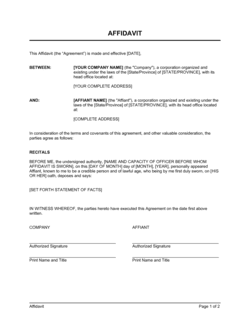
Estoppel Affidavit of Mortgagor Template

Free Word download β€’ Edit online β€’ Save & share with Drive β€’ Export to PDF

5 pagesβ€’25–30 min to fillβ€’Difficulty: Standardβ€’Signature requiredβ€’Legal review recommended
Learn more ↓
FreeEstoppel Affidavit of Mortgagor Template

At a glance

What it is
An Estoppel Affidavit of Mortgagor is a sworn, legally binding statement in which the borrower (mortgagor) certifies the current status of their mortgage loan β€” including the outstanding principal balance, interest rate, payment history, and any known disputes or defenses β€” as of a specific date. This free Word download lets you complete, edit, and export the affidavit as PDF for use in real estate transactions, loan assignments, and refinancing.
When you need it
Use it when a property is being sold, when the existing mortgage is being assigned to a new lender, when a title company or buyer's counsel requires confirmation of loan terms before closing, or when a lender is refinancing or purchasing the note and needs the borrower to certify the debt's status.
What's inside
Parties and property identification, sworn certification of outstanding principal balance and interest rate, payment status and last payment date, disclosure of any offsets or defenses, acknowledgment that the lender may rely on the statements, and notarized signature block.

What is an Estoppel Affidavit of Mortgagor?

An Estoppel Affidavit of Mortgagor is a sworn, notarized statement in which the borrower on a mortgage loan certifies the current status of that loan β€” including the exact outstanding principal balance, interest rate, monthly payment amount, last payment date, maturity date, and the absence of any known defenses or offsets against the lender. Once signed under oath before a notary public, the mortgagor is legally bound by those certifications and cannot later contradict them, which is the core function of estoppel as a legal doctrine. The document is used by buyers, title companies, note purchasers, and new lenders as reliable, third-party-reliance evidence that the loan's terms and status are exactly as represented.

Why You Need This Document

Without a properly executed estoppel affidavit, buyers and note purchasers have no sworn confirmation that the mortgage balance, payment history, and loan terms are as represented β€” leaving them exposed to claims that the debt is larger, in default, or subject to borrower defenses that were never disclosed. Title companies cannot issue a clean policy over an existing mortgage without knowing its certified status. Secondary-market note buyers will not fund a loan acquisition without it. A borrower who fails to provide an accurate, notarized affidavit can delay or kill a closing, trigger indemnity claims, or face personal liability for losses caused by material inaccuracies certified under oath. This template gives you a complete, legally structured affidavit you can fill out in under an hour and execute before any notary β€” closing the documentation gap that title companies and lenders require before every covered transaction.

Which variant fits your situation?

If your situation is…Use this template
Borrower certifying loan status to a new lender purchasing the noteEstoppel Affidavit of Mortgagor
Lender certifying the status of the mortgage to a buyer or title insurerEstoppel Certificate (Mortgagee)
Tenant certifying lease terms to a prospective landlord or lenderTenant Estoppel Certificate
Confirming HOA dues, special assessments, and fees owed before closingHOA Estoppel Certificate
Seller disclosing all known property encumbrances and liensSeller's Affidavit of Title
Borrower providing a sworn payoff statement for a private mortgage noteMortgage Payoff Statement
Confirming no default or offset exists as part of a commercial loan assumptionLoan Assumption Agreement

Common mistakes to avoid

❌ Certifying an estimated rather than exact principal balance

Why it matters: An approximate balance certified under oath becomes a sworn inaccuracy if the true figure differs, exposing the mortgagor to fraud or misrepresentation claims by the recipient who relied on it.

Fix: Obtain a formal loan status letter from the lender dated within 10 days of the affidavit and use the balance stated in that letter β€” no rounding or estimation.

❌ Signing outside the notary's presence

Why it matters: An affidavit that has not been sworn before a notary is not a sworn statement and is routinely rejected by title insurers, courts, and secondary-market lenders as legally defective.

Fix: Always appear in person before a licensed notary with valid photo ID and sign only when the notary is physically present to witness and acknowledge the signature.

❌ Omitting a prior loan modification or forbearance agreement

Why it matters: Undisclosed modifications discovered during post-closing due diligence give the note buyer or title insurer grounds to claim the affidavit was fraudulent, potentially rescinding the transaction or triggering indemnity claims.

Fix: Review the complete loan file for any modification, deferral, extension, or forbearance β€” no matter how minor β€” and list each one by date in the modifications disclosure clause.

❌ Using a street address instead of the legal property description

Why it matters: Street addresses are not title-quality identifiers β€” they can change, duplicate across jurisdictions, or fail to match the recorded instrument, leaving the affidavit without a clear connection to the encumbered property.

Fix: Copy the full legal description β€” including lot, block, subdivision, and recording reference β€” directly from the county recorder's record or title commitment.

The 10 key clauses, explained

Parties and property identification

In plain language: Identifies the mortgagor by full legal name, the mortgagee by name, the property address, and the legal description of the encumbered real estate.

Sample language
The undersigned, [MORTGAGOR FULL LEGAL NAME] ('Mortgagor'), hereby certifies the following with respect to that certain mortgage dated [DATE] given to [MORTGAGEE NAME] ('Mortgagee'), encumbering the real property located at [PROPERTY ADDRESS], [CITY], [STATE], legally described as [LEGAL DESCRIPTION].

Common mistake: Using an informal address instead of the full legal property description from the recorded deed. A mismatch between the affidavit description and county records can invalidate the document's title-clearing effect.

Outstanding principal balance certification

In plain language: States the exact unpaid principal balance as of a specific certification date, creating an estoppel against the borrower claiming a different balance later.

Sample language
As of [CERTIFICATION DATE], the outstanding principal balance due under the Mortgage Note is $[AMOUNT], and no principal payments are in dispute.

Common mistake: Using an approximate or rounded balance instead of the exact figure from the lender's payment ledger. An inaccurate balance certified under oath can expose the borrower to a fraud claim if the true balance differs at closing.

Interest rate and payment terms

In plain language: Confirms the current interest rate, whether it is fixed or adjustable, the monthly payment amount, and the payment due date each month.

Sample language
The Mortgage Note bears interest at the rate of [X]% per annum, [fixed / adjustable], with monthly installments of $[AMOUNT] due on the [DAY] of each month.

Common mistake: Omitting whether the rate is fixed or adjustable. For an adjustable-rate mortgage, the current rate must be stated along with the next adjustment date and index reference, otherwise the certification is incomplete.

Last payment date and payment status

In plain language: Records the date of the most recent payment received, the period it covers, and whether the loan is current, past due, or in default.

Sample language
The last payment was received on [DATE] and applied to the installment due [DATE]. As of the date of this Affidavit, the Mortgage loan is [current / in default β€” describe].

Common mistake: Certifying the loan as current when a payment is in a grace period rather than formally received. If the loan later appears delinquent, this inconsistency undermines the affidavit's reliability and may trigger lender disputes.

Maturity date

In plain language: States the date on which the full remaining loan balance is due, allowing the buyer or new lender to assess the remaining loan term.

Sample language
The Mortgage Note matures on [MATURITY DATE], at which time the entire outstanding principal balance and all accrued interest shall be due and payable in full.

Common mistake: Confusing the maturity date with the amortization end date on a balloon-payment loan. For balloon mortgages, the maturity date (when the balloon is due) is distinct from the full amortization date β€” conflating them misstates the true payoff obligation.

No offsets, defenses, or counterclaims

In plain language: The mortgagor certifies that they have no claims, defenses, or offsets against the lender that would reduce or extinguish the debt.

Sample language
Mortgagor has no offsets, defenses, counterclaims, or claims of any kind against Mortgagee or against the indebtedness evidenced by the Mortgage Note, and no event has occurred that would constitute a basis for any such claim.

Common mistake: Signing this clause without reviewing the loan history for any overcharged fees, escrow errors, or force-placed insurance disputes. Certifying no defenses when a valid claim exists can constitute a waiver of that claim.

Disclosure of modifications and side agreements

In plain language: Confirms that the mortgage note and loan documents have not been modified, amended, or supplemented except as specifically listed.

Sample language
The Mortgage Note and Mortgage have not been modified, amended, extended, or supplemented, except as follows: [NONE / LIST MODIFICATIONS WITH DATES]. No side agreements exist between Mortgagor and Mortgagee relating to the indebtedness.

Common mistake: Failing to disclose a prior forbearance agreement or loan modification. Undisclosed modifications discovered post-closing expose the mortgagor to fraud liability and may give the note buyer grounds to rescind the assignment.

Reliance and inducement

In plain language: Acknowledges that the recipient β€” a buyer, title insurer, or new lender β€” is relying on the certifications in this affidavit to proceed with the transaction.

Sample language
Mortgagor understands and acknowledges that [RECIPIENT NAME] and its successors and assigns are relying upon the certifications contained in this Affidavit in connection with [DESCRIBE TRANSACTION], and Mortgagor intends that [RECIPIENT NAME] so rely.

Common mistake: Naming only the immediate lender or buyer in the reliance clause and excluding successors and assigns. A note that is later re-sold loses the estoppel protection if the reliance clause does not extend to future holders.

Accuracy of information and indemnification

In plain language: The mortgagor warrants that all certified information is accurate and agrees to indemnify the recipient for losses caused by any material inaccuracy.

Sample language
Mortgagor warrants that all information contained herein is true, accurate, and complete as of the date hereof, and agrees to indemnify and hold harmless [RECIPIENT NAME] from and against any loss, cost, or damage arising from any material inaccuracy in this Affidavit.

Common mistake: Accepting an unlimited indemnification scope without carving out losses caused by the recipient's own negligence. Without this carve-out, the mortgagor could be liable for losses entirely unrelated to the certified information.

Notarized signature block

In plain language: The mortgagor signs under oath before a notary public, who verifies identity and witnesses the signature to give the affidavit legal force.

Sample language
Executed this [DAY] day of [MONTH], [YEAR]. [MORTGAGOR SIGNATURE LINE] STATE OF [STATE], COUNTY OF [COUNTY] β€” Before me, a Notary Public, personally appeared [NAME], known to me to be the person who executed this Affidavit and acknowledged that they executed the same as their free and voluntary act.

Common mistake: Having the document signed outside the presence of a notary and mailed in. An affidavit signed without live notarization is not sworn testimony and may be rejected by courts and title insurers as fatally defective.

How to fill it out

  1. 1

    Gather the original loan documents

    Collect the original mortgage note, deed of trust, and any recorded modifications or forbearance agreements before completing any field. Every certified figure must match the lender's payment history and recorded instruments.

    πŸ’‘ Request a formal payoff or loan status letter from your lender dated within 10 days of the affidavit β€” this is the authoritative source for the principal balance and payment status.

  2. 2

    Enter the full legal names of all parties

    Use the mortgagor's exact legal name as it appears on the original loan documents and the deed. Use the mortgagee's full registered entity name. Abbreviations or trade names that differ from recorded instruments can create title defects.

    πŸ’‘ If the mortgagee has changed its name or been acquired since the loan was originated, use the current legal name and reference the predecessor in a parenthetical.

  3. 3

    Insert the property legal description

    Copy the legal description from the recorded deed or title commitment exactly β€” lot number, block, subdivision, and county. Do not substitute a street address for the legal description in this field.

    πŸ’‘ Pull the legal description directly from the county recorder's digital record to eliminate transcription errors that could invalidate the affidavit.

  4. 4

    Certify the outstanding principal balance and rate

    Enter the exact principal balance as of the certification date, the interest rate (and whether fixed or adjustable), and the monthly payment amount. For adjustable-rate loans, state the current rate and the next adjustment date.

    πŸ’‘ Use a certification date that is as close as possible to the closing date β€” lenders typically accept certifications within 30 days, but title companies may require 10 days or fewer.

  5. 5

    Confirm payment status and last payment date

    State the date the last payment was received and the period it covered. Explicitly state whether the loan is current or in default. If in default, describe the nature and amount of the delinquency.

    πŸ’‘ Do not estimate the last payment date from memory β€” retrieve the confirmation number or bank statement showing the payment was received, not just sent.

  6. 6

    Disclose all modifications and side agreements

    List every loan modification, deferral, forbearance agreement, or rate adjustment by date. If none exist, write 'None' explicitly β€” leaving the field blank is not equivalent and may be treated as incomplete.

    πŸ’‘ Include COVID-era forbearance agreements even if the deferred amounts have been repaid β€” note buyers conduct due diligence on the loan history and undisclosed forbearance is a common red flag.

  7. 7

    Review and sign before a notary public

    Read every certified statement against your source documents before appearing before the notary. Sign only in the notary's presence, with valid government-issued photo identification available for verification.

    πŸ’‘ Schedule the notarization within 5 business days of the closing date to ensure the certification date aligns with the lender's expectation for a current statement.

  8. 8

    Deliver the executed original to the requesting party

    Provide the wet-signed, notarized original to the title company, buyer's counsel, or lender as specified in the closing instructions. Retain a certified copy for your records.

    πŸ’‘ Confirm whether the recipient requires the original or will accept a notarized copy β€” some title insurers require the original for their policy file.

Frequently asked questions

What is an estoppel affidavit of mortgagor?

An estoppel affidavit of mortgagor is a sworn written statement in which the borrower certifies the current status of their mortgage loan β€” including the outstanding principal balance, interest rate, payment status, and the absence of any defenses or offsets against the lender. Once signed before a notary, the mortgagor is legally prevented (estopped) from asserting facts that contradict what they certified, protecting buyers, title companies, and note purchasers who relied on the document.

When is an estoppel affidavit of mortgagor required?

It is typically required when an existing mortgage is being assigned to a new lender, when a property is being sold and the buyer's title company needs to confirm encumbrance balances, when a lender is purchasing a mortgage note on the secondary market, or when a borrower is refinancing and the new lender requires a sworn confirmation of the current loan terms. Some commercial transactions require one as a standard closing condition.

What is the difference between an estoppel affidavit and an estoppel certificate?

Both documents certify facts to prevent later contradiction, but an estoppel affidavit is sworn under oath before a notary public, giving it the weight of sworn testimony. An estoppel certificate is typically a signed but unsworn acknowledgment used in commercial real estate for tenant lease certifications. For mortgage transactions, lenders and title insurers generally prefer the affidavit form because the notarization adds an additional layer of legal enforceability.

Does an estoppel affidavit of mortgagor need to be notarized?

Yes, in virtually all use cases. The notarization transforms the document from a simple written statement into sworn testimony, making the estoppel legally binding and admissible as evidence. Title insurers and secondary-market lenders typically refuse to accept an un-notarized affidavit. Some states also require notarization as a statutory condition for the document to be recorded or to create estoppel by deed.

Can a mortgagor be held liable for inaccuracies in the affidavit?

Yes. Because the affidavit is sworn under oath, a material inaccuracy β€” particularly one that a buyer, lender, or title company relied on to their detriment β€” can expose the mortgagor to claims of fraud, negligent misrepresentation, or breach of warranty. Most affidavits also include an express indemnification clause requiring the mortgagor to compensate the recipient for any loss caused by an inaccurate certification. Always verify every figure against source documents before signing.

How current does the principal balance certification need to be?

Most title companies and lenders require the certified balance to be as of a date no more than 30 days before closing, and many commercial transactions require 10 days or fewer. The certification date should always be stated explicitly in the affidavit. If the closing is delayed past the certification's effective window, a new affidavit with an updated balance will typically be required.

What happens if the mortgagor has a legitimate defense against the lender?

If a genuine offset or defense exists β€” such as a documented escrow overcharge, force-placed insurance dispute, or lender breach β€” the mortgagor should not certify that no defenses exist. Instead, the known dispute should be disclosed in the affidavit and the parties should resolve it before or at closing. Signing away a valid defense by certifying it does not exist is generally treated as a waiver of that claim in most jurisdictions, so legal counsel should review the loan history before execution.

Is an estoppel affidavit the same as a mortgage payoff statement?

No. A payoff statement is issued by the lender and states the exact dollar amount needed to fully satisfy and discharge the loan on a specific date, typically including per-diem interest. An estoppel affidavit of mortgagor is issued by the borrower and certifies the loan's current status and terms. Both documents are often required in the same closing package, but they serve different functions and come from opposite parties.

Do I need a lawyer to complete an estoppel affidavit of mortgagor?

For straightforward residential transactions where the loan has no modifications, no disputes, and is clearly current, a well-structured template is often sufficient. However, legal review is strongly recommended if the loan has been modified, if there are any payment disputes, if the transaction is commercial, or if the indemnification clause is unusually broad. A real estate attorney can typically review the completed affidavit in under an hour at a cost of $150–$400 β€” worthwhile given the sworn-statement liability involved.

How this compares to alternatives

vs Estoppel Certificate (Mortgagee)

A mortgagee estoppel certificate is issued by the lender certifying the loan terms to a buyer or title company. An estoppel affidavit of mortgagor is issued by the borrower certifying the same facts from the borrower's perspective. Lenders often require both in the same transaction β€” the mortgagee's certificate confirms what the lender believes is owed; the mortgagor's affidavit confirms the borrower agrees and has no offsets.

vs Mortgage Payoff Statement

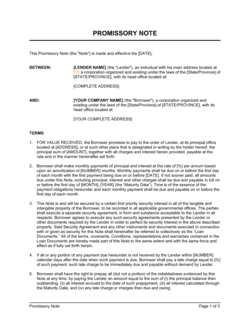
A payoff statement is a lender-issued document stating the exact dollar amount needed to fully discharge the loan as of a specific date, including per-diem interest. An estoppel affidavit of mortgagor is a borrower-issued sworn statement certifying current loan status and the absence of defenses. A payoff statement quantifies the debt for discharge; the affidavit certifies the debt's terms and status for reliance by a third party.

vs Deed of Trust

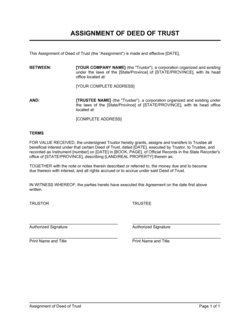
A deed of trust is the original security instrument that creates the mortgage lien against the property when the loan is originated. An estoppel affidavit of mortgagor is a certification document used later in the loan's life to confirm the current status of the obligations created by the deed of trust. The deed of trust establishes the encumbrance; the affidavit verifies its current state.

vs Loan Assumption Agreement

A loan assumption agreement transfers the mortgage obligation from the original borrower to a new buyer who takes over the existing loan. An estoppel affidavit of mortgagor is the certification that typically precedes a loan assumption, establishing the baseline terms and balance the assuming party is taking on. The affidavit is an input to the assumption; the assumption agreement is the operative transfer document.

Industry-specific considerations

Residential Real Estate

Used at closing to certify the existing mortgage balance and payment status before the buyer's lender funds the new loan or the title company issues its policy.

Commercial Real Estate

Required by note buyers and commercial lenders during loan assumption or assignment transactions, often alongside tenant estoppel certificates and SNDA agreements.

Banking and Mortgage Lending

Secondary-market note purchasers require executed mortgagor estoppel affidavits as part of the loan-file due-diligence package before funding a note acquisition.

Title Insurance

Title underwriters use the affidavit to confirm encumbrance balances and the absence of borrower defenses before committing to insure a property transfer free and clear of the existing mortgage.

Jurisdictional notes

United States

Requirements vary by state. In Florida, estoppel affidavits are commonly required by statute in HOA and condominium transactions and must be delivered within specific timeframes. Several states β€” including New York and California β€” require the affidavit to be acknowledged before a notary in the state where the property is located. Failure to disclose a material inaccuracy under oath can constitute perjury in addition to civil liability.

Canada

Canadian mortgage transactions more commonly use an estoppel certificate or acknowledgment form rather than a sworn affidavit, but lenders in Ontario and British Columbia increasingly require notarized borrower certifications for secondary-market note sales. Quebec's civil law tradition applies distinct rules for sworn declarations before a commissioner of oaths, and French-language documents are required for provincially regulated transactions in Quebec.

United Kingdom

English and Welsh property law uses estoppel as an equitable doctrine rather than through a standardized affidavit form; solicitors typically obtain borrower confirmations through a formal letter of undertaking or statutory declaration. In Scotland, the distinct legal system uses similar sworn declaration procedures before a notary public or justice of the peace. Mortgage regulatory requirements under the Financial Conduct Authority may impose additional disclosure obligations on lenders before requesting borrower certifications.

European Union

EU member states apply varying mortgage disclosure regimes under the Mortgage Credit Directive (2014/17/EU), which standardizes pre-contractual information but does not prescribe a specific estoppel affidavit format. Germany requires notarized real estate instruments before a Notar, which typically incorporates borrower certifications into the deed process. France and Spain use notarial acts that serve a similar function to the affidavit. Cross-border note assignments within the EU may trigger GDPR considerations when borrower information is shared with the note purchaser.

Template vs lawyer β€” what fits your deal?

PathBest forCostTime
Use the templateStraightforward residential mortgage certifications with no modifications, disputes, or payment delinquenciesFree30–60 minutes
Template + legal reviewLoans with prior modifications, forbearance history, payment disputes, or broad indemnification clauses$150–$400 (real estate attorney review)1–2 business days
Custom draftedComplex commercial transactions, multi-lender loans, litigation history, or cross-border note assignments$750–$2,500+3–7 business days

Glossary

Estoppel
A legal principle that prevents a party from asserting a position that contradicts what they have previously certified in writing when another party has relied on that certification.
Mortgagor
The borrower who pledges real property as collateral for a mortgage loan β€” the party giving the affidavit in this document.
Mortgagee
The lender who holds the mortgage lien against the borrower's property as security for repayment of the loan.
Outstanding Principal Balance
The remaining amount of the original loan that has not yet been repaid, excluding accrued interest and fees.
Affidavit
A written statement of facts voluntarily sworn under oath before a notary public or other authorized officer, carrying legal weight as sworn testimony.
Mortgage Assignment
The transfer of a mortgage note and lien from the original lender to a new lender or note buyer, often requiring an estoppel affidavit from the borrower.
Offset or Defense
A claim the borrower could assert against the lender that would reduce or cancel the amount owed β€” such as a breach of the original loan agreement.
Notarization
The process by which a licensed notary public verifies the identity of a signatory and witnesses the signature, certifying that the affidavit was sworn voluntarily.
Encumbrance
Any lien, mortgage, easement, or claim attached to a property that may limit the owner's ability to transfer clear title.
Closing Date
The specific date on which a real estate transaction or loan assignment is finalized, to which the estoppel certification is typically tied.
Maturity Date
The date on which the full outstanding loan balance becomes due and payable, as stated in the original mortgage note.

Part of your Business Operating System

This document is one of 3,000+ business & legal templates included in Business in a Box.

  • Fill-in-the-blanks β€” ready in minutes
  • 100% customizable Word document
  • Compatible with all office suites
  • Export to PDF and share electronically

Create your document in 3 simple steps.

From template to signed document β€” all inside one Business Operating System.
1
Download or open template

Access over 3,000+ business and legal templates for any business task, project or initiative.

2
Edit and fill in the blanks with AI

Customize your ready-made business document template and save it in the cloud.

3
Save, Share, Send, Sign

Share your files and folders with your team. Create a space of seamless collaboration.

Save time, save money, and create top-quality documents.

β˜…β˜…β˜…β˜…β˜…

"Fantastic value! I'm not sure how I'd do without it. It's worth its weight in gold and paid back for itself many times."

Managing Director Β· Mall Farm
Robert Whalley
Managing Director, Mall Farm Proprietary Limited
β˜…β˜…β˜…β˜…β˜…

"I have been using Business in a Box for years. It has been the most useful source of templates I have encountered. I recommend it to anyone."

Business Owner Β· 4+ years
Dr Michael John Freestone
Business Owner
β˜…β˜…β˜…β˜…β˜…

"It has been a life saver so many times I have lost count. Business in a Box has saved me so much time and as you know, time is money."

Owner Β· Upstate Web
David G. Moore Jr.
Owner, Upstate Web

Run your business with a system β€” not scattered tools

Stop downloading documents. Start operating with clarity. Business in a Box gives you the Business Operating System used by over 250,000 companies worldwide to structure, run, and grow their business.

Start freeΒ Β·Β No credit card required