Enhancing Meeting Efficiency For Business Professionals Template

Free Word download • Edit online • Save & share with Drive • Export to PDF

3 pages25–30 min to fillDifficulty: StandardSignature requiredLegal review recommended
Learn more ↓
FreeEnhancing Meeting Efficiency For Business Professionals Template

At a glance

What it is
An Enhancing Meeting Efficiency Policy is a binding internal governance document that establishes enforceable standards for how business meetings are planned, conducted, documented, and followed up across an organization. This free Word download covers agenda requirements, attendance obligations, decision-making authority, action-item tracking, and accountability — and can be edited online and exported as PDF for distribution to all staff.
When you need it
Use it when unstructured or overloaded meeting schedules are consuming productive work time, when accountability gaps mean decisions made in meetings are not followed through, or when a growing team needs a consistent framework for how meetings are governed across departments.
What's inside
Purpose and scope, meeting types and categories, agenda and pre-read requirements, attendance and punctuality obligations, facilitation and decision-rights rules, action-item and minutes standards, escalation procedures, accountability and enforcement, and governing review terms.

What is an Enhancing Meeting Efficiency Policy?

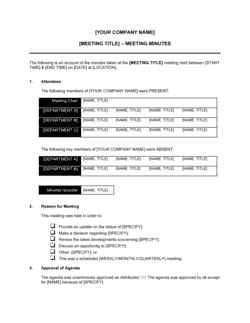
An Enhancing Meeting Efficiency Policy is a binding internal governance document that establishes enforceable organizational standards for how business meetings are planned, conducted, documented, and followed up on. It defines meeting categories, agenda requirements, attendance obligations, decision-rights protocols, action-item standards, and accountability mechanisms — replacing informal norms with a written framework that applies consistently across departments, seniority levels, and meeting formats including in-person, virtual, and hybrid. Typically executed as a signed policy document and incorporated by reference into the employee handbook or employment agreement, it creates enforceable expectations that can be addressed through standard performance management channels when not met.

Why You Need This Document

Without a formal meeting policy, organizations lose an estimated 30–50% of knowledge-worker hours to meetings that lack agendas, produce no recorded decisions, and generate action items that nobody follows through on — because nobody was specifically named as responsible. The compounding cost is significant: a 10-person team where each member attends three unnecessary 60-minute meetings per week loses more than 1,500 hours of productive time annually. Beyond direct time cost, unstructured meetings create decision disputes when attendees misremember outcomes, compliance exposure when minutes are absent from regulated discussions, and calendar fragmentation that blocks the focused work periods necessary for complex tasks. A properly drafted and signed meeting efficiency policy closes these gaps by making agenda preparation, action-item ownership, and minutes distribution organizational requirements — not suggestions. This template gives you a ready-to-use framework you can customize and deploy in under two hours.

Which variant fits your situation?

If your situation is…Use this template
Company-wide policy covering all meeting types and departmentsEnhancing Meeting Efficiency For Business Professionals
Quick one-page meeting ground rules for a single teamTeam Meeting Charter
Recurring weekly or monthly leadership meeting agendaMeeting Agenda Template
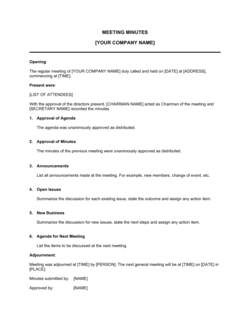
Post-meeting documentation and decision logMeeting Minutes Template
Remote or hybrid-specific video call conduct policyRemote Work Agreement
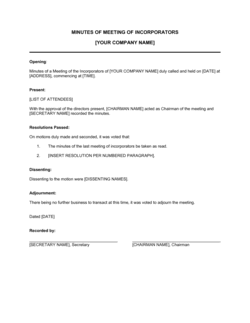
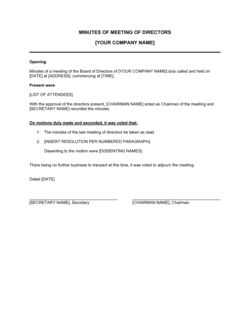
Board-level governance meetings with formal voting proceduresBoard Meeting Minutes Template
Project kickoff meetings requiring formal sign-off by stakeholdersProject Charter

Common mistakes to avoid

❌ No enforcement mechanism

Why it matters: A meeting policy without consequences defaults to a suggestion within weeks. Teams revert to previous habits once initial novelty wears off and no one is held accountable.

Fix: Tie non-compliance to the standard performance management process and designate a role — typically Operations or the direct manager — responsible for monitoring and addressing violations.

❌ Setting agenda deadlines as 'before the meeting'

Why it matters: Vague timing results in agendas distributed minutes before the call, leaving attendees no time to prepare and forcing meetings to begin with information transfer rather than decision-making.

Fix: Specify a fixed minimum — 24 hours for standard meetings, 48 hours for strategic sessions — and name the agenda owner in the policy.

❌ Assigning action items to groups rather than individuals

Why it matters: Tasks owned by 'the team' or 'marketing' are owned by no one. They accumulate in parking lots and produce follow-up meetings to discuss why the original meeting's outputs were never completed.

Fix: Require every action item to have exactly one named accountability owner and a specific calendar deadline before the meeting is adjourned.

❌ Declaring no-meeting blocks without calendar enforcement

Why it matters: Senior leaders who book over protected blocks immediately signal that the policy is optional. Once breached by leadership, no-meeting blocks are ignored at every level within days.

Fix: Enter no-meeting blocks as recurring calendar holds owned by Operations and configure calendar systems to warn organizers when a meeting is being scheduled during protected time.

❌ Omitting a quorum requirement for decision meetings

Why it matters: Without a quorum rule, a meeting where only two of eight required attendees show up can still produce binding decisions — creating disputes and rework when absent parties learn of outcomes they were not consulted on.

Fix: Define quorum as a percentage of required attendees and specify that decisions made without quorum are provisional pending confirmation from absent required parties.

❌ No annual review provision

Why it matters: Organizations evolve — hybrid work, new team structures, or acquisitions can make a policy obsolete within 12–18 months of adoption if there is no scheduled update process.

Fix: Include a named role responsible for the annual review and add the review date to the organization's governance calendar on the day the policy takes effect.

The 10 key clauses, explained

Purpose, scope, and definitions

In plain language: States why the policy exists, which employees and meeting types it covers, and defines key terms used throughout the document.

Sample language
This Policy applies to all employees, contractors, and third-party participants attending meetings organized by [COMPANY NAME] in any format — in-person, virtual, or hybrid. Its purpose is to reduce unproductive meeting time, improve decision quality, and establish clear accountability for outcomes.

Common mistake: Scoping the policy only to formal scheduled meetings and accidentally excluding ad hoc calls — which often consume more time and produce fewer recorded decisions.

Meeting classification and frequency standards

In plain language: Defines the permitted categories of meetings (strategic, operational, project, one-on-one, all-hands) and sets maximum frequency or duration norms for each type.

Sample language
Meetings are classified as: (a) Strategic — quarterly, maximum 3 hours; (b) Operational — weekly, maximum 60 minutes; (c) Project — as needed, maximum 45 minutes; (d) One-on-One — biweekly, maximum 30 minutes.

Common mistake: Omitting duration limits for each meeting type, which results in all meetings defaulting to 60-minute calendar blocks regardless of actual scope.

Agenda requirements and distribution timeline

In plain language: Requires a written agenda for every meeting, specifies who must prepare it, what it must include, and how far in advance it must be distributed to attendees.

Sample language
The meeting organizer shall distribute a written agenda no less than [24 / 48] hours before any scheduled meeting. The agenda shall include: (a) meeting objective, (b) time-boxed topics with named discussion leads, (c) required pre-read materials, and (d) expected outcomes or decisions.

Common mistake: Setting the distribution deadline as 'before the meeting' without a specific hour threshold — attendees receive agendas minutes before the call and arrive unprepared.

Attendance, punctuality, and quorum

In plain language: States who is required versus optional to attend, defines punctuality expectations, and sets a quorum rule for meetings where binding decisions are made.

Sample language
Required attendees must confirm availability within [24] hours of the meeting invitation. A quorum of [X]% of required attendees must be present for any binding decision to be recorded. Meetings shall begin no more than [5] minutes past the scheduled start time regardless of late arrivals.

Common mistake: Not distinguishing between required and optional attendees — without the distinction, every invitee assumes their presence is mandatory, leading to calendar gridlock.

Facilitation and decision-rights protocol

In plain language: Assigns a named facilitator for each meeting type, specifies how agenda time is managed, and clarifies who holds decision authority for each topic.

Sample language
Each meeting shall have a designated Facilitator responsible for managing time, parking off-topic discussion, and calling for decisions. For each agenda item, the decision right shall be pre-assigned as: Decide ([NAME/ROLE]), Advise ([NAMES/ROLES]), Inform ([NAMES/ROLES]).

Common mistake: Assigning a facilitator role informally by seniority rather than pre-assignment — the most senior person present often dominates rather than facilitates, producing HiPPO-driven decisions rather than informed consensus.

Action items, owners, and deadlines

In plain language: Requires that every action item identified in a meeting be recorded with a named owner and a specific completion date before the meeting closes.

Sample language
Before adjournment, the Facilitator shall confirm all action items: (a) description of the task, (b) named Accountability Owner, (c) deadline (specific calendar date, not 'ASAP'). No action item may be recorded without an owner and date.

Common mistake: Recording action items as group responsibilities with no single named owner — shared ownership produces no ownership, and tasks consistently fall through.

Meeting minutes standards and distribution

In plain language: Specifies the required content of meeting minutes, who is responsible for drafting them, and the maximum time allowed before distribution to attendees.

Sample language
Minutes shall be drafted by the designated Notetaker and distributed to all attendees and named stakeholders within [24] hours of meeting close. Minutes shall record: (a) date, time, and attendees, (b) decisions made with rationale, (c) all action items per Clause [X], and (d) items deferred with reason.

Common mistake: Circulating meeting notes days after the fact — delayed minutes allow attendees to misremember decisions and create disputes about what was actually agreed.

No-meeting blocks and calendar hygiene

In plain language: Establishes protected focus time on the company calendar by designating specific days or hours as meeting-free, and sets rules for cancellation and rescheduling.

Sample language
The Company designates [DAY(S)] from [TIME] to [TIME] as No-Meeting Blocks. Meetings shall not be scheduled during these periods without written approval from [ROLE]. Meetings cancelled with less than [X] hours' notice shall be documented with a reason.

Common mistake: Declaring no-meeting blocks without enforcement — senior leaders who book over protected time immediately signal that the policy is advisory, and adherence collapses.

Escalation and unresolved issues procedure

In plain language: Provides a defined path for topics that cannot be resolved within the meeting — who decides how to escalate, to whom, and within what timeframe.

Sample language
If a decision cannot be reached within the allotted agenda time, the Facilitator shall place the item in the Parking Lot and assign an escalation owner to resolve it within [X business days] by consulting [ROLE / COMMITTEE]. The resolution shall be communicated to all original attendees.

Common mistake: Leaving unresolved items in the parking lot indefinitely — without a named escalation owner and a deadline, parking-lot items accumulate and are never actioned.

Policy review, enforcement, and amendments

In plain language: Defines how compliance is monitored, what happens when the policy is not followed, who can authorize amendments, and how often the policy is reviewed.

Sample language
This Policy shall be reviewed annually by [ROLE] and updated as needed. Non-compliance shall be addressed through [COMPANY NAME]'s standard performance management process. Amendments require written approval from [AUTHORIZED SIGNATORY] and must be communicated to all employees within [X] days of adoption.

Common mistake: No review cadence and no enforcement mechanism — a policy without consequences is a suggestion, and organizations revert to old habits within weeks of rollout.

How to fill it out

  1. 1

    Define the scope and effective date

    Identify which employees, contractors, and meeting formats the policy covers. Set the effective date and confirm whether existing recurring meetings must be audited against the new standards.

    💡 Pilot the policy with one department for 30 days before company-wide rollout — this surfaces enforcement gaps before they become organization-wide habits.

  2. 2

    Classify your meeting types and set duration norms

    List the meeting categories used in your organization and assign a maximum duration and frequency to each. Use your calendar analytics (Google Workspace or Microsoft 365 reports) to identify where time is currently going before setting limits.

    💡 Default all meeting invites to 25 or 50 minutes instead of 30 or 60 — the built-in buffer reduces back-to-back scheduling without requiring a policy change.

  3. 3

    Set the agenda distribution deadline

    Choose a specific time threshold — 24 hours is standard for most internal meetings; 48 hours for strategic or cross-functional sessions. Name who is responsible for drafting the agenda: the meeting organizer by default.

    💡 Include a required 'expected outcome' field on every agenda. If the organizer cannot state what the meeting is meant to decide or produce, the meeting should not be scheduled.

  4. 4

    Assign attendance categories and quorum rules

    For each meeting type, distinguish required from optional attendees. Set a quorum percentage for meetings where binding decisions will be recorded — typically 75–100% of required attendees.

    💡 Keep required attendee lists ruthlessly small. Amazon's two-pizza rule (no more people than two pizzas can feed) is a useful heuristic for decision-making meetings.

  5. 5

    Establish decision-rights and facilitation assignments

    For each meeting type, pre-assign a facilitator role and document which roles hold Decide, Advise, and Inform authority for recurring agenda topics.

    💡 Use a RACI or DACI matrix in the appendix to map decision rights to roles — this makes facilitation faster and removes authority ambiguity in the room.

  6. 6

    Designate no-meeting blocks and enforce cancellation rules

    Choose at least one half-day per week as a protected focus block and enter the cancellation notice threshold. Consider requiring a written reason for any meeting cancelled within 4 hours of its scheduled start.

    💡 Block no-meeting periods directly in the company calendar system as recurring hold events owned by the Operations team — passive enforcement outperforms policy enforcement.

  7. 7

    Set the minutes distribution timeline and template

    Specify that minutes must be distributed within 24 hours and link to or attach the approved minutes template. Name the default notetaker role for each meeting category.

    💡 Use an AI meeting assistant (Otter.ai, Fireflies, or native Microsoft Copilot) to auto-generate draft minutes — the notetaker's job becomes editing rather than transcription.

  8. 8

    Sign, distribute, and schedule the annual review

    Have the authorized signatory execute the policy, distribute it to all employees with a read-receipt mechanism, and calendar the first annual review date on the day of rollout.

    💡 Include the policy in new-hire onboarding materials and require a signed acknowledgment — it signals that meeting standards are organizational expectations, not suggestions.

Frequently asked questions

What is a meeting efficiency policy?

A meeting efficiency policy is a formal internal governance document that sets binding standards for how meetings are scheduled, prepared for, conducted, documented, and followed up on within an organization. It covers agenda requirements, attendance obligations, decision-rights assignment, action-item tracking, and accountability mechanisms. Unlike informal norms or suggestions, a signed policy creates enforceable expectations for all employees.

Why do organizations need a formal meeting policy?

Research consistently finds that knowledge workers spend 30–50% of their working hours in meetings, with a significant portion rated as unproductive. Without a formal policy, meeting norms are set by the most senior or most assertive person in the room rather than by organizational standards. A written policy reduces calendar overload, speeds decision-making, improves accountability for action items, and provides a basis for managing non-compliance through normal performance channels.

Is a meeting efficiency policy legally binding on employees?

When incorporated into an employment agreement, employee handbook, or standalone signed acknowledgment, a meeting policy creates an enforceable workplace conduct standard. Non-compliance can be addressed through standard disciplinary processes in most jurisdictions. It does not create external legal liability in the way a contract with a third party would, but it is generally enforceable as an internal governance document when properly adopted and communicated.

What should a meeting efficiency policy include?

A complete policy covers: scope and definitions, meeting type classifications with duration limits, agenda preparation and distribution requirements, attendance and quorum rules, facilitation and decision-rights protocols, action-item and minutes standards, no-meeting block designations, escalation procedures for unresolved items, and enforcement and annual review provisions. Missing any of these creates gaps that teams exploit or ignore.

How do you enforce a meeting efficiency policy?

Enforcement typically operates at three levels: manager-level reminders for first-time or minor violations, formal performance management documentation for repeated non-compliance, and calendar-system configuration that passively enforces rules like no-meeting blocks. Enforcement credibility depends on whether senior leaders visibly comply — a policy that executives routinely override loses organizational buy-in within weeks.

How often should a meeting efficiency policy be reviewed?

An annual review is the standard minimum. Organizations that undergo significant structural changes — acquisitions, shifts to hybrid or fully remote work, or rapid headcount growth — should trigger an out-of-cycle review within 90 days of the change. The named reviewer should compare calendar analytics from the past 12 months against the policy's stated objectives before proposing amendments.

Does this policy apply to remote and hybrid meetings?

Yes, and it is especially important for distributed teams. The policy should explicitly address virtual meeting standards including camera expectations, technology requirements, time-zone scheduling fairness, and how meeting recordings are stored and shared. Remote meetings without a formal structure tend to produce lower action-item completion rates than in-person meetings because informal social accountability is absent.

What is the difference between a meeting policy and a meeting agenda template?

A meeting agenda template is a reusable formatting tool for a single meeting — it structures the topics, times, and owners for one specific session. A meeting efficiency policy is an organizational governance document that defines the rules, obligations, and standards that apply to all meetings. The policy is the framework; the agenda template is one of the tools used to comply with it.

How do I get leadership buy-in for a meeting efficiency policy?

Quantify the current cost using calendar data: average number of meetings per employee per week, average attendee count, and average duration. Multiply by fully-loaded hourly cost to produce a dollar figure for meeting time. Then model the savings from a 20% reduction. Leadership teams that resist abstract policy changes often respond quickly to a concrete cost-reduction case expressed in annual salary spend.

How this compares to alternatives

vs Employee Handbook

An employee handbook covers the full spectrum of workplace conduct, HR policies, and employment terms. A meeting efficiency policy is a standalone operational governance document focused exclusively on how meetings are run. The policy is often incorporated by reference into the handbook but is detailed enough to stand alone for distribution and enforcement purposes.

vs Meeting Agenda Template

A meeting agenda template is a formatting tool for a single meeting session — it structures topics, time allocations, and owners. A meeting efficiency policy is the organizational governance document that makes using an agenda template a binding requirement. One is an instrument; the other is the rule requiring its use.

vs Remote Work Agreement

A remote work agreement governs the terms of working outside the office — location, equipment, hours, and data security. A meeting efficiency policy governs how all meetings are conducted regardless of where employees are located. For distributed teams, both documents should be active and cross-referenced, particularly regarding virtual meeting attendance and technology standards.

vs Project Charter

A project charter establishes the scope, objectives, and governance of a specific project, including how project meetings and decisions will be managed within that initiative. A meeting efficiency policy operates at the organizational level and governs all meetings company-wide. The project charter may reference or defer to the organizational meeting policy for meeting conduct standards.

Industry-specific considerations

Technology / SaaS

Daily standups, sprint planning, and cross-functional product reviews require strict time-boxing and async pre-read norms to protect engineer focus time.

Financial Services

Regulatory and audit committee meetings require documented quorum, formal minutes, and clear decision-rights trails that satisfy compliance officer and external auditor requirements.

Professional Services

Billable utilization rates make internal meeting overhead directly measurable in lost revenue — efficiency policies are often justified with a per-meeting cost calculation tied to bill rates.

Healthcare

Clinical, administrative, and compliance meetings each carry different attendee and documentation requirements, and minutes may be subject to regulatory retention and disclosure rules.

Manufacturing

Shift-change briefings, safety reviews, and production standup meetings require clear escalation protocols and action-item tracking tied to shift schedules and production targets.

Retail / E-commerce

Seasonal planning cycles, vendor meetings, and cross-department promotional reviews benefit from standardized agenda structures and decision logs to manage high meeting volumes across buying, marketing, and operations.

Jurisdictional notes

United States

No federal law mandates internal meeting policies, but meeting minutes and decisions recorded under this policy may be relevant in employment disputes, discrimination claims, or regulatory investigations. In unionized workplaces, changes to meeting requirements may constitute a mandatory subject of bargaining under the NLRA. California employers should ensure that mandatory meeting attendance outside scheduled hours complies with wage and hour law.

Canada

Provincial employment standards legislation governs compensable work time — mandatory attendance at meetings outside regular hours may trigger overtime obligations in Ontario, British Columbia, and Quebec. Quebec employers must ensure policy documents are available in French for provincially-regulated employees. Meeting minutes that document disciplinary discussions may be subject to access and privacy rights under PIPEDA or provincial equivalents.

United Kingdom

Meeting policies in the UK should be consistent with the Working Time Regulations 1998, particularly regarding mandatory meetings scheduled outside contractual hours. Where a meeting policy is incorporated into the employment contract, changes require reasonable notice and, in some cases, employee agreement. Meeting records that document performance concerns may be relevant to unfair dismissal claims and should be retained in line with GDPR data minimization principles.

European Union

GDPR applies to any personal data processed in meeting records, including names, attendance logs, and performance-related notes — retention schedules and access controls must be documented. Works council or employee representative consultation may be required before implementing a binding meeting policy in Germany, France, the Netherlands, and several other member states. Mandatory meeting attendance outside contracted hours must comply with the EU Working Time Directive's 48-hour weekly cap.

Template vs lawyer — what fits your deal?

PathBest forCostTime
Use the templateSMBs and growth-stage companies standardizing internal meeting conduct with no complex regulatory requirementsFree1–2 hours to customize and distribute
Template + legal reviewCompanies incorporating the policy into employment agreements or regulated industries where minutes retention has compliance implications$200–$5001–3 days
Custom draftedEnterprise organizations with complex union agreements, multi-jurisdiction workforces, or board-level governance obligations that intersect with meeting conduct standards$1,000–$3,500+1–2 weeks

Glossary

Meeting Facilitator
The designated individual responsible for keeping a meeting on agenda, managing time, and ensuring decisions and action items are recorded.
Agenda
A written list of topics to be addressed in a meeting, distributed in advance with time allocations and any required pre-read materials.
Action Item
A specific task assigned to a named individual during or after a meeting, with a defined completion deadline.
Decision Right
The explicit authority assigned to a role or individual to make a final call on a given topic — distinguishing between who decides, who advises, and who is informed.
Standing Meeting
A recurring meeting scheduled at a fixed frequency — daily, weekly, or monthly — for an ongoing purpose such as team status updates or pipeline reviews.
Ad Hoc Meeting
An unscheduled or short-notice meeting convened to address a specific issue or opportunity that cannot wait for a standing meeting.
Pre-Read
Materials distributed to attendees before a meeting so that discussion time is spent on decisions and analysis rather than information transfer.
Quorum
The minimum number of required attendees who must be present for a meeting's decisions to be considered valid and binding.
Meeting Minutes
A written record of what was discussed, decided, and assigned during a meeting, distributed to attendees and relevant stakeholders within a defined timeframe.
Time-Boxing
Assigning a fixed maximum time to each agenda item so discussion does not overrun and all topics receive proportionate attention.
Escalation Path
The defined process for raising unresolved issues from a meeting to a higher authority or decision-maker when consensus cannot be reached.
Accountability Owner
The individual named as responsible for ensuring an action item is completed and reporting its status at the next relevant meeting.

Part of your Business Operating System

This document is one of 3,000+ business & legal templates included in Business in a Box.

  • Fill-in-the-blanks — ready in minutes
  • 100% customizable Word document
  • Compatible with all office suites
  • Export to PDF and share electronically

Create your document in 3 simple steps.

From template to signed document — all inside one Business Operating System.
1
Download or open template

Access over 3,000+ business and legal templates for any business task, project or initiative.

2
Edit and fill in the blanks with AI

Customize your ready-made business document template and save it in the cloud.

3
Save, Share, Send, Sign

Share your files and folders with your team. Create a space of seamless collaboration.

Save time, save money, and create top-quality documents.

★★★★★

"Fantastic value! I'm not sure how I'd do without it. It's worth its weight in gold and paid back for itself many times."

Managing Director · Mall Farm
Robert Whalley
Managing Director, Mall Farm Proprietary Limited
★★★★★

"I have been using Business in a Box for years. It has been the most useful source of templates I have encountered. I recommend it to anyone."

Business Owner · 4+ years
Dr Michael John Freestone
Business Owner
★★★★★

"It has been a life saver so many times I have lost count. Business in a Box has saved me so much time and as you know, time is money."

Owner · Upstate Web
David G. Moore Jr.
Owner, Upstate Web

Run your business with a system — not scattered tools

Stop downloading documents. Start operating with clarity. Business in a Box gives you the Business Operating System used by over 250,000 companies worldwide to structure, run, and grow their business.

Start free · No credit card required