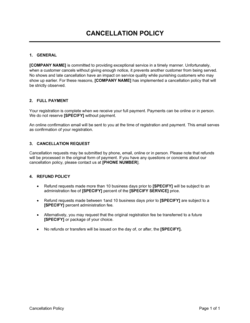
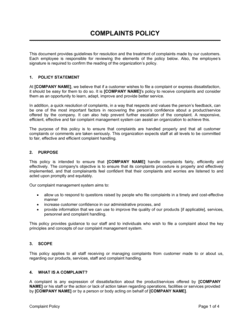
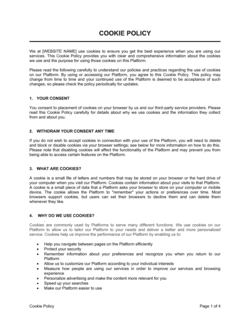
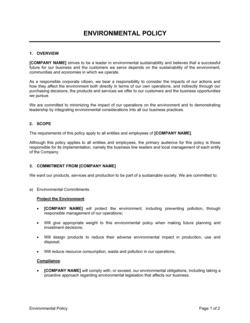
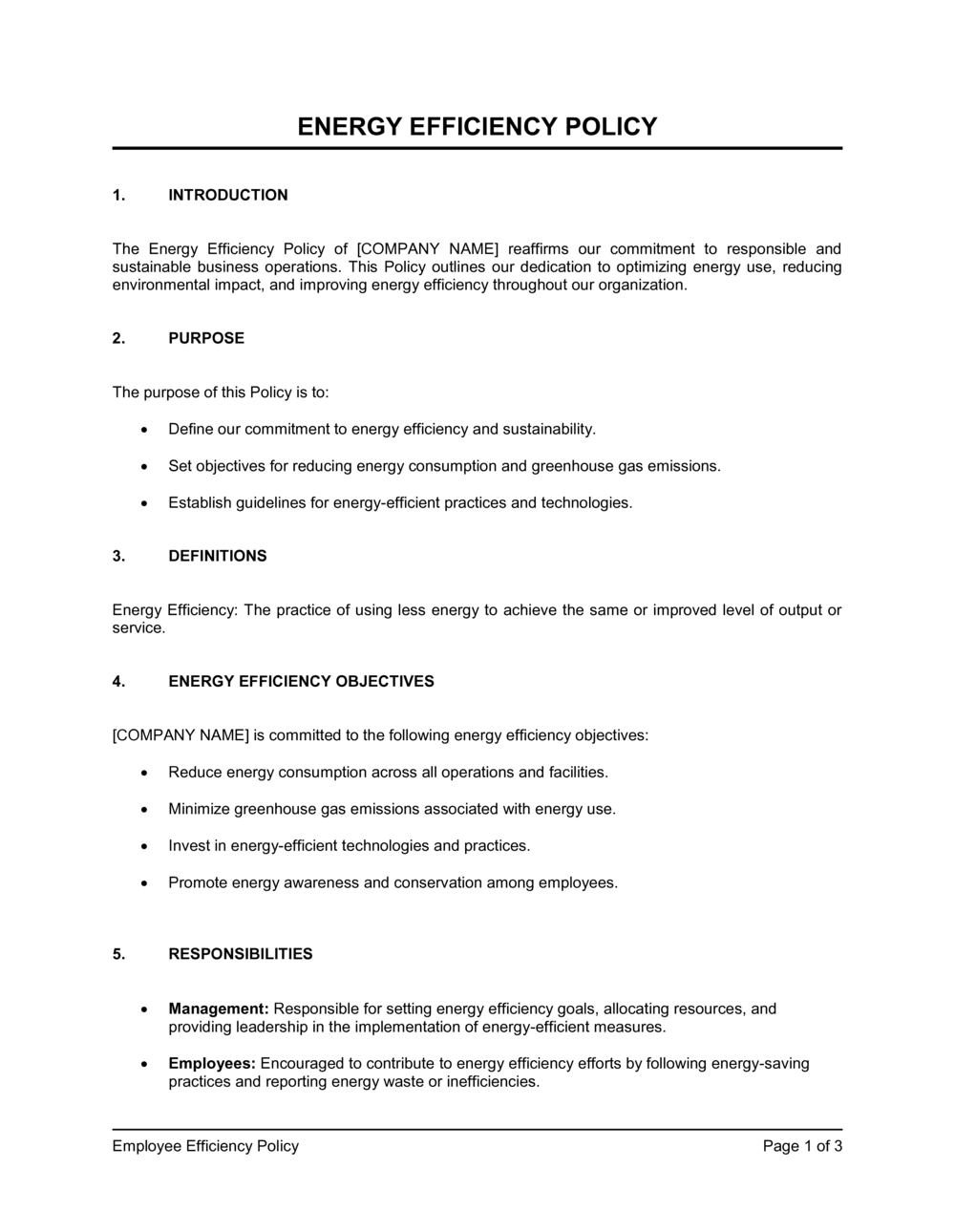
Energy Efficiency Policy Template

Free Word download β€’ Edit online β€’ Save & share with Drive β€’ Export to PDF

3 pagesβ€’20–25 min to fillβ€’Difficulty: Standard
Learn more ↓
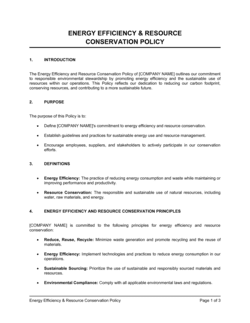
FreeEnergy Efficiency Policy Template

At a glance

What it is
An Energy Efficiency Policy is a formal internal document that defines a business's commitment to reducing energy consumption, sets measurable targets, assigns accountability, and outlines the procedures employees and managers must follow to achieve those targets. This free Word download gives you a structured, editable starting point you can customize for your facilities and export as PDF for staff distribution or regulatory submission.
When you need it
Use it when your organization wants to reduce operating costs through lower utility bills, when a client, investor, or certifying body (such as ISO 50001) requests evidence of a formal energy management commitment, or when local regulations require a documented energy reduction plan.
What's inside
Purpose and scope, energy consumption baseline, reduction targets and KPIs, roles and responsibilities, operational controls and best practices, procurement guidelines, monitoring and measurement procedures, employee training requirements, and a review and continuous improvement cycle.

What is an Energy Efficiency Policy?

An Energy Efficiency Policy is a formal internal document through which an organization commits to reducing its energy consumption, sets measurable reduction targets, assigns clear accountability to named roles, and defines the operational procedures staff must follow to achieve those targets. It records the organization's energy baseline, identifies the systems and processes that consume the most energy, establishes controls for each, and sets a cadence for monitoring, reporting, and annual review. Unlike a broad sustainability statement, an energy efficiency policy is specifically focused on quantifiable energy outcomes β€” measured in kWh, MWh, or intensity ratios β€” and the day-to-day behaviors and procurement decisions that drive them.

Why You Need This Document

Without a written energy efficiency policy, energy costs go unmanaged by default: staff have no documented obligations, managers have no targets to report against, and procurement decisions ignore lifetime energy costs in favor of lower purchase prices. The financial consequences compound β€” a mid-sized commercial facility running without active energy controls typically overspends on utilities by 10–20% relative to a comparable managed operation. Beyond cost, an undocumented energy position creates exposure in three other directions: corporate procurement processes increasingly require suppliers to demonstrate a formal energy policy; regulatory schemes in the UK, EU, and elsewhere mandate energy audits and management documentation for organizations above defined consumption thresholds; and ESG reporting frameworks expect quantified energy data backed by a governing policy. This template gives you the structure to close all three gaps in a single afternoon, with the flexibility to scale from a one-page office policy to a multi-site management system as your organization grows.

Which variant fits your situation?

If your situation is…Use this template
Organization pursuing ISO 50001 energy management system certificationISO 50001 Energy Management Policy
Retail or hospitality business targeting utility cost reductionEnergy Efficiency Policy
Manufacturing site managing high-consumption industrial equipmentEnvironmental Management Policy
Company tracking full carbon footprint across scopes 1, 2, and 3Sustainability Policy
Business preparing a full ESG or CSR disclosureCorporate Social Responsibility Policy
Government or public-sector entity with mandatory energy reportingEnvironmental Policy
Building owner seeking LEED or BREEAM certification documentationGreen Building Policy

Common mistakes to avoid

❌ Targets stated as aspirations, not commitments

Why it matters: Phrases like 'we aim to reduce energy where possible' cannot be measured, reported on, or held against anyone β€” they are meaningless to auditors, certifying bodies, and tendering clients.

Fix: Replace aspirational language with a specific percentage reduction, an absolute kWh target, and a deadline β€” e.g., 'reduce site energy consumption by 15% by December 31, 2027 against the 2024 baseline.'

❌ No named energy manager or single point of accountability

Why it matters: When responsibility belongs to everyone, no one acts. Energy reduction tasks are deprioritized against operational demands and the policy collects dust.

Fix: Assign a named individual or specific role as energy manager with defined responsibilities and the time allocation β€” even 20% of a facilities manager's role β€” to execute them.

❌ Operational controls written as suggestions

Why it matters: Staff interpret 'please consider switching off lights' as optional, producing inconsistent compliance and making behavioral audits impossible.

Fix: Rewrite every control as a mandatory procedure using 'must' or 'shall', and pair each with a consequence for non-compliance consistent with your HR policy.

❌ Policy reviewed annually on paper but never updated in practice

Why it matters: An outdated policy references superseded targets, former employees, and decommissioned equipment β€” undermining credibility with auditors and staff alike.

Fix: Schedule a calendar reminder with a named owner each year. Log every review with a date and version number, even if no changes are made, to demonstrate the review took place.

The 10 key sections, explained

Purpose and scope

Policy statement and commitments

Roles and responsibilities

Energy consumption baseline and targets

Significant energy users (SEUs)

Operational controls and best practices

Procurement and capital investment guidelines

Monitoring, measurement, and reporting

Employee training and awareness

Review, audit, and continual improvement

How to fill it out

  1. 1

    Define the scope of the policy

    List all facilities, operations, and staff categories covered. Decide whether remote workers are included and whether the policy extends to contractors on site.

    πŸ’‘ If you operate across multiple sites with different energy profiles, consider a single umbrella policy with site-specific appendices rather than separate documents.

  2. 2

    Establish your energy baseline

    Pull 12 months of utility bills or meter data for each covered site. Normalize for degree-days or production volume if consumption fluctuates with weather or output.

    πŸ’‘ Use at least a full calendar year of data to capture seasonal HVAC peaks. A summer-only or winter-only baseline will produce misleading targets.

  3. 3

    Set specific, time-bound reduction targets

    Express targets in absolute terms (MWh saved) and intensity terms (kWh per square meter or per unit produced). Set sub-targets by system β€” HVAC, lighting, process equipment β€” so managers have clear ownership.

    πŸ’‘ Anchor targets to a credible benchmark: an energy audit finding, an industry average, or an ISO 50001 improvement rate of 3–5% per year is a defensible starting point.

  4. 4

    Identify and document significant energy users

    Rank all energy-consuming systems by annual kWh. Designate any system that accounts for more than 10% of total consumption as an SEU and assign a named owner to each.

    πŸ’‘ If sub-meters are not installed, use nameplate wattage Γ— estimated operating hours as a proxy to rank SEUs before investing in metering.

  5. 5

    Write the operational controls for each SEU

    For every SEU, write at least one mandatory operational control: a shutdown schedule, setpoint limit, or usage procedure. Use imperative language β€” 'must', 'shall' β€” not 'should' or 'encouraged'.

    πŸ’‘ Post a one-page summary of controls in each plant room or at each major piece of equipment as a physical reminder β€” policy documents rarely get read at the point of behavior.

  6. 6

    Assign named roles and accountabilities

    Enter a specific job title or employee name for each responsibility: energy manager, department heads, procurement lead, and senior sponsor. Do not assign responsibilities to unnamed teams.

    πŸ’‘ If your organization does not have a dedicated energy manager, assign the role formally to an existing position β€” facilities manager or operations lead β€” and confirm it in writing.

  7. 7

    Configure your monitoring and reporting cadence

    Set monthly meter reading or utility bill reviews, quarterly management reports, and annual policy reviews. Confirm who receives each report and in what format.

    πŸ’‘ A simple dashboard showing actual vs. target consumption β€” even a shared spreadsheet β€” improves compliance more than a detailed report that only the energy manager reads.

  8. 8

    Get leadership sign-off and distribute the policy

    Have the most senior relevant executive sign the policy statement before distributing. Store the signed version in your document management system and communicate it to all staff covered by the scope.

    πŸ’‘ Send a one-paragraph summary email from the CEO or COO alongside the full document. A visible leadership endorsement increases employee compliance rates significantly.

Frequently asked questions

What is an energy efficiency policy?

An energy efficiency policy is a formal document that commits an organization to reducing its energy consumption, sets measurable targets, assigns accountability to specific roles, and defines the procedures employees must follow to achieve those targets. It forms the governance foundation for an energy management program and is typically reviewed annually to reflect changes in operations or energy costs.

Does my business legally need an energy efficiency policy?

In many jurisdictions, organizations above a certain size or energy consumption threshold are required to conduct energy audits or participate in energy reporting schemes β€” such as the UK's ESOS or the EU's Energy Efficiency Directive. A written policy is typically required to demonstrate compliance with these schemes and with standards such as ISO 50001. Even where no mandate exists, many corporate procurement and tender processes now require suppliers to provide evidence of a formal energy policy.

What is the difference between an energy efficiency policy and an environmental policy?

An environmental policy covers the full range of a company's environmental impacts β€” waste, water, emissions, biodiversity, and energy. An energy efficiency policy focuses specifically on energy consumption and reduction, with targets expressed in kWh or MWh, EnPIs, and system-level controls. The two documents are complementary: the environmental policy sets the strategic environmental commitment; the energy policy operationalizes the energy component of it.

What reduction targets should we set in the policy?

A widely used starting benchmark is a 3–5% absolute reduction per year, which aligns with ISO 50001 continual improvement expectations and typical low-cost efficiency gains from behavioral and operational controls. Organizations with older facilities or significant sub-metering gaps often achieve 10–15% in the first two years. Targets should be grounded in an energy audit rather than set arbitrarily β€” an audit identifies the feasible savings from each system before you commit to a number publicly.

Who should be responsible for implementing the energy efficiency policy?

A named energy manager β€” or an existing role such as facilities or operations manager with energy management added to their remit β€” should own day-to-day implementation. Department heads are responsible for compliance within their areas. Senior leadership sponsors the policy, approves capital investment decisions, and reviews progress at least quarterly. Without that three-level structure, policies tend to stall between the energy manager and the budget holders.

How does an energy efficiency policy support ISO 50001 certification?

ISO 50001 requires organizations to establish, implement, and maintain an energy management system β€” and a documented energy policy endorsed by top management is one of the core requirements. The policy must include a commitment to continual improvement, compliance with applicable requirements, and support for procurement of energy-efficient products and services. A well-structured energy efficiency policy template covers all of these clauses and can be adapted to the ISO 50001 framework without starting from scratch.

How often should the energy efficiency policy be reviewed?

Annual review is standard for most organizations. A review should also be triggered by any significant change in operations β€” moving to a new facility, adding a major production line, or a significant shift in occupancy or working patterns. Each review should compare actual consumption against targets, update the baseline if targets have been met, and revise any operational controls that proved unworkable. Version numbering and dated sign-off on each revision creates an audit trail.

Can a small business use this template, or is it only for large companies?

The template is designed to scale. A small business with a single office can implement a one-page policy that covers a handful of operational controls and a simple monthly meter-reading process. Larger organizations add sub-targets by site, formal SEU registers, and quarterly management reporting. The core structure β€” baseline, targets, controls, monitoring, review β€” applies regardless of company size, and even modest behavioral controls in a small office typically reduce energy bills by 5–10%.

What is an energy performance indicator (EnPI) and how do I choose one?

An EnPI is a quantitative measure that normalizes energy consumption against a relevant driver β€” production volume, floor area, or occupied hours β€” so you can track efficiency independent of changes in business activity. Common choices include kWh per square meter for office buildings, kWh per unit produced for manufacturing, and kWh per guest night for hospitality. Choose the driver that best explains natural variation in your consumption; a poor driver choice will make performance look worse during busy periods and better during slow ones, masking real trends.

How this compares to alternatives

vs Environmental Policy

An environmental policy addresses the full scope of a company's environmental impacts β€” waste, water, biodiversity, emissions, and energy combined. An energy efficiency policy focuses exclusively on energy consumption and reduction targets. Most organizations need both: the environmental policy sets the strategic commitment; the energy policy operationalizes the energy-specific controls, targets, and monitoring processes.

vs Sustainability Policy

A sustainability policy covers social, governance, and environmental dimensions β€” including supply chain ethics, community engagement, and carbon reporting. An energy efficiency policy is narrower and more operational, focused on measurable kWh reductions, specific equipment controls, and utility cost savings. Where a sustainability policy answers 'what do we stand for,' the energy policy answers 'how do we reduce our energy bill and hit our targets.'

vs Carbon Reduction Plan

A carbon reduction plan quantifies greenhouse gas emissions across scopes 1, 2, and 3 and sets decarbonization pathways aligned to net-zero commitments. An energy efficiency policy focuses on energy consumption (kWh) and the operational controls that reduce it β€” carbon impact is a downstream benefit rather than the primary metric. Organizations pursuing net-zero typically need both, with the energy policy driving the Scope 2 reductions that feed the carbon plan.

vs Facilities Management Policy

A facilities management policy governs the full spectrum of building operations β€” maintenance schedules, access control, health and safety, cleaning, and space management. An energy efficiency policy is a focused subset dealing only with energy consumption and reduction. In larger organizations, the energy policy sits underneath the facilities management framework; in smaller ones, energy controls are often embedded directly in the facilities policy.

Industry-specific considerations

Manufacturing

Process equipment and compressed air systems typically account for 60–80% of site consumption, making SEU identification and shift-based operational controls the highest-impact focus area.

Retail

Lighting and refrigeration dominate retail energy use; policies typically include LED retrofit commitments, refrigeration door protocols, and overnight setback schedules for HVAC.

Healthcare

24/7 operations and infection-control requirements constrain shutdown options, so policies focus on equipment efficiency standards, medical gas systems, and building management system optimization.

Professional Services

Office-based consumption is dominated by IT equipment and HVAC; policies typically address server room cooling efficiency, hybrid-work occupancy scheduling, and procurement of Energy Star–rated devices.

Hospitality

Guest comfort requirements limit setpoint flexibility, so policies focus on occupancy-triggered HVAC controls, keycard-linked room energy systems, and laundry and kitchen equipment schedules.

Construction

Temporary site power, diesel plant, and on-site accommodation drive consumption; policies address generator sizing, temporary lighting standards, and fuel consumption monitoring per project.

Template vs pro β€” what fits your needs?

PathBest forCostTime
Use the templateSMEs, single-site businesses, and organizations with straightforward office or retail energy profilesFree2–4 hours
Template + professional reviewMulti-site organizations, businesses pursuing ISO 50001 certification, or those with mandatory energy reporting obligations$300–$1,500 for an energy consultant review1–3 days
Custom draftedLarge industrial or manufacturing sites with complex SEU registers, regulated energy users, or organizations tendering for contracts that require certified energy management$2,000–$8,000 for a full energy management system design2–6 weeks

Glossary

Energy Baseline
A documented measure of an organization's energy consumption over a reference period, used as the starting point against which improvements are tracked.
Energy Performance Indicator (EnPI)
A quantitative measure β€” such as kWh per square meter or kWh per unit produced β€” used to evaluate energy performance relative to the baseline.
ISO 50001
An international standard published by the International Organization for Standardization that specifies requirements for an energy management system.
Scope 2 Emissions
Indirect greenhouse gas emissions from the generation of purchased electricity, steam, heat, or cooling consumed by an organization.
Sub-metering
Installing individual energy meters on specific circuits, equipment, or zones to isolate and measure consumption at a granular level.
Load Shifting
Moving high-energy-draw activities β€” such as running industrial equipment β€” to off-peak hours to reduce demand charges on utility bills.
Operational Control
A specific procedure or behavioral rule β€” such as switching off equipment when not in use β€” that an organization puts in place to reduce energy consumption.
Significant Energy User (SEU)
A piece of equipment, system, or process that accounts for a substantial portion of an organization's total energy consumption and therefore receives focused management attention.
Energy Audit
A systematic inspection and analysis of energy flows in a building or process to identify opportunities for improving efficiency and reducing waste.
Demand Response
A program in which energy users voluntarily reduce or shift consumption during periods of high grid demand, often in exchange for utility credits or lower rates.

Part of your Business Operating System

This document is one of 3,000+ business & legal templates included in Business in a Box.

  • Fill-in-the-blanks β€” ready in minutes
  • 100% customizable Word document
  • Compatible with all office suites
  • Export to PDF and share electronically

Create your document in 3 simple steps.

From template to signed document β€” all inside one Business Operating System.
1
Download or open template

Access over 3,000+ business and legal templates for any business task, project or initiative.

2
Edit and fill in the blanks with AI

Customize your ready-made business document template and save it in the cloud.

3
Save, Share, Send, Sign

Share your files and folders with your team. Create a space of seamless collaboration.

Save time, save money, and create top-quality documents.

β˜…β˜…β˜…β˜…β˜…

"Fantastic value! I'm not sure how I'd do without it. It's worth its weight in gold and paid back for itself many times."

Managing Director Β· Mall Farm
Robert Whalley
Managing Director, Mall Farm Proprietary Limited
β˜…β˜…β˜…β˜…β˜…

"I have been using Business in a Box for years. It has been the most useful source of templates I have encountered. I recommend it to anyone."

Business Owner Β· 4+ years
Dr Michael John Freestone
Business Owner
β˜…β˜…β˜…β˜…β˜…

"It has been a life saver so many times I have lost count. Business in a Box has saved me so much time and as you know, time is money."

Owner Β· Upstate Web
David G. Moore Jr.
Owner, Upstate Web

Run your business with a system β€” not scattered tools

Stop downloading documents. Start operating with clarity. Business in a Box gives you the Business Operating System used by over 250,000 companies worldwide to structure, run, and grow their business.

Start freeΒ Β·Β No credit card required