Diversity Policy Template

Free Word download β€’ Edit online β€’ Save & share with Drive β€’ Export to PDF

3 pagesβ€’20–30 min to fillβ€’Difficulty: Standard
Learn more ↓
FreeDiversity Policy Template

At a glance

What it is
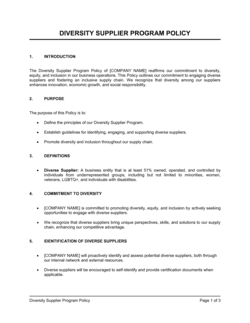
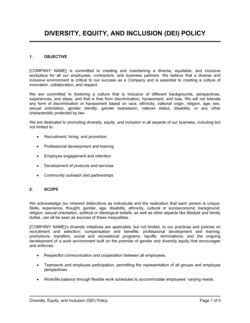
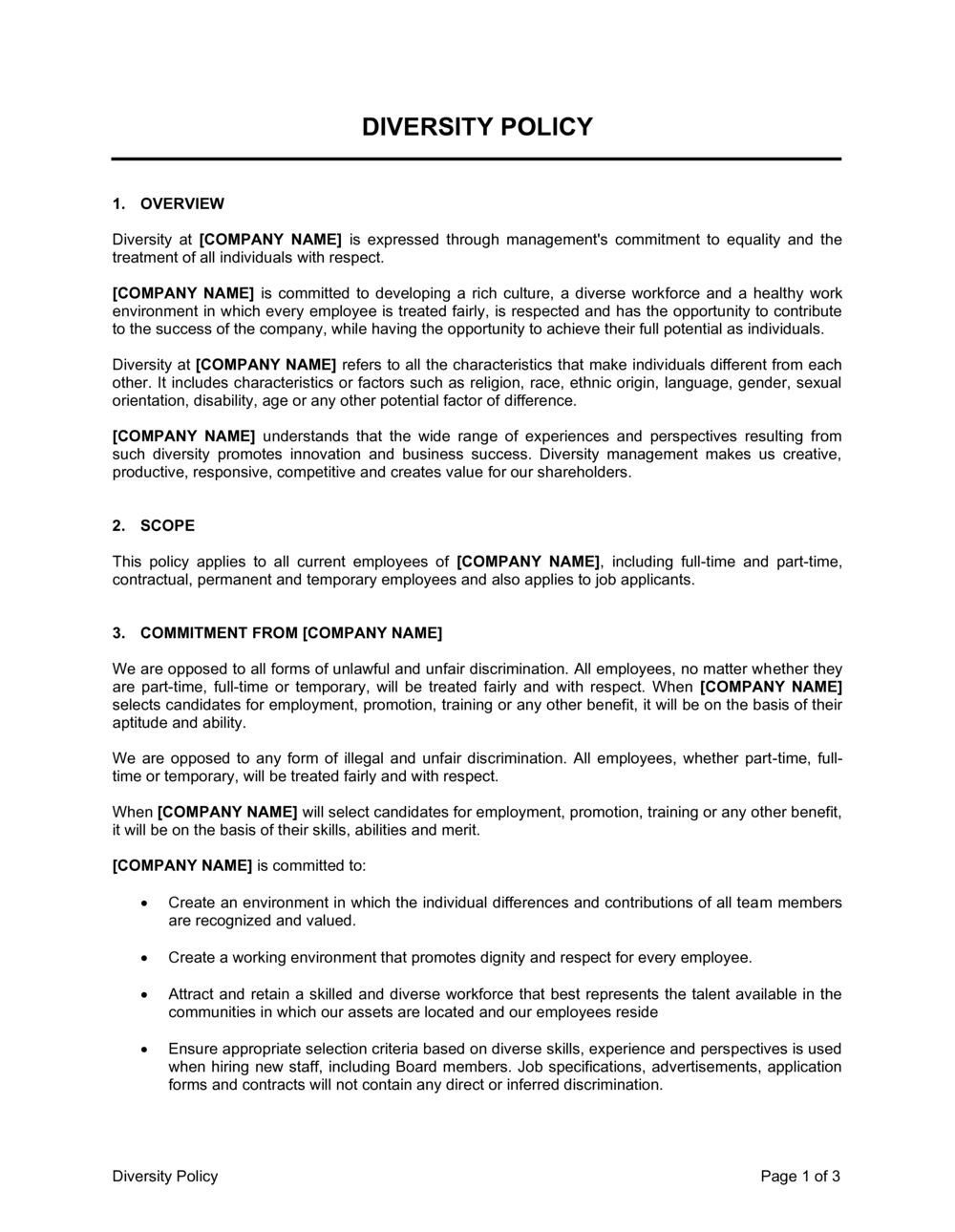
A Diversity Policy is a formal written statement that defines an organization's commitment to equal opportunity, inclusive hiring practices, and a workplace free from discrimination and harassment. This free Word download gives you a structured, editable template you can tailor to your organization's size and values, then distribute to employees or publish in your employee handbook.
When you need it
Use it when onboarding employees for the first time, updating your employee handbook, responding to a client or government contractor requirement for a documented DEI policy, or aligning leadership around a concrete inclusion framework.
What's inside
A purpose and scope statement, protected characteristics definitions, equal opportunity commitments, inclusive hiring and promotion standards, anti-harassment provisions, reporting and complaint procedures, accountability measures, and a policy review schedule.

What is a Diversity Policy?

A Diversity Policy is a formal written statement that defines an organization's commitment to equal opportunity, non-discrimination, and an inclusive workplace across all employment decisions β€” from recruitment and hiring through promotion, compensation, and termination. It identifies the protected characteristics the company will not use as a basis for adverse decisions, establishes the processes employees must follow to report discrimination or harassment, assigns accountability to specific roles, and sets a schedule for keeping the policy current with applicable law. Unlike an informal culture statement or a values slide in a pitch deck, a properly drafted diversity policy creates documented, enforceable standards that managers and employees are expected to follow.

Why You Need This Document

Without a written diversity policy, your organization has no documented standard against which to measure conduct, no clear complaint procedure for employees who experience discrimination, and no evidence of preventive action if an employment claim is filed. Courts and regulatory agencies in most jurisdictions assess whether the employer took "reasonable steps" to prevent discrimination β€” and the absence of a written policy is the first gap they identify. Beyond legal exposure, an undocumented diversity commitment is invisible to job candidates, clients, and government procurement officers who routinely request written DEI policies as a condition of doing business. This template gives you a complete, editable starting point you can adapt to your organization's size and jurisdiction in a single working session β€” closing the policy gap before it becomes a compliance problem or a competitive disadvantage.

Which variant fits your situation?

If your situation is…Use this template
Comprehensive policy covering hiring, promotion, pay equity, and cultureDiversity Policy
Standalone anti-harassment and anti-discrimination rulesAnti-Harassment Policy
Structured multi-year roadmap with targets and metricsDiversity and Inclusion Plan
Employee handbook section summarizing all conduct policiesEmployee Handbook
Formal equal opportunity employer statement for job postingsEqual Opportunity Policy
Annual report on DEI progress shared with stakeholdersDiversity Report
Remote or hybrid team inclusion guidelinesRemote Work Policy

Common mistakes to avoid

❌ Generic language with no operational specifics

Why it matters: A policy that says 'we value diversity' without describing any concrete practices is unenforceable, unconvincing to employees, and offers no protection in a discrimination claim.

Fix: Replace every aspirational statement with a specific, observable behavior β€” named reporting contacts, defined training timelines, and documented hiring criteria.

❌ Omitting contractors and applicants from scope

Why it matters: Anti-discrimination law in most jurisdictions protects job applicants and workers classified as contractors, not just full-time employees. A narrow scope clause creates a compliance gap.

Fix: Define covered persons broadly: 'all employees, contractors, temporary workers, interns, and job applicants' at the top of the policy.

❌ Single complaint reporting contact with no alternative

Why it matters: When the HR contact is the subject of the complaint β€” or a close colleague of the accused β€” employees have no safe path to report, and the policy fails its primary purpose.

Fix: Name at least two reporting contacts and include an anonymous channel (hotline or online form) as a third option.

❌ No annual review commitment

Why it matters: Employment law changes every year at the federal, state, and local level. A policy that was compliant in 2022 may omit newly protected characteristics or outdated procedures by 2025.

Fix: Add an explicit review date and calendar it immediately. Assign a named owner who approves and communicates updates.

❌ Treating the diversity policy as a standalone document

Why it matters: Employees won't find it unless it is embedded in the employee handbook, referenced in the onboarding checklist, and linked from the intranet. An unfindable policy has no effect on behavior.

Fix: Cross-reference the policy in the employee handbook, the onboarding packet, and any anti-harassment training materials. Note the version date and storage location in the document itself.

❌ No consequences stated for violations

Why it matters: A policy with no disciplinary language is widely interpreted as advisory rather than binding, which undermines deterrence and weakens the company's position if a violation is later disputed.

Fix: State explicitly that violations may result in disciplinary action up to and including termination, consistent with the company's progressive discipline policy.

The 9 key sections, explained

Purpose and scope

Statement of commitment

Protected characteristics

Equal opportunity in employment decisions

Inclusive hiring practices

Anti-harassment and respectful workplace

Reporting and complaint procedure

Accountability and training

Policy review and update schedule

How to fill it out

  1. 1

    Confirm your legal entity name and locations

    Enter your company's full registered name and list all locations or jurisdictions where the policy applies. This scopes the document correctly for multi-state or international employers.

    πŸ’‘ If you operate in California, New York, or Illinois, verify state-specific protected characteristics before finalizing the protected-characteristics section β€” these states extend coverage beyond federal law.

  2. 2

    Customize the protected characteristics list

    Start from the federal baseline and add any state or local protected characteristics applicable to your locations. Check your city or county's human rights ordinance in addition to state law.

    πŸ’‘ Use a side-by-side comparison of federal, state, and local law for each jurisdiction where you employ people β€” a one-size list can leave local protections unaddressed.

  3. 3

    Tailor the inclusive hiring practices section

    Replace placeholder language with your actual recruiting process steps β€” the specific job boards you use for diverse sourcing, your interview panel composition requirements, and the competency framework you use to evaluate candidates.

    πŸ’‘ Only describe processes you will actually follow. An aspirational policy that describes practices you don't implement creates credibility and legal risk if challenged.

  4. 4

    Assign named accountability owners

    Replace generic role references (e.g., 'HR') with specific job titles β€” and ideally named individuals β€” who own complaint intake, investigation, training delivery, and annual review.

    πŸ’‘ Designate at least two reporting contacts so employees always have an alternative if the primary contact is the subject of a complaint.

  5. 5

    Set your training timeline and method

    Define whether training is in-person, online, or blended; how long the initial session runs; and the annual refresh schedule. Enter the specific timeframe for new-hire completion (30 days is the most common standard).

    πŸ’‘ Link to or name the specific training program in the policy so managers can verify completion and HR can track it against an audit trail.

  6. 6

    Insert the complaint reporting contact details

    Enter the HR contact email, phone number or anonymous hotline URL, and any external reporting channel (e.g., an ombudsperson or third-party ethics hotline).

    πŸ’‘ Test the reporting channel before publishing the policy β€” a broken link or disconnected phone number in a complaint procedure is a significant liability.

  7. 7

    Set the review date and approval chain

    Enter the annual review date, the role that approves changes, and the location where the current version is stored (e.g., your HRIS, intranet, or employee handbook).

    πŸ’‘ Calendar the annual review now β€” a recurring reminder prevents the policy from becoming stale and signals genuine institutional commitment.

Frequently asked questions

What is a diversity policy?

A diversity policy is a formal written document that states an organization's commitment to equal opportunity, non-discrimination, and an inclusive workplace. It defines protected characteristics, describes the practices the company uses to promote fairness in hiring and employment, establishes a complaint procedure, and assigns accountability for implementation. It is typically distributed to all employees and published in the employee handbook.

Is a diversity policy legally required?

No federal law in the US mandates a standalone written diversity policy for private employers, but several anti-discrimination statutes β€” Title VII, the ADA, the ADEA, and the Equal Pay Act β€” require employers to maintain non-discriminatory practices. Federal contractors above certain revenue thresholds must have written affirmative action plans. Many states and cities require written harassment prevention policies. A formal diversity policy demonstrates that the employer has taken reasonable steps to prevent discrimination, which can reduce liability in employment disputes.

What is the difference between a diversity policy and an equal opportunity policy?

An equal opportunity policy is narrower β€” it focuses specifically on ensuring that hiring, promotion, and compensation decisions are not based on protected characteristics. A diversity policy is broader, addressing not only equal opportunity but also active inclusion initiatives, culture, anti-harassment, training requirements, and accountability structures. Many organizations combine both into a single DEI policy document.

Who should approve and own the diversity policy?

Typically the HR director or Chief People Officer drafts and maintains the policy, with approval from the CEO or an executive sponsor to signal leadership commitment. For organizations with a board of directors, board approval or acknowledgment is best practice for publicly disclosed policies. Day-to-day accountability β€” complaint intake, training delivery, and annual review β€” should be assigned to a specific named role, not a department generally.

How often should a diversity policy be updated?

Annual review is the standard. Employment law at the state and local level changes frequently β€” new protected characteristics are added, complaint procedure requirements evolve, and training mandates shift. A policy that is more than 18 months old without review risks being out of compliance. Any significant structural change to the organization β€” a merger, a new operating jurisdiction, or a substantial headcount increase β€” should also trigger an out-of-cycle review.

What should the complaint procedure in a diversity policy include?

At minimum: at least two named or titled reporting contacts, an anonymous reporting option, a commitment to a prompt and impartial investigation, a clear statement that retaliation is prohibited, and a description of the general investigation timeline. The procedure should apply to internal complaints and reports about third parties such as clients or vendors. Vague complaint language β€” "employees may raise concerns with management" β€” is not sufficient.

Can a small business use the same diversity policy as a large company?

The core structure applies to any size organization, but the specifics must be calibrated. A 10-person company cannot realistically maintain a dedicated DEI committee or run quarterly diversity training. Adapt the accountability section to reflect your actual capacity β€” a named founder or HR generalist, annual training, and a clear reporting contact are credible and enforceable at small scale. Avoid copying Fortune 500 language that implies infrastructure you don't have.

Should the diversity policy be included in the employee handbook?

Yes. Embedding the policy in the employee handbook ensures every employee receives it during onboarding and acknowledges it in writing. A standalone policy document that is stored in a shared drive but not actively distributed provides far weaker evidence of notice in an employment dispute. Cross-reference the diversity policy from related sections β€” anti-harassment, disciplinary procedures, and accommodation requests β€” so employees can navigate the full framework.

What training requirements should a diversity policy include?

At minimum, specify a new-hire training timeline (30 days from start date is most common), an annual refresh requirement, and the format (online module, in-person workshop, or blended). California requires at least 2 hours of sexual harassment prevention training for supervisors every two years; New York requires annual training for all employees. Reference the specific program or platform your company uses so managers can verify completion and HR can maintain an audit trail.

How this compares to alternatives

vs Anti-Harassment Policy

An anti-harassment policy focuses specifically on prohibiting, reporting, and investigating harassing conduct. A diversity policy is broader β€” it covers equal opportunity in all employment decisions, inclusive hiring, accountability structures, and culture. Most organizations need both; the diversity policy should cross-reference the anti-harassment policy rather than duplicate it.

vs Employee Handbook

An employee handbook is a comprehensive reference document covering all workplace policies β€” compensation, time off, conduct, benefits, and more. A diversity policy is a single focused section or standalone document within that framework. The diversity policy should be embedded in or formally referenced by the handbook to ensure employees receive it during onboarding.

vs Code of Conduct

A code of conduct governs general professional behavior, ethics, conflicts of interest, and company values across all interactions. A diversity policy specifically addresses discrimination, equal opportunity, and inclusion in employment decisions. The code of conduct typically references the diversity policy for discrimination-related conduct rather than duplicating its content.

vs Affirmative Action Plan

An affirmative action plan is a detailed, data-driven document required of US federal contractors with 50 or more employees and contracts above $50,000 β€” it includes workforce utilization analysis, goal-setting, and audit obligations. A diversity policy is a principles and procedures document that any employer can adopt voluntarily. Federal contractors typically need both: the policy as a public commitment and the plan as a compliance document.

Industry-specific considerations

Technology / SaaS

Tech employers face intense public scrutiny on gender and racial representation in engineering and leadership; the policy typically includes specific sourcing commitments and pay equity audit language.

Healthcare

Patient-facing workforces benefit from language addressing cultural competency and language access, and the policy must align with Joint Commission and CMS non-discrimination requirements.

Professional Services

Client-facing firms increasingly face RFP requirements to produce a written DEI policy; the policy is also used to demonstrate ESG commitments to institutional clients.

Manufacturing

Shift-based and union environments require the policy to address consistent application across all shifts and alignment with collective bargaining agreement non-discrimination clauses.

Retail / Hospitality

High-turnover environments need a concise, plain-language policy that can be reviewed quickly during onboarding and covers customer-facing conduct expectations as well as internal employment practices.

Education

Educational institutions must align the policy with Title IX, Section 504, and IDEA obligations, and the scope typically extends to students and parents in addition to employees.

Template vs pro β€” what fits your needs?

PathBest forCostTime
Use the templateSmall to mid-size businesses establishing a written DEI policy for the first time or updating an outdated documentFree1–3 hours
Template + professional reviewEmployers in multiple states, government contractors, or organizations that have recently faced a discrimination complaint$300–$800 for an employment attorney or HR consultant review3–5 days
Custom draftedFederal contractors requiring an affirmative action plan, publicly traded companies with ESG disclosure obligations, or organizations in heavily regulated industries$1,500–$5,000+2–4 weeks

Glossary

Protected Characteristic
An attribute β€” such as race, gender, age, religion, disability, or sexual orientation β€” that anti-discrimination laws prohibit employers from using as a basis for adverse employment decisions.
DEI
Diversity, Equity, and Inclusion β€” a framework that addresses representation (diversity), fairness in access and outcomes (equity), and belonging for all employees (inclusion).
Equal Opportunity Employer (EOE)
An employer that commits not to discriminate against applicants or employees based on any protected characteristic in any employment decision.
Unconscious Bias
A prejudice or preference that operates below conscious awareness and can influence hiring, promotion, and evaluation decisions without the decision-maker realizing it.
Reasonable Accommodation
A modification to a job, work environment, or standard practice that enables an employee with a disability or religious need to perform their role without causing undue hardship to the employer.
Adverse Action
Any employment decision that negatively affects an employee β€” termination, demotion, pay reduction, or assignment change β€” when taken for discriminatory reasons.
Affirmative Action
Proactive steps an organization takes to increase the representation of underrepresented groups in hiring, promotion, and retention β€” required by law for certain federal contractors in the US.
Pay Equity
The principle that employees performing substantially similar work receive comparable compensation regardless of gender, race, or other protected characteristics.
Intersectionality
The concept that individuals may hold multiple identities simultaneously β€” e.g., a person who is both a woman and a person of color β€” and that these overlapping identities can compound barriers or disadvantages.
Retaliation
Any adverse employment action taken against an employee because they filed a discrimination complaint, participated in an investigation, or exercised a protected right.

Part of your Business Operating System

This document is one of 3,000+ business & legal templates included in Business in a Box.

  • Fill-in-the-blanks β€” ready in minutes
  • 100% customizable Word document
  • Compatible with all office suites
  • Export to PDF and share electronically

Create your document in 3 simple steps.

From template to signed document β€” all inside one Business Operating System.
1
Download or open template

Access over 3,000+ business and legal templates for any business task, project or initiative.

2
Edit and fill in the blanks with AI

Customize your ready-made business document template and save it in the cloud.

3
Save, Share, Send, Sign

Share your files and folders with your team. Create a space of seamless collaboration.

Save time, save money, and create top-quality documents.

β˜…β˜…β˜…β˜…β˜…

"Fantastic value! I'm not sure how I'd do without it. It's worth its weight in gold and paid back for itself many times."

Managing Director Β· Mall Farm
Robert Whalley
Managing Director, Mall Farm Proprietary Limited
β˜…β˜…β˜…β˜…β˜…

"I have been using Business in a Box for years. It has been the most useful source of templates I have encountered. I recommend it to anyone."

Business Owner Β· 4+ years
Dr Michael John Freestone
Business Owner
β˜…β˜…β˜…β˜…β˜…

"It has been a life saver so many times I have lost count. Business in a Box has saved me so much time and as you know, time is money."

Owner Β· Upstate Web
David G. Moore Jr.
Owner, Upstate Web

Run your business with a system β€” not scattered tools

Stop downloading documents. Start operating with clarity. Business in a Box gives you the Business Operating System used by over 250,000 companies worldwide to structure, run, and grow their business.

Free Forever PlanΒ Β·Β No credit card required