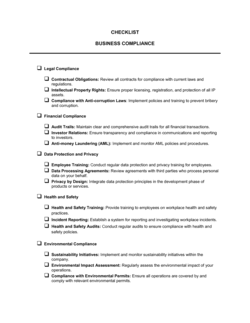
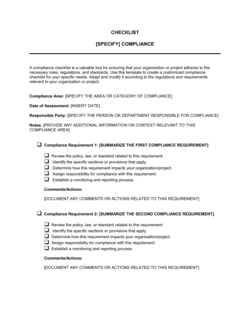
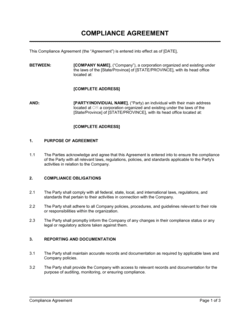
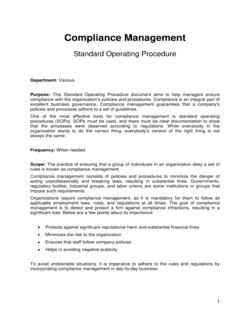
Employee Compliance Survey Template

Free Word download • Edit online • Save & share with Drive • Export to PDF

1 page20–30 min to fillDifficulty: StandardSignature requiredLegal review recommended
Learn more ↓
FreeEmployee Compliance Survey Template

At a glance

What it is
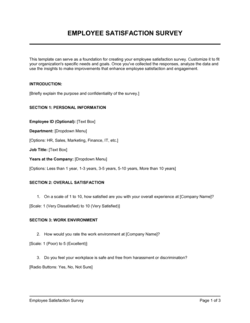
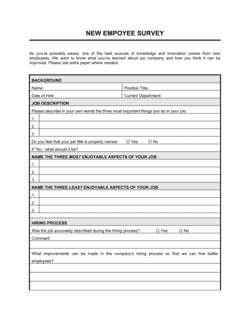
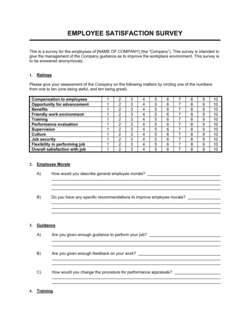
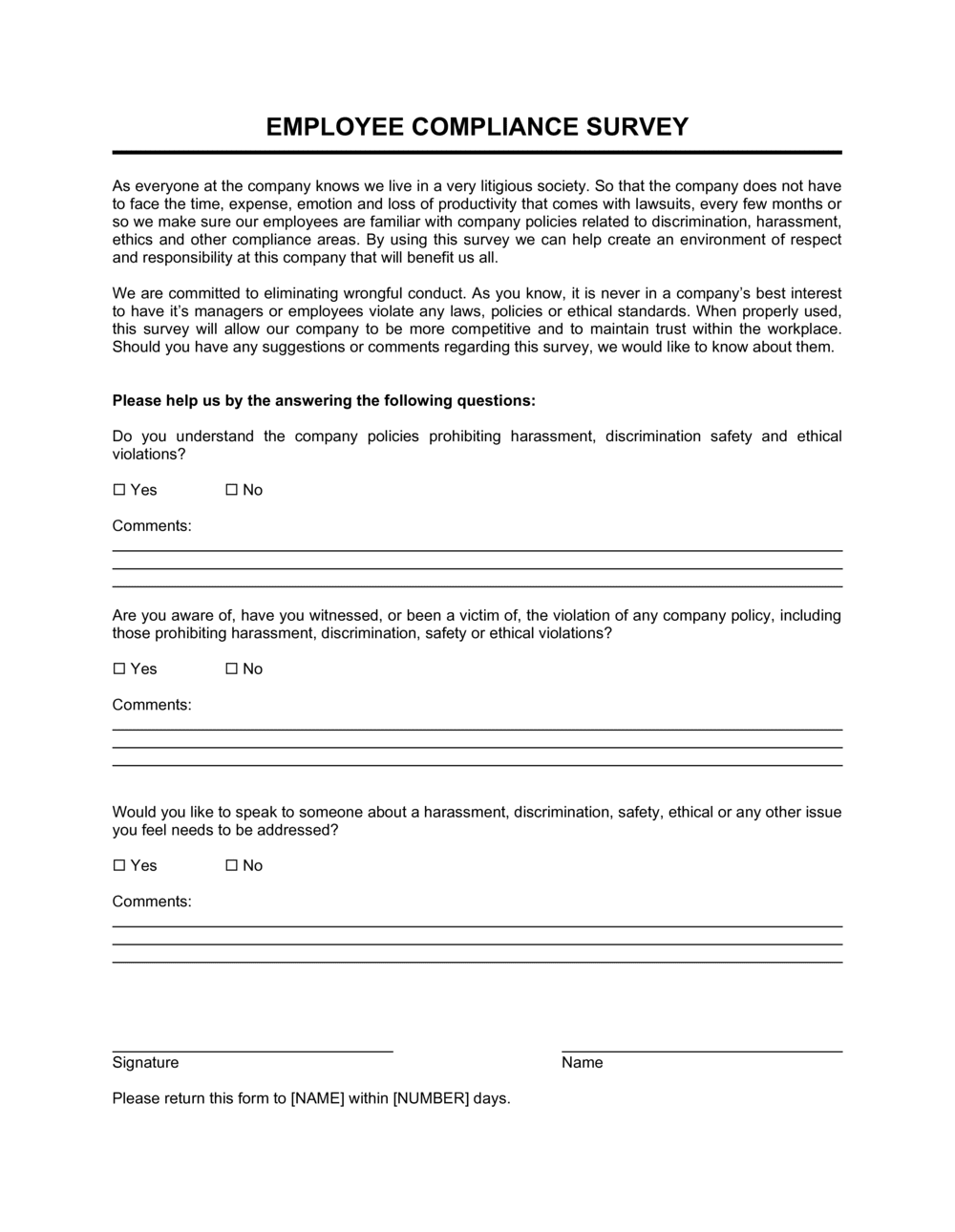
An Employee Compliance Survey is a formal document used by employers to collect signed acknowledgments from staff confirming they have read, understood, and agree to comply with applicable laws, regulations, and internal policies. This free Word download is editable online and exportable as PDF — structured to capture disclosures, conflicts of interest, policy acknowledgments, and employee attestations in a single defensible record.
When you need it
Use it during annual compliance reviews, onboarding cycles, or any time regulatory changes require documented employee acknowledgment. It is especially important in regulated industries where auditors or enforcement agencies require evidence that staff received, reviewed, and agreed to specific policies.
What's inside
Employee identification and role details, policy acknowledgment declarations, conflict-of-interest disclosures, ethics and code-of-conduct attestations, data protection and confidentiality confirmations, regulatory training certifications, and a signed employee attestation with date.

What is an Employee Compliance Survey?

An Employee Compliance Survey is a formal legal document used by employers to collect signed declarations from employees confirming that they have read, understood, and agree to comply with the company's applicable policies, regulations, and legal obligations. Unlike a simple policy acknowledgment form, a compliance survey consolidates multiple attestation categories into a single structured document — covering conflict-of-interest disclosures, anti-bribery certifications, data protection confirmations, mandatory training records, and whistleblower reporting awareness. The employee's dated signature transforms the survey from a questionnaire into a legally defensible acknowledgment record that can be produced in response to a regulatory inquiry, internal investigation, or litigation discovery request.

Why You Need This Document

Without a signed, versioned compliance survey on file, employers have no contemporaneous evidence that their workforce was informed of — and committed to — the legal obligations governing their roles. Regulators in financial services, healthcare, and data-heavy industries routinely request exactly this kind of documentation during audits, and the absence of records is treated as evidence of non-compliance, not merely an administrative gap. A single undocumented conflict of interest, an unacknowledged data protection policy, or a missing anti-bribery attestation can expose a business to enforcement action, fines, and reputational damage that far outweighs the cost of a 30-minute annual survey process. This template gives HR and compliance teams a structured, repeatable mechanism to close that gap — creating a retrievable, jurisdiction-specific record for every employee, every year.

Which variant fits your situation?

If your situation is…Use this template
Onboarding a new employee who must acknowledge all policies before startingNew Employee Compliance Acknowledgment
Annual workforce-wide compliance review with regulatory attestation requirementsAnnual Employee Compliance Survey
Documenting a specific conflict-of-interest disclosure onlyConflict of Interest Disclosure Form
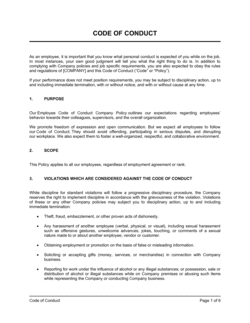
Collecting acknowledgment of a revised code of conduct after a policy updateCode of Conduct Acknowledgment Form
Confirming employee awareness of data protection and GDPR obligationsData Protection Policy Acknowledgment
Documenting completion of mandatory compliance training for an audit trailTraining Completion and Acknowledgment Form
Capturing ethics disclosures for executives and board members onlyExecutive Ethics Disclosure Statement

Common mistakes to avoid

❌ Distributing a generic survey without jurisdiction-specific regulatory references

Why it matters: A survey that names no governing law provides no documented evidence of compliance with specific regulations. Auditors in regulated industries require employees to acknowledge the actual statutes and rules that apply to their role.

Fix: Maintain a jurisdiction and role matrix, and pre-populate the correct regulatory citations for each employee cohort before distribution.

❌ Accepting blank disclosure fields instead of requiring an affirmative 'None'

Why it matters: A blank conflict-of-interest field creates an ambiguity — the employee may have misread the question or intentionally left it unanswered. Courts and regulators treat blanks differently from affirmative declarations.

Fix: Require every disclosure field to contain either specific information or the word 'None' before the survey is accepted as complete. Reject and return incomplete forms.

❌ Referencing policy titles without version numbers or effective dates

Why it matters: Policies are updated over time. Without a version number and date, it is impossible to prove in a dispute which policy an employee acknowledged — especially if the policy has since been revised.

Fix: Enter the policy title, version number, and effective date for every policy listed in the acknowledgment declaration, and attach or link the actual policy document.

❌ Collecting signed surveys but storing them in an inaccessible or unsecured location

Why it matters: A compliance survey that cannot be retrieved within a reasonable time during a regulatory inquiry or litigation provides no practical protection. Regulators treat failure to produce records as evidence of non-compliance.

Fix: Store executed surveys in a compliance management system or secure HR platform with role-based access controls and a documented retrieval process. Test retrieval speed annually.

❌ Running the compliance survey cycle once without annual renewal

Why it matters: A single survey from three years ago does not demonstrate ongoing compliance. Regulations change, policies are updated, and employee circumstances shift — regulators expect annual attestation cycles in most governed industries.

Fix: Schedule the survey as a recurring annual event tied to the fiscal or calendar year-end, with automated reminders and a hard deadline for completion.

❌ Omitting the employee attestation and signature clause

Why it matters: Without a signed attestation, the survey is a questionnaire — not a legal document. The signature transforms the employee's answers into a formal declaration that can be relied upon in disciplinary proceedings or regulatory defense.

Fix: Ensure every survey version ends with a dated signature block and an attestation statement that references the consequences of providing false information.

The 9 key clauses, explained

Employee Identification and Role Details

In plain language: Records the employee's full legal name, job title, department, reporting manager, and the date the survey is completed — establishing a clear audit trail.

Sample language
Full Name: [EMPLOYEE FULL NAME] | Job Title: [JOB TITLE] | Department: [DEPARTMENT] | Reports To: [MANAGER NAME] | Date Completed: [DATE]

Common mistake: Using a nickname or shortened name instead of the employee's legal name. When a dispute arises, the acknowledgment record must match payroll and HR system records exactly.

Policy Acknowledgment Declaration

In plain language: Confirms the employee has received, read, and understood the listed company policies — typically the employee handbook, code of conduct, and any industry-specific policy documents.

Sample language
I confirm that I have received, read, and understood the [COMPANY NAME] Employee Handbook (Version [X], dated [DATE]), the Code of Conduct, and the [POLICY NAME] Policy, and agree to comply with them in full.

Common mistake: Listing policy titles without version numbers or dates. If a policy is later updated and a dispute arises, it becomes impossible to confirm which version the employee acknowledged.

Conflict of Interest Disclosure

In plain language: Requires the employee to disclose any personal, financial, or business interests that could conflict with their duties — and to certify that no undisclosed conflicts exist.

Sample language
I confirm that I have no conflicts of interest to disclose, except as listed below. [DISCLOSURE OR 'NONE']. I understand that any new conflicts arising during my employment must be disclosed promptly to [COMPLIANCE CONTACT / HR].

Common mistake: Making the disclosure field optional. An employee who leaves it blank and later proves to have a conflict can claim they misunderstood the requirement — a mandatory 'None' checkbox eliminates this ambiguity.

Ethics and Anti-Bribery Attestation

In plain language: Confirms the employee has not offered, accepted, or facilitated any bribe, kickback, or improper payment and agrees to report any such activity going forward.

Sample language
I confirm that I have not offered, accepted, or facilitated any payment, gift, or benefit that constitutes bribery or a corrupt practice under applicable law, including [FCPA / UK Bribery Act / APPLICABLE LAW], and that I have reported any suspected violations to [COMPLIANCE OFFICER / HOTLINE].

Common mistake: Omitting a reference to the specific anti-bribery law applicable in the employee's jurisdiction. Generic 'no bribery' language provides weaker regulatory cover than a clause that names the governing statute.

Data Protection and Confidentiality Confirmation

In plain language: Confirms the employee has reviewed the company's data protection policy, understands their obligations under applicable privacy law, and has handled personal data only in authorized ways during the review period.

Sample language
I confirm that during the period [START DATE] to [END DATE], I have accessed, processed, and stored personal data only in accordance with [COMPANY NAME]'s Data Protection Policy and applicable law, including [GDPR / CCPA / APPLICABLE REGULATION].

Common mistake: Using a generic confidentiality statement that doesn't reference data protection law. Regulators treat data protection acknowledgments as distinct obligations — a single combined confidentiality clause does not satisfy GDPR or CCPA documentation requirements.

Regulatory Training Certification

In plain language: Documents which mandatory compliance training modules the employee completed during the review period, with dates of completion and confirmation of pass status.

Sample language
I confirm completion of the following mandatory training during [REVIEW PERIOD]: [TRAINING MODULE NAME] — completed [DATE] — [PASS/ATTENDED]; [TRAINING MODULE NAME] — completed [DATE] — [PASS/ATTENDED].

Common mistake: Collecting training acknowledgment verbally without a written record. Regulators auditing training compliance require contemporaneous written evidence — verbal or email-only confirmation is routinely rejected.

Reporting Obligations and Whistleblower Awareness

In plain language: Confirms the employee is aware of the company's reporting channels for ethics violations and legal breaches, and that they have not suppressed or failed to escalate a known compliance issue.

Sample language
I confirm that I am aware of [COMPANY NAME]'s reporting channels, including [HOTLINE / EMAIL / PORTAL], and that I have not knowingly suppressed or failed to report any compliance violation, regulatory breach, or suspected misconduct during [REVIEW PERIOD].

Common mistake: Omitting the whistleblower protection statement. Without it, employees may fear retaliation and choose not to disclose — defeating the purpose of the survey and creating regulatory exposure.

Outside Activities and Secondary Employment Disclosure

In plain language: Requires the employee to disclose any outside employment, board membership, or business interest that could create a conflict or compete with the employer's business.

Sample language
I confirm that I am not engaged in any outside employment, directorship, or business activity that conflicts with my duties at [COMPANY NAME], except as disclosed below: [DISCLOSURE OR 'NONE']. I understand prior written approval is required before accepting any such role.

Common mistake: Omitting secondary employment entirely from the survey. Employees running side businesses that compete with or divert resources from the employer represent a material compliance risk that a well-drafted survey should capture explicitly.

Employee Attestation and Signature

In plain language: The closing declaration in which the employee certifies — under penalty of disciplinary action — that all answers in the survey are truthful and complete to the best of their knowledge.

Sample language
I certify that the information provided in this survey is true, accurate, and complete to the best of my knowledge. I understand that providing false or misleading information may result in disciplinary action up to and including termination of employment. Signature: _______________ Date: _______________

Common mistake: No attestation clause at the end of the survey. Without it, the survey is a collection of answers with no formal commitment — removing the legal weight that makes the document defensible in an audit or dispute.

How to fill it out

  1. 1

    Insert the company name and review period

    Replace all [COMPANY NAME] and [REVIEW PERIOD] placeholders throughout the document before distributing. Every employee's completed copy must reference the same company entity name and the identical review period — mismatched dates across a batch of surveys create auditability problems.

    💡 Use a find-and-replace to update all instances at once before the template is distributed — stray placeholder text in a signed document undermines its credibility.

  2. 2

    List all policies the employee is acknowledging

    In the Policy Acknowledgment Declaration clause, enter each policy name, version number, and issue date. Confirm that the listed version is the currently effective one before distribution.

    💡 Attach hyperlinks or references to the actual policy documents so employees cannot later claim they couldn't access what they were asked to acknowledge.

  3. 3

    Tailor the regulatory references to the employee's jurisdiction and role

    Replace generic law references — [FCPA / UK Bribery Act / APPLICABLE LAW] — with the specific statutes that apply to the employee's location and job function. A customer service representative and a finance director face different regulatory obligations.

    💡 Maintain a jurisdiction matrix listing which regulations apply to which roles, and use it to pre-populate the correct statutory references before each survey cycle.

  4. 4

    Complete the regulatory training certification section

    Enter the names of all mandatory training modules the employee was required to complete during the review period, then have the employee fill in the completion dates and pass status. Cross-reference against your LMS records before the employee signs.

    💡 If an employee has not completed a required module, resolve the training gap before issuing the survey — allowing an incomplete training record to be signed creates a false compliance picture.

  5. 5

    Prompt conflict-of-interest and outside-activity disclosures

    Instruct employees to enter either specific disclosures or the word 'None' in each disclosure field. A blank field must not be acceptable — require an affirmative 'None' to prevent ambiguity during future reviews.

    💡 Send a reminder communication 48 hours before the survey deadline reminding employees that 'None' is a valid and required answer if they have nothing to disclose.

  6. 6

    Obtain a dated signature before the deadline

    Collect a handwritten or e-signature and a date on the Employee Attestation section. The signature date must fall within the declared review period. Retain the executed original in the employee's HR file.

    💡 Use Business in a Box eSign to capture a timestamped electronic signature — this creates an immutable audit record that is easier to retrieve during a regulatory inquiry than a scanned paper form.

  7. 7

    Archive completed surveys in a secure, retrievable location

    Store all executed surveys in a secure HR or compliance system with access controls. Index them by employee name, review period, and date signed so they can be retrieved within 24 hours of a regulatory request.

    💡 Retention requirements vary by jurisdiction — in the US, EEOC guidance suggests 1–3 years; in the EU, GDPR requires you to retain only as long as necessary for the stated purpose. Confirm the applicable retention period with legal counsel.

Frequently asked questions

What is an employee compliance survey?

An employee compliance survey is a formal document that employers use to collect signed acknowledgments from staff confirming they have read, understood, and agree to comply with applicable laws, regulations, and internal policies. It typically covers conflict-of-interest disclosures, ethics attestations, data protection confirmations, and regulatory training certifications. The signed survey creates a contemporaneous legal record that is used during audits, investigations, and regulatory inquiries to demonstrate that employees were informed of their obligations.

Is an employee compliance survey legally binding?

When properly drafted and executed, an employee compliance survey functions as a binding acknowledgment document. The employee's signed attestation that they have read and agreed to comply with stated policies and laws creates an enforceable record that can support disciplinary action, regulatory defense, and litigation. The document's weight depends on specificity — generic surveys with no policy version numbers or regulatory citations provide weaker legal protection than precisely drafted ones. Consider having legal counsel review the template for your specific jurisdiction and industry.

How often should an employee compliance survey be conducted?

Most regulated industries require or strongly recommend an annual compliance survey cycle. Financial services firms regulated by the SEC or FCA, healthcare organizations subject to HIPAA, and companies operating under GDPR all typically run annual attestation cycles tied to their calendar or fiscal year-end. Outside of regulated industries, a survey should be run whenever material policy changes occur, after a compliance incident, or at least once per year as a standard governance practice.

What is the difference between a compliance survey and a code of conduct acknowledgment?

A code of conduct acknowledgment is a single-purpose form confirming that an employee has read and agrees to the company's code of conduct. An employee compliance survey is broader — it captures acknowledgments across multiple policy areas simultaneously, including data protection, anti-bribery, conflict of interest, training completion, and reporting obligations. The survey consolidates what would otherwise require multiple separate forms into a single signed record.

Does a compliance survey need to be signed?

Yes — in the context of creating a legally defensible record, a signature is essential. An unsigned survey is a questionnaire; a signed one is a formal declaration. The signature, combined with an attestation clause confirming truthfulness and awareness of consequences, is what transforms the document into an enforceable compliance record. Electronic signatures are generally accepted in most jurisdictions under laws such as the US ESIGN Act, Canada's PIPEDA, the UK's Electronic Communications Act, and EU eIDAS regulation.

Who should complete an employee compliance survey?

All employees should complete a compliance survey, though the specific questions and regulatory references may differ by role. Frontline employees typically acknowledge general conduct policies and data protection obligations. Managers and senior staff may additionally need to disclose conflicts of interest, outside business activities, and sector-specific regulatory obligations. In regulated industries, certain certifications and disclosures are mandatory for all staff regardless of seniority.

Can I use an employee compliance survey during onboarding?

Yes — an onboarding compliance survey is a standard practice for establishing a baseline compliance record before an employee begins work. It typically covers initial acknowledgment of the employee handbook, code of conduct, data protection policy, and any role-specific regulatory obligations. A separate annual survey then captures re-acknowledgment as policies are updated and regulatory obligations evolve. Running both ensures there is no gap in the compliance record.

What happens if an employee refuses to complete or sign the compliance survey?

Refusal to complete a mandatory compliance survey is typically treated as a disciplinary matter under the employee's contract and the company's HR policies. In regulated industries, failure to obtain a signed compliance acknowledgment from a specific employee may itself constitute a reportable breach. The attestation clause in the survey should make clear that completion is a condition of continued employment, and the survey distribution process should include a documented deadline and follow-up procedure for non-completions.

How long should completed compliance surveys be retained?

Retention requirements vary by jurisdiction and industry. In the US, general employment records are typically retained for 3–7 years depending on the applicable regulation; financial services firms may face longer requirements under SEC Rule 17a-4. In the EU, GDPR requires that personal data — including HR records — be retained only as long as necessary for the stated purpose, but industry-specific rules may impose minimum periods. Consult legal counsel to establish a retention schedule that satisfies all applicable obligations in your operating jurisdictions.

What industries most commonly require employee compliance surveys?

Financial services, healthcare, pharmaceuticals, government contracting, legal and professional services, and any industry subject to anti-bribery laws — such as the FCPA or UK Bribery Act — most commonly mandate formal compliance surveys. However, growing regulatory pressure around data protection (GDPR, CCPA), anti-discrimination, and workplace safety means that compliance surveys are increasingly standard across all industries regardless of sector-specific regulation.

How this compares to alternatives

vs Code of Conduct Acknowledgment Form

A code of conduct acknowledgment is a single-purpose form confirming the employee has read and agreed to the company's behavioral standards. An employee compliance survey is broader — it consolidates acknowledgments across data protection, anti-bribery, conflict of interest, training, and reporting obligations into one signed document. Use the acknowledgment form for a targeted policy rollout; use the survey for an annual multi-policy compliance cycle.

vs Conflict of Interest Disclosure Form

A conflict of interest disclosure form is dedicated to a single category of compliance — identifying and documenting personal or financial interests that could impair an employee's judgment. The compliance survey includes a conflict-of-interest section alongside several other attestation categories. Use the standalone form when a specific conflict requires immediate disclosure outside the annual review cycle.

vs Employee Handbook Acknowledgment

An employee handbook acknowledgment confirms receipt and review of the full handbook as a single document. An employee compliance survey references specific policy versions across multiple compliance domains and adds disclosure questions and training certifications. The handbook acknowledgment is appropriate at onboarding; the compliance survey is the ongoing annual governance mechanism.

vs Employment Contract

An employment contract establishes the binding legal relationship between employer and employee at the outset — covering duties, compensation, IP, and termination. An employee compliance survey is an ongoing acknowledgment instrument used throughout the employment relationship to document regulatory awareness and policy adherence. The contract creates the obligation; the compliance survey documents its continuing performance.

Industry-specific considerations

Financial Services

Annual attestation requirements under SEC, FINRA, and FCA rules covering insider trading policies, MNPI handling, gifts and entertainment limits, and personal account dealing declarations.

Healthcare

HIPAA privacy and security rule acknowledgments, patient data handling confirmations, and anti-kickback statute attestations are required annually for clinical and administrative staff.

Professional Services

Conflict-of-interest disclosures are especially critical in law, accounting, and consulting firms where client relationships create ongoing independence and ethics obligations.

Manufacturing

Anti-bribery and supply-chain compliance attestations under FCPA and UK Bribery Act, combined with health and safety policy acknowledgments, are standard for procurement and operations staff.

Technology / SaaS

Data protection and GDPR/CCPA policy acknowledgments, acceptable-use-of-systems confirmations, and IP assignment reminders are the most common compliance survey elements in tech companies.

Government Contracting

FAR and DFARS compliance acknowledgments, ethics and anti-corruption certifications, and classified information handling confirmations are required by contract terms and federal regulation.

Jurisdictional notes

United States

Federal regulations including FCPA, SOX, HIPAA, and FINRA rules require documented employee acknowledgments in regulated industries. State privacy laws — particularly California's CCPA and CPRA — add data protection acknowledgment requirements for employers operating in California. The NLRA limits the scope of certain policy acknowledgments for non-supervisory employees; overly broad conduct policies may be challenged as interfering with protected concerted activity.

Canada

Federal PIPEDA and provincial privacy laws — including Quebec's Law 25 (Bill 64) — require employers to document that employees handling personal data understand their obligations. Quebec's Law 25 imposes some of the strictest privacy requirements in North America and mandates documented training and acknowledgment for staff with access to personal information. Employment standards vary by province; legal counsel should review the survey to confirm compliance with applicable provincial requirements.

United Kingdom

The UK Bribery Act 2010 imposes a strict liability offense on companies that fail to prevent bribery — documented annual compliance surveys with anti-bribery attestations are a key component of the 'adequate procedures' defense. UK GDPR requires documented evidence that employees handling personal data have received appropriate training and have acknowledged their data protection obligations. The Financial Conduct Authority requires annual attestations from staff in controlled and senior management functions.

European Union

GDPR Article 5 accountability obligations require employers to demonstrate active compliance — employee acknowledgment records form part of this evidence base. The EU Whistleblower Protection Directive (2019/1937), implemented in member states by December 2023, requires companies with 50 or more employees to establish formal reporting channels and document employee awareness of them. Anti-bribery acknowledgments should reference the applicable national law (e.g., the French Sapin II law, the German Criminal Code) rather than relying on a generic anti-corruption statement.

Template vs lawyer — what fits your deal?

PathBest forCostTime
Use the templateSMEs and non-regulated businesses running standard annual compliance acknowledgment cyclesFree30–60 minutes to configure and distribute
Template + legal reviewCompanies in regulated industries, multi-jurisdiction workforces, or those with sector-specific attestation requirements$300–$800 for a legal review of the customized template2–5 business days
Custom draftedFinancial services, healthcare, or government contractors with complex multi-regulatory environments and hundreds of employees$1,500–$5,000+1–3 weeks

Glossary

Compliance Attestation
A signed declaration by an employee confirming they have read, understood, and agree to abide by specific policies or legal requirements.
Conflict of Interest
A situation in which an employee's personal interests — financial, relational, or otherwise — could impair their ability to act in the employer's best interest.
Code of Conduct
A written set of behavioral standards and ethical expectations that employees are required to follow in the workplace.
Material Non-Public Information (MNPI)
Confidential information about a publicly traded company that has not yet been disclosed to the market and that could influence an investor's decision — relevant in financial services compliance surveys.
Whistleblower Protection
Legal protections that prevent employers from retaliating against employees who report compliance violations, regulatory breaches, or unethical conduct in good faith.
Data Subject
Any individual whose personal data is collected, stored, or processed — a term central to GDPR and similar data protection regulations that employees may be asked to acknowledge in a compliance survey.
Anti-Bribery and Corruption (ABC) Policy
An internal policy prohibiting employees from offering, receiving, or facilitating bribes, kickbacks, or corrupt payments — often requiring annual attestation under laws like the UK Bribery Act or FCPA.
Due Diligence
The process of investigating and verifying information to ensure legal, financial, and regulatory compliance before taking a business action.
Regulatory Obligation
A legally mandated requirement imposed on a business or its employees by a government body, industry regulator, or enforcement agency.
Acknowledgment Record
A retained, signed copy of a completed compliance survey or policy acknowledgment form used as evidence during audits, litigation, or regulatory inquiries.
Safe Harbor
A legal provision that protects a party from liability when they have acted in good faith and met specified procedural requirements — relevant where employee attestation creates a documented defense.
Policy Refresh Cycle
The scheduled interval — typically annual — at which all employees are required to re-read and re-acknowledge updated workplace policies and compliance obligations.

Part of your Business Operating System

This document is one of 3,000+ business & legal templates included in Business in a Box.

  • Fill-in-the-blanks — ready in minutes
  • 100% customizable Word document
  • Compatible with all office suites
  • Export to PDF and share electronically

Create your document in 3 simple steps.

From template to signed document — all inside one Business Operating System.
1
Download or open template

Access over 3,000+ business and legal templates for any business task, project or initiative.

2
Edit and fill in the blanks with AI

Customize your ready-made business document template and save it in the cloud.

3
Save, Share, Send, Sign

Share your files and folders with your team. Create a space of seamless collaboration.

Save time, save money, and create top-quality documents.

★★★★★

"Fantastic value! I'm not sure how I'd do without it. It's worth its weight in gold and paid back for itself many times."

Managing Director · Mall Farm
Robert Whalley
Managing Director, Mall Farm Proprietary Limited
★★★★★

"I have been using Business in a Box for years. It has been the most useful source of templates I have encountered. I recommend it to anyone."

Business Owner · 4+ years
Dr Michael John Freestone
Business Owner
★★★★★

"It has been a life saver so many times I have lost count. Business in a Box has saved me so much time and as you know, time is money."

Owner · Upstate Web
David G. Moore Jr.
Owner, Upstate Web

Run your business with a system — not scattered tools

Stop downloading documents. Start operating with clarity. Business in a Box gives you the Business Operating System used by over 250,000 companies worldwide to structure, run, and grow their business.

Free Forever Plan · No credit card required