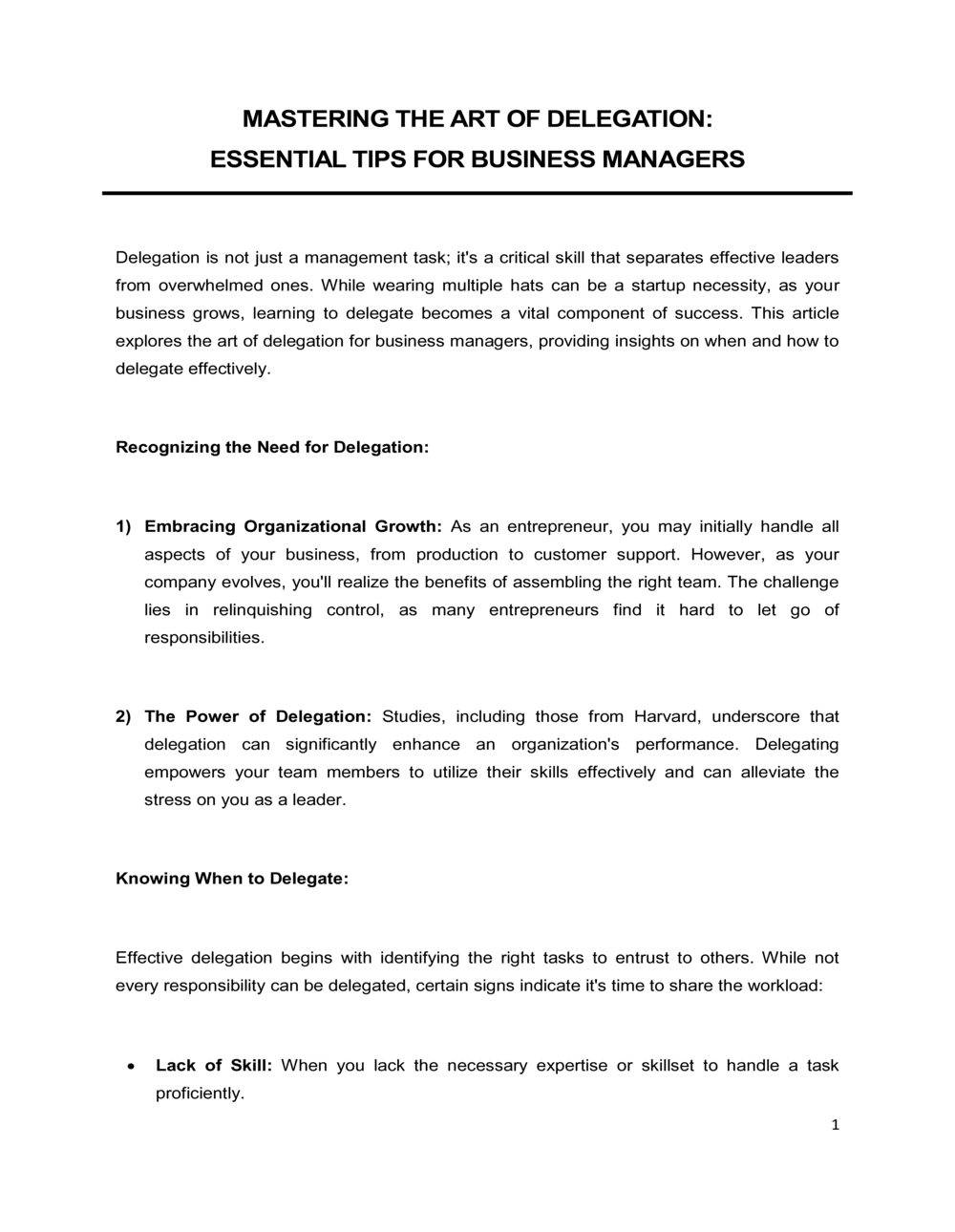
Delegation Tips For Business Managers

Free to read β€’ Save or share with one click

FreeDelegation Tips For Business Managers Template

At a glance

What it is
Delegation Tips for Business Managers is a structured Word document that formalizes how managers assign tasks, transfer authority, and establish accountability chains within an organization. This free download gives managers a ready-to-edit framework covering scope of authority, task ownership, reporting obligations, and performance benchmarks β€” all in a single signed document you can tailor to any role, department, or project.
When you need it
Use it when onboarding a new team lead, restructuring reporting lines, assigning project ownership to a direct report, or creating a formal record of authority transfer that HR and legal can reference in performance or liability disputes.
What's inside
Scope of delegated authority, task and deliverable definitions, reporting and escalation protocols, performance benchmarks, time boundaries, liability and accountability clauses, and signatures from both the delegating manager and the delegate.

What is a Delegation Tips for Business Managers Document?

A Delegation Tips for Business Managers document is a formally structured, signed agreement that records the transfer of specific decision-making authority from a manager to a direct report β€” defining exactly what the delegate is authorized to do, to what limit, for how long, and under what reporting obligations. It transforms verbal task handoffs into an enforceable internal record that both parties can reference if accountability, performance, or liability questions arise. The document covers scope of authority, deliverable definitions, escalation protocols, performance benchmarks, and a mutual acknowledgment that the delegate accepts the obligations attached to the transferred authority.

Why You Need This Document

Without a written delegation record, authority gaps and overreach occur predictably and expensively. Delegates interpret informal handoffs as broader permission than intended; managers assume subordinates will escalate decisions they are actually resolving independently; and when something goes wrong, neither party has a signed document establishing who was authorized to do what. The consequences range from unauthorized financial commitments and vendor disputes to HR grievances and regulatory exposure in industries where documented authority chains are legally required. A properly executed delegation document protects the manager by establishing the limits of transferred authority, protects the delegate by confirming what they are expressly permitted to do, and gives HR and legal a clear record for any subsequent review. This template provides the complete structure in a free Word download you can edit, sign, and file in under an hour.

Which variant fits your situation?

If your situation is…Use this template
Delegating financial signing authority above a set dollar thresholdDelegation of Authority Policy
Transferring full management responsibility during a leave of absenceActing Manager Authorization Letter
Assigning a specific project to a team lead with defined deliverablesProject Charter
Documenting a direct report's new expanded responsibilities permanentlyJob Description Update
Establishing cross-departmental task ownership for a recurring processStandard Operating Procedure (SOP)
Setting performance expectations tied to delegated tasksPerformance Improvement Plan
Delegating vendor management authority to a procurement leadVendor Management Policy

Common mistakes to avoid

❌ Delegating authority without defined limits

Why it matters: A delegate with no stated ceiling will make decisions at whatever level feels natural to them. Organizations have faced six-figure unauthorized commitments because a scope clause said what the delegate could do but not how much they could spend.

Fix: Every authority category β€” budget, hiring, contracts, vendor approvals β€” must carry an explicit numeric or procedural ceiling in the scope clause.

❌ Open-ended delegation with no expiry date

Why it matters: Undated delegations drift into de facto permanent authority transfers. When the business needs to revoke or restructure, the delegate can credibly claim the arrangement was ongoing and disputes arise.

Fix: Set a specific end date or tie the delegation's termination to a defined milestone, and include a revocation clause giving the manager the right to withdraw authority with written notice.

❌ Signing after the delegate has already started acting

Why it matters: In common-law jurisdictions, obligations accepted after the fact raise enforceability questions β€” particularly around liability allocation and accountability clauses. A delegate who has already been operating under assumed authority has given nothing new by signing later.

Fix: Execute the delegation document before or on the effective date. If the arrangement predates the document, add a recitals clause acknowledging the prior conduct and confirming the written terms govern going forward.

❌ No escalation protocol or reporting cadence

Why it matters: Without structured reporting, managers lose visibility until problems are too large to fix quietly. The absence of an escalation trigger also means delegates resolve disputes or overruns independently, which compounds liability exposure.

Fix: State the reporting frequency and list at least three specific escalation triggers with response time obligations. Review the first two status reports personally to calibrate expectations.

❌ Assuming employment confidentiality clauses cover delegation-period data access

Why it matters: Delegation grants access to information the delegate would not normally see β€” budget data, personnel records, vendor contracts. General employment confidentiality clauses do not always specify this scope.

Fix: Include a delegation-specific confidentiality clause identifying the categories of information accessed and the permitted use, even if it cross-references the employment contract.

❌ Omitting the delegate's signature

Why it matters: A document signed only by the manager proves the authority was granted but does not prove the delegate accepted the associated obligations and limitations. In a disciplinary or liability dispute, this gap is significant.

Fix: Require the delegate's signature alongside the manager's, and consider having HR witness both. Route a copy to the delegate immediately so they cannot claim they never received the terms.

The 10 key clauses, explained

Parties and role identification

In plain language: Identifies the delegating manager and the delegate by full name, title, and department, establishing who is granting authority and who is receiving it.

Sample language
This Delegation Agreement is entered into between [MANAGER FULL NAME], [TITLE], [DEPARTMENT] ('Manager'), and [DELEGATE FULL NAME], [TITLE], [DEPARTMENT] ('Delegate'), effective [DATE].

Common mistake: Using job titles alone without legal names. If the named titleholder changes, the document becomes ambiguous and unenforceable in a dispute.

Scope of delegated authority

In plain language: Defines precisely what decisions, approvals, and actions the delegate is authorized to take β€” and equally important, what remains outside their authority.

Sample language
Delegate is authorized to approve purchase orders up to $[AMOUNT], manage vendor communications for [PROJECT/DEPARTMENT], and execute [SPECIFIC TASK]. Delegate may not enter contracts exceeding $[THRESHOLD] or make hiring decisions without prior written approval from Manager.

Common mistake: Defining only what the delegate can do without stating explicit limits. Ambiguous ceilings lead to delegates overstepping and managers losing accountability.

Task and deliverable definitions

In plain language: Lists each specific task, project, or responsibility being delegated with measurable outputs and deadlines.

Sample language
Delegate shall complete the following: (1) [TASK DESCRIPTION] by [DATE], resulting in [DELIVERABLE]; (2) [TASK DESCRIPTION] by [DATE], resulting in [DELIVERABLE]. All deliverables must meet the acceptance criteria set out in Schedule A.

Common mistake: Listing tasks without attaching acceptance criteria. Without measurable output definitions, performance disputes become subjective and unresolvable.

Reporting and escalation protocol

In plain language: Establishes how often the delegate reports progress, what format updates take, and the exact conditions that trigger escalation back to the manager.

Sample language
Delegate shall provide Manager with a written status update every [FREQUENCY]. Any matter exceeding Delegate's authority, involving a third-party dispute, or carrying a budget impact above $[AMOUNT] must be escalated to Manager within [X] business hours of identification.

Common mistake: No defined escalation trigger. Delegates interpret this as permission to handle everything independently, which exposes the organization to unauthorized commitments.

Performance benchmarks

In plain language: States the measurable standards against which the delegate's performance of delegated tasks will be evaluated.

Sample language
Delegate's performance shall be assessed against the following benchmarks: [BENCHMARK 1 β€” e.g., project delivered within 5% of budget], [BENCHMARK 2 β€” e.g., vendor response time under 24 hours], [BENCHMARK 3 β€” e.g., team satisfaction score above 80%].

Common mistake: Setting qualitative benchmarks like 'satisfactory performance.' Without numbers, managers cannot objectively assess whether the delegation succeeded or justify corrective action.

Time boundaries and review period

In plain language: Specifies the start and end dates of the delegation, any renewal conditions, and a scheduled review point to reassess the arrangement.

Sample language
This delegation is effective from [START DATE] to [END DATE]. A formal review will occur on [REVIEW DATE]. The arrangement may be extended by mutual written agreement or terminated by Manager on [X] business days' written notice.

Common mistake: Open-ended delegations with no expiry date. These drift into permanent authority transfers that are never reviewed and cannot be cleanly revoked.

Accountability and liability allocation

In plain language: Clarifies which party retains ultimate accountability for outcomes and how liability is allocated between the manager and delegate for errors or unauthorized actions.

Sample language
Manager retains ultimate accountability for outcomes within the delegated scope. Delegate accepts personal accountability for any action taken in excess of the authority granted herein. Actions taken outside the defined scope may be treated as unauthorized and subject to [DISCIPLINARY / LEGAL CONSEQUENCE].

Common mistake: Assuming delegation transfers all liability to the subordinate. Courts and HR tribunals consistently hold the delegating manager accountable for foreseeable outcomes of poorly scoped delegation.

Confidentiality and information handling

In plain language: Restricts the delegate's use of sensitive information accessed during the delegation period and aligns with the organization's existing confidentiality policy.

Sample language
Delegate shall treat all confidential business information, personnel data, and financial records accessed in connection with this delegation as strictly confidential and shall not disclose such information to any third party without prior written consent from Manager or [AUTHORIZED TITLE].

Common mistake: Omitting confidentiality obligations on the assumption that the employment contract covers it. Delegation-specific confidentiality language reinforces what data the delegate accessed and for what purpose.

Revocation and modification

In plain language: Gives the manager the right to withdraw or modify the delegation at any time, subject to a defined notice period.

Sample language
Manager may revoke or modify this delegation at any time by providing [X] business days' written notice to Delegate. Upon revocation, Delegate shall immediately transfer all relevant records, accounts, and pending matters to Manager or a designated successor.

Common mistake: No revocation clause at all. Without one, a delegate can argue the authority was permanent, complicating disciplinary action or organizational restructuring.

Signatures and acknowledgment

In plain language: Records the date of signing by both parties, confirming the delegate has read and accepted the terms and that the manager has authorized the arrangement.

Sample language
By signing below, Manager confirms the delegated authority described herein is formally granted, and Delegate confirms they have read, understood, and accepted the obligations and limitations of this arrangement. Manager: [SIGNATURE / DATE]. Delegate: [SIGNATURE / DATE]. Witnessed by: [HR REPRESENTATIVE NAME / TITLE / DATE].

Common mistake: Obtaining only the manager's signature. Without the delegate's signature, the document proves authority was granted but not that the delegate accepted its terms and limitations.

How to fill it out

  1. 1

    Identify the parties and effective date

    Enter the full legal names, job titles, and departments of both the delegating manager and the delegate. Set the effective date to the first day the delegation takes effect.

    πŸ’‘ Use the employee's name exactly as it appears in HR records to avoid ambiguity if the document is referenced in a personnel dispute.

  2. 2

    Define the scope of authority with explicit ceilings

    List every category of decision the delegate is authorized to make, and state a specific dollar threshold, headcount limit, or approval level above which they must escalate. Both the permissions and the limits are equally important.

    πŸ’‘ Draft the limits first β€” this forces clarity on where delegation ends before you enumerate what it includes.

  3. 3

    Attach a Schedule A for detailed tasks and deliverables

    Move granular task descriptions, output specifications, and deadlines into a Schedule A rather than the main body. This keeps the contract readable and lets you update task details without amending the core document.

    πŸ’‘ Each deliverable in Schedule A should answer three questions: what is it, how will it be measured, and when is it due.

  4. 4

    Set the reporting cadence and escalation triggers

    Define how frequently the delegate provides written updates (weekly, bi-weekly, or at project milestones) and list the specific conditions β€” budget overrun, third-party dispute, scope change β€” that require immediate escalation.

    πŸ’‘ Tie escalation triggers to dollar amounts and time thresholds, not subjective judgments. 'Significant issue' means nothing; 'any single expense exceeding $5,000' is actionable.

  5. 5

    Enter performance benchmarks

    Write at least three quantifiable benchmarks the delegate must meet. Pull these from existing KPIs for the role or derive them from the project's success criteria.

    πŸ’‘ Benchmarks that mirror existing performance review criteria make it easier to fold delegation results into the annual review cycle.

  6. 6

    Set start date, end date, and review point

    Enter a specific start and end date for the delegation period. Add a mid-point review date where both parties formally assess whether the scope, authority, or benchmarks need adjusting.

    πŸ’‘ For project-based delegations, tie the end date to a deliverable completion event rather than a calendar date β€” this prevents the arrangement from expiring before the work is done.

  7. 7

    Have both parties sign before delegation begins

    Obtain the delegate's signature before the effective date β€” not after they have already been operating under the assumed authority. Route a copy to HR for the personnel file.

    πŸ’‘ Consider having an HR representative witness the signing. This creates a neutral record if the delegate later disputes the scope of their authority.

  8. 8

    Schedule the formal review and file the document

    Calendar the review date immediately after signing. Store the executed document in the employee's HR file and a shared management folder accessible to the delegate.

    πŸ’‘ A missed review date is the most common reason delegations drift β€” set a calendar reminder the day you file the document.

Frequently asked questions

What is a delegation document for business managers?

A delegation document for business managers is a formal written record that transfers specific decision-making authority from a manager to a subordinate for a defined scope of tasks, a set time period, and within stated limits. It replaces informal verbal handoffs with a signed agreement that both parties can reference if accountability or liability questions arise. It also creates a structured record for HR, auditors, and legal counsel.

Why should delegation be documented in writing?

Undocumented delegation creates three compounding risks: the delegate acts beyond the intended authority, the manager loses visibility into decisions being made in their name, and disputes about who was responsible for an outcome have no written reference point. A signed delegation document eliminates ambiguity on all three fronts and gives both parties a clear, enforceable record of what was agreed.

Is a delegation document legally binding?

A properly executed delegation document is generally enforceable as an internal employment agreement when it meets the basic elements of a binding contract β€” identified parties, defined obligations, consideration (the role and compensation already in place), and mutual signatures. However, it does not override statutory employment rights or supersede the employee's primary employment contract. Consider having legal counsel review it when delegating significant financial or legal authority.

What is the difference between delegation and abdication?

Delegation transfers authority for specific tasks while the manager retains oversight through reporting requirements, escalation protocols, and defined benchmarks. Abdication occurs when a manager assigns responsibility without maintaining any visibility or accountability structure β€” effectively abandoning the oversight role entirely. This document is specifically designed to formalize delegation, not abdication, by requiring regular reporting and explicit escalation triggers.

What should the scope of authority clause include?

The scope clause should identify every category of decision the delegate can make independently β€” vendor approvals, purchase orders, team scheduling, client communications β€” and attach a specific ceiling to each. Dollar thresholds, headcount limits, and approval tiers are the most common ceiling types. The clause should also explicitly state what falls outside the delegate's authority to prevent ambiguity at the margins.

How long should a delegation arrangement last?

The duration depends on the purpose. Project-based delegations should run from the start date to the deliverable completion milestone, typically 4–12 weeks. Standing operational delegations β€” such as budget approval authority for a team lead β€” are best structured as 6–12 month renewable arrangements with a formal mid-period review. Open-ended delegations with no defined end date are consistently the source of authority disputes and should be avoided.

Who should sign a delegation document?

Both the delegating manager and the delegate must sign. The manager's signature confirms the authority has been formally granted; the delegate's signature confirms they have read, understood, and accepted the scope and limitations. Having an HR representative witness the signing creates a neutral record and ensures a copy is filed in both the manager's and delegate's personnel files.

Can a manager delegate authority they don't have themselves?

No. A fundamental principle of delegation is that you can only transfer authority you actually hold. A manager cannot grant a delegate signing authority above their own approval threshold, or authorize actions that require board or executive approval. Attempting to do so creates unauthorized commitments that the organization is not bound to honor and exposes the manager to disciplinary or personal liability.

What happens if a delegate acts outside their delegated authority?

Actions taken outside the defined scope are typically treated as unauthorized and may expose the delegate to disciplinary action up to and including termination, depending on the severity and the terms of the document. The organization may also be able to disclaim the unauthorized commitment to third parties. The accountability and revocation clauses in a properly drafted delegation document provide the procedural basis for both disciplinary action and contract disavowal in most jurisdictions.

How this compares to alternatives

vs Standard Operating Procedure (SOP)

An SOP documents how a recurring process should be performed β€” it is a process reference guide, not an authority transfer document. A delegation document formally assigns who holds authority for a specific scope and period. Use an SOP to define the process and a delegation document to record who is authorized to execute it.

vs Project Charter

A project charter defines the goals, scope, stakeholders, and resources of a specific project. A delegation document defines who holds authority and accountability within that project structure. Both are often used together: the charter sets the project parameters; the delegation document formalizes which team members have authority to act within them.

vs Power of Attorney

A power of attorney is a formal legal instrument granting one party the authority to act on behalf of another in legal and financial matters, and is enforceable against third parties. A delegation document is an internal employment governance record that defines authority within the organization but does not carry the same external legal weight. Use a power of attorney when the delegate must bind the organization in third-party contracts or legal proceedings.

vs Performance Improvement Plan

A performance improvement plan addresses documented underperformance with corrective action goals and a review timeline. A delegation document is proactive β€” it structures a new or expanded authority arrangement from the outset. If a delegation arrangement fails, a PIP may follow, but the two documents serve entirely different purposes and neither replaces the other.

Industry-specific considerations

Professional Services

Partners formally delegate client relationship management and billing authority to senior associates during high-volume periods or partner absences, with explicit client communication limits.

Construction and Trades

Site managers delegate materials procurement and subcontractor coordination to foremen with defined purchase order thresholds and daily reporting obligations tied to project milestones.

Healthcare

Clinical managers delegate administrative approvals and scheduling authority to charge nurses, with escalation protocols tied to patient safety thresholds and regulatory compliance requirements.

Retail and E-commerce

Store or operations managers delegate inventory ordering, staff scheduling, and vendor communications to department leads with clear spending caps and same-day escalation requirements for stockouts.

Technology / SaaS

Engineering managers delegate sprint planning authority and vendor API approvals to tech leads, with escalation triggers tied to security, compliance, or budget impact thresholds.

Financial Services

Compliance and operations managers delegate transaction approval and client onboarding authority within tightly defined regulatory limits, with mandatory same-day escalation for anything that triggers AML or KYC review.

Jurisdictional notes

United States

No federal law mandates written delegation documents, but signed authority records are essential evidence in employment disputes, wage-and-hour misclassification claims, and unauthorized-commitment litigation. State agency law governs when a delegate can bind the organization to third parties β€” scope and authority limits in the document directly affect enforceability. California and New York courts scrutinize authority scope particularly closely in employment disputes.

Canada

Canadian employment law holds organizations accountable for actions taken by employees within their apparent authority, regardless of internal delegation limits. Clear written scope clauses are critical to establishing the boundaries of apparent authority under common-law agency principles. Quebec's Civil Code applies distinct agency rules for provincially regulated employers, and French-language requirements apply to workplace documents for employees working in Quebec.

United Kingdom

Under UK employment and agency law, an organization can be bound by a delegate's actions if a third party reasonably believed the delegate had authority β€” making written scope limits especially important for external-facing roles. GDPR and UK data protection law impose specific obligations when a delegate accesses personal data; the confidentiality clause should reference the organization's data protection policy explicitly. The Employment Rights Act 1996 affects disciplinary consequences for unauthorized actions.

European Union

EU member states vary significantly in how they regulate internal employment authority structures, but GDPR is consistent across all: any delegation that grants access to personal data must be documented, purpose-limited, and aligned with the organization's data processing records. Works council or employee representative consultation may be required before implementing formal delegation policies in Germany, France, and the Netherlands. Employment contracts in most EU jurisdictions limit unilateral changes to role scope without employee consent.

Template vs lawyer β€” what fits your deal?

PathBest forCostTime
Use the templateManagers delegating operational or project authority to direct reports in straightforward domestic rolesFree20–30 minutes
Template + legal reviewDelegations involving financial signing authority, sensitive personnel data, or cross-departmental accountability$200–$500 for an HR or employment law review1–3 days
Custom draftedExecutive-level authority transfers, regulated industries, or delegations with material third-party liability exposure$800–$2,500+1–2 weeks

Glossary

Delegation of Authority
The formal transfer of decision-making power from a manager to a subordinate for a defined scope of tasks or responsibilities.
Accountability Chain
The documented line of responsibility from the person performing a task back to the manager or executive who ultimately owns the outcome.
Scope of Authority
The boundaries within which a delegate may act independently β€” covering budget limits, personnel decisions, and approval thresholds.
Escalation Protocol
The defined process a delegate must follow when a situation exceeds their delegated authority and requires a senior decision.
Deliverable
A specific, measurable output the delegate is responsible for producing by a stated deadline as part of the delegation arrangement.
Span of Control
The number of direct reports or task owners a manager oversees β€” a key factor in determining how much to delegate and to whom.
RACI Matrix
A responsibility-assignment framework labeling each task as Responsible, Accountable, Consulted, or Informed β€” used to prevent authority gaps and overlaps.
Upward Delegation
When a subordinate redirects a decision back to their manager rather than acting within their delegated authority β€” a pattern this document is designed to prevent.
Performance Benchmark
A quantifiable standard used to evaluate whether the delegate has successfully fulfilled the delegated responsibility.
Residual Liability
The portion of legal or operational responsibility retained by the delegating manager even after authority has been formally transferred to a subordinate.

Part of your Business Operating System

This document is one of 3,000+ business & legal templates included in Business in a Box.

  • Fill-in-the-blanks β€” ready in minutes
  • Compatible with all office suites
  • Export to PDF and share electronically

Create your document in 3 simple steps.

From template to signed document β€” all inside one Business Operating System.
1
Download or open template

Access over 3,000+ business and legal templates for any business task, project or initiative.

2
Edit and fill in the blanks with AI

Customize your ready-made business document template and save it in the cloud.

3
Save, Share, Send, Sign

Share your files and folders with your team. Create a space of seamless collaboration.

Save time, save money, and create top-quality documents.

β˜…β˜…β˜…β˜…β˜…

"Fantastic value! I'm not sure how I'd do without it. It's worth its weight in gold and paid back for itself many times."

Managing Director Β· Mall Farm
Robert Whalley
Managing Director, Mall Farm Proprietary Limited
β˜…β˜…β˜…β˜…β˜…

"I have been using Business in a Box for years. It has been the most useful source of templates I have encountered. I recommend it to anyone."

Business Owner Β· 4+ years
Dr Michael John Freestone
Business Owner
β˜…β˜…β˜…β˜…β˜…

"It has been a life saver so many times I have lost count. Business in a Box has saved me so much time and as you know, time is money."

Owner Β· Upstate Web
David G. Moore Jr.
Owner, Upstate Web

Run your business with a system β€” not scattered tools

Stop downloading documents. Start operating with clarity. Business in a Box gives you the Business Operating System used by over 250,000 companies worldwide to structure, run, and grow their business.

Start freeΒ Β·Β No credit card required