Deed In Lieu of Foreclosure Template

Free Word download • Edit online • Save & share with Drive • Export to PDF

1 page20–30 min to fillDifficulty: StandardSignature requiredLegal review recommended
Learn more ↓
FreeDeed In Lieu of Foreclosure Template

At a glance

What it is
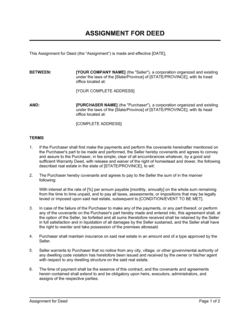
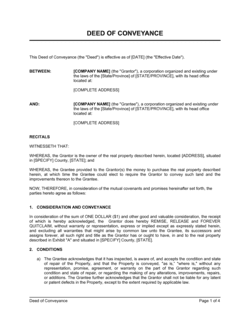
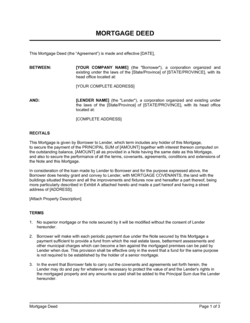
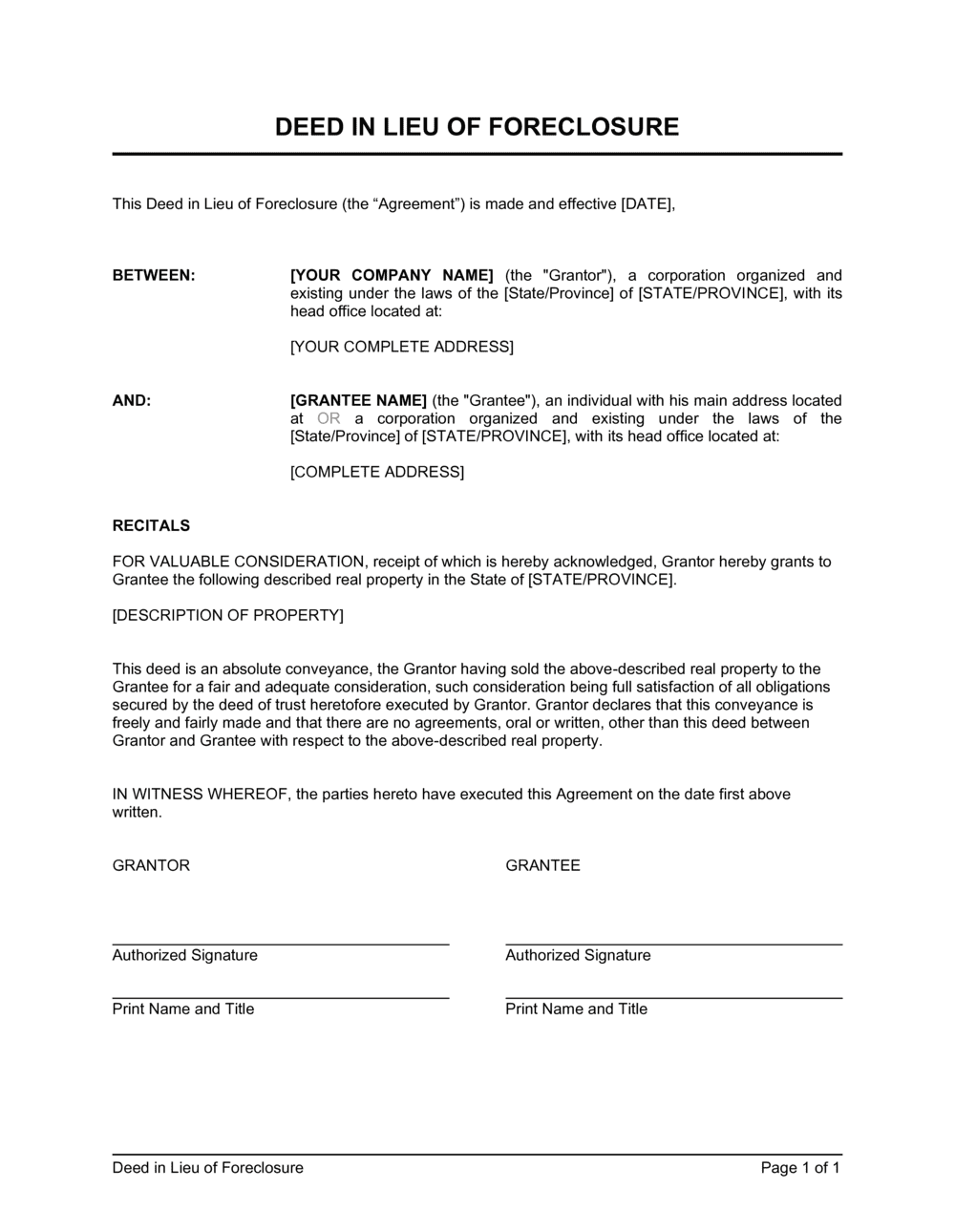
A Deed In Lieu Of Foreclosure is a legally binding agreement in which a borrower in default voluntarily transfers title to real property to the lender in exchange for a release from the mortgage debt obligation — avoiding a formal foreclosure proceeding. This free Word download gives you a structured, attorney-ready starting point you can edit online and export as PDF to facilitate a negotiated property transfer and debt resolution between borrower and lender.
When you need it
Use it when a borrower is unable to meet mortgage obligations and both parties prefer a negotiated transfer over the time, cost, and public record of a full foreclosure. It is typically initiated after the borrower has exhausted loan modification and short-sale options.
What's inside
Property description and deed of conveyance, loan and mortgage identification, full or partial debt release language, representations and warranties from both parties, conditions to closing, subordinate lien confirmation, and governing law and notarization blocks.

What is a Deed In Lieu Of Foreclosure?

A Deed In Lieu Of Foreclosure is a legally binding agreement in which a borrower who has defaulted on a mortgage loan voluntarily conveys title to the secured property directly to the lender, in exchange for a release from the outstanding debt obligation and — when negotiated — a waiver of any deficiency judgment. Rather than forcing the lender to pursue a lengthy and costly formal foreclosure proceeding, both parties agree to a negotiated transfer that resolves the default, clears the mortgage lien from the property records, and provides the borrower with a defined exit from an unsustainable debt. The agreement must be executed with the same legal formality as any real estate deed: notarized, recorded in the county property records, and paired with a concurrent release of the mortgage lien.

Why You Need This Document

Without a written deed in lieu agreement, a borrower in default has no protection against deficiency judgments, no confirmation of debt release, and no enforceable commitment from the lender regarding credit reporting or relocation assistance. A handshake understanding or informal surrender does not release the mortgage lien from the public record or extinguish personal liability on the promissory note — the borrower remains legally exposed to both. For lenders, an undocumented voluntary transfer creates chain-of-title defects that block future sale or financing of the property. This template gives both parties a structured, attorney-ready framework that documents every material term — the conveyance, the debt release, the deficiency waiver, the closing conditions, and the recording obligations — in a single enforceable instrument, reducing the risk of post-closing disputes and ensuring the transaction achieves its intended legal effect for both sides.

Which variant fits your situation?

If your situation is…Use this template
Residential mortgage default with a single lender and no subordinate liensDeed In Lieu Of Foreclosure (Residential)
Commercial property default involving a corporate borrower entityCommercial Deed In Lieu Of Foreclosure
Borrower wants to remain in the property temporarily after transferDeed In Lieu With Leaseback Agreement
Property has subordinate liens that must be released before transferDeed In Lieu With Lien Release Addendum
Lender and borrower prefer a structured sale below market valueShort Sale Agreement
Borrower seeks to reduce monthly payments and keep the propertyLoan Modification Agreement
Lender initiates formal court process to recover collateralNotice of Default and Foreclosure

Common mistakes to avoid

❌ Executing without confirming the lender holds the note

Why it matters: If the servicer executing the agreement no longer holds the promissory note — common after mortgage-backed securities sales — the release may be legally ineffective, leaving the borrower exposed to claims from the actual note holder.

Fix: Require the lender to produce evidence of note ownership (a copy of the endorsed note or a pooling-and-servicing agreement reference) before execution. A title company can help verify this.

❌ No explicit deficiency waiver

Why it matters: Without a clear written waiver, lenders in most US states retain the right to sue the borrower for the difference between the loan balance and the property's value — defeating the borrower's main reason for agreeing to the transfer.

Fix: Draft an unambiguous deficiency waiver in the debt release clause. Have the borrower's attorney review this language specifically before signing.

❌ Proceeding with undisclosed subordinate liens on title

Why it matters: A second mortgage, judgment lien, or unpaid property tax lien transfers with the property, leaving the lender with encumbered title and potentially voiding the transaction if the lender later discovers the defect.

Fix: Order a full title search before drafting the agreement and require the borrower to clear or disclose all subordinate liens as a closing condition.

❌ Using an informal property address instead of the legal description

Why it matters: A deed referencing only a street address may be unrecordable and legally insufficient to transfer title — county recorders require the full legal description from the plat map or prior deed.

Fix: Pull the legal description from the county deed records and copy it verbatim into the conveyance clause. Have a title professional confirm the description matches the insured property.

❌ No maintenance obligation between signing and closing

Why it matters: Borrowers experiencing financial distress sometimes strip fixtures, allow utilities to lapse, or permit vandalism between the execution and closing dates, materially reducing the property's value before the lender takes possession.

Fix: Include an explicit maintenance covenant requiring the borrower to keep the property in its current condition, prohibit removal of fixtures, and grant the lender inspection rights during the pre-closing period.

❌ Failing to require simultaneous recording of the deed and mortgage release

Why it matters: If the deed is recorded but the mortgage release is not filed promptly, the borrower's credit report continues to show an open mortgage lien and the property's chain of title remains clouded.

Fix: Use a title company to handle concurrent recording of both documents at closing. Include a contractual deadline — typically 5 business days — for the lender to record the release.

The 10 key clauses, explained

Parties and recitals

In plain language: Identifies the borrower (grantor) and the lender or servicer (grantee) by full legal name and entity type, and summarizes the background — the original loan, the default, and the parties' intent to resolve the default through voluntary conveyance.

Sample language
This Deed In Lieu Of Foreclosure ('Agreement') is entered into as of [DATE] between [BORROWER FULL LEGAL NAME] ('Grantor'), a [INDIVIDUAL / ENTITY TYPE] of [STATE / COUNTRY], and [LENDER FULL LEGAL NAME] ('Grantee'), a [ENTITY TYPE] organized under the laws of [STATE].

Common mistake: Using a trade name or informal identifier instead of the borrower's full legal name as it appears on the original mortgage. A name mismatch requires a correction deed and delays closing.

Property description and conveyance

In plain language: Contains the full legal description of the property being transferred — including lot, block, county, and state references — and the granting language that formally conveys title from the borrower to the lender.

Sample language
Grantor hereby grants, conveys, and transfers to Grantee all of Grantor's right, title, and interest in and to the real property legally described as: [LEGAL DESCRIPTION FROM COUNTY RECORDS], together with all improvements, fixtures, and appurtenances thereto ('Property').

Common mistake: Copying a shorthand address instead of the full legal description from the county deed records. An informal description can cause the conveyance to be void or unrecordable.

Mortgage and loan identification

In plain language: References the specific mortgage note, trust deed, or loan agreement being satisfied — including the original loan amount, recording reference, and current outstanding balance — so the release is tied unambiguously to one debt instrument.

Sample language
This conveyance is made in connection with that certain Promissory Note dated [DATE] in the original principal amount of $[AMOUNT] ('Note'), secured by that certain Deed of Trust/Mortgage recorded on [DATE] as Instrument No. [NUMBER] in the official records of [COUNTY], [STATE].

Common mistake: Omitting the recording instrument number. Without it, the release cannot be matched to the recorded mortgage in county records, leaving the lien technically unresolved.

Debt release and deficiency waiver

In plain language: States whether the lender agrees to accept the property as full satisfaction of the outstanding loan balance, and whether the lender waives its right to pursue a deficiency judgment for any shortfall between the loan balance and the property's value.

Sample language
In consideration of the conveyance of the Property, Grantee agrees to accept the Property as full and complete satisfaction of the indebtedness evidenced by the Note and agrees to release Grantor from any and all personal liability thereunder, including any deficiency that may remain after Grantee's disposition of the Property.

Common mistake: Leaving the deficiency waiver vague or absent. Without an explicit waiver, the lender may still pursue the borrower for the loan shortfall — eliminating the main benefit of the deed in lieu for the borrower.

Representations and warranties of the grantor

In plain language: The borrower warrants that they have clear title and authority to convey, that no undisclosed liens or encumbrances exist, that the property is in a described condition, and that no bankruptcy proceedings are pending.

Sample language
Grantor represents and warrants that: (a) Grantor holds marketable title to the Property free of all liens except the Mortgage; (b) no bankruptcy or insolvency proceeding is pending or contemplated; (c) the Property has not been materially altered since the date of the last lender inspection; and (d) Grantor has full legal authority to execute this Agreement.

Common mistake: Failing to confirm the absence of subordinate liens before execution. If a junior lien exists and is not disclosed, the lender receives encumbered title and the transaction must be unwound or litigated.

Representations and warranties of the grantee

In plain language: The lender confirms it holds the original note and has authority to accept the conveyance, grant the release, and discharge the mortgage — and that no third-party approval is required beyond what is stated.

Sample language
Grantee represents and warrants that: (a) Grantee is the current holder of the Note and the Mortgage; (b) Grantee has full authority to accept this conveyance and to release Grantor from the indebtedness; and (c) no consent of any third party investor, guarantor, or regulatory body is required that has not already been obtained.

Common mistake: Omitting lender warranties entirely. If the servicer executing the agreement is not the actual note holder, the release may be legally ineffective — the borrower must confirm the executing party has standing.

Conditions to closing

In plain language: Lists the specific conditions both parties must satisfy before the deed is recorded and the release becomes effective — including title search results, property condition requirements, leaseback terms if applicable, and third-party approvals.

Sample language
The closing of this transaction is conditioned upon: (a) Grantee's receipt of a title search confirming no liens other than the Mortgage; (b) Grantor's delivery of all keys, access codes, and property documents; (c) completion of a property inspection satisfactory to Grantee; and (d) execution of a Mutual Release by both parties.

Common mistake: Setting no deadline for satisfaction of closing conditions. Open-ended conditions let either party delay indefinitely — specify a closing date no more than 30–60 days from execution.

Property condition and possession

In plain language: Addresses the physical state of the property at transfer, the date the borrower must vacate, whether a cash-for-keys payment is made, and the borrower's obligation to maintain the property until the closing date.

Sample language
Grantor shall maintain the Property in its current condition until the Closing Date, shall not remove any fixtures or appliances, and shall surrender possession of the Property to Grantee no later than [DATE], leaving the Property in broom-clean condition. In consideration of timely surrender, Grantee shall pay Grantor $[AMOUNT] ('Relocation Assistance') at closing.

Common mistake: No maintenance obligation between signing and closing. Borrowers in financial distress sometimes allow properties to deteriorate during this window, reducing the lender's recovery — specify obligations and inspection rights explicitly.

Mutual release

In plain language: Both parties release each other from all claims related to the loan and the property, except for obligations expressly preserved in the agreement — a clean break for both sides.

Sample language
Upon recording of the deed, each party hereby releases and forever discharges the other from any and all claims, demands, and causes of action arising out of or relating to the Loan, the Mortgage, or the Property, except as otherwise expressly stated in this Agreement.

Common mistake: Carving out too many exceptions to the mutual release, which can leave claims open that defeat the purpose of the agreement and expose the borrower to future litigation.

Governing law, notarization, and recording

In plain language: Specifies the jurisdiction whose law governs the agreement, requires notarization of the deed as a condition of valid recording, and obligates the lender to record the deed and release the mortgage lien promptly after closing.

Sample language
This Agreement shall be governed by the laws of [STATE]. The deed conveying the Property shall be acknowledged before a notary public and recorded in the official records of [COUNTY], [STATE] within [5] business days of the Closing Date. Grantee shall concurrently record a Release of Mortgage.

Common mistake: Failing to require simultaneous recording of the deed and the mortgage release. If the release is not recorded promptly, the borrower's credit report continues to reflect an open mortgage lien.

How to fill it out

  1. 1

    Confirm lender eligibility and obtain written approval

    Contact the lender or servicer in writing to request a deed in lieu. Lenders must approve the transaction before any document is drafted — many require a financial hardship package including bank statements, tax returns, and a hardship letter.

    💡 Get the lender's approval in writing before preparing the deed. Verbal commitments are not binding and can be withdrawn if servicing rights transfer to a new servicer.

  2. 2

    Order a title search and lien report

    Commission a full title search on the property to confirm the lender holds a first-priority lien and that no subordinate mortgages, judgment liens, or tax liens exist. The lender will require clean title before accepting the deed.

    💡 If subordinate liens are found, they must be released, paid off, or subordinated before the deed in lieu can close — address them early to avoid a collapsed transaction.

  3. 3

    Enter the full legal description of the property

    Pull the exact legal description from the county deed records — not the property address. Copy it verbatim into the conveyance clause. Include all parcels if the collateral covers multiple lots.

    💡 Request a certified copy of the existing deed from the county recorder's office as your source — do not rely on the mortgage document, which may contain a shortened description.

  4. 4

    Reference the loan documents precisely

    Record the original loan amount, note date, and the instrument number and recording date of the mortgage or deed of trust. Cross-reference against the title search report to confirm they match.

    💡 If the loan has been sold or transferred since origination, confirm the current note holder — servicers and note holders are often different entities, and the note holder must be the executing grantee.

  5. 5

    Negotiate and draft the deficiency waiver

    Clearly state whether the lender waives the right to pursue a deficiency judgment for any shortfall between the outstanding balance and the property's value. Both parties must agree on this term before signing.

    💡 In states that permit deficiency judgments (most US states), an explicit written waiver is critical for the borrower — assume no waiver exists unless it is stated in plain language in the agreement.

  6. 6

    Set the closing conditions and deadline

    List every condition that must be satisfied before the deed is recorded — title clearance, property inspection, keys and possession delivery, relocation assistance payment — and assign a specific closing date no more than 60 days out.

    💡 A hard closing date motivates both parties. If the lender's approval will expire, calendar that date and set the closing at least 5 business days before it.

  7. 7

    Execute before a notary and record

    Both parties sign the deed and agreement before a licensed notary public. The borrower's signature on the deed must be notarized for the deed to be recordable in every US state and most other jurisdictions.

    💡 Use a title company to handle closing — they will manage fund disbursement, simultaneous recording of the deed and mortgage release, and title insurance issuance for the lender.

  8. 8

    Confirm mortgage release is recorded

    After closing, verify that the lender has recorded both the deed and the release of mortgage lien with the county recorder. Obtain a copy of the recorded release for your files.

    💡 Pull a post-closing title search 30 days after recording to confirm the mortgage lien no longer appears in the county records — this protects the borrower from future title disputes.

Frequently asked questions

What is a deed in lieu of foreclosure?

A deed in lieu of foreclosure is a legal agreement in which a borrower who has defaulted on a mortgage voluntarily transfers ownership of the property to the lender in exchange for a release from the outstanding loan obligation. It avoids the formal foreclosure process, which can take months or years and generate a public record that damages the borrower's credit more severely. Both parties must agree to the transaction, and the lender is not required to accept one.

What is the difference between a deed in lieu of foreclosure and a short sale?

In a short sale, the borrower sells the property to a third party for less than the outstanding loan balance, with the lender's approval. In a deed in lieu, the borrower transfers the property directly to the lender — no third-party buyer is involved. A short sale typically takes longer due to buyer search and lender approval timelines, but may leave less of a credit impact. A deed in lieu is faster but requires clean title with no subordinate liens, which a short sale does not.

Does a deed in lieu of foreclosure eliminate all debt?

Only if the lender explicitly agrees to a full deficiency waiver in the agreement. Without a written waiver, the lender may pursue a deficiency judgment for the difference between the outstanding loan balance and the property's fair market value. Borrowers should never assume debt is fully extinguished — the agreement must state the waiver in unambiguous language, and a lawyer should review it before signing.

What happens to subordinate liens in a deed in lieu transaction?

Subordinate liens — second mortgages, home equity lines, judgment liens, or unpaid property taxes — do not automatically disappear when the borrower transfers title to the first-lien lender. The lender receiving the deed acquires the property subject to any recorded subordinate liens, which is why most lenders require proof of clean title before accepting a deed in lieu. Borrowers must either pay off, negotiate releases of, or disclose all subordinate liens before closing.

Does a deed in lieu of foreclosure affect your credit score?

Yes, a deed in lieu of foreclosure typically appears on a credit report as a significant negative event, similar in impact to a foreclosure — though some lenders and credit bureaus treat it slightly more favorably than a completed foreclosure. The impact generally lasts 7 years. Borrowers should confirm with the lender how the transaction will be reported to credit bureaus and negotiate favorable reporting language in the agreement if possible.

Can a lender refuse a deed in lieu of foreclosure?

Yes. Lenders are not obligated to accept a deed in lieu. Common reasons for refusal include the presence of subordinate liens on the property, environmental contamination concerns, a property value significantly below the loan balance, the borrower's failure to demonstrate genuine financial hardship, or the lender's determination that foreclosure is faster or more economically advantageous in that jurisdiction.

Is a deed in lieu of foreclosure taxable?

Potentially. The IRS may treat forgiven mortgage debt as cancellable discharge of indebtedness income, which is taxable unless an exclusion applies — such as the qualified principal residence exclusion under the Mortgage Forgiveness Debt Relief Act, insolvency, or bankruptcy. Tax treatment varies by jurisdiction and individual circumstance. Borrowers should consult a tax professional before executing the agreement to understand the potential tax liability.

Does a deed in lieu of foreclosure require notarization?

Yes, in virtually all US states and most other common-law jurisdictions. The deed transferring title must be signed and acknowledged before a licensed notary public to be recordable in the county real property records. An unnotarized deed is generally unrecordable and may be unenforceable as a conveyance. Some states also require witnesses in addition to notarization.

How long does a deed in lieu of foreclosure process take?

From initial borrower request to recorded deed, the process typically takes 60 to 120 days for residential properties, and longer for commercial properties with complex title issues. The main time drivers are lender approval of the hardship package, title search and lien clearance, property valuation and inspection, and preparation and recording of closing documents. Using a title company to manage closing can compress the timeline significantly.

How this compares to alternatives

vs Foreclosure

A formal foreclosure is a lender-initiated legal process — judicial or non-judicial — to recover the collateral property after default. It can take 3 months to 3 years depending on state law, generates a public court or trustee record, and typically results in a more severe credit impact. A deed in lieu is a voluntary negotiated transfer that avoids the formal process, costs less in legal fees for both parties, and can include a deficiency waiver not available in foreclosure.

vs Short Sale Agreement

A short sale involves selling the property to a third-party buyer for less than the loan balance, with lender approval. It typically takes longer than a deed in lieu due to the buyer-search process but does not require clean title from subordinate liens — the lender negotiates those releases as part of approving the sale. A deed in lieu is simpler when no subordinate liens exist, but a short sale may result in a higher net recovery for the lender when a buyer is available.

vs Loan Modification Agreement

A loan modification restructures the existing mortgage — reducing the interest rate, extending the term, or deferring principal — so the borrower can continue to make payments and keep the property. It is the appropriate first option when the borrower's hardship is temporary. A deed in lieu is appropriate only when the borrower has exhausted modification options or the property is so far underwater that retention is not viable.

vs Quitclaim Deed

A quitclaim deed transfers whatever interest the grantor holds in a property without any warranties of title. A deed in lieu of foreclosure is a specific contractual transaction that includes a debt release, deficiency waiver, representations and warranties, and closing conditions — it is not simply a quitclaim. Using a bare quitclaim without the surrounding agreement leaves the debt obligation, liability, and deficiency questions unresolved.

Industry-specific considerations

Residential Real Estate

Homeowners in default use deed in lieu agreements to avoid foreclosure on primary residences, preserve some credit standing, and negotiate relocation assistance from the lender.

Commercial Real Estate

Corporate borrowers transferring office, retail, or industrial properties to lenders must address entity authorization requirements, environmental liability disclosures, and tenant lease obligations as part of the closing conditions.

Financial Services and Banking

Banks and loan servicers use standardized deed in lieu agreements to resolve non-performing loans efficiently, reduce foreclosure-related legal costs, and manage REO (real estate owned) portfolios under regulatory capital guidelines.

Hospitality and Hotels

Hotel property deed in lieu transactions require additional provisions for franchise agreement termination, management contract assignment or cancellation, and FF&E (furniture, fixtures, and equipment) inventory documentation at transfer.

Jurisdictional notes

United States

Deed in lieu procedures and enforceability vary significantly by state. Judicial foreclosure states (e.g., New York, Florida) often make deed in lieu more attractive because foreclosure is slow and expensive. Non-judicial states (e.g., California, Texas) may have faster foreclosure timelines, reducing lender incentive to accept a deed in lieu. California's one-action rule limits deficiency judgments, while many other states permit them unless contractually waived. Federal tax implications under the Mortgage Forgiveness Debt Relief Act apply to qualifying principal residences.

Canada

Canadian mortgage law is provincially regulated, and voluntary conveyance in lieu of foreclosure (called 'quit claim' or 'consent order' in some provinces) follows different procedures than the US model. In Alberta and British Columbia, power-of-sale or judicial foreclosure is standard; voluntary transfers are less common but recognized. In Ontario, a power-of-sale process is most typical. Quebec civil law governs real property transactions differently from common-law provinces, and French-language documentation is required for provincially regulated Quebec transactions.

United Kingdom

In England and Wales, voluntary repossession — where a borrower surrenders a property to a mortgage lender — is recognized but less standardized than in North America. Lenders must comply with FCA mortgage conduct rules and the pre-action protocol for possession claims before accepting or enforcing a surrender. Scotland has a separate legal system with distinct property law; deed-based voluntary surrender requires specific Scottish law advice. Stamp Duty Land Tax implications on the transfer should be assessed by a solicitor.

European Union

The EU Mortgage Credit Directive encourages member states to allow borrowers to discharge mortgage debt through voluntary surrender of the collateral property, but implementation varies widely. Germany, France, Spain, and the Netherlands each have distinct civil law procedures governing voluntary conveyance in satisfaction of debt. In Spain, dación en pago (deed in lieu) became more common after the 2008 financial crisis and is regulated under mortgage legislation. GDPR considerations apply to the handling of borrower financial data during the transaction process.

Template vs lawyer — what fits your deal?

PathBest forCostTime
Use the templateBorrowers and lenders seeking a structured starting point for a straightforward residential deed in lieu with a single lender and no subordinate liensFree1–2 hours to complete the template
Template + legal reviewResidential deed in lieu transactions involving a deficiency waiver, relocation assistance, or borrower credit reporting concerns$500–$1,500 for attorney review and closing guidance3–7 days
Custom draftedCommercial property transfers, multi-lender situations, subordinate lien negotiations, environmental concerns, or cross-border real estate$2,000–$10,000+ depending on complexity2–8 weeks

Glossary

Deed In Lieu Of Foreclosure
A legal instrument by which a borrower voluntarily conveys title to mortgaged property to the lender to satisfy a defaulted loan and avoid formal foreclosure proceedings.
Deficiency Judgment
A court order requiring a borrower to pay the difference between the outstanding loan balance and the net proceeds recovered by the lender from the property — often waived in a deed in lieu agreement.
Subordinate Lien
Any mortgage, judgment, or encumbrance on the property that ranks below the primary lender's lien in priority — must typically be cleared before a deed in lieu is accepted.
Conveyance
The legal act of transferring ownership or title of real property from one party to another, documented in a signed and notarized deed.
Non-Recourse Clause
A provision limiting the lender's recovery to the value of the collateral property, preventing the lender from pursuing the borrower's other assets after the transfer.
Estoppel Certificate
A signed statement from a party confirming the current status of a loan or lease — used in deed in lieu transactions to certify the outstanding loan balance at closing.
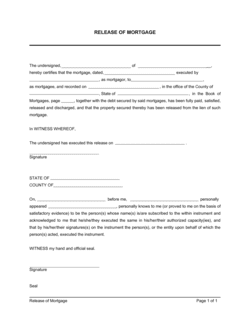
Release of Mortgage
A recorded document confirming that the lender has satisfied or discharged its mortgage lien on the property following the deed in lieu transfer.
Title Insurance
An insurance policy protecting the lender or buyer against losses arising from defects in the property's title, including undisclosed liens or ownership disputes.
Voluntary Conveyance
The willing transfer of property without coercion, a key legal element that distinguishes a deed in lieu from a foreclosure and supports its enforceability.
Closing Conditions
Specific requirements — such as clear title, executed release agreements, and property inspection — that must be satisfied before the deed transfer becomes effective.
Arm's Length Transaction
A transaction conducted between unrelated parties acting in their own independent interests, required in most deed in lieu agreements to confirm no fraud or collusion.

Part of your Business Operating System

This document is one of 3,000+ business & legal templates included in Business in a Box.

  • Fill-in-the-blanks — ready in minutes
  • 100% customizable Word document
  • Compatible with all office suites
  • Export to PDF and share electronically

Create your document in 3 simple steps.

From template to signed document — all inside one Business Operating System.
1
Download or open template

Access over 3,000+ business and legal templates for any business task, project or initiative.

2
Edit and fill in the blanks with AI

Customize your ready-made business document template and save it in the cloud.

3
Save, Share, Send, Sign

Share your files and folders with your team. Create a space of seamless collaboration.

Save time, save money, and create top-quality documents.

★★★★★

"Fantastic value! I'm not sure how I'd do without it. It's worth its weight in gold and paid back for itself many times."

Managing Director · Mall Farm
Robert Whalley
Managing Director, Mall Farm Proprietary Limited
★★★★★

"I have been using Business in a Box for years. It has been the most useful source of templates I have encountered. I recommend it to anyone."

Business Owner · 4+ years
Dr Michael John Freestone
Business Owner
★★★★★

"It has been a life saver so many times I have lost count. Business in a Box has saved me so much time and as you know, time is money."

Owner · Upstate Web
David G. Moore Jr.
Owner, Upstate Web

Run your business with a system — not scattered tools

Stop downloading documents. Start operating with clarity. Business in a Box gives you the Business Operating System used by over 250,000 companies worldwide to structure, run, and grow their business.

Start free · No credit card required