Conflict Of Interest Policy For Nonprofit Organizations Template

Free Word download β€’ Edit online β€’ Save & share with Drive β€’ Export to PDF

4 pagesβ€’20–30 min to fillβ€’Difficulty: Standard
Learn more ↓
FreeConflict Of Interest Policy For Nonprofit Organizations Template

At a glance

What it is
A Conflict of Interest Policy for Nonprofit Organizations is a formal governance document that defines what constitutes a conflict of interest, requires board members, officers, and key employees to disclose potential conflicts, and establishes procedures for handling those disclosures. This free Word download is editable online and exportable as PDF β€” ready to adopt at a board meeting or submit alongside IRS Form 1023.
When you need it
Use it when applying for 501(c)(3) tax-exempt status, onboarding new board members, or formalizing governance practices to satisfy donor, grant, or accreditation requirements. The IRS recommends this policy in its Form 1023 instructions and treats its absence as a governance risk indicator.
What's inside
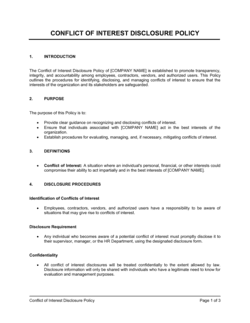
Purpose and scope, definitions of covered persons and conflicts, annual disclosure statement requirements, meeting disclosure and recusal procedures, violations and consequences, and record-keeping obligations β€” structured to align with IRS and state charity law expectations.

What is a Conflict of Interest Policy for Nonprofit Organizations?

A Conflict of Interest Policy for Nonprofit Organizations is a formal governance document that defines what constitutes a conflict of interest, identifies which individuals are subject to its requirements, mandates annual and situational disclosure of potential conflicts, and establishes a structured recusal process for board decisions involving an interested person. It functions as the primary mechanism through which a nonprofit demonstrates to the IRS, state regulators, donors, and the public that its board makes decisions in the organization's interest β€” not in the private interest of any individual director, officer, or key employee. The IRS includes a model conflict of interest policy in its Form 1023 instructions and treats its adoption as a key indicator of sound governance.

Why You Need This Document

Operating without a conflict of interest policy exposes a nonprofit to four concrete risks simultaneously. First, IRS Form 990 Part VI asks publicly whether the organization has this policy β€” a 'no' answer is visible to every donor, journalist, and watchdog organization that pulls the filing, and it triggers heightened scrutiny during audits. Second, undisclosed conflicts that result in financial transactions can constitute private benefit or inurement, both of which jeopardize 501(c)(3) status. Third, several states β€” including California, New York, and Massachusetts β€” impose conflict of interest requirements on charities by statute, making the absence of a policy a compliance violation independent of the IRS. Fourth, major foundations and government grantmakers increasingly require applicants to submit a copy of their conflict of interest policy as part of the grant application. This template gives you an IRS-aligned, attorney-reviewed starting point you can adopt at a single board meeting, complete with the annual disclosure form and acknowledgment language that turn a written policy into a living governance practice.

Which variant fits your situation?

If your situation is…Use this template
Filing for 501(c)(3) tax-exempt status with the IRSConflict of Interest Policy for Nonprofit Organizations
Governing a public charity with a large volunteer boardBoard Member Code of Conduct
Managing related-party transactions between the nonprofit and a vendorRelated Party Transaction Policy
Onboarding new board members with a signed acknowledgmentBoard Member Agreement
Documenting whistleblower protections required under Sarbanes-OxleyWhistleblower Policy for Nonprofits
Establishing a complete governance policy suite for a new nonprofitNonprofit Governance Policy Package
Addressing a specific board member conflict already under disputeBoard Resolution Template

Common mistakes to avoid

❌ Covering only board directors and omitting officers and key employees

Why it matters: IRS Form 990 Part VI asks whether the policy covers officers, directors, and key employees separately. Answering 'no' for any category signals a governance gap to the IRS and to major donors who review 990s.

Fix: Amend the 'covered persons' definition to explicitly list board directors, all officers, the executive director, and any employee with organizational-wide financial decision-making authority.

❌ Allowing the interested person to stay in the room during deliberations

Why it matters: The IRS model policy and most state charity guidelines require the conflicted party to physically leave the meeting room β€” not merely abstain from voting. Presence during deliberations compromises the independence of the decision.

Fix: Revise the recusal procedure to require the interested person to leave for the full duration of the discussion and vote, and instruct the secretary to document the departure in the minutes.

❌ Adopting the policy without an annual disclosure form

Why it matters: A policy with no disclosure mechanism is unenforceable in practice β€” you cannot identify conflicts you do not systematically ask about. Auditors and grant reviewers will ask to see completed disclosure forms.

Fix: Attach a signed disclosure form template as Exhibit A and collect completed forms from every covered person at adoption and annually thereafter.

❌ No documented board vote or minutes recording adoption

Why it matters: Undocumented adoption means you cannot prove to the IRS, a state regulator, or a funder that the policy is in effect. A policy that exists only as a file on someone's computer has not been 'adopted' in any meaningful governance sense.

Fix: Place the policy on a formal board meeting agenda, record the motion and vote in the minutes, and retain the signed acknowledgment forms with the organizational records.

❌ Setting no review schedule and never updating the policy

Why it matters: An unamended policy adopted five years ago may not reflect current relationships, program activities, or IRS guidance changes β€” and a stale policy signals passive governance to auditors and regulators.

Fix: Add an annual review date to the policy text and to the board's governance calendar, with a designated person β€” typically the board chair or governance committee β€” responsible for initiating the review.

❌ Using aspirational language ('should' or 'encouraged to') instead of mandatory language ('shall')

Why it matters: Soft language makes the policy advisory rather than binding. If a board member chooses not to disclose and the organization later faces an IRS inquiry, a policy full of 'shoulds' provides no protection.

Fix: Replace all instances of 'should,' 'is encouraged to,' and 'is expected to' with 'shall' throughout the policy to establish clear, enforceable obligations.

The 10 key sections, explained

Purpose and scope

Definitions

Duty to disclose

Recusal and non-participation procedure

Annual disclosure statement

Violations and consequences

Record-keeping and minutes

Periodic review

Compensation decisions

Acknowledgment and certification

How to fill it out

  1. 1

    Insert the organization's legal name and state of incorporation

    Replace all [ORGANIZATION NAME] and [STATE] placeholders with your nonprofit's full registered name and state. Use the exact name as it appears in your articles of incorporation.

    πŸ’‘ Some states have their own model conflict of interest policy language β€” check whether your state attorney general's office has issued guidance before finalizing.

  2. 2

    Define the scope of covered persons

    Review the 'covered persons' definition and confirm it includes all board directors, officers, the executive director, and any key employees who influence financial decisions. Extend coverage to immediate family members and related organizations.

    πŸ’‘ The IRS Form 990 asks whether the policy covers officers and key employees, not just directors β€” confirm your definition is broad enough to answer 'yes' on all three counts.

  3. 3

    Customize the financial interest definition

    Tailor the definition of 'financial interest' to reflect your organization's common related-party relationships β€” vendor contracts, employment of relatives, board members who are also donors, or officers who sit on other boards.

    πŸ’‘ Include a de minimis threshold (e.g., ownership of less than 5% of a publicly traded company need not be disclosed) to prevent the policy from being over-burdensome for board recruitment.

  4. 4

    Attach the annual disclosure form as Exhibit A

    Complete the annual disclosure statement exhibit with fields for each covered person's name, role, and a table for listing financial interests, related organizations, and family relationships with entities doing business with the nonprofit.

    πŸ’‘ Build the disclosure form to mirror Schedule L of IRS Form 990, which asks about transactions with interested persons β€” this makes annual tax preparation faster.

  5. 5

    Set the recusal procedure language

    Confirm that the policy explicitly requires the interested person to leave the room during deliberations and the vote β€” not merely to abstain. Add language that the remaining quorum is sufficient to act without the recused member.

    πŸ’‘ Check your bylaws to confirm quorum requirements β€” some nonprofits need a bylaw amendment to allow action without a conflicted director counted toward quorum.

  6. 6

    Draft the compensation review procedure

    Add a specific section for executive and officer compensation decisions that references the IRS rebuttable presumption of reasonableness: independent approval, comparability data, and contemporaneous documentation.

    πŸ’‘ Name the specific source of comparability data you plan to use β€” GuideStar, IRS Form 990 data from peer organizations, or a formal compensation survey β€” so the procedure is actionable, not aspirational.

  7. 7

    Present the policy to the board for formal adoption

    Place the policy on the board agenda as an action item. Record the vote adopting the policy in the meeting minutes, and attach the signed acknowledgment forms from all covered persons to the organizational records.

    πŸ’‘ Date-stamp the adoption in the policy footer β€” the IRS, auditors, and grant officers often ask when the policy was last reviewed and approved.

  8. 8

    Schedule an annual review and distribute updated disclosure forms

    Add the conflict of interest policy review to the board's annual governance calendar, typically at the first meeting of the fiscal year. Redistribute the disclosure form and collect new signatures from all covered persons at the same meeting.

    πŸ’‘ Pair the annual disclosure collection with D&O insurance renewal β€” the two processes require the same information and sharing them reduces administrative burden.

Frequently asked questions

What is a conflict of interest policy for a nonprofit?

A conflict of interest policy for a nonprofit is a formal governance document that defines what constitutes a conflict of interest, requires board members, officers, and key employees to disclose potential conflicts, and establishes procedures for handling those disclosures β€” including recusal from votes. It protects the organization's tax-exempt status, public credibility, and fiduciary integrity by ensuring decisions are made in the organization's interest rather than any individual's private interest.

Is a conflict of interest policy required for nonprofits?

The IRS does not legally mandate a conflict of interest policy for 501(c)(3) organizations, but it strongly recommends one and includes a model policy in the Form 1023 instructions. IRS Form 990 Part VI asks whether the organization has a written conflict of interest policy and whether officers, directors, and key employees are required to disclose annually. Answering 'no' is a public red flag on a document that donors, journalists, and watchdog organizations routinely review. Several states β€” including California, New York, and Massachusetts β€” impose conflict of interest requirements on charities by statute.

Who must be covered by a nonprofit conflict of interest policy?

At minimum, the policy should cover all board directors, corporate officers, the executive director, and any key employees with organization-wide financial decision-making authority. The IRS model policy also recommends extending coverage to members of their immediate families and to organizations in which covered persons hold a financial interest. Limiting coverage to board members only will result in a 'no' answer on IRS Form 990 Part VI, Question 12b.

What should be disclosed under a conflict of interest policy?

Covered persons should disclose any financial interest β€” ownership stake, compensation arrangement, or other economic benefit β€” in any entity the nonprofit is considering a transaction with. They should also disclose employment of family members, service on the boards of organizations that compete with or contract with the nonprofit, and any other relationship that could reasonably be perceived as influencing their judgment on organizational decisions.

What happens when a conflict of interest is disclosed?

After disclosure, the interested person must leave the meeting room for the duration of the discussion and vote on the matter. The remaining board members independently determine whether a conflict exists, whether proceeding with the transaction is in the organization's interest, and whether the terms are fair and reasonable. The board's deliberation and vote are recorded in the minutes along with the name of the person who disclosed the conflict and the nature of the interest.

How does a conflict of interest policy relate to IRS Form 1023?

IRS Form 1023, the application for 501(c)(3) recognition, asks whether the organization has adopted a conflict of interest policy and whether it follows the procedures described in the IRS model policy. While submitting a policy is not technically required to obtain exempt status, organizations that answer 'no' or submit a policy that deviates significantly from the IRS model may receive additional scrutiny or requests for explanation during the review process.

How often should the annual disclosure form be collected?

Covered persons should complete and sign the disclosure form once per year β€” typically at the first board meeting of the fiscal or calendar year β€” and immediately upon joining the board or accepting an officer role. A new form should also be completed promptly any time a covered person's circumstances change materially, such as joining the board of a vendor organization or a family member being hired by the nonprofit.

What is the difference between a conflict of interest policy and a code of ethics?

A conflict of interest policy is narrow and procedural β€” it focuses specifically on financial and personal interests that could improperly influence organizational decisions, and it establishes a mandatory disclosure and recusal process. A code of ethics is broader and aspirational, addressing general conduct standards, values, and professional behavior expectations. Nonprofits typically need both: the conflict of interest policy for IRS compliance and the code of ethics for comprehensive governance.

Can a board member vote on a matter in which they have a disclosed conflict?

No. Under a properly drafted conflict of interest policy, an interested person who has disclosed a conflict must leave the room and is not permitted to vote on the matter. Allowing a conflicted director to vote β€” even with disclosure β€” undermines the independence of the decision and can expose the organization and the director to liability, particularly if the transaction later proves unfavorable to the nonprofit.

How this compares to alternatives

vs Code of Ethics

A code of ethics sets broad conduct standards and organizational values for all staff and board members. A conflict of interest policy is narrower and procedural β€” it governs a specific category of risk (financial and personal conflicts) with mandatory disclosure and recusal requirements. Nonprofits typically need both documents; the conflict of interest policy satisfies IRS and state charity law requirements that a code of ethics alone does not.

vs Whistleblower Policy

A whistleblower policy protects employees and board members who report financial misconduct, fraud, or policy violations from retaliation. A conflict of interest policy prevents improper transactions from occurring in the first place through proactive disclosure. The two policies are complementary: the conflict of interest policy is preventive; the whistleblower policy is the corrective mechanism when prevention fails.

vs Board Member Agreement

A board member agreement is a broader onboarding document covering a director's duties, term, meeting attendance expectations, and fundraising commitments. A conflict of interest policy is a standalone governance policy that all covered persons must acknowledge β€” it is typically attached to or referenced by the board member agreement, not a substitute for it.

vs Related Party Transaction Policy

A related party transaction policy governs the approval, documentation, and fairness review of specific financial transactions between the nonprofit and persons with a connection to it. A conflict of interest policy sets the broader framework for identifying and disclosing all potential conflicts β€” including situations that may never result in a transaction. Organizations with significant vendor relationships or executive compensation complexity often need both.

Industry-specific considerations

Healthcare nonprofits

Physician board members who refer patients to the nonprofit's facilities, or executives who also hold interests in medical equipment vendors, create frequent disclosure obligations requiring a clear recusal process.

Education and higher education

Trustees who are alumni donors, parents of current students, or contractors for campus construction projects face recurring conflicts that a formal policy structures and documents consistently.

Community foundations and grantmakers

Board members who are also grant applicants, or who serve on the boards of organizations receiving grants, represent the highest-frequency conflict scenario in philanthropic governance.

Arts and cultural organizations

Board members who are also artists, gallery owners, or event vendors frequently create undisclosed transactional conflicts that a mandatory annual disclosure form is specifically designed to surface.

Template vs pro β€” what fits your needs?

PathBest forCostTime
Use the templateNonprofits at any stage seeking IRS-compliant governance documentation without a dedicated legal teamFree1–2 hours to customize and adopt
Template + professional reviewOrganizations in states with statutory conflict of interest requirements (CA, NY, MA) or those with complex related-party relationships$300–$800 for a nonprofit attorney review3–5 business days
Custom draftedLarge nonprofits, hospital systems, university foundations, or organizations under IRS or state attorney general scrutiny$1,000–$3,000+1–3 weeks

Glossary

Conflict of Interest
A situation in which a covered person's private financial or personal interests could improperly influence β€” or appear to influence β€” a decision they make on behalf of the organization.
Covered Person
Any individual subject to the policy, typically including board members, officers, key employees, and members of their immediate families.
Financial Interest
An ownership stake, compensation arrangement, or other economic benefit a covered person holds in an entity that does business with or competes against the nonprofit.
Recusal
The act of removing oneself from a discussion and vote on a matter in which one has a disclosed conflict of interest.
Disclosure Statement
A signed annual form on which each covered person lists all potential conflicts of interest for review by the board or governance committee.
Arm's-Length Transaction
A transaction conducted as if the parties were unrelated and acting in their own independent self-interest, used as a standard to evaluate related-party dealings.
Private Benefit
Any economic advantage flowing to a private individual or entity as a result of the nonprofit's activities β€” excessive private benefit can jeopardize tax-exempt status.
Interested Person
A covered person who has a financial interest in a specific matter before the board and must therefore disclose and recuse under the policy.
Form 1023
The IRS application for recognition of 501(c)(3) tax-exempt status, which includes a question about whether the organization has adopted a conflict of interest policy.
Inurement
The prohibited flow of a nonprofit's net earnings to the benefit of private shareholders or individuals, which disqualifies an organization from tax-exempt status.

Part of your Business Operating System

This document is one of 3,000+ business & legal templates included in Business in a Box.

  • Fill-in-the-blanks β€” ready in minutes
  • 100% customizable Word document
  • Compatible with all office suites
  • Export to PDF and share electronically

Create your document in 3 simple steps.

From template to signed document β€” all inside one Business Operating System.
1
Download or open template

Access over 3,000+ business and legal templates for any business task, project or initiative.

2
Edit and fill in the blanks with AI

Customize your ready-made business document template and save it in the cloud.

3
Save, Share, Send, Sign

Share your files and folders with your team. Create a space of seamless collaboration.

Save time, save money, and create top-quality documents.

β˜…β˜…β˜…β˜…β˜…

"Fantastic value! I'm not sure how I'd do without it. It's worth its weight in gold and paid back for itself many times."

Managing Director Β· Mall Farm
Robert Whalley
Managing Director, Mall Farm Proprietary Limited
β˜…β˜…β˜…β˜…β˜…

"I have been using Business in a Box for years. It has been the most useful source of templates I have encountered. I recommend it to anyone."

Business Owner Β· 4+ years
Dr Michael John Freestone
Business Owner
β˜…β˜…β˜…β˜…β˜…

"It has been a life saver so many times I have lost count. Business in a Box has saved me so much time and as you know, time is money."

Owner Β· Upstate Web
David G. Moore Jr.
Owner, Upstate Web

Run your business with a system β€” not scattered tools

Stop downloading documents. Start operating with clarity. Business in a Box gives you the Business Operating System used by over 250,000 companies worldwide to structure, run, and grow their business.

Start freeΒ Β·Β No credit card required