5 Ways To Improve Team Collaboration

Free to read • Save or share with one click

Free5 Ways To Improve Team Collaboration Template

At a glance

What it is
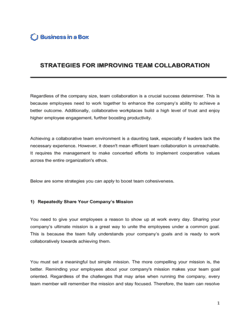
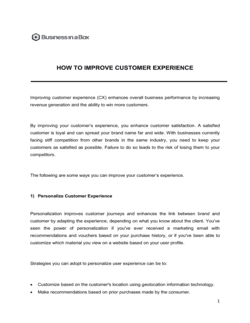
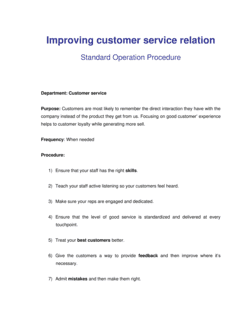
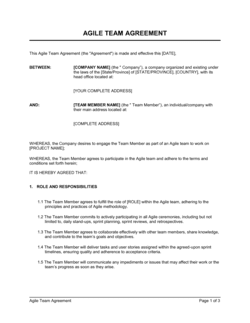
The 5 Ways To Improve Team Collaboration template is a structured Word document that guides managers and team leads through five proven strategies for strengthening how their teams communicate, coordinate, and execute together. This free Word download gives you a ready-made framework you can edit online, tailor to your team's specific gaps, and export as PDF to share with stakeholders or use in a team workshop.
When you need it
Use it when a team is experiencing recurring miscommunication, duplicated work, missed handoffs, or low engagement. It is also useful when onboarding a new team, restructuring after growth, or following a post-project retrospective that surfaced collaboration issues.
What's inside
Five core collaboration strategies — each with a clear rationale, specific action steps, and implementation guidance — covering communication norms, shared goals, trust-building, tooling, and accountability structures. Each section includes space to document current-state observations and planned next steps tailored to your team.

What is a 5 Ways To Improve Team Collaboration document?

A 5 Ways To Improve Team Collaboration document is a structured operational guide that walks managers and team leads through five evidence-based strategies for strengthening how a team communicates, coordinates, and delivers work together. It moves beyond generic advice by providing a current-state assessment framework, specific action steps for each strategy, a phased implementation timeline, named ownership for each initiative, and measurable success metrics. The document functions as both a diagnostic tool and an execution plan — identifying where collaboration is breaking down and prescribing concrete changes to fix it.

Why You Need This Document

Teams that operate without documented collaboration norms rely on assumptions that rarely align across members — leading to duplicated work, missed handoffs, slow decisions, and disengaged employees. The cost of unaddressed collaboration friction is tangible: projects overrun their timelines, senior managers spend disproportionate time resolving preventable conflicts, and high performers leave teams where coordination is chronically frustrating. This template gives you a structured path from diagnosis to implementation in a single document, reducing the time it takes to move from "we need to work better together" to measurable, sustained improvement.

Which variant fits your situation?

If your situation is…Use this template
Addressing a specific breakdown between two departmentsCross-Functional Team Charter
Improving communication across a fully remote teamRemote Work Policy
Running a structured team retrospective to surface issuesProject Post-Mortem Report
Setting shared goals and tracking team-level OKRsOKR Planning Template
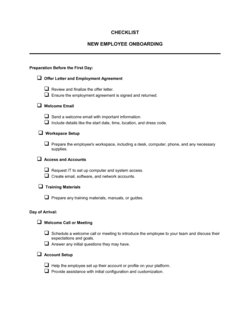
Onboarding new hires into existing team normsEmployee Onboarding Checklist
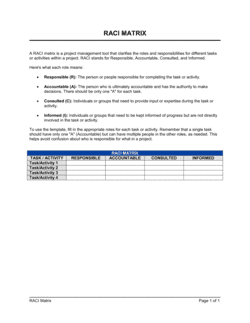
Documenting role responsibilities to prevent duplicationRACI Matrix
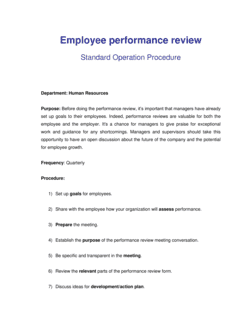
Conducting a structured team performance reviewTeam Performance Review Template

Common mistakes to avoid

❌ Launching all five strategies at once

Why it matters: Teams experience change fatigue when multiple new practices are introduced simultaneously — adoption drops across the board and none of the strategies gets enough attention to stick.

Fix: Phase the rollout over 8–10 weeks, introducing one strategy at a time and confirming adoption before adding the next.

❌ No named owner for each strategy

Why it matters: When ownership is shared or vague, implementation stalls within two weeks as everyone waits for someone else to act.

Fix: Assign a single named individual as the driver for each strategy. Record the name in the template so it is visible to the whole team.

❌ Measuring activity instead of outcomes

Why it matters: Tracking messages sent or meetings held rewards noise rather than effective collaboration — teams can score well on activity metrics while communication outcomes actually worsen.

Fix: Choose outcome metrics such as decision turnaround time, blocker resolution speed, or on-time handoff rate. Establish a baseline before rollout begins.

❌ Skipping the current-state assessment

Why it matters: Applying a generic five-strategy framework without diagnosing the team's actual pain points produces solutions that address the wrong problems and frustrate team members.

Fix: Spend 30–60 minutes on the assessment section first — a brief anonymous survey or structured retrospective surfaces the highest-priority gaps before any strategy is written.

The 8 key sections, explained

Current-state assessment

Strategy 1 — Establish clear communication norms

Strategy 2 — Align on shared goals and priorities

Strategy 3 — Build trust and psychological safety

Strategy 4 — Define roles and accountability

Strategy 5 — Optimize meeting and workflow cadence

Implementation timeline

Success metrics and review cadence

How to fill it out

  1. 1

    Complete the current-state assessment before editing anything else

    Survey or interview team members to identify the top three collaboration friction points. Record specific examples — not general feelings — in the assessment section.

    💡 A five-question anonymous pulse survey completed before the first team session produces more honest data than an open group discussion.

  2. 2

    Prioritize which of the five strategies to address first

    Rank the five strategies by the severity of the gap they address for your team. A team with no shared goals needs Strategy 2 before Strategy 5.

    💡 Start with one strategy for the first two weeks. Early wins build team buy-in for the remaining strategies.

  3. 3

    Assign a named owner to each strategy

    For each strategy, designate one person responsible for driving implementation — not a group. Record their name and the target completion date.

    💡 The owner does not have to be the most senior person — they need to be the most invested in that particular area.

  4. 4

    Fill in the communication norms section with specific channel rules

    For each communication channel your team uses, write one sentence defining the types of messages it handles and the expected response window.

    💡 Include a rule for what to do when a message falls between channels — ambiguity at the edges is where communication breaks down most often.

  5. 5

    Complete the roles and accountability section using a RACI format

    List each recurring deliverable or decision and assign one Responsible, one Accountable, and any Consulted or Informed parties. Highlight any cells where two people share the Responsible role — those need to be resolved.

    💡 If you cannot name a single Accountable person for a deliverable, that deliverable does not have an owner yet — do not move on until it does.

  6. 6

    Build the implementation timeline in phases

    Map each strategy to a two-week window over a 10-week rollout. Include a 30-day check-in meeting in the timeline where the team reviews early results and adjusts.

    💡 Block the 30-day check-in on the team calendar the same day you share the finished document — it is easy to deprioritize without a standing commitment.

  7. 7

    Define success metrics before the rollout begins

    Write down three to five specific, measurable indicators of improvement in the metrics section. Establish a baseline measurement now so you have something to compare against at the 30-day check-in.

    💡 Pick at least one metric that team members themselves can observe daily — not just a number that only the manager sees.

Frequently asked questions

What is a team collaboration improvement plan?

A team collaboration improvement plan is a structured document that identifies the root causes of collaboration friction on a team and outlines specific, actionable strategies to address them. It typically covers communication norms, shared goals, role clarity, trust-building practices, and meeting cadence — with named owners and measurable outcomes for each initiative.

Why does team collaboration break down in growing organizations?

As teams grow beyond 8–10 people, informal coordination that worked at smaller size stops scaling. Communication channels multiply, priorities diverge, and role boundaries blur. Without documented norms and accountability structures, individuals default to their own assumptions about how collaboration should work — and those assumptions rarely match.

How long does it take to improve team collaboration noticeably?

Most teams see measurable improvement within 30–45 days of consistently applying two or three focused changes — particularly in communication clarity and role accountability. Deeper changes to trust and psychological safety typically take 60–90 days of sustained practice. Rolling out all five strategies simultaneously delays results for all of them.

What are the most important factors in effective team collaboration?

Research consistently points to five factors: clarity of shared goals, well-defined roles with clear handoffs, psychological safety to speak up and disagree, consistent communication norms, and a meeting cadence that creates rhythm without consuming deep-work time. The five strategies in this template map directly to each of these factors.

Can this template be used for remote or hybrid teams?

Yes, and the need is arguably higher for distributed teams. Remote teams lack the ambient communication that co-located teams take for granted, making explicit documentation of norms, channels, and accountability structures even more critical. The communication norms and meeting cadence sections in particular should be customized for async-first workflows when used with remote teams.

How do I measure whether team collaboration has improved?

Choose three to five outcome metrics before the rollout begins — for example, time-to-decision on cross-team requests, on-time handoff rate between roles, or the percentage of weekly syncs that start with a shared agenda. Measure baseline values first, then track the same metrics at the 30-day and 60-day marks. Improvement in two of five metrics within 30 days typically indicates the most critical friction point has been addressed.

Should this document be shared with the whole team?

Yes. A collaboration improvement plan is most effective when all team members have read it, contributed to the assessment section, and understand the rationale behind each strategy. Co-ownership of the document drives co-ownership of the outcomes. Sharing only with managers and rolling out changes top-down reduces adoption significantly.

What is the difference between this template and a team charter?

A team charter defines the team's purpose, scope, membership, and authority — the foundational agreement for a new or restructured team. This template focuses specifically on improving collaboration practices for an already-operating team. A charter establishes what the team is; this document addresses how the team works together day to day.

How this compares to alternatives

vs Team Charter

A team charter is a foundational document for a new or restructured team that defines its purpose, authority, membership, and scope. This template addresses how an already-operating team improves its day-to-day working practices. Use a team charter to establish a team from scratch; use this document when an existing team's collaboration is underperforming.

vs RACI Matrix

A RACI matrix is a single-purpose tool that assigns Responsible, Accountable, Consulted, and Informed roles to specific tasks or decisions. This template uses RACI logic within Strategy 4 but also covers communication norms, goals, trust, and meeting cadence. Use the RACI matrix when role clarity is the only issue; use this template when collaboration is breaking down across multiple dimensions.

vs Project Post-Mortem Report

A post-mortem report documents what went wrong on a completed project and why — it is retrospective and diagnostic. This template is forward-looking and prescriptive, translating diagnosed problems into actionable improvement strategies. The two documents work best in sequence: run a post-mortem to identify issues, then use this template to build the improvement plan.

vs Employee Performance Review

A performance review assesses individual contribution against goals and competencies. This template addresses team-level collaboration systems and norms — the conditions that individual performance reviews cannot fix alone. Poor collaboration metrics on a team review often signal a structural or process problem better addressed by this template than by managing individual performance.

Industry-specific considerations

Technology / SaaS

Distributed engineering and product teams use this to establish async communication norms, sprint handoff protocols, and cross-functional decision-making boundaries between product, engineering, and design.

Professional Services

Consulting and agency teams apply it to reduce duplicated client work, clarify billable-task ownership across project roles, and build consistent client communication practices.

Healthcare

Clinical and administrative teams use the accountability and communication sections to reduce handoff errors between shifts, departments, or care settings where miscommunication has direct patient-safety consequences.

Manufacturing

Production and operations teams apply the role clarity and meeting cadence sections to tighten shift handoffs, reduce downtime from miscommunication, and synchronize floor and management priorities.

Template vs pro — what fits your needs?

PathBest forCostTime
Use the templateTeam managers and HR leads addressing collaboration gaps on a single team or departmentFree2–4 hours to complete, 8–10 weeks to implement
Template + professional reviewOrganizations rolling out collaboration improvements across multiple teams or following a significant restructure$500–$2,000 for a facilitated team workshop or HR consultant review1–2 weeks with external facilitation
Custom draftedEnterprises with persistent collaboration failures across divisions, or teams undergoing a culture transformation initiative$5,000–$20,000+ for an organizational development consultant engagement4–12 weeks

Glossary

Collaboration Norm
An agreed-upon behavior or practice — such as response time expectations or meeting protocols — that a team commits to following consistently.
Psychological Safety
A team condition where members feel safe to speak up, admit mistakes, and propose ideas without fear of punishment or ridicule.
Asynchronous Communication
Communication where participants do not need to be present at the same time — such as email, recorded video, or documented comments in a shared tool.
RACI Matrix
A responsibility assignment chart that defines who is Responsible, Accountable, Consulted, and Informed for each task or decision.
Shared Mental Model
A common understanding among team members of goals, roles, processes, and priorities — the foundation of effective coordination without constant check-ins.
Accountability Structure
A documented system that defines who owns each outcome, how progress is tracked, and what happens when commitments are not met.
Meeting Cadence
The scheduled frequency and format of recurring team meetings — such as daily standups, weekly syncs, and monthly retrospectives.
Communication Channel
The medium used to exchange information — email, instant messaging, video call, or project management tool — each suited to different urgency and context levels.
Cross-Functional Team
A group of people from different departments or specialties working together toward a shared deliverable or goal.
Feedback Loop
A structured mechanism for sharing observations on performance or process — designed to surface issues early and reinforce positive behaviors.

Part of your Business Operating System

This document is one of 3,000+ business & legal templates included in Business in a Box.

  • Fill-in-the-blanks — ready in minutes
  • Compatible with all office suites
  • Export to PDF and share electronically

Create your document in 3 simple steps.

From template to signed document — all inside one Business Operating System.
1
Download or open template

Access over 3,000+ business and legal templates for any business task, project or initiative.

2
Edit and fill in the blanks with AI

Customize your ready-made business document template and save it in the cloud.

3
Save, Share, Send, Sign

Share your files and folders with your team. Create a space of seamless collaboration.

Save time, save money, and create top-quality documents.

★★★★★

"Fantastic value! I'm not sure how I'd do without it. It's worth its weight in gold and paid back for itself many times."

Managing Director · Mall Farm
Robert Whalley
Managing Director, Mall Farm Proprietary Limited
★★★★★

"I have been using Business in a Box for years. It has been the most useful source of templates I have encountered. I recommend it to anyone."

Business Owner · 4+ years
Dr Michael John Freestone
Business Owner
★★★★★

"It has been a life saver so many times I have lost count. Business in a Box has saved me so much time and as you know, time is money."

Owner · Upstate Web
David G. Moore Jr.
Owner, Upstate Web

Run your business with a system — not scattered tools

Stop downloading documents. Start operating with clarity. Business in a Box gives you the Business Operating System used by over 250,000 companies worldwide to structure, run, and grow their business.

Start free · No credit card required