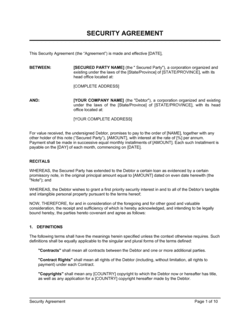
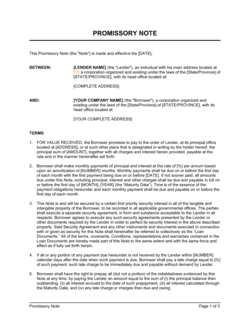
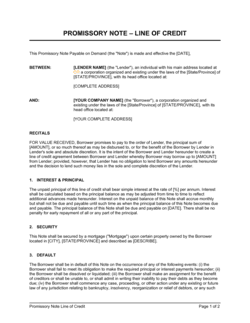
Checklist Items to Consider for Drafting a Promissory Note

Free download • Use as a template • Print or share

1 page15–25 min to useDifficulty: Standard
Learn more ↓
FreeChecklist Items to Consider for Drafting a Promissory Note Template

At a glance

What it is
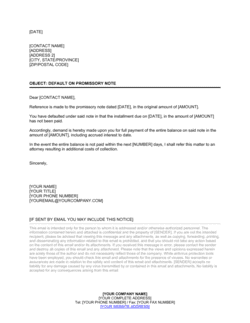
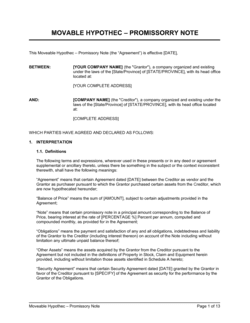
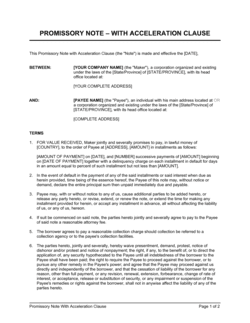
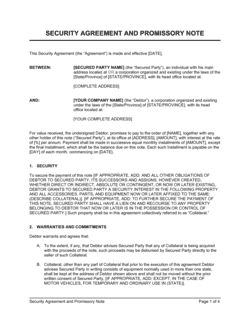
A Checklist Items To Consider For Drafting A Promissory Note is a structured form that walks lenders and borrowers through every decision point—parties, loan amount, interest, repayment schedule, collateral, and default provisions—before pen touches paper on the actual note. This free Word download gives you a pre-drafting reference sheet you can complete in minutes and export as PDF to share with your counterparty or legal advisor.
When you need it
Use it any time you are preparing to lend or borrow money and need to confirm all key terms are decided before drafting the binding promissory note itself. It is especially useful when multiple stakeholders need to align on terms before a lawyer or template is engaged.
What's inside
Party identification fields, principal amount and currency, interest rate and accrual method, repayment schedule details, collateral and security information, default and cure period provisions, governing law, and a signature/witness requirements section.

What is a Checklist Items To Consider For Drafting A Promissory Note?

A Promissory Note Drafting Checklist is a structured reference form that walks lenders and borrowers through every material decision point—party identification, principal amount, interest rate and accrual method, repayment schedule, collateral, default triggers, and governing law—before the binding note itself is written. By capturing all terms in one place ahead of drafting, it eliminates the gaps and ambiguities that turn straightforward loan arrangements into costly disputes. This free Word download gives you a fillable, printable checklist you can complete in under 15 minutes and share with your counterparty or attorney as a definitive record of agreed terms.

Why You Need This Document

Skipping a pre-drafting checklist is the most common reason promissory notes end up with missing or contradictory terms—an interest rate specified without an accrual method, collateral described too vaguely to enforce, or a cure period so short a court will not uphold acceleration. Each gap costs money: a vague collateral description can make a security interest unenforceable in bankruptcy; an undefined repayment schedule triggers immediate disputes over what was actually owed; a rate above the local usury ceiling can void all interest on the note. This checklist ensures every term is decided before a single sentence of the note is written, giving both parties a shared reference point and giving any attorney you engage complete instructions from the first call.

Which variant fits your situation?

If your situation is…Use this template
Lending money to an individual with a personal guaranteePromissory Note (Unsecured)
Lending against real property or business assetsSecured Promissory Note
Structuring a loan that converts to equity at a future roundConvertible Promissory Note
Documenting a demand loan with no fixed repayment dateDemand Promissory Note
Installment-based loan repaid on a defined monthly scheduleInstallment Promissory Note
Loan between family members or friendsPersonal Loan Agreement
Bridge financing between two known transaction datesBridge Loan Agreement

Common mistakes to avoid

❌ Using informal names instead of legal entity names

Why it matters: A note made out to 'John's Plumbing' instead of 'Johnson Plumbing LLC' may be unenforceable against the entity's assets, leaving the lender with only a personal claim.

Fix: Verify the exact registered name of every party before filling in the identification fields—15 minutes of registry research prevents years of enforcement headaches.
❌ Leaving the interest accrual method undefined

Why it matters: On a $50,000 loan at 8% over 3 years, simple versus compound accrual differs by roughly $3,200 in total interest—enough for a genuine dispute between parties who both think they are right.

Fix: Explicitly check either 'simple interest' or 'compound interest' in the checklist and carry that selection verbatim into the promissory note draft.

❌ Not verifying the interest rate against local usury limits

Why it matters: Charging above the usury ceiling does not just make the excess interest void—in some states, the entire note is unenforceable and the lender forfeits all interest.

Fix: Look up the usury limit for the governing jurisdiction before setting the rate, and build in a 2–3% buffer below the ceiling.

❌ Describing collateral vaguely

Why it matters: A lien on 'office equipment' cannot be enforced against a specific server or vehicle because the collateral cannot be uniquely identified at the time of seizure.

Fix: Use make, model, serial number, VIN, or legal property description for every item pledged as collateral—then copy that exact language into the security agreement.

The 9 key fields, explained

Lender and borrower identification

Principal loan amount and currency

Interest rate and accrual method

Repayment schedule

Prepayment terms

Collateral and security

Default events and cure period

Governing law and dispute resolution

Witness and notarization requirements

How to fill it out

  1. 1

    Identify both parties with their legal names

    Enter the full registered legal name, address, and entity type for both lender and borrower. For business entities, confirm the name matches the state or provincial corporate registry.

    💡 Ask the borrower for a copy of their state business registration if you are lending to an LLC or corporation—trade names are not legal entities.

  2. 2

    Confirm the principal amount and currency

    Write the amount in both numerals and words and specify the currency. For any cross-border arrangement, note the exchange rate mechanism if the loan is in a currency other than the borrower's functional currency.

    💡 Adding 'USD' or 'CAD' explicitly avoids currency disputes that have derailed otherwise simple repayments.

  3. 3

    Decide on interest rate type and accrual method

    Choose between a fixed rate and a variable rate tied to a benchmark (e.g., prime + X%). Select simple or compound accrual and note the day-count convention. Check local usury limits before finalizing the rate.

    💡 Most US states cap personal loan interest rates between 10% and 36% annually—exceeding the usury ceiling voids the interest entirely in some states.

  4. 4

    Map out the full repayment schedule

    Determine whether repayment is a single balloon, fixed monthly installments, or interest-only with a balloon at maturity. Confirm the payment amount fully retires the balance by the maturity date using an amortization calculation.

    💡 A free amortization spreadsheet takes 2 minutes to build and will immediately flag any mismatch between payment size and maturity date.

  5. 5

    Define collateral and any required filings

    If the note is secured, describe the collateral precisely—serial numbers, legal property descriptions, or account numbers. Note whether a UCC-1 financing statement or mortgage needs to be filed to perfect the security interest.

    💡 An unperfected security interest gives the lender no priority over other creditors in a bankruptcy—file the UCC-1 the same day the note is signed.

  6. 6

    Set default events and the cure period

    List every event that triggers default, assign a cure period of at least 5–10 days for payment defaults, and specify what happens after the cure period expires (acceleration, demand for full repayment, or seizure of collateral).

    💡 A 10-day cure period for payment default is standard in most commercial lending and reduces the risk of a court finding the acceleration clause unreasonable.

Frequently asked questions

What is a promissory note drafting checklist?

A promissory note drafting checklist is a structured form that guides lenders and borrowers through every decision that must be made before writing the binding note itself—parties, loan amount, interest rate, repayment schedule, collateral, default provisions, and governing law. Completing it ensures no critical term is left undefined when the note is executed.

Do I need a lawyer to complete this checklist?

No—the checklist itself is an information-gathering tool, not a legal document, so no legal expertise is needed to fill it out. However, once you have completed the checklist and are ready to draft the actual promissory note, review by a lawyer is worthwhile for loans above $25,000, secured notes, or cross-border arrangements.

What is the difference between a secured and an unsecured promissory note?

A secured promissory note is backed by specific collateral—real property, equipment, or receivables—that the lender can claim if the borrower defaults. An unsecured note relies solely on the borrower's promise to pay, with no specific asset pledged. Secured notes carry lower risk for lenders and typically command lower interest rates as a result.

What interest rate should I charge on a promissory note?

The rate depends on the risk profile of the borrower, the loan term, and the legal usury limit in the governing jurisdiction. For most US states, permissible rates on personal loans range from 10% to 36% annually. Commercial loans between businesses often have higher statutory ceilings or none at all. Always confirm the applicable usury limit before finalizing the rate.

How is interest calculated on a promissory note?

Interest is calculated based on the accrual method specified in the note. Simple interest is computed only on the outstanding principal: Principal × Rate × Time. Compound interest accrues on both principal and previously accumulated interest, producing a higher total cost over time. The checklist prompts you to choose one method explicitly so there is no ambiguity in the note.

What happens if a borrower defaults on a promissory note?

If the borrower misses a payment and fails to cure within the specified cure period, the lender may typically accelerate the note (demand the entire balance immediately), pursue collection through the courts, or—for secured notes—initiate proceedings to claim the pledged collateral. The exact remedies depend on the default provisions drafted into the note.

Does a promissory note need to be notarized?

In most US states, a promissory note does not require notarization to be legally binding between the parties. However, if the note is secured by real property and needs to be recorded in a county land registry, a notarized signature is typically required. The checklist includes a field to confirm whether notarization is needed for your specific situation.

Can a promissory note be used between family members?

Yes—in fact, the IRS requires that loans between family members charge at least the Applicable Federal Rate (AFR) published monthly to avoid the loan being recharacterized as a taxable gift. A properly documented promissory note with market-rate interest protects both parties and satisfies IRS requirements for loans above $10,000.

How this compares to alternatives

vs Promissory Note

A promissory note is the binding legal document a borrower signs to promise repayment. This checklist is the pre-drafting reference tool used to confirm all terms before the note is written. Complete the checklist first, then use the finalized terms to populate the note itself.

vs Loan Agreement

A loan agreement is a bilateral contract that both parties sign, covering the full mechanics of the lending relationship including covenants and representations. A promissory note is a unilateral promise by the borrower alone and is simpler in structure. Loans with complex covenants or multiple drawdowns typically use a full loan agreement rather than a standalone note.

vs Personal Loan Agreement

A personal loan agreement is used for informal lending between individuals or family members. A promissory note is more formal and is preferred when the loan needs to be sold, assigned, or enforced through the courts. The checklist applies equally to preparing either document.

vs IOU

An IOU is an informal acknowledgment of a debt with minimal legal structure—no interest rate, no repayment schedule, and no default provisions. A promissory note is a legally enforceable instrument with all terms specified. The checklist exists precisely to ensure the promissory note captures everything an IOU leaves out.

Industry-specific considerations

Real estate

Seller-financing arrangements require a note tied to a deed of trust or mortgage, making collateral description and recording requirements especially critical checklist items.

Financial services

Private lenders and credit funds use structured checklists to standardize pre-drafting review across high volumes of notes with varied terms.

Professional services

Accounting and law firms use the checklist to gather complete client instructions before drafting, reducing revision cycles and billable time.

Manufacturing

Equipment financing notes must precisely describe serial numbers and model details in the collateral field to support a valid UCC-1 filing.

Template vs pro — what fits your needs?

PathBest forCostTime
Use the templateIndividuals and small businesses organizing loan terms for straightforward unsecured notes under $25,000Free10–15 minutes
Template + professional reviewSecured notes, cross-border loans, or any loan above $25,000 where enforceability is critical$150–$400 for a one-hour attorney review1–2 business days
Custom draftedComplex structured loans, convertible notes with equity conversion triggers, or multi-party lending arrangements$500–$2,000+ for a fully custom note and security agreement3–7 business days

Glossary

Promissory Note
A written, signed promise by one party to pay a specific sum of money to another party under defined terms.
Principal
The original loan amount borrowed, before interest or fees are added.
Accrual Method
The basis on which interest accumulates—simple interest calculates on principal only, while compound interest calculates on principal plus accumulated interest.
Maturity Date
The date by which the full outstanding balance of a loan must be repaid.
Collateral
An asset pledged by the borrower that the lender can claim if the borrower defaults on the loan.
Default
Failure by the borrower to meet any material obligation under the note—most commonly missing a scheduled payment.
Cure Period
A defined number of days after a default event during which the borrower may remedy the breach before the lender can accelerate or enforce remedies.
Acceleration Clause
A provision that makes the full outstanding balance immediately due and payable upon a specified default event.
Usury
The practice of charging interest above the legal maximum rate permitted in the applicable jurisdiction.
Governing Law
The jurisdiction whose laws control the interpretation and enforcement of the note.

Part of your Business Operating System

This document is one of 3,000+ business & legal templates included in Business in a Box.

  • Fill-in-the-blanks — ready in minutes
  • 100% customizable Word document
  • Compatible with all office suites
  • Export to PDF and share electronically

Create your document in 3 simple steps.

From template to signed document — all inside one Business Operating System.
1
Download or open template

Access over 3,000+ business and legal templates for any business task, project or initiative.

2
Edit and fill in the blanks with AI

Customize your ready-made business document template and save it in the cloud.

3
Save, Share, Send, Sign

Share your files and folders with your team. Create a space of seamless collaboration.

Save time, save money, and create top-quality documents.

★★★★★

"Fantastic value! I'm not sure how I'd do without it. It's worth its weight in gold and paid back for itself many times."

Managing Director · Mall Farm
Robert Whalley
Managing Director, Mall Farm Proprietary Limited
★★★★★

"I have been using Business in a Box for years. It has been the most useful source of templates I have encountered. I recommend it to anyone."

Business Owner · 4+ years
Dr Michael John Freestone
Business Owner
★★★★★

"It has been a life saver so many times I have lost count. Business in a Box has saved me so much time and as you know, time is money."

Owner · Upstate Web
David G. Moore Jr.
Owner, Upstate Web

Run your business with a system — not scattered tools

Stop downloading documents. Start operating with clarity. Business in a Box gives you the Business Operating System used by over 250,000 companies worldwide to structure, run, and grow their business.

Free Forever Plan · No credit card required