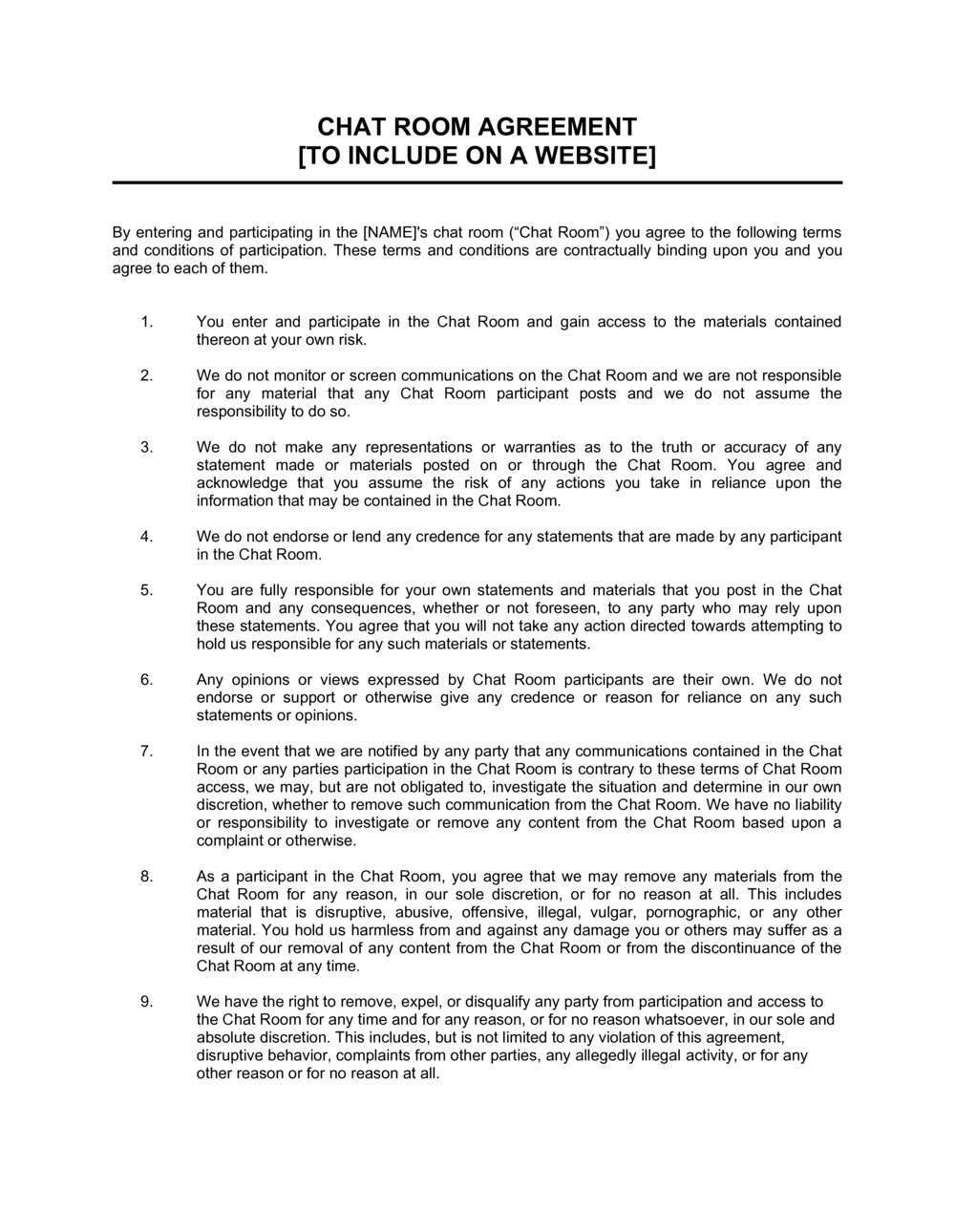
Chat Room Agreement Template

Free Word download • Edit online • Save & share with Drive • Export to PDF

2 pages25–30 min to fillDifficulty: StandardSignature requiredLegal review recommended
Learn more ↓
FreeChat Room Agreement Template

At a glance

What it is
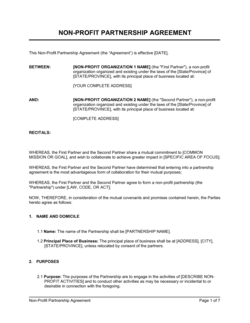
A Chat Room Agreement is a legally binding document that establishes the rules, rights, and obligations governing user participation in an online chat environment — whether a standalone chat room, a platform messaging feature, or a community forum. This free Word download lets you define acceptable conduct, content ownership, moderation authority, privacy practices, and liability limits in a single structured document you can edit online and export as PDF.
When you need it
Use it before launching any chat feature, online community, or messaging platform where multiple users interact in real time. It is equally necessary when adding a chat function to an existing website, SaaS product, or membership community.
What's inside
Acceptable use and prohibited conduct, content ownership and licensing, moderation and enforcement powers, privacy and data handling, disclaimers and limitation of liability, account suspension and termination, and governing law. Each clause is written to protect the platform operator while setting clear expectations for every participant.

What is a Chat Room Agreement?

A Chat Room Agreement is a legally binding document that governs user participation in an online chat environment — whether a standalone messaging room, an in-app team chat, a moderated community forum, or a live-event Q&A feature. It defines the rights and obligations of both the platform operator and every user who accesses the chat, covering acceptable conduct, content ownership, the operator's moderation authority, privacy practices, liability limits, and the conditions for account suspension or termination. Unlike a general website terms of use, a chat room agreement is purpose-built for interactive, real-time or asynchronous user-to-user communication — where the speed of interaction, volume of user-generated content, and potential for harmful conduct create distinct legal risks that broader site policies rarely address with enough specificity to be enforceable.

Why You Need This Document

Operating a chat feature without a binding agreement exposes you on every front simultaneously. Without defined conduct rules, you have no contractual basis to remove harmful posts or ban abusive users — and any moderation decision you do make can be challenged as arbitrary. Without a content license clause, users could argue the platform has no right to store or display their messages. Without a limitation of liability clause, a single harmful interaction between users could expose the operator to uncapped damages claims. Regulators in the US, UK, and EU are actively increasing platform accountability: the UK Online Safety Act and EU Digital Services Act both impose legal duties on user-to-user services that require documented, enforced community standards to satisfy. This template gives you a structured, jurisdiction-aware starting point — covering the conduct rules, moderation authority, privacy disclosures, and liability protections that any chat-enabled platform needs before a single user types their first message.

Which variant fits your situation?

If your situation is…Use this template
Running a public-facing chat room open to unregistered visitorsChat Room Agreement (Public)
Operating a private members-only community with paid subscriptionOnline Community Membership Agreement
Governing all user interactions across a full website or appWebsite Terms and Conditions
Handling personal data collected through chat interactionsPrivacy Policy
Protecting platform-hosted user-generated content more broadlyUser-Generated Content Policy
Setting rules for a child-directed chat platform or featureChildren's Online Privacy Policy (COPPA)
Covering moderators or staff who manage the chat environmentVolunteer/Moderator Agreement

Common mistakes to avoid

❌ Using browsewrap instead of clickwrap acceptance

Why it matters: Courts in the US, Canada, and UK have repeatedly declined to enforce agreements where users were not given clear notice and an affirmative opportunity to accept. A footer link alone is not sufficient.

Fix: Require users to check a box or click an explicit 'I Agree' button linked to the full agreement text before accessing the chat for the first time.

❌ Omitting a minimum age clause

Why it matters: Without an age gate, the operator is exposed to COPPA liability in the US and GDPR Article 8 liability in the EU — both of which carry substantial civil penalties for collecting personal data from minors without parental consent.

Fix: Add an explicit minimum age requirement and an affirmative age confirmation step during registration or first access.

❌ Describing moderation as an obligation rather than a right

Why it matters: Promising to monitor or remove harmful content creates a duty of care. If the platform fails to catch a harmful post, the operator can be held liable for breach of that promise — especially in the UK under the Online Safety Act.

Fix: Use consistent 'reserves the right' language throughout all moderation clauses: 'Operator may, but is not obligated to, monitor or remove content.'

❌ No data retention policy referenced for terminated accounts

Why it matters: Promising immediate deletion of all data on termination conflicts with data retention obligations in multiple jurisdictions — including SEC Rule 17a-4 for financial platforms and GDPR minimum retention standards.

Fix: Replace blanket deletion promises with a reference to your data retention policy, which should specify the applicable retention periods by data category and jurisdiction.

❌ Governing law clause with no EU or UK carve-out

Why it matters: The EU and UK apply mandatory consumer protection rules that override foreign governing law choices for users located there — a clause that ignores this is routinely struck down, which can void the entire dispute-resolution section.

Fix: Add a sentence acknowledging that mandatory consumer law in the user's jurisdiction may apply, and that this does not affect the operator's choice of law for all other disputes.

❌ Not updating the agreement after adding new platform features

Why it matters: If the chat room gains AI moderation, voice chat, video, or third-party integrations after the agreement was written, users interact with features that are not covered — creating uncontrolled liability exposure for the operator.

Fix: Build an amendment clause into the original agreement and treat every major feature addition as a trigger for a legal review of whether the current terms still cover the new functionality.

The 10 key clauses, explained

Parties, Platform Description, and Acceptance

In plain language: Identifies the platform operator and defines the chat environment being governed. Establishes that using the chat constitutes binding acceptance of all terms.

Sample language
This Chat Room Agreement ('Agreement') is entered into between [PLATFORM OPERATOR LEGAL NAME] ('Operator') and you ('User'). By accessing or participating in the [PLATFORM NAME] chat service ('Chat Service'), you agree to be bound by this Agreement.

Common mistake: Using a brand name instead of the operator's registered legal entity — if a dispute arises, enforcing the agreement against the correct legal person becomes complicated.

Eligibility and Registration

In plain language: Sets the minimum age for participation (typically 13 or 18), any account registration requirements, and the user's responsibility for maintaining accurate account information.

Sample language
You must be at least [AGE] years of age to use the Chat Service. By registering, you represent that all information you provide is accurate and that you will maintain its accuracy throughout your use of the Chat Service.

Common mistake: Omitting a minimum age requirement entirely. Without one, the operator faces COPPA liability in the US and equivalent child-protection obligations under GDPR Article 8 in the EU.

Acceptable Use and Prohibited Conduct

In plain language: Lists what users may and may not do in the chat — including prohibitions on harassment, hate speech, spam, illegal content, impersonation, and sharing personal data of third parties.

Sample language
Users shall not post content that is defamatory, harassing, obscene, fraudulent, or in violation of any applicable law. Prohibited conduct includes, but is not limited to: [LIST OF PROHIBITED BEHAVIORS], impersonating any person or entity, and transmitting unsolicited commercial messages.

Common mistake: Using a vague catch-all like 'inappropriate content' without specific examples. Courts and users interpret vague standards inconsistently — specificity both deters violations and supports enforcement decisions.

User-Generated Content Ownership and License

In plain language: Clarifies that users retain ownership of their content but grant the operator a license to store, display, moderate, and remove it as needed to operate the platform.

Sample language
You retain ownership of content you submit to the Chat Service. By submitting content, you grant [PLATFORM OPERATOR LEGAL NAME] a worldwide, royalty-free, non-exclusive license to use, store, display, and moderate such content solely to operate and improve the Chat Service.

Common mistake: Granting an overbroad perpetual license that covers commercial exploitation. Users who later discover their content has been repurposed beyond the platform's operation can challenge the clause as unconscionable.

Moderation Authority and Enforcement

In plain language: Reserves the operator's right to monitor, edit, remove, or archive any content and to suspend or terminate accounts — at any time, with or without notice — for any conduct that violates the agreement.

Sample language
Operator reserves the right, but not the obligation, to monitor, edit, or remove any content posted to the Chat Service and to suspend or terminate any User's account for violation of this Agreement, at Operator's sole discretion and without prior notice.

Common mistake: Framing moderation as an obligation rather than a right. If the agreement says the operator 'will' moderate all content, failing to catch harmful content can create liability — use 'reserves the right' language throughout.

Privacy and Data Collection

In plain language: Discloses what personal data is collected through the chat (messages, IP addresses, device identifiers), how it is used, and whether it is shared with third parties. Cross-references the operator's Privacy Policy.

Sample language
Operator may collect and process personal data you provide or that is generated through your use of the Chat Service, including message content, IP addresses, and usage metadata. Such data is handled in accordance with Operator's Privacy Policy, incorporated herein by reference.

Common mistake: Embedding a full privacy policy inside the chat room agreement. Duplication creates version-control problems — instead, incorporate the privacy policy by reference and keep each document current independently.

Disclaimers and Limitation of Liability

In plain language: States that the chat service is provided 'as is,' disclaims warranties about uptime and content accuracy, and caps the operator's total liability to users — typically to fees paid in the prior 12 months or a fixed nominal amount.

Sample language
THE CHAT SERVICE IS PROVIDED 'AS IS' WITHOUT WARRANTY OF ANY KIND. TO THE MAXIMUM EXTENT PERMITTED BY APPLICABLE LAW, OPERATOR'S TOTAL LIABILITY TO USER FOR ANY CLAIM ARISING UNDER THIS AGREEMENT SHALL NOT EXCEED $[AMOUNT] OR THE FEES PAID BY USER IN THE PRECEDING 12 MONTHS, WHICHEVER IS LESSER.

Common mistake: Omitting all-caps formatting for disclaimer and limitation-of-liability language. In the US, conspicuous display — typically uppercase — is required in several states for warranty disclaimers to be enforceable against consumers.

Indemnification

In plain language: Requires the user to defend and compensate the operator for any third-party claims, losses, or legal costs arising from the user's content or conduct on the platform.

Sample language
You agree to indemnify, defend, and hold harmless [PLATFORM OPERATOR LEGAL NAME] and its officers, directors, employees, and agents from and against any claims, liabilities, damages, and expenses (including reasonable attorneys' fees) arising out of your use of the Chat Service or your violation of this Agreement.

Common mistake: Including a mutual indemnification clause without legal review. For consumer-facing platforms, one-sided user indemnification is standard; mutual indemnification can inadvertently expand operator exposure to user claims.

Account Suspension and Termination

In plain language: Sets out the conditions under which accounts are suspended or permanently terminated, whether the operator must provide notice, and what happens to user content after termination.

Sample language
Operator may suspend or terminate your access to the Chat Service immediately and without notice for any violation of this Agreement. Upon termination, your right to access the Chat Service ceases. Operator may delete or retain your content at its discretion in accordance with its data retention policy.

Common mistake: Promising to delete all user data immediately upon termination without accounting for legal retention obligations. Many jurisdictions require retention of certain communications records for 12–36 months — a blanket immediate-deletion promise creates compliance conflicts.

Governing Law, Dispute Resolution, and Amendments

In plain language: Specifies the jurisdiction whose law governs the agreement, how disputes are resolved (arbitration, mediation, or court), and the operator's right to update the agreement with notice to users.

Sample language
This Agreement is governed by the laws of [STATE/COUNTRY], without regard to conflict-of-law principles. Disputes shall be resolved by binding arbitration administered by [AAA / JAMS] in [CITY]. Operator may amend this Agreement at any time by posting a revised version; continued use of the Chat Service following notice of amendment constitutes acceptance.

Common mistake: Choosing a governing law with no connection to where the operator or majority of users are located. In the EU and UK, consumer-protection rules may override a foreign governing law choice regardless of what the contract states.

How to fill it out

  1. 1

    Identify the operator's legal entity and describe the platform

    Enter the registered legal name of the business operating the chat service, not a brand or product name. Add a brief description of the chat environment — standalone room, in-app feature, or moderated community forum.

    💡 Cross-check the entity name against your corporate registry filing before inserting it — a mismatch between the agreement and your legal registration can complicate enforcement.

  2. 2

    Set the minimum age and eligibility requirements

    Choose a minimum age threshold of 13 (COPPA minimum in the US) or 16 (GDPR Article 8 default in most EU states) depending on your audience. If your platform is adult-only, set the threshold at 18 and include an age-verification acknowledgment.

    💡 If any part of your platform could attract users under 13, add an explicit COPPA compliance note and consider a separate children's privacy policy.

  3. 3

    Draft a specific list of prohibited conduct

    Replace generic language with an enumerated list of at least eight to ten specific behaviors — harassment, doxxing, spam, illegal content, impersonation, NSFW material, self-promotion, and so on. Tailor the list to your community type.

    💡 Mirror your prohibited-conduct list in your moderation guidelines so that enforcement decisions are consistent and defensible.

  4. 4

    Define the content license scope

    State explicitly that the license covers only what is necessary to operate the platform — storage, display, moderation, and service improvement. Avoid language implying the right to sell or commercially exploit user content.

    💡 If you plan to use anonymized chat data to train AI models, add a separate, conspicuous disclosure — several jurisdictions and platform-trust norms now require this.

  5. 5

    Set the limitation of liability cap

    Insert a specific dollar amount or tie it to fees paid in the prior 12 months. For free platforms, $100 is a common nominal cap. Ensure the cap is stated in a clearly visible clause using uppercase formatting where required.

    💡 Some US states — including New Jersey and Massachusetts — have consumer-protection statutes that limit how low a liability cap can be set for certain types of harm. Consider a legal review if your platform serves consumers in those states.

  6. 6

    Cross-reference your privacy policy

    Insert the URL of your current Privacy Policy and include a sentence confirming it is incorporated into the Chat Room Agreement by reference. Do not duplicate privacy policy text inside this document.

    💡 Update the Privacy Policy URL in the agreement whenever you revise the privacy policy — a dead link or outdated URL in a legal document creates unnecessary ambiguity.

  7. 7

    Choose governing law and dispute resolution method

    Select the jurisdiction where your business is incorporated or primarily operates. Choose between binding arbitration (lower cost, faster), mediation followed by arbitration, or courts of a specific jurisdiction. Include the city for arbitration or litigation venue.

    💡 If you have significant EU users, add a note acknowledging that EU consumer mandatory law may apply regardless of your chosen governing law — this reduces the risk of the entire clause being struck down.

  8. 8

    Establish an amendment process and execute before going live

    Include a clause allowing you to update the agreement by posting a revised version with reasonable notice. Ensure the agreement is signed or electronically acknowledged by users before they first access the chat — not after.

    💡 A clickwrap acceptance (checkbox with 'I agree to the Chat Room Agreement' linking to the full text) is more consistently enforceable than browsewrap, where the link is only in a footer.

Frequently asked questions

What is a chat room agreement?

A chat room agreement is a legally binding document between a platform operator and its users that governs participation in an online chat environment. It defines acceptable conduct, content ownership and licensing, moderation authority, privacy practices, liability limits, and the conditions for account suspension or termination. It functions as both a terms of use and a community conduct policy in a single enforceable document.

Do I need a chat room agreement for my platform?

Yes, if your platform allows any form of user-to-user text interaction — live chat, threaded messaging, or forum posts — you need a binding agreement in place before users begin interacting. Without one, you have no contractual basis to remove harmful content, ban abusive users, or limit your liability for third-party claims. Regulators in the US, UK, and EU increasingly expect platforms to have documented and enforced community standards.

What is the difference between a chat room agreement and website terms and conditions?

Website terms and conditions govern the entire relationship between a user and a site — including browsing, purchases, intellectual property, and general use. A chat room agreement focuses specifically on the rules, rights, and liability framework for real-time or asynchronous messaging features. Many operators use both: the broader terms of use for the platform as a whole and a dedicated chat room agreement for the interactive community component.

Is a chat room agreement enforceable if users just click 'I Agree'?

Clickwrap agreements — where users affirmatively check a box or click an 'I Agree' button linked to the full agreement text — are generally enforceable in the US, Canada, UK, and EU when the user has clear notice of what they are agreeing to. Courts have consistently upheld clickwrap agreements that meet these standards. Browsewrap agreements, where the link appears only in a site footer without affirmative acceptance, are far less reliably enforced and should be avoided for agreements you intend to rely on.

How does Section 230 affect my chat room agreement?

Section 230 of the US Communications Decency Act generally protects interactive computer service providers from liability for content posted by third-party users — meaning the chat room operator is typically not legally responsible for what users say to each other. However, Section 230 does not protect operators from federal criminal liability, does not apply outside the US, and can be affected by how the operator moderates content. A well-drafted chat room agreement complements Section 230 protection but does not replace it; a legal review is advisable for platforms with significant user bases.

What age restrictions should I include in a chat room agreement?

At minimum, set the threshold at 13 years old to align with COPPA in the US, which requires verifiable parental consent for collecting personal data from children under 13. Most EU member states set the digital consent age at 16 under GDPR Article 8 (though some permit 13). If your platform is adult-only, set the minimum age at 18 and include an explicit age-verification acknowledgment. Child-directed platforms require a separate COPPA-compliant privacy policy in addition to the chat room agreement.

Can I moderate or delete user content under the agreement?

Yes — a properly drafted chat room agreement reserves the operator's right to monitor, edit, archive, or remove any user-generated content and to suspend or terminate accounts without prior notice. The key drafting principle is to frame moderation as a right, not a duty. If the agreement promises to monitor all content, failing to catch harmful posts can create liability. Use 'reserves the right to' language consistently throughout the moderation clauses.

What data privacy requirements apply to a chat room?

Chat platforms typically collect message content, IP addresses, device identifiers, and usage metadata — all of which are personal data subject to GDPR in the EU, PIPEDA in Canada, and a patchwork of state laws in the US (including CCPA/CPRA in California). The chat room agreement should cross-reference a current Privacy Policy rather than duplicating privacy disclosures. If you plan to retain chat logs for moderation or compliance purposes, your data retention policy must specify how long records are kept and under what conditions they are deleted.

Do I need a lawyer to create a chat room agreement?

For a straightforward internal platform or small community, a high-quality template is a practical starting point. Engage a lawyer when your platform serves users in multiple jurisdictions (especially the EU or UK), when your chat feature processes sensitive data, when your user base includes minors, or when your platform has grown to the point where regulatory scrutiny — under the EU Digital Services Act or UK Online Safety Act — is a realistic risk. A 1–2 hour legal review typically costs $300–$600 and is worthwhile for any consumer-facing chat platform.

How often should I update my chat room agreement?

Review the agreement at least annually and whenever you add a significant new feature (voice, video, AI moderation, third-party integrations) or expand into a new jurisdiction. Regulatory changes — such as the EU Digital Services Act obligations that took full effect in 2024 or evolving state privacy laws in the US — can create new requirements that an older agreement does not address. Notify users of material changes before they take effect and require re-acceptance where your jurisdiction requires it.

How this compares to alternatives

vs Website Terms and Conditions

Website terms and conditions govern the full scope of a user's relationship with a site — navigation, purchases, IP, and general use. A chat room agreement is a narrower, focused document covering only the interactive messaging environment. Platforms with both a general website and a chat feature typically need both documents, with the chat room agreement either incorporated by reference or presented as a separate clickwrap at chat entry.

vs Privacy Policy

A privacy policy discloses how personal data is collected, used, and shared across the entire platform. A chat room agreement references the privacy policy and adds conduct rules, content licensing, and moderation authority specific to the chat environment. The two documents are complementary — a chat room agreement without a current privacy policy cross-reference is legally incomplete in any jurisdiction with data protection law.

vs Non-Disclosure Agreement

An NDA is a bilateral contract preventing specific parties from disclosing defined confidential information. A chat room agreement is a platform governance document covering all users simultaneously. If a chat environment is used for sensitive business discussions — such as a client collaboration portal — a separate NDA between the specific parties provides targeted confidentiality protection that a general chat room agreement cannot deliver.

vs Acceptable Use Policy

An acceptable use policy (AUP) focuses exclusively on prohibited behaviors and enforcement mechanisms — it is essentially one clause of a chat room agreement expanded into a standalone document. A chat room agreement is broader, adding content licensing, liability limits, privacy disclosures, and dispute resolution. For platforms with complex conduct requirements, maintaining a standalone AUP incorporated by reference into the chat room agreement keeps each document concise and independently updatable.

Industry-specific considerations

SaaS / Technology

In-app messaging and team chat features raise IP ownership questions about work-product shared via chat; the agreement must address whether message content is company data or user data.

E-learning and Education

Student-facing chat rooms often involve minors, triggering COPPA and FERPA obligations in the US; the agreement must include age restrictions and reference compliant data handling practices.

Gaming and Entertainment

High-volume, anonymous player chat creates elevated harassment and hate-speech risks; the prohibited-conduct clause and moderation authority sections require more granular enumeration than most platforms.

Financial Services

Regulated firms using chat for client communication face SEC, FINRA, or FCA recordkeeping obligations that require the agreement to align with mandatory retention schedules rather than promising user-controlled deletion.

Healthcare

Any chat feature that handles patient health information intersects with HIPAA in the US and equivalent medical data regulations in the EU; the privacy clause must reference BAA requirements and restrict disclosure of health-related messages.

Retail / E-commerce

Marketplace buyer-seller messaging requires the agreement to address fraud, off-platform solicitation, and the operator's right to review communications to enforce marketplace policies.

Jurisdictional notes

United States

Section 230 of the Communications Decency Act provides broad immunity for platform operators from liability for third-party user content, but does not cover federal criminal violations or protect operators who materially contribute to harmful content. COPPA requires verifiable parental consent for users under 13. State laws — particularly California's CCPA/CPRA — impose additional data rights that must be reflected in the Privacy Policy cross-referenced by the agreement. Several states are actively considering or have enacted new platform-liability and minor-protection statutes.

Canada

PIPEDA (and Quebec's Law 25, which imposes stricter requirements) governs personal data collected through chat interactions, including message logs and IP addresses. Canada has no direct equivalent to Section 230, and platform operators face greater exposure for hosting harmful content. Quebec's French-language requirements may apply to consumer-facing agreements for platforms with Quebec users. The minimum digital age of consent is 13 federally but 14 under Quebec's Act Respecting the Protection of Personal Information in the Private Sector.

United Kingdom

The Online Safety Act 2023 imposes legally enforceable duties of care on user-to-user services to prevent illegal content and, for larger platforms, to address legal but harmful content. The moderation authority and enforcement clauses must be drafted to reflect these proactive obligations rather than passive 'right to remove' language. UK GDPR applies to personal data of UK residents. Consumer protection law may override foreign governing law clauses for UK-based users, meaning a US or EU governing law selection may not be fully effective.

European Union

The EU Digital Services Act (DSA), fully applicable since February 2024, requires platforms providing intermediary services — including chat — to implement notice-and-action mechanisms, publish transparency reports, and provide redress for content moderation decisions. GDPR requires a lawful basis for processing chat-generated personal data and restricts transfers outside the EEA. The digital age of consent varies by member state (13–16 years). A foreign governing law clause does not override EU mandatory consumer and data protection rules for EU-resident users.

Template vs lawyer — what fits your deal?

PathBest forCostTime
Use the templateSmall communities, internal team chat tools, or single-jurisdiction platforms with a general adult user baseFree30–60 minutes
Template + legal reviewConsumer-facing chat platforms, platforms with minor users, or those expanding into EU or UK markets$300–$7002–5 days
Custom draftedLarge-scale platforms subject to the EU Digital Services Act, UK Online Safety Act, COPPA-regulated products, or financial and healthcare chat environments$1,500–$5,000+2–4 weeks

Glossary

Acceptable Use Policy (AUP)
A written set of rules specifying how users may and may not use a platform, network, or service — forming the behavioral backbone of a chat room agreement.
User-Generated Content (UGC)
Any text, images, links, or media that a user posts or transmits through the platform, as distinct from content the operator itself publishes.
Content License
The grant of rights from a user to the platform operator allowing the operator to store, display, moderate, or remove content submitted through the chat.
Moderation
The process of reviewing, filtering, editing, or removing user content and suspending or banning accounts that violate the platform's conduct rules.
Limitation of Liability
A clause capping the operator's financial exposure to users — typically limiting damages to fees paid or a fixed dollar amount — for claims arising from platform use.
Safe Harbor (Section 230)
A US legal protection under 47 U.S.C. § 230 that generally shields interactive computer service providers from liability for third-party content posted on their platforms.
Account Suspension
Temporary restriction of a user's access to the chat platform, typically triggered by a conduct violation pending investigation or as a graduated enforcement step.
Termination for Cause
Permanent removal of a user's account due to a serious or repeated violation of the chat room agreement, without obligation to provide a refund or continued access.
Indemnification
A contractual obligation requiring the user to compensate the platform operator for any losses, legal costs, or claims arising from the user's conduct or content.
Governing Law
The jurisdiction whose laws will be used to interpret and enforce the agreement, typically the state or country where the platform operator is incorporated.
COPPA
The Children's Online Privacy Protection Act — a US federal law requiring verifiable parental consent before collecting personal data from children under 13.
GDPR
The EU General Data Protection Regulation — a comprehensive data privacy framework requiring lawful basis for processing personal data of EU residents, with significant penalties for non-compliance.

Part of your Business Operating System

This document is one of 3,000+ business & legal templates included in Business in a Box.

  • Fill-in-the-blanks — ready in minutes
  • 100% customizable Word document
  • Compatible with all office suites
  • Export to PDF and share electronically

Create your document in 3 simple steps.

From template to signed document — all inside one Business Operating System.
1
Download or open template

Access over 3,000+ business and legal templates for any business task, project or initiative.

2
Edit and fill in the blanks with AI

Customize your ready-made business document template and save it in the cloud.

3
Save, Share, Send, Sign

Share your files and folders with your team. Create a space of seamless collaboration.

Save time, save money, and create top-quality documents.

★★★★★

"Fantastic value! I'm not sure how I'd do without it. It's worth its weight in gold and paid back for itself many times."

Managing Director · Mall Farm
Robert Whalley
Managing Director, Mall Farm Proprietary Limited
★★★★★

"I have been using Business in a Box for years. It has been the most useful source of templates I have encountered. I recommend it to anyone."

Business Owner · 4+ years
Dr Michael John Freestone
Business Owner
★★★★★

"It has been a life saver so many times I have lost count. Business in a Box has saved me so much time and as you know, time is money."

Owner · Upstate Web
David G. Moore Jr.
Owner, Upstate Web

Run your business with a system — not scattered tools

Stop downloading documents. Start operating with clarity. Business in a Box gives you the Business Operating System used by over 250,000 companies worldwide to structure, run, and grow their business.

Free Forever Plan · No credit card required