Casting Sheet Template

Free Word download • Edit online • Save & share with Drive • Export to PDF

2 pages20–25 min to fillDifficulty: Standard
Learn more ↓
FreeCasting Sheet Template

At a glance

What it is
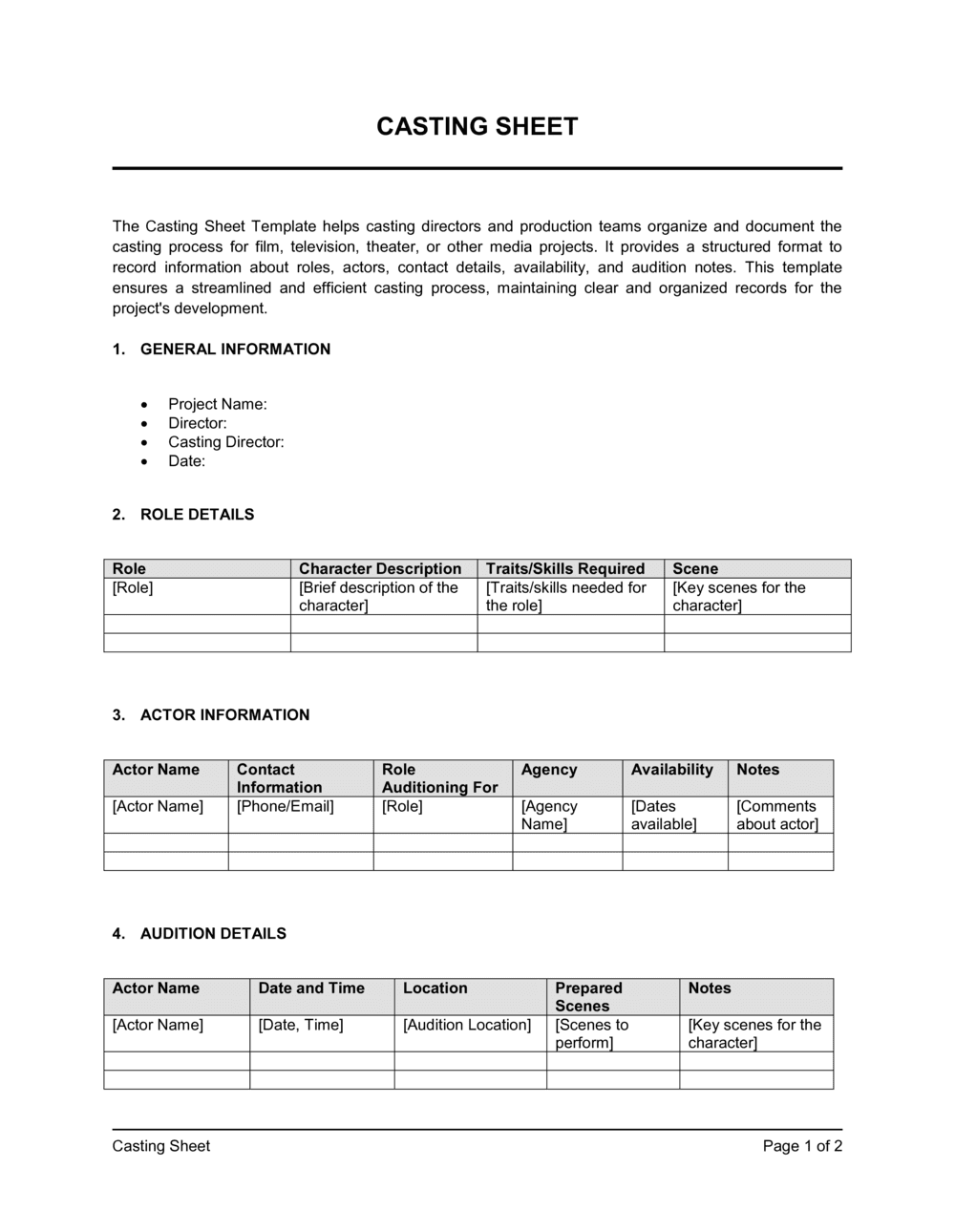
A Casting Sheet is a structured form used by directors, producers, and casting coordinators to record and compare auditioner information for specific roles in a production. This free Word download gives you a ready-to-use form you can edit online and print or share digitally to capture headshot references, physical attributes, experience, and evaluator notes across every candidate seen for a role.
When you need it
Use it whenever you are holding auditions or open calls for a film, television episode, theater production, commercial, or voice-over project and need a consistent record of every performer considered for each role.
What's inside
Production and role details, performer contact and physical information, experience and availability fields, and a structured evaluator scoring and notes section — covering everything needed to compare candidates and document callback decisions.

What is a Casting Sheet?

A Casting Sheet is a structured form used by directors, producers, and casting coordinators to record and evaluate every performer considered for a specific role in a film, television, theater, commercial, or corporate video production. It captures each auditioner's contact details, physical attributes, union status, availability, and evaluator scores in a consistent format — so that everyone on the creative team can compare candidates objectively across multiple audition sessions and callback rounds.

Why You Need This Document

Without a standardized casting sheet, audition records fragment across sticky notes, emails, and verbal recollections — and after a long day of callbacks, details blur fast. Missing union status information can trigger unexpected signatory obligations or penalty payments mid-production. Undocumented brand exclusivity conflicts can force a re-cast after an offer is already extended. And when a casting decision is later questioned by a performer, an agency, or a funder, a complete paper trail is your primary evidence that the process was conducted fairly. This template gives you a consistent, ready-to-use form that captures every field you need from check-in through final decision — so your casting process is organized, defensible, and easy to hand off to anyone on the team.

Which variant fits your situation?

If your situation is…Use this template
Auditioning actors for a feature film with multiple rolesCasting Sheet (Film)
Holding open-call auditions for a stage musical or playTheater Audition Form
Booking talent for a commercial or print advertisementTalent Booking Form
Tracking background extras across multiple shoot daysExtras Casting Log
Selecting voice-over talent for an audio or video projectVoice-Over Casting Sheet
Managing model submissions for a fashion show or lookbookModel Casting Sheet
Documenting talent considered for a corporate spokesperson roleOn-Camera Talent Evaluation Form

Common mistakes to avoid

❌ Using one sheet for multiple roles

Why it matters: Evaluator notes for different characters become mixed, making it impossible to compare performers fairly within a single role.

Fix: Prepare one casting sheet per role before auditions begin and assign each performer to the correct sheet at check-in.
❌ Skipping union status verification

Why it matters: Booking a union performer on a non-union production — or vice versa — can trigger penalty payments, signatory obligations, or talent withdrawal mid-production.

Fix: Confirm union card status and record the membership number for every performer at the audition, not at the offer stage.

❌ Relying solely on free-text notes for evaluation

Why it matters: After 30 or more auditions, qualitative notes alone cannot produce a defensible ranking when multiple stakeholders disagree on the shortlist.

Fix: Use a 1–5 numeric scale for at least three dimensions — read quality, physicality, and overall presence — in addition to free-text comments.

❌ Not recording brand exclusivity conflicts for commercial work

Why it matters: A performer contracted exclusively to a competing brand cannot appear in your campaign, and discovering this after an offer is extended causes costly re-casting delays.

Fix: Add a dedicated exclusivity field to every casting sheet used for commercial or branded content auditions and check it before extending callbacks.

The 9 key fields, explained

Production and role information

Audition date and session number

Performer name and contact details

Representation

Physical attributes

Union status and rate

Availability and conflicts

Evaluator scores and impressions

Callback and decision status

How to fill it out

  1. 1

    Set up one sheet per role

    Create a separate casting sheet for each named role in the production. Place the production title, role name, and role type at the top before the session begins.

    💡 Color-code sheets by role when running multi-role audition days — sorting by color at wrap is faster than reading headers.

  2. 2

    Assign a session number and record the date

    Number each session sequentially and enter the audition date and call time before the first performer arrives.

    💡 If auditions run across multiple days, restart session numbering from 1 each day and prefix with the date — e.g., 0502-001 — to prevent duplicate numbers.

  3. 3

    Capture performer contact and representation details

    Record the performer's legal name, direct contact information, and agency submission reference at check-in, not from memory after the session.

    💡 Have performers verify their contact details on the form at check-in rather than relying on a casting database that may be outdated.

  4. 4

    Log physical attributes and union status

    Fill in height, hair, eye color, and any role-specific attributes. Confirm union card status and note the card number for SAG-AFTRA or Equity members.

    💡 For physical attributes, measure rather than estimate — costume departments routinely flag sheets where height was guessed and later proved incorrect.

  5. 5

    Record availability and conflicts before the read

    Ask about shoot-date availability and any existing booking conflicts or brand exclusivities before investing time in the full audition.

    💡 A 30-second availability check at the start of each session prevents wasted callback time on performers who cannot actually take the role.

  6. 6

    Score and annotate immediately after each read

    Enter numeric scores and brief impressions within two minutes of the performer leaving the room — memory degrades rapidly across a full audition day.

    💡 Keep a consistent scoring rubric posted at the evaluation table so all panelists score the same dimensions in the same order.

  7. 7

    Update status fields after each round

    Mark each sheet as callback, hold, offer extended, or released at the end of each session or day. Do not leave status fields blank overnight.

    💡 Photograph or scan completed sheets at the end of each day before storing the physical copies — a backup prevents a total loss if originals are misplaced.

Frequently asked questions

What is a casting sheet?

A casting sheet is a structured form used by directors, producers, and casting coordinators to record each auditioner's contact details, physical attributes, union status, availability, and evaluator scores for a specific role in a production. It creates a consistent, comparable record across every performer seen, making shortlisting and callback decisions faster and more defensible.

What is the difference between a casting sheet and a call sheet?

A casting sheet is used during the pre-production audition process to evaluate and select performers. A call sheet is a production document issued before each shoot day listing the crew, cast, locations, and shooting schedule. The two documents serve entirely different purposes and are used at different stages of the production timeline.

Who fills out a casting sheet?

Typically, a casting coordinator or assistant records the performer's information at check-in, while the director or casting director completes the evaluation scores and notes after each read. On smaller productions, a single person may handle both roles.

Do I need a separate casting sheet for each role?

Yes. Using one sheet per role keeps evaluator notes and scores organized by character, which is essential when the same performer auditions for multiple roles or when dozens of performers are seen across several days. Mixing roles on a single sheet makes objective comparison nearly impossible.

Should performers sign the casting sheet?

A standard casting sheet does not require a performer's signature. However, if you are collecting personal data subject to privacy regulations, or if the sheet doubles as a release for audition footage, add a signature block and a brief consent statement. For productions subject to GDPR or CCPA, consult your legal team on data retention and consent requirements.

How long should casting sheets be kept after a production?

Retain casting sheets for at least two years after the production wraps. If a discrimination claim or contract dispute arises, casting records are primary evidence of the selection process. Productions in regulated industries or receiving public funding may be subject to longer retention requirements — check applicable local rules.

Can a casting sheet be used for background extras?

Yes, though a simplified version with fewer evaluation fields is common for extras work. Key fields to retain are performer name, contact, union status, physical attributes, and confirmed shoot-date availability. Detailed read-quality scoring is typically not needed for non-speaking background roles.

How is a casting sheet different from a talent release form?

A casting sheet is an internal evaluation and tracking document used during auditions; it has no contractual effect. A talent release form is a legal document signed by the performer granting the production rights to use their likeness, voice, or performance. Both are standard documents in professional productions, but they serve separate purposes at different stages.

How this compares to alternatives

vs Call Sheet

A call sheet is issued before each shoot day to communicate crew, cast, locations, and schedule to the entire production team. A casting sheet is an internal audition record used weeks or months earlier during talent selection. They cover different stages of production and should never be confused or combined.

vs Talent Release Form

A talent release form is a signed legal document granting the production rights to use a performer's likeness. A casting sheet is an internal evaluation form with no contractual effect. Productions need both — the casting sheet during auditions, the release form at or before the first day of performance or filming.

vs Audition Sign-In Sheet

An audition sign-in sheet captures only basic check-in data — name, time, and contact — to manage the flow of performers through the room. A casting sheet is a full evaluation record that includes scoring, physical attributes, availability, and callback status. The sign-in sheet feeds into the casting sheet but does not replace it.

vs Talent Agreement

A talent agreement is the binding contract executed once a performer is selected, covering pay, usage rights, exclusivity, and deliverables. A casting sheet is a pre-selection document used to reach that decision. The casting sheet informs the offer; the talent agreement formalizes it.

Industry-specific considerations

Film and television

Multi-role audition tracking across callback rounds, union compliance notation, and avail-check documentation for principal and day-player roles.

Theater and live performance

Open-call management for musicals and plays, Equity status verification, and ensemble continuity tracking across a full season of productions.

Advertising and commercial production

Brand exclusivity conflict screening, on-camera presence scoring, and multi-agency submission tracking for talent considered across competing campaigns.

Corporate video and training

On-screen spokesperson selection, non-union talent coordination, and internal approval documentation for stakeholders not present at the audition.

Template vs pro — what fits your needs?

PathBest forCostTime
Use the templateIndependent filmmakers, theater companies, and small production teams running their own auditionsFree10 minutes to set up per role
Template + professional reviewProductions collecting audition footage or personal data that may trigger GDPR or CCPA consent requirements$100–$300 for a brief legal review of consent language1–2 days
Custom draftedLarge studio productions with union signatory obligations, multi-country talent pools, or integrated casting database requirements$500–$2,000 for custom form design and database integration1–2 weeks

Glossary

Casting Sheet
A standardized form used to record each auditioner's attributes, experience, and evaluator feedback for a specific production role.
Callback
A second or subsequent audition invitation extended to performers who advanced past the initial round of consideration.
Sides
Short excerpts from a script given to auditioners to prepare and perform during an audition.
Headshot
A professional photograph of the performer, typically cropped at the shoulders, used by casting teams to identify and remember candidates.
Slate
A brief self-introduction by the performer at the start of an audition — stating their name, representation, and sometimes the role they are reading for.
Type
A shorthand descriptor for the kind of roles a performer is best suited to based on appearance, voice, and energy — such as 'leading man' or 'character actor.'
Avail Check
A preliminary inquiry to confirm a performer's availability for specific shoot or performance dates before an offer is formally extended.
Scale Rate
The minimum pay rate established by a performers' union (such as SAG-AFTRA or Equity) for a given type of engagement.
Non-Union Talent
A performer who is not a member of any performers' union, allowing engagement outside collective bargaining minimums.
Principal Role
A speaking or featured character role, as distinguished from background or extra work, typically carrying higher pay and billing.

Part of your Business Operating System

This document is one of 3,000+ business & legal templates included in Business in a Box.

  • Fill-in-the-blanks — ready in minutes
  • 100% customizable Word document
  • Compatible with all office suites
  • Export to PDF and share electronically

Create your document in 3 simple steps.

From template to signed document — all inside one Business Operating System.
1
Download or open template

Access over 3,000+ business and legal templates for any business task, project or initiative.

2
Edit and fill in the blanks with AI

Customize your ready-made business document template and save it in the cloud.

3
Save, Share, Send, Sign

Share your files and folders with your team. Create a space of seamless collaboration.

Save time, save money, and create top-quality documents.

★★★★★

"Fantastic value! I'm not sure how I'd do without it. It's worth its weight in gold and paid back for itself many times."

Managing Director · Mall Farm
Robert Whalley
Managing Director, Mall Farm Proprietary Limited
★★★★★

"I have been using Business in a Box for years. It has been the most useful source of templates I have encountered. I recommend it to anyone."

Business Owner · 4+ years
Dr Michael John Freestone
Business Owner
★★★★★

"It has been a life saver so many times I have lost count. Business in a Box has saved me so much time and as you know, time is money."

Owner · Upstate Web
David G. Moore Jr.
Owner, Upstate Web

Run your business with a system — not scattered tools

Stop downloading documents. Start operating with clarity. Business in a Box gives you the Business Operating System used by over 250,000 companies worldwide to structure, run, and grow their business.

Start free · No credit card required