Car Dealership Business Plan Template

Free Word download β€’ Edit online β€’ Save & share with Drive β€’ Export to PDF

26 pagesβ€’2h 20m – 3h 5m to fillβ€’Difficulty: Expert
Learn more ↓
FreeCar Dealership Business Plan Template

At a glance

What it is
A Car Dealership Business Plan is a structured operational document that maps a dealership's market opportunity, inventory model, sales and finance strategy, staffing plan, and 3–5 year financial projections into a single presentation-ready file. This free Word download gives you a complete, lender-ready starting point you can edit online and export as PDF to share with banks, franchise manufacturers, or investors.
When you need it
Use it when applying for a floor-plan financing line, seeking a franchise agreement with an OEM, opening a new dealership location, or acquiring an existing lot and needing to present a credible operational strategy to lenders or partners.
What's inside
Executive summary, dealership concept and location analysis, market and competitive landscape, inventory and procurement strategy, sales and F&I revenue model, marketing plan, organizational structure, and full financial projections including floor-plan cost, gross profit per unit, and monthly cash flow.

What is a Car Dealership Business Plan?

A Car Dealership Business Plan is a structured operational document that defines a dealership's market opportunity, inventory model, revenue strategy across new vehicles, used vehicles, and F&I, staffing plan, and 3–5 year financial projections into a single lender-ready file. Unlike a generic business plan, it incorporates automotive-industry mechanics as core sections: floor-plan financing cost, inventory days supply targets, gross profit per retail unit by department, and OEM franchise requirements. It functions as both an internal operating roadmap and the primary submission document for floor-plan lenders, SBA loan applications, and OEM franchise candidate reviews.

Why You Need This Document

Without a formal dealership business plan, floor-plan lenders have no basis to evaluate your inventory carrying capacity, and OEM franchise departments will not advance your application past the initial screening call. A dealership that opens without a written plan routinely discovers working capital shortfalls in Month 2 or 3 β€” before the sales team has reached productive volume β€” because the cash requirements of floor-plan interest, payroll, and facility costs were never modeled against a realistic unit ramp. Lenders also use the plan to set your initial floor-plan line limit; an underdocumented application typically results in a smaller line than the inventory model requires, constraining sales before the business has started. This template gives you the industry-specific structure that automotive lenders recognize, with every section β€” floor-plan cost, F&I income, service absorption, and use of funds β€” built in and ready to complete.

Which variant fits your situation?

If your situation is…Use this template
Opening a franchised new-vehicle dealership with an OEMFranchise Car Dealership Business Plan
Launching an independent used-car lotUsed Car Dealership Business Plan
Applying for SBA financing for a dealership startupBank Loan Business Plan
Expanding an existing dealership into a second locationBusiness Expansion Plan
Starting a dealership focused exclusively on EVsEV Dealership Business Plan
Quick internal planning before a formal plan is writtenOne-Page Business Plan
Presenting an acquisition deal to investorsInvestor Business Plan

Common mistakes to avoid

❌ Omitting floor-plan interest from the P&L

Why it matters: Floor-plan interest is one of the largest operating expenses for a dealership, often $15,000–$50,000 per month at scale. Excluding it produces a net income figure that bears no relationship to actual cash performance.

Fix: Model floor-plan interest as its own P&L line using your expected line size, average inventory turn, and current floor-plan rate. Update it monthly as inventory levels change.

❌ Using national averages instead of local market data

Why it matters: OEM franchise departments and automotive lenders evaluate the specific trade area. A plan quoting national average household income or vehicle-per-capita rates instead of local DMV registration data is rejected as insufficiently researched.

Fix: Pull trade area data from your state DMV, Polk/S&P Global Mobility, or the OEM's own market study. Cite your sources with the report name and date.

❌ Understating working capital requirements

Why it matters: Most new dealerships require 60–90 days of operating expenses in reserve before unit sales generate enough gross profit to cover overhead. Underestimating this figure leads to a cash crisis in Month 2 or 3, before the sales team has hit stride.

Fix: Calculate total monthly fixed overhead (rent, payroll, advertising, floor-plan minimum) and multiply by 3 as the minimum working capital reserve to include in the funding ask.

❌ Projecting headcount without tying it to volume

Why it matters: A plan showing 80 units per month with a 3-person sales team and no BDC implies either that each salesperson sells 27 units per month (unrealistic) or that the volume projection is inflated.

Fix: Use industry benchmarks: a productive salesperson averages 10–15 units per month. Staff each department to the volume projection and show the headcount ramp alongside the sales ramp.

❌ Ignoring fixed operations in the plan

Why it matters: Service and parts departments typically generate 40–60% of a mature dealership's gross profit and are the primary financial buffer when vehicle sales slow. A plan that treats fixed ops as a footnote signals inexperience to OEM reviewers.

Fix: Model the service department separately with bay count, technician hours, effective labor rate, and a service absorption target. Include it in the gross profit waterfall.

❌ Writing the executive summary before completing the financials

Why it matters: An executive summary written before the financial model is complete will cite unit targets and revenue figures that contradict the detailed projections β€” an immediate credibility problem with any lender.

Fix: Complete every other section of the plan first, then write the executive summary as a distillation of the finished document.

The 10 key sections, explained

Executive Summary

Business Overview and Dealership Concept

Market and Location Analysis

Inventory and Procurement Strategy

Sales Strategy and Revenue Model

Marketing and Customer Acquisition Plan

Organizational Structure and Staffing Plan

Service and Fixed Operations Plan

Financial Projections

Funding Requirements and Use of Funds

How to fill it out

  1. 1

    Define the dealership concept and legal structure

    Enter your legal entity name, state of organization, ownership structure, and whether the dealership will be franchised (OEM-affiliated) or independent. Note the franchise brand if applicable.

    πŸ’‘ Confirm your entity type with your accountant before filing β€” an S-Corp or LLC structure affects how floor-plan lenders evaluate owner liability.

  2. 2

    Research the local trade area with primary data

    Pull vehicle registration data from your state DMV or a data provider like Polk/S&P Global Mobility. Map competing rooftops within a 15-mile radius and identify the demand gap your dealership fills.

    πŸ’‘ OEM franchise departments will cross-reference your market data against their own registration studies β€” use the same data sources they do to avoid discrepancies.

  3. 3

    Build the inventory model with floor-plan cost

    Set your target units on hand for new and used vehicles, identify sourcing channels and percentages, and calculate monthly floor-plan carrying cost at your expected rate. Model 30-day, 45-day, and 60-day supply scenarios.

    πŸ’‘ Every 15 additional days of supply at a 100-unit lot adds roughly $7,000–$12,000/month in floor-plan interest at current rates β€” show the sensitivity in your plan.

  4. 4

    Project revenue by department using per-unit metrics

    Build the revenue model from the unit level up: new-vehicle front-end gross PRU, used-vehicle front-end gross PRU, F&I income PRU, and service revenue per repair order. Multiply by projected monthly volume in each department.

    πŸ’‘ Use NADA 20 Group averages for your franchise brand or segment as a benchmark β€” lenders recognize these figures and will compare your assumptions against them.

  5. 5

    Lay out the marketing budget and cost-per-sale

    Allocate your monthly advertising spend across digital, traditional, and OEM co-op channels. Calculate the implied cost per lead and cost per unit sold, and confirm the ratios are consistent with industry benchmarks.

    πŸ’‘ OEM co-op programs can offset 50–100% of qualified digital advertising costs β€” confirm eligibility requirements before finalizing the budget.

  6. 6

    Define the org chart and hiring timeline

    Map every department role to a headcount number and hire date. Tie each hire directly to a volume trigger β€” for example, a second F&I manager when monthly retail units exceed 60.

    πŸ’‘ Include compensation structure (salary vs. commission) for each role β€” automotive lenders know industry pay plans and will flag unrealistic comp projections.

  7. 7

    Build the three-statement financial model

    Model P&L, cash flow, and balance sheet monthly for Year 1 and annually for Years 2–5. Include floor-plan interest as a standalone expense line and show the cash breakeven unit volume.

    πŸ’‘ Run a stress test at 70% of projected unit volume β€” if the dealership cannot survive a slow quarter, the working capital reserve is likely undersized.

  8. 8

    Write the executive summary last

    Summarize the concept, market opportunity, funding ask, Year 1 unit target, and the ownership team's dealership experience in no more than two pages. Pull every data point from the completed sections.

    πŸ’‘ Floor-plan lenders and OEM franchise teams read the executive summary and financials first β€” if those two sections are not self-consistent, the rest of the plan will not be reviewed.

Frequently asked questions

What is a car dealership business plan?

A car dealership business plan is a structured document that defines a dealership's concept, target market, inventory model, revenue strategy, staffing plan, and 3–5 year financial projections. It is used to secure floor-plan financing, obtain an OEM franchise agreement, apply for an SBA or commercial real estate loan, or present an acquisition strategy to investors. A complete plan covers both variable operations (vehicle sales and F&I) and fixed operations (service and parts).

What do floor-plan lenders look for in a dealership business plan?

Floor-plan lenders primarily evaluate the owner's dealership experience, the projected inventory turn rate, the working capital reserve, and the cash flow model at various volume scenarios. They want to see floor-plan interest modeled as a standalone P&L expense and a demonstrated understanding of local market demand. Lenders also look for an equity injection of at least 10–20% of the total facility cost.

Do I need a business plan to get a car dealership franchise?

Yes. Every major OEM β€” Ford, Toyota, GM, Honda, and others β€” requires a formal business plan as part of the dealer candidate application. The plan must include a market analysis using the OEM's trade area definitions, a facility plan meeting brand standards, a capitalization summary, and a 5-year financial projection. Requirements vary by brand; confirm the specific format and data sources with the OEM's regional dealer development representative before submitting.

How long should a car dealership business plan be?

A complete dealership business plan runs 25–40 pages plus a financial model appendix. The narrative sections (market analysis, inventory strategy, marketing plan, org chart) typically run 15–20 pages. The financial model β€” monthly P&L for Year 1 and annual statements for Years 2–5 β€” is presented as a separate Excel appendix and is often the section lenders and OEM reviewers spend the most time on.

What financial projections should a car dealership business plan include?

At minimum: a monthly P&L for Year 1 and annual P&L for Years 2–5, a monthly cash flow statement, a projected balance sheet, and a departmental gross profit waterfall separating new-vehicle, used-vehicle, F&I, and service/parts contributions. The model should include floor-plan interest as a separate expense line, show the cash breakeven unit volume, and include a sensitivity analysis at 70% and 85% of projected sales.

What is a realistic gross profit per unit for a car dealership?

For franchised new-vehicle dealerships, total front-end gross (selling price minus dealer cost) typically runs $1,500–$3,500 per unit depending on brand and market conditions. F&I income adds another $1,200–$2,200 per retail unit on average. Used vehicles tend to carry higher front-end gross β€” $2,000–$4,000 per unit β€” but with greater reconditioning cost variability. NADA 20 Group benchmarks for your specific brand are the most reliable reference.

How much capital do I need to open a car dealership?

Capital requirements vary widely by franchise brand, facility ownership vs. lease, and market size. A modest independent used-car lot can launch with $150,000–$500,000 in combined floor-plan, facility, and working capital. A franchised new-vehicle dealership typically requires $1M–$5M in total capitalization, with OEMs often mandating a minimum net worth and liquid capital threshold for franchise candidates. Confirm the OEM's minimum capitalization requirements early in the process.

Can I use this template for a used-car dealership?

Yes. The template is structured to cover both franchised new-vehicle and independent used-vehicle operations. For a used-car dealership, the inventory section should focus on auction sourcing, trade-in reconditioning costs, and days supply targets for a used-only lot. The F&I section should reflect the lender tier mix typical for used-vehicle buyers. The OEM franchise sections can be omitted or replaced with a dealer license and compliance overview.

How often should a car dealership business plan be updated?

Update the plan annually to reflect actual vs. projected performance and revised market conditions. For active lender or OEM relationships, a mid-year financial model update is standard, particularly if inventory mix, floor-plan rates, or staffing have changed materially. A plan more than 18 months old is not suitable for a new financing application without a full refresh of the market analysis and financial projections.

How this compares to alternatives

vs General Business Plan

A general business plan covers the universal elements of any venture β€” market analysis, team, financials β€” but lacks automotive-specific sections such as floor-plan financing, inventory days supply, F&I income modeling, and OEM franchise requirements. A car dealership business plan embeds these industry mechanics as first-class sections rather than generic notes.

vs One-Page Business Plan

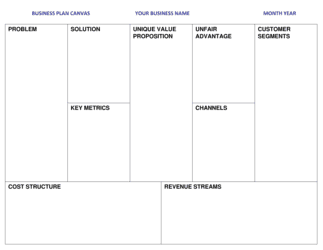
A one-page plan is useful for rapid internal alignment or early-stage ideation but is entirely insufficient for a floor-plan lender, OEM franchise application, or SBA loan. Dealership lenders require a full three-statement financial model and detailed market evidence. Use the one-page canvas to test the concept, then build the full dealership plan before any capital conversation.

vs Strategic Plan

A strategic plan focuses on goals, initiatives, and KPIs for an operating business β€” it is an internal alignment tool, not a capital-raising document. A car dealership business plan is externally oriented, built to satisfy lender and OEM due diligence requirements, and includes the capitalization structure and financial projections a strategic plan omits.

vs Financial Projections Template

A standalone financial projections template covers the numbers β€” P&L, cash flow, balance sheet β€” but provides no market context, inventory strategy, or operational narrative. Lenders and OEM franchise teams require both the financial model and the business plan narrative to evaluate a dealership application. The projections template is best used as the financial appendix to the full dealership plan.

Industry-specific considerations

New-Vehicle Franchised Dealers

OEM franchise application requirements, CSI score targets, holdback modeling, and facility investment standards set by the manufacturer.

Independent Used-Car Dealers

Auction sourcing strategy, reconditioning cost per unit, subprime lender relationships, and lot-level inventory turn targets without OEM allocation support.

Luxury and Specialty Automotive

Higher per-unit gross with lower volume, white-glove service department economics, certified pre-owned program participation, and affluent buyer marketing channels.

EV and Emerging-Brand Dealers

Direct-to-consumer competitive dynamics, charging infrastructure capex, service technician EV certification costs, and OEM incentive program structures unique to electric vehicles.

Template vs pro β€” what fits your needs?

PathBest forCostTime
Use the templateIndependent used-car dealers, first-time applicants for dealer licenses, and internal planning before a financing conversationFree2–4 weeks (40–70 hours)
Template + professional reviewSBA loan applications, floor-plan lender submissions, and OEM franchise candidate packages requiring a polished financial model$1,000–$3,000 for an automotive CPA or dealership consultant review3–5 weeks
Custom draftedMulti-rooftop acquisitions, luxury OEM franchise applications, or PE-backed dealership group launches requiring institutional-quality documentation$5,000–$15,000 for a specialized automotive business plan writer or dealership advisory firm4–8 weeks

Glossary

Floor-Plan Financing
A revolving line of credit used by dealerships to purchase vehicle inventory, where each unit serves as collateral and the loan is repaid when the vehicle is sold.
Days Supply
A measure of how many days a dealership's current inventory would last at its current sales pace β€” typically 45–60 days is considered healthy for new vehicles.
Front-End Gross
The profit earned on the vehicle sale itself β€” the difference between the selling price and the dealer's cost, before any finance or insurance income.
F&I (Finance and Insurance)
The dealership department that arranges buyer financing, extended warranties, and protection products, typically generating 25–40% of total gross profit.
Holdback
A percentage of MSRP (typically 1–3%) that an OEM pays back to the dealer after a vehicle is sold, representing a hidden margin element in new-vehicle deals.
OEM (Original Equipment Manufacturer)
The vehicle manufacturer β€” Ford, Toyota, GM, etc. β€” that grants franchise rights and sets sales standards, facility requirements, and customer satisfaction metrics.
CSI (Customer Satisfaction Index)
An OEM-administered survey score measuring buyer satisfaction with the purchase and service experience β€” low scores can affect allocations and franchise standing.
Trade-In Reconditioning
The process of inspecting, repairing, and detailing a trade-in vehicle to prepare it for resale on the used-car lot, with associated labor and parts costs.
Pack
A fixed dollar amount a dealership adds to a vehicle's cost before calculating a salesperson's commission β€” used to protect gross profit on discounted deals.
Variable Operations
The new and used vehicle sales departments of a dealership, as opposed to fixed operations (service and parts), which generate revenue independently of vehicle sales volume.


Part of your Business Operating System

This document is one of 3,000+ business & legal templates included in Business in a Box.

  • Fill-in-the-blanks β€” ready in minutes
  • 100% customizable Word document
  • Compatible with all office suites
  • Export to PDF and share electronically

Create your document in 3 simple steps.

From template to signed document β€” all inside one Business Operating System.
1
Download or open template

Access over 3,000+ business and legal templates for any business task, project or initiative.

2
Edit and fill in the blanks with AI

Customize your ready-made business document template and save it in the cloud.

3
Save, Share, Send, Sign

Share your files and folders with your team. Create a space of seamless collaboration.

Save time, save money, and create top-quality documents.

β˜…β˜…β˜…β˜…β˜…

"Fantastic value! I'm not sure how I'd do without it. It's worth its weight in gold and paid back for itself many times."

Managing Director Β· Mall Farm
Robert Whalley
Managing Director, Mall Farm Proprietary Limited
β˜…β˜…β˜…β˜…β˜…

"I have been using Business in a Box for years. It has been the most useful source of templates I have encountered. I recommend it to anyone."

Business Owner Β· 4+ years
Dr Michael John Freestone
Business Owner
β˜…β˜…β˜…β˜…β˜…

"It has been a life saver so many times I have lost count. Business in a Box has saved me so much time and as you know, time is money."

Owner Β· Upstate Web
David G. Moore Jr.
Owner, Upstate Web

Run your business with a system β€” not scattered tools

Stop downloading documents. Start operating with clarity. Business in a Box gives you the Business Operating System used by over 250,000 companies worldwide to structure, run, and grow their business.

Free Forever PlanΒ Β·Β No credit card required