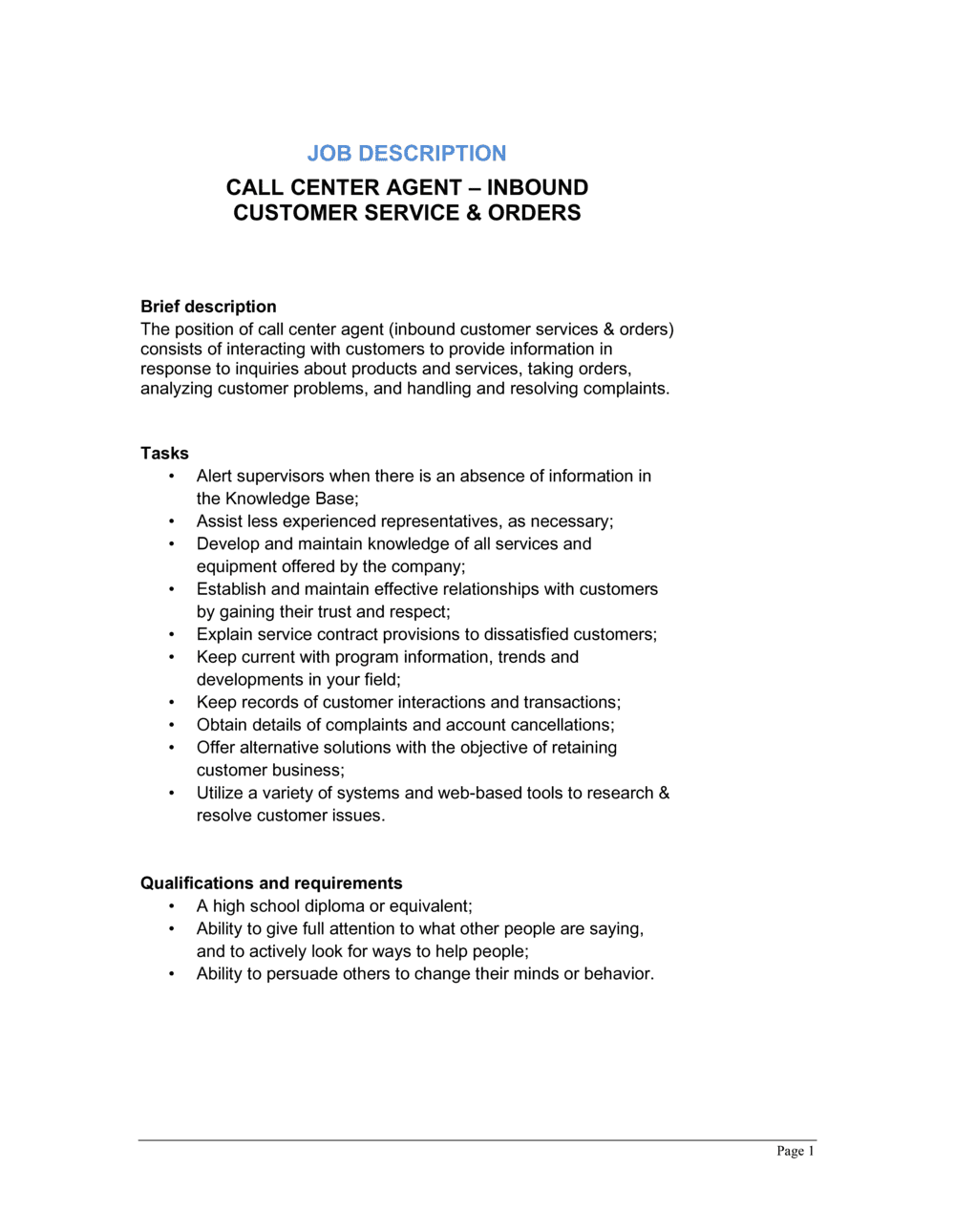
Call Center Agent_Inbound_Customer Service & Orders Job Description Template

Free Word download • Edit online • Save & share with Drive • Export to PDF

2 pages20–30 min to fillDifficulty: StandardSignature requiredLegal review recommended
Learn more ↓
FreeCall Center Agent_Inbound_Customer Service & Orders Job Description Template

At a glance

What it is
A Call Center Agent Inbound Customer Service & Orders Job Description is a formal employment document that defines the role, responsibilities, performance expectations, qualifications, and reporting structure for an inbound call center agent handling customer inquiries and order processing. This free Word download gives employers a structured, legally grounded starting point they can edit online and export as PDF to attach to offer letters or employment contracts.
When you need it
Use it when recruiting or onboarding a new inbound call center agent, when formalizing an existing agent's role following a team restructure, or when establishing enforceable performance standards against which the position will be managed and evaluated.
What's inside
Role summary, reporting structure, core duties covering inbound call handling and order processing, key performance indicators, required qualifications and skills, compensation band, schedule requirements, and acknowledgment signature block for both employer and employee.

What is a Call Center Agent Inbound Customer Service & Orders Job Description?

A Call Center Agent Inbound Customer Service & Orders Job Description is a formal employment document that defines the specific duties, performance standards, qualifications, schedule, and reporting structure for an agent whose role is to receive and handle customer-initiated calls — including inquiries, complaints, and product or service order processing. Unlike a general job posting, this document functions as a binding reference point that both the employer and employee sign before the first day of work, establishing the exact expectations against which performance will be measured, managed, and — if necessary — enforced. It covers everything from the CRM and order management systems the agent must operate, to the KPIs they are accountable for, to the data privacy obligations they assume when handling customer personal and payment information.

Why You Need This Document

Operating an inbound call center without a signed, specific job description exposes the employer on multiple fronts simultaneously. Without documented duties, disciplinary actions for poor performance become legally vulnerable — an agent who was never formally told that FCR of 75% was the standard can credibly argue they had no notice they were underperforming. Without a confidentiality clause referencing the applicable data protection law, a data-handling breach investigation leaves the employer unable to demonstrate the agent had clear obligations. Without a signed acknowledgment, the entire document is reduced to an informational handout that carries no evidentiary weight in an employment tribunal or court. This template gives call center operators and HR teams a structured, jurisdiction-aware starting point that closes those gaps in under 30 minutes — and that can be attached directly to an offer letter or employment contract to form a complete onboarding package.

Which variant fits your situation?

If your situation is…Use this template
Hiring an agent who handles only outbound sales callsCall Center Agent Outbound Sales Job Description
Defining a supervisory role overseeing a team of inbound agentsCall Center Supervisor Job Description
Formalizing the full employment relationship beyond the role descriptionEmployment Contract
Hiring a technical support agent who resolves product or software issuesTechnical Support Specialist Job Description
Onboarding a remote customer service representative with work-from-home termsRemote Work Employment Agreement
Engaging a contract call center agent through a third-party agencyIndependent Contractor Agreement
Documenting a bilingual customer service agent positionBilingual Customer Service Representative Job Description

Common mistakes to avoid

❌ Using aspirational language instead of observable duties

Why it matters: Duties written as 'strives to deliver excellent service' cannot be measured or enforced. When performance issues arise, HR cannot demonstrate the employee failed a defined standard.

Fix: Rewrite every duty as a specific, measurable action: 'Resolves customer complaints within [X] minutes or escalates to a supervisor per the escalation protocol.'

❌ Omitting the signature block or treating it as optional

Why it matters: Without a signed acknowledgment, the employer cannot prove the employee received and understood the performance standards — undermining disciplinary actions and wrongful-termination defenses.

Fix: Include a signature block on the final page and obtain signatures before or on the first day of employment. Store the executed copy in the personnel file.

❌ Setting KPI targets above the team's actual performance average

Why it matters: If the job description states an FCR target of 85% but your team averages 68%, disciplining an agent for hitting 70% becomes legally and ethically difficult to defend.

Fix: Calibrate KPI targets to your current team's 75th-percentile performance, then adjust upward in subsequent reviews as the team improves.

❌ Listing data privacy obligations without naming the applicable law

Why it matters: A generic 'protect customer data' clause gives the agent no actionable guidance and provides the employer with weak legal footing in a data-breach investigation or regulatory audit.

Fix: Name the specific regulation (GDPR, CCPA, PIPEDA) applicable to the agent's location and reference the company's internal Data Handling Policy by title.

❌ Combining required and preferred qualifications in a single undifferentiated list

Why it matters: Candidates cannot distinguish what is mandatory from what is nice-to-have, leading to under-qualified applicants self-screening out and over-qualified candidates demanding compensation for credentials you do not actually need.

Fix: Use two clearly labeled subsections — 'Required' and 'Preferred' — and ensure every required item can be tied directly to a core job duty.

❌ Omitting the time zone for remote or hybrid roles

Why it matters: Without a specified time zone, remote agents interpret shift hours against their local time, creating coverage gaps and schedule disputes that are difficult to resolve without a written reference point.

Fix: State the shift hours in the employer's operating time zone with the full zone name — for example, '9:00 AM–5:30 PM Eastern Time (ET)' — and confirm the agent's agreement in writing.

The 9 key clauses, explained

Role Summary and Position Title

In plain language: States the official job title, the department it belongs to, the employment classification (full-time, part-time, or contract), and a two-to-three sentence overview of the role's primary purpose.

Sample language
Position Title: Call Center Agent — Inbound Customer Service & Orders. Department: Customer Experience. Classification: Full-Time, Non-Exempt. The Agent is responsible for handling inbound customer inquiries, processing orders, and resolving issues in a timely and professional manner.

Common mistake: Using a generic title like 'Customer Service Rep' without specifying 'Inbound' — this creates classification confusion when calculating overtime eligibility and assigning shift schedules.

Reporting Structure

In plain language: Identifies the direct supervisor or team leader the agent reports to and any dotted-line relationships with QA, training, or workforce management teams.

Sample language
The [JOB TITLE] reports directly to the [CALL CENTER SUPERVISOR / TEAM LEADER NAME OR TITLE] and coordinates with the Quality Assurance team on call monitoring and performance feedback.

Common mistake: Omitting the reporting line entirely — without it, agents have no documented chain of escalation, and disciplinary actions become harder to defend.

Core Duties — Inbound Call Handling

In plain language: Lists the specific call-handling responsibilities: answering inbound calls within SLA, identifying customer needs, providing accurate information, and documenting call outcomes in the CRM.

Sample language
Agent shall: (a) answer all inbound calls within [X] seconds per SLA; (b) accurately identify caller needs and provide information or resolution within established authority levels; (c) log all call details in [CRM SYSTEM] within [ACW TIME] of call completion.

Common mistake: Listing duties as aspirational goals rather than specific, observable behaviors — this makes performance management and termination-for-cause defenses significantly weaker.

Core Duties — Order Processing

In plain language: Details the steps the agent must follow to receive, verify, enter, and confirm customer orders, including payment processing, fraud checks, and confirmation communications.

Sample language
Agent shall process customer orders by: (a) verifying customer identity and payment authorization; (b) accurately entering order details into [ORDER MANAGEMENT SYSTEM]; (c) issuing an order confirmation number to the customer; (d) flagging discrepancies or suspected fraud per the [FRAUD ESCALATION PROCEDURE].

Common mistake: Combining order processing duties with general call-handling duties in a single undifferentiated list — auditors and HR teams cannot distinguish compliance failures from service failures during a dispute.

Performance Standards and Key Performance Indicators

In plain language: Defines the measurable targets the agent is expected to meet — AHT, FCR rate, CSAT score, call quality score, and attendance thresholds — along with the review cadence.

Sample language
Agent is expected to maintain: (a) Average Handle Time ≤ [X] minutes; (b) First Call Resolution ≥ [X]%; (c) Customer Satisfaction Score ≥ [X]/5; (d) QA call quality score ≥ [X]%; (e) Schedule adherence ≥ [X]%. Performance is reviewed [monthly / quarterly].

Common mistake: Setting KPIs in the job description at targets the current team does not actually meet — this creates an implied promise that can be used against the employer if the agent is disciplined for performance that exceeds the average.

Qualifications, Skills, and Experience

In plain language: States the minimum education, prior experience, and technical skills required for the role — distinguishing required qualifications from preferred ones.

Sample language
Required: High school diploma or equivalent; minimum [X] year(s) of inbound call center or customer service experience; proficiency with [CRM / ORDER MANAGEMENT SYSTEM]. Preferred: Experience in [INDUSTRY]; bilingual in [LANGUAGE]; typing speed ≥ [X] WPM.

Common mistake: Listing every desirable trait as 'required' — overly restrictive qualifications can expose the employer to disparate-impact discrimination claims if the requirements are not demonstrably linked to job performance.

Schedule, Location, and Remote Work Terms

In plain language: Specifies the expected shift schedule, whether the role is on-site, hybrid, or remote, and any flexibility or rotation requirements the agent must accept.

Sample language
Agent is assigned to [SHIFT — e.g., Monday–Friday, 9:00 AM–5:30 PM, [TIMEZONE]]. The role is [on-site / hybrid / remote]. Agent may be required to work [rotating shifts / weekends / holidays] as business needs require, with [X] days' advance notice.

Common mistake: Omitting the time zone for remote or hybrid roles — schedule disputes between agents in different zones are one of the most common HR escalations in distributed call centers.

Confidentiality and Data Handling

In plain language: Obligates the agent to maintain the confidentiality of customer personal data, payment information, company scripts, and pricing — and to comply with applicable data protection laws.

Sample language
Agent shall not disclose, copy, or transmit any customer personal data, payment card information, or proprietary company information outside the scope of their duties. Agent shall comply with all applicable data privacy laws including [GDPR / CCPA / PIPEDA] and the Company's Data Handling Policy.

Common mistake: Referencing data protection laws generically without naming the specific regulation applicable to the agent's location — a vague clause is harder to enforce and provides weaker protection in a regulatory investigation.

Acknowledgment and Signature Block

In plain language: Records the employee's and employer's signatures confirming that both parties have read, understood, and agreed to the terms of the job description.

Sample language
By signing below, Employee acknowledges receipt of this Job Description, confirms they have read and understood its contents, and agrees to perform the duties and meet the standards set out herein. Employee: _______________ Date: _____ | Employer Representative: _______________ Date: _____

Common mistake: Treating the job description as an informational handout rather than a signed document — without a signature, the employer cannot demonstrate the employee was on notice of the performance standards used to justify disciplinary action.

How to fill it out

  1. 1

    Enter the position title and employment classification

    Fill in the exact job title, department name, and FLSA or local-law classification (exempt or non-exempt, full-time or part-time). Confirm the classification with your payroll team before publishing the document.

    💡 Inbound call center agents are almost always non-exempt under the FLSA — misclassifying them as exempt eliminates their overtime entitlement and creates wage-and-hour liability.

  2. 2

    Define the reporting structure

    Identify the direct supervisor by title (not name, since personnel change) and any secondary reporting lines to QA or workforce management. Include the escalation chain the agent follows when a call exceeds their authority.

    💡 Using a title rather than a person's name means you never need to update the document when a manager changes.

  3. 3

    List inbound call-handling duties as specific, observable actions

    Write each duty as a verb-led statement — 'Answers all inbound calls within 20 seconds per SLA' rather than 'Responsible for answering calls.' Observable behaviors are enforceable; vague responsibilities are not.

    💡 Aim for 8–12 duty statements. Fewer than 8 is too thin for a disciplinary record; more than 15 becomes unmanageable in a performance review.

  4. 4

    Separate order-processing duties from general call handling

    Create a distinct section for order entry, payment verification, fraud flagging, and confirmation steps. Reference the specific order management system by name and the fraud escalation procedure by document title.

    💡 Naming the system (e.g., Salesforce, SAP, Shopify) makes the training requirement concrete and supports a termination-for-cause decision if the agent consistently misuses it.

  5. 5

    Set KPIs with specific numeric targets

    Enter real numbers for AHT, FCR, CSAT, QA score, and schedule adherence. Pull these from your current team's actuals or your operation's SLA commitments — do not use industry benchmarks as targets if your operation cannot realistically meet them.

    💡 Include the review cadence (monthly, quarterly) so the agent knows when they will be evaluated against these targets.

  6. 6

    Distinguish required from preferred qualifications

    Label each qualification explicitly as 'Required' or 'Preferred.' Required qualifications must be demonstrably linked to job performance — if you cannot explain why a college degree is necessary for an inbound agent role, list it as preferred.

    💡 Overly restrictive requirements reduce your candidate pool and increase disparate-impact risk. Keep the 'required' list to the minimum needed to perform the role on day one.

  7. 7

    Specify the schedule, time zone, and remote-work terms

    State the shift days and hours, the applicable time zone, whether the role is on-site or remote, and whether the agent may be required to work rotating shifts or holidays.

    💡 For remote agents, include the minimum internet speed and home-office equipment requirements in this section or a separate addendum — this prevents equipment disputes at onboarding.

  8. 8

    Obtain signatures before the employee's first day

    Both the employer representative and the employee must sign and date the document before the start date. File the executed copy in the employee's personnel record and provide the employee with their own copy.

    💡 In jurisdictions that require written employment particulars (UK, EU), the signed job description can serve as supporting documentation for the statutory statement of terms — but confirm with a local HR advisor that it meets the specific requirements.

Frequently asked questions

What is a call center agent inbound job description?

A call center agent inbound job description is a formal document that defines the duties, performance standards, qualifications, schedule, and reporting structure for an agent who handles customer-initiated calls — including inquiries, complaints, and order processing. It serves as both a hiring tool and a legally referenced performance management document throughout the employee's tenure.

Why should a job description be signed by both parties?

A signed job description creates a documented record that the employee received and acknowledged the role's expectations before starting work. This is critical for disciplinary actions, performance improvement plans, and termination-for-cause decisions — all of which typically require the employer to demonstrate the employee was on notice of the standard they failed to meet. Without a signature, that proof is difficult to establish.

What KPIs should be included in an inbound call center job description?

The most commonly used KPIs are Average Handle Time (AHT), First Call Resolution rate (FCR), Customer Satisfaction Score (CSAT), QA call quality score, and schedule adherence percentage. Each should be stated as a specific numeric target with the review cadence — monthly or quarterly. Targets should reflect your operation's realistic performance range, not industry benchmarks your team cannot currently meet.

Is a job description a legally binding contract?

A job description is generally not a standalone employment contract, but it can create enforceable obligations when signed by both parties and incorporated by reference into an offer letter or employment agreement. Courts and employment tribunals regularly use job descriptions as evidence of what duties and standards were communicated to the employee, particularly in wrongful-termination and discrimination cases. Consider having a lawyer review before use if the role involves sensitive data handling.

What data privacy obligations apply to inbound call center agents?

Inbound agents regularly handle personally identifiable information (PII) and payment card data, making them subject to applicable data protection laws. In the US, this may include CCPA for California residents and PCI-DSS for payment card data. In Canada, PIPEDA applies federally. In the UK and EU, GDPR governs all personal data processing. The job description should name the applicable regulation and reference the company's internal Data Handling Policy.

Can this job description be used for remote call center agents?

Yes, with appropriate additions. Remote roles should specify the time zone, minimum internet speed and equipment requirements, expected availability during shift hours, and any monitoring or call-recording software the agent must consent to install. In some jurisdictions, remote-work monitoring requires explicit written consent — confirm requirements with a local employment lawyer before deployment.

How often should an inbound call center job description be updated?

Review and update the job description at least annually, or whenever the role's core duties change materially — such as when a new order management system is deployed, when KPI targets are revised, or when a shift schedule restructure occurs. Provide the employee with a copy of any updated version and obtain a new signature. Using an outdated job description in a disciplinary proceeding for duties the employee was never formally assigned is a common HR compliance error.

What is the difference between an inbound and outbound call center job description?

An inbound job description focuses on reactive duties — answering customer calls, resolving inquiries, and processing orders initiated by the customer. An outbound job description focuses on proactive duties — making calls to prospects or customers for sales, collections, or surveys. The KPIs, scripts, compliance requirements (particularly around TCPA in the US), and training needs differ significantly between the two. Using the wrong template creates misaligned performance expectations from day one.

Should qualifications in a job description specify a degree requirement?

Only if a specific degree is genuinely required to perform the job — which is rarely the case for inbound call center roles. Requiring a college degree for a role that can be performed competently with a high school diploma and call center experience can constitute disparate-impact discrimination under EEOC guidelines in the US. List a degree as 'preferred' rather than 'required' unless your legal team can document the operational necessity.

How this compares to alternatives

vs Employment Contract

An employment contract governs the full legal relationship — compensation, IP assignment, non-compete, termination, and severance — while a job description defines role duties and performance standards. The two documents work together: the contract creates binding obligations; the job description specifies what the employee is expected to do and how success is measured. Use both for any permanent hire.

vs Offer Letter

An offer letter summarizes compensation and start date to secure the candidate's acceptance. It does not detail specific duties, KPIs, or performance standards. A job description fills that gap and should be attached to the offer letter or incorporated by reference. Relying on an offer letter alone leaves performance expectations undocumented.

vs Independent Contractor Agreement

An independent contractor agreement engages a self-employed individual with no employment entitlements — no benefits, no tax withholding, no overtime. A call center agent job description is an employment document and implies an employer-employee relationship. Misclassifying an inbound agent as a contractor triggers payroll tax liability and benefit obligations in most jurisdictions.

vs Call Center Supervisor Job Description

A supervisor job description covers management duties — coaching agents, monitoring QA scores, scheduling, and escalation resolution — rather than frontline call handling. Supervisors are typically classified as exempt from overtime in the US, whereas inbound agents are almost always non-exempt. Using the wrong template creates compensation classification errors from the start.

Industry-specific considerations

E-commerce and Retail

Order entry, return processing, shipping inquiry handling, and payment dispute resolution are the primary inbound call types — all of which require distinct duty clauses and system-specific training references.

Financial Services

Agents handle account inquiries, transaction disputes, and fraud alerts, requiring explicit PCI-DSS and GLBA confidentiality obligations and enhanced QA monitoring standards in the job description.

Healthcare

HIPAA confidentiality obligations and patient data handling protocols must be incorporated by reference, and appointment or prescription inquiry duties require separate procedural clauses.

Telecommunications

High call volumes, complex billing inquiry handling, and regulatory requirements around call recording disclosures (TCPA in the US) require precise duty language and consent-notice steps embedded in the core duties clause.

Jurisdictional notes

United States

Inbound call center agents are almost universally classified as non-exempt under the FLSA, entitling them to overtime pay for hours over 40 per week. The EEOC's uniform guidelines require that any qualification listed as 'required' be demonstrably job-related — a degree requirement for a call center role is frequently challenged. California, Illinois, and New York impose additional restrictions on call monitoring and recording — agents must be notified, and in California all parties must consent.

Canada

Each province sets its own employment standards for hours of work, overtime thresholds, and termination notice — Ontario's Employment Standards Act and BC's Employment Standards Act differ on overtime calculation. PIPEDA governs personal data handling at the federal level, with Quebec's Law 25 imposing stricter requirements applicable to Quebec-based agents. Job descriptions should reference the applicable provincial act by name. French-language job descriptions are required for roles in Quebec's provincially regulated sector.

United Kingdom

UK employers must provide a written statement of employment particulars on or before day one under the Employment Rights Act 1996 — the signed job description can support this obligation but typically cannot replace it on its own. The ICO's UK GDPR requires explicit data handling obligations for agents processing customer personal data. Call recording must be disclosed to both the agent and the customer, and monitoring must be proportionate under the Investigatory Powers Act 2016.

European Union

The EU's Transparent and Predictable Working Conditions Directive requires employers to provide written terms within seven days of hire. GDPR Article 88 allows member states to set additional rules on employee data monitoring — call recording and quality monitoring practices must be proportionate, documented, and disclosed in the job description or a linked privacy notice. Works councils in Germany, France, and the Netherlands may need to be consulted before implementing monitoring policies referenced in the document.

Template vs lawyer — what fits your deal?

PathBest forCostTime
Use the templateSmall businesses and call centers hiring inbound agents for standard customer service and order roles in a single jurisdictionFree20–30 minutes
Template + legal reviewOperations with remote agents in multiple states or provinces, or roles involving payment card data or health information$200–$500 for an HR advisor or employment lawyer review1–3 days
Custom draftedLarge-scale call center operations with complex QA obligations, heavily regulated industries, or agents across multiple international jurisdictions$800–$2,500+1–2 weeks

Glossary

Inbound Call
A call initiated by the customer to the company, as opposed to an outbound call placed by an agent to a customer or prospect.
Average Handle Time (AHT)
The average total time an agent spends on a single call, including talk time, hold time, and after-call work — a standard call center KPI.
First Call Resolution (FCR)
The percentage of customer issues fully resolved on the first call without requiring a follow-up contact.
Customer Satisfaction Score (CSAT)
A post-interaction survey metric measuring how satisfied a customer was with the service they received, typically on a 1–5 or 1–10 scale.
Order Processing
The sequence of steps an agent follows to receive, verify, enter, and confirm a customer's product or service order in the company's system.
Escalation Protocol
A defined procedure for transferring a call to a supervisor or specialist when the agent cannot resolve the customer's issue within their authority level.
Quality Assurance (QA) Monitoring
The practice of recording and reviewing agent calls against a scoring rubric to evaluate compliance, tone, accuracy, and adherence to scripts.
Service Level Agreement (SLA)
A commitment — often internal — to answer a defined percentage of inbound calls within a specified number of seconds, such as 80% of calls answered within 20 seconds.
After-Call Work (ACW)
Time spent by an agent immediately after a call ends to complete documentation, update the CRM, or process the order before accepting the next call.
At-Will Employment
Employment that either party may end at any time for any lawful reason without advance notice — applicable in most US states and referenced in many job descriptions.
Non-Disclosure Agreement (NDA)
A confidentiality agreement preventing the agent from sharing proprietary customer data, scripts, pricing, or business processes with unauthorized parties.

Part of your Business Operating System

This document is one of 3,000+ business & legal templates included in Business in a Box.

  • Fill-in-the-blanks — ready in minutes
  • 100% customizable Word document
  • Compatible with all office suites
  • Export to PDF and share electronically

Create your document in 3 simple steps.

From template to signed document — all inside one Business Operating System.
1
Download or open template

Access over 3,000+ business and legal templates for any business task, project or initiative.

2
Edit and fill in the blanks with AI

Customize your ready-made business document template and save it in the cloud.

3
Save, Share, Send, Sign

Share your files and folders with your team. Create a space of seamless collaboration.

Save time, save money, and create top-quality documents.

★★★★★

"Fantastic value! I'm not sure how I'd do without it. It's worth its weight in gold and paid back for itself many times."

Managing Director · Mall Farm
Robert Whalley
Managing Director, Mall Farm Proprietary Limited
★★★★★

"I have been using Business in a Box for years. It has been the most useful source of templates I have encountered. I recommend it to anyone."

Business Owner · 4+ years
Dr Michael John Freestone
Business Owner
★★★★★

"It has been a life saver so many times I have lost count. Business in a Box has saved me so much time and as you know, time is money."

Owner · Upstate Web
David G. Moore Jr.
Owner, Upstate Web

Run your business with a system — not scattered tools

Stop downloading documents. Start operating with clarity. Business in a Box gives you the Business Operating System used by over 250,000 companies worldwide to structure, run, and grow their business.

Free Forever Plan · No credit card required