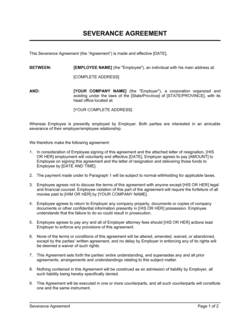
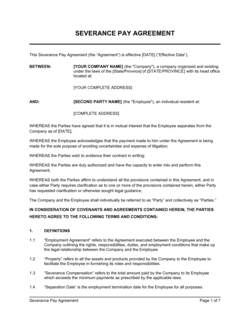
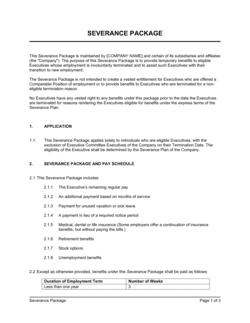
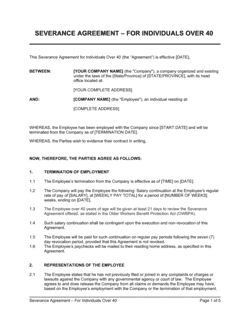
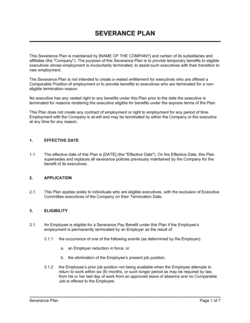
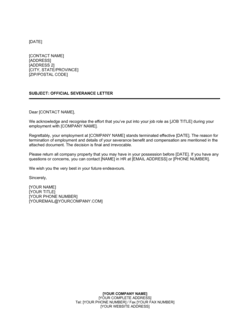
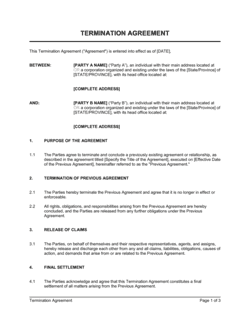
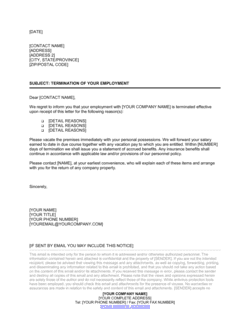
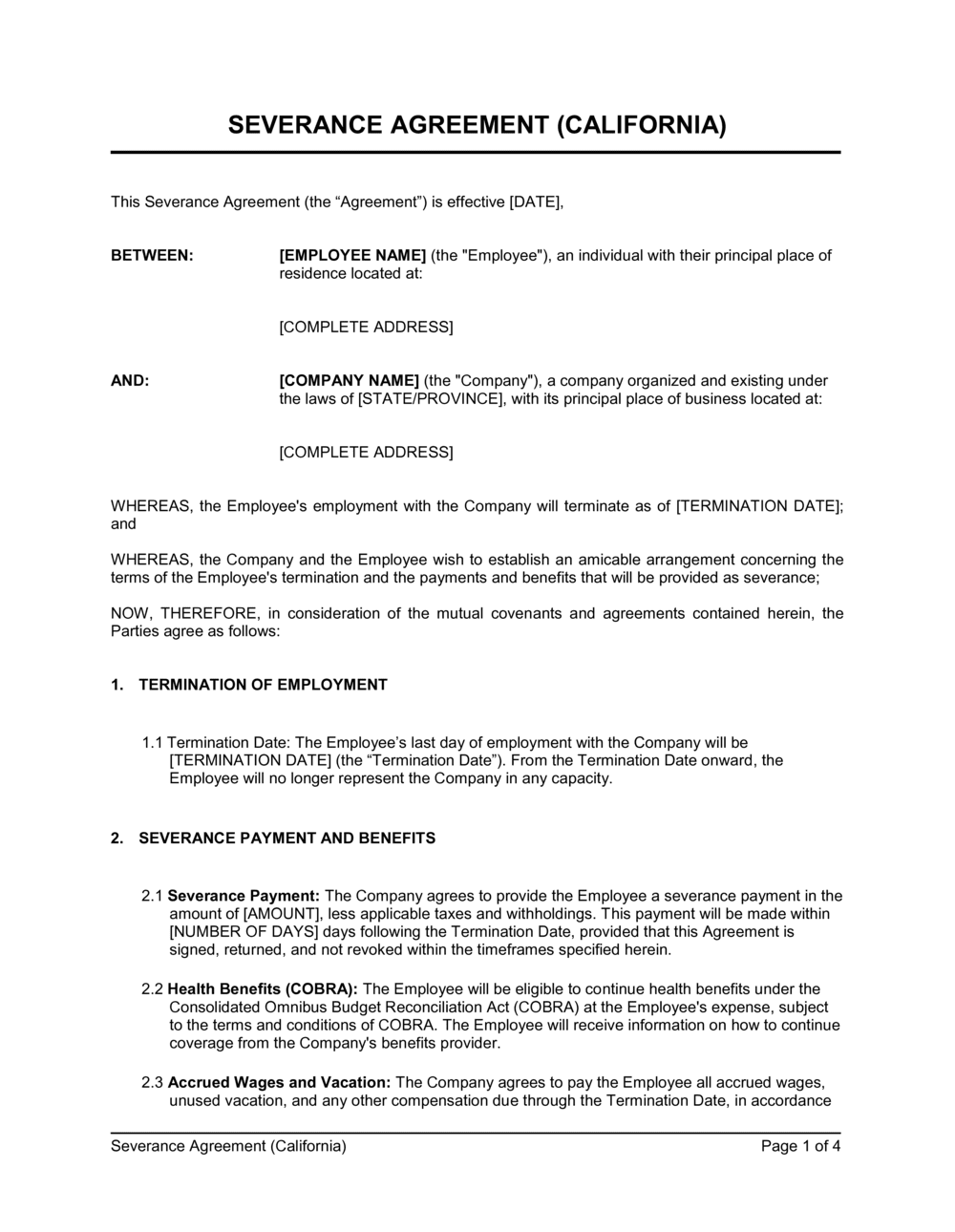
California Severance Agreement Template

Free Word download • Edit online • Save & share with Drive • Export to PDF

4 pages25–35 min to fillDifficulty: ComplexSignature requiredLegal review recommended
Learn more ↓
FreeCalifornia Severance Agreement Template

At a glance

What it is
A California Severance Agreement is a binding contract between an employer and a departing employee that exchanges severance pay and benefits for the employee's release of legal claims against the company. This free Word download is pre-structured for California's strict employment law requirements — including mandatory ADEA waiver language, 21-day consideration periods, and 7-day revocation rights — and can be edited online and exported as PDF.
When you need it
Use it whenever you are separating an employee — whether through layoff, restructuring, or mutual agreement — and offering compensation beyond statutory minimums in exchange for a release of claims. It is especially important in California, where employees retain unusually broad litigation rights and courts scrutinize releases closely.
What's inside
Severance payment amount and schedule, comprehensive release of claims including ADEA and FEHA waivers, confidentiality and non-disparagement obligations, return of company property, benefits continuation terms, and the mandatory 21-day consideration and 7-day revocation periods required under federal and California law.

What is a California Severance Agreement?

A California Severance Agreement is a legally binding contract between an employer and a departing employee that exchanges severance compensation for the employee's release of legal claims arising from the employment relationship. Unlike a general release used in other states, a California severance agreement must comply with a layered set of requirements: it must expressly waive the employee's rights under California Civil Code § 1542 (which would otherwise preserve unknown claims), include FEHA release language, comply with ADEA/OWBPA procedural mandates for employees aged 40 or older, and avoid post-employment non-compete language that is void under Business and Professions Code § 16600. A template that meets federal standards but ignores California's additional requirements produces a release with gaps that California courts can — and routinely do — void in whole or in part.

Why You Need This Document

Without a properly executed California severance agreement, a departing employee retains the full right to sue under Title VII, FEHA, the ADEA, California Labor Code, and common law — regardless of what was communicated verbally at separation. California employees have some of the broadest litigation rights of any workforce in the country, and plaintiffs' employment attorneys work on contingency, making demand letters and lawsuits a low-cost option for dissatisfied former employees. The direct cost of a single employment discrimination claim in California — even one that settles early — routinely exceeds $50,000 in legal fees alone. A severance agreement that is presented correctly, includes the § 1542 waiver and ADEA-compliant language, and is signed before the Effective Date closes that exposure for the cost of the severance payment itself. This template gives you the California-specific structure — complete with consideration periods, revocation windows, and the required statutory language — so you can execute compliant separations without rebuilding the document from scratch each time.

Which variant fits your situation?

If your situation is…Use this template
Separating an employee aged 40 or olderCalifornia Severance Agreement with ADEA/OWBPA Waiver
Group layoff affecting two or more employees aged 40+OWBPA Group Termination Disclosure and Severance Agreement
Settling a specific discrimination or harassment claimEmployment Settlement Agreement and Release
Separating a C-suite executive with equity and clawback provisionsExecutive Separation Agreement
Parting ways with an independent contractorContractor Termination Agreement
Mutual separation with no monetary paymentMutual Separation and Release Agreement
Non-California employee separation at a national companyGeneral Employee Severance Agreement

Common mistakes to avoid

❌ Omitting the California Civil Code § 1542 waiver

Why it matters: Without express § 1542 waiver language, the employee can assert unknown claims after signing — effectively rendering the entire release unenforceable under California law.

Fix: Include the full current statutory text of § 1542 and a sentence confirming the employee expressly waives its protections. Use the post-2018 amended language.

❌ Paying severance before the 7-day revocation period expires

Why it matters: If the employee revokes and you have already paid, recovering the funds is difficult. More importantly, paying early can be construed as pressure to discourage revocation — a violation of the OWBPA.

Fix: Make payment explicitly contingent on the Effective Date — defined as 8 calendar days after the employee's signature — and process payment only after that date passes without revocation.

❌ Using the 21-day consideration period for a group layoff

Why it matters: Group terminations involving two or more employees aged 40 or older require a 45-day consideration period and a written disclosure listing job titles and ages of all affected and non-affected employees. Using 21 days voids the ADEA waiver for all affected employees.

Fix: Any time two or more employees aged 40+ are terminated in connection with the same reduction in force, use the group termination OWBPA protocol and 45-day disclosure requirements.

❌ Including non-compete or non-solicit language in the agreement

Why it matters: California Business and Professions Code § 16600 renders virtually all post-employment non-compete and non-solicit agreements void. Including them does not make them enforceable — it signals legal error and can undermine the credibility of the whole agreement.

Fix: Remove all post-employment non-compete and customer non-solicit language. California permits trade secret protections and client non-solicitation only in very narrow circumstances — consult counsel before including any restriction.

❌ Mixing final wages and accrued PTO into the severance calculation

Why it matters: California Labor Code §§ 201–203 require final wages and accrued PTO to be paid on the last day of employment. These are statutory obligations — not consideration — and cannot be conditioned on signing a severance agreement.

Fix: Process final wages and accrued PTO as a separate, unconditional final paycheck on the termination date. State in the severance agreement that severance is above and beyond these already-paid amounts.

❌ No severability clause

Why it matters: California courts frequently strike individual clauses — particularly overbroad non-disparagement or confidentiality provisions. Without severability language, striking one clause can void the entire agreement, unwinding the release.

Fix: Include a standard severability clause confirming that if any provision is held unenforceable, the remaining provisions survive in full force and effect.

The 10 key clauses, explained

Parties, Separation Date, and Recitals

In plain language: Identifies the employer and employee as legal entities, states the official last day of employment, and sets out the background context for the agreement.

Sample language
This California Severance Agreement and General Release ('Agreement') is entered into as of [DATE] between [EMPLOYER LEGAL NAME], a [STATE] [ENTITY TYPE] ('Company'), and [EMPLOYEE FULL NAME] ('Employee'). Employee's employment with the Company terminated on [SEPARATION DATE].

Common mistake: Using a trade name instead of the registered legal entity. If the employer's name doesn't match the employing entity on record, the release may not bind the correct legal party and is harder to enforce.

Severance Payment and Schedule

In plain language: States the total severance amount, how it is calculated, the payment schedule, and that it exceeds what the employee would otherwise be entitled to receive.

Sample language
In consideration of Employee's execution and non-revocation of this Agreement, Company shall pay Employee a lump-sum severance of $[AMOUNT], less applicable withholdings, within [8] calendar days of the Effective Date. This amount exceeds any payment to which Employee is otherwise entitled.

Common mistake: Failing to state explicitly that the severance exceeds statutory entitlements. Without this language, courts may find the employee received nothing beyond what was already owed — rendering the release unsupported by valid consideration.

General Release of Known and Unknown Claims

In plain language: The employee releases all claims against the employer, including California Civil Code § 1542 unknown claims — the most legally critical clause in the entire agreement.

Sample language
Employee releases and discharges Company from all claims, known or unknown, including but not limited to claims under Title VII, the ADEA, FEHA, California Labor Code, and any other federal, state, or local law. Employee expressly waives the protections of California Civil Code § 1542, which provides: 'A general release does not extend to claims that the creditor or releasing party does not know or suspect to exist in his or her favor at the time of executing the release...'

Common mistake: Omitting the California Civil Code § 1542 waiver. Without it, employees can later assert unknown claims — effectively nullifying the entire release under California law.

ADEA and OWBPA Waiver (Employees Aged 40+)

In plain language: For employees aged 40 or older, includes mandatory statutory language waiving age discrimination claims and confirms the employee's right to 21 days to consider and 7 days to revoke.

Sample language
Employee knowingly and voluntarily waives all claims under the Age Discrimination in Employment Act. Employee acknowledges that: (a) this waiver is written in plain language; (b) Employee is advised to consult an attorney; (c) Employee has [21] days to consider this Agreement; and (d) Employee has 7 days after signing to revoke this Agreement.

Common mistake: Using a single ADEA waiver template for both individual and group terminations. Group layoffs of two or more employees aged 40+ require a 45-day consideration period and a written disclosure of job titles and ages of all affected employees — not just 21 days.

Confidentiality of Agreement Terms

In plain language: Prohibits the employee from disclosing the existence or financial terms of the severance agreement to third parties, with standard exceptions for attorneys, tax advisors, and immediate family.

Sample language
Employee agrees to keep the terms and conditions of this Agreement strictly confidential and shall not disclose them to any third party, except Employee's attorneys, accountants, or immediate family members who are themselves bound to confidentiality.

Common mistake: Omitting the carve-out for attorneys, accountants, and family. California courts scrutinize confidentiality clauses and have found overbroad restrictions — with no exceptions — to be unconscionable, potentially voiding the clause or the entire agreement.

Non-Disparagement

In plain language: Each party agrees not to make negative public or private statements about the other. Often mutual, though employers frequently draft it as one-sided.

Sample language
Employee agrees not to make any disparaging, negative, or defamatory statements about Company, its officers, directors, employees, products, or services. Company agrees to provide only neutral references confirming Employee's dates of employment and last position held.

Common mistake: Drafting non-disparagement as one-sided (employee only) without disclosing this to the employee. California courts have increasingly found one-sided non-disparagement clauses to be evidence of unconscionability when combined with other imbalanced terms.

Return of Company Property and Data

In plain language: Requires the employee to return all company property — devices, documents, credentials, and confidential data — on or before the separation date.

Sample language
On or before the Separation Date, Employee shall return all Company property, including but not limited to laptops, mobile devices, access credentials, and any documents or data (in any format) containing Confidential Information. Employee shall permanently delete any Company data from personal devices.

Common mistake: No requirement to delete company data from personal devices. Remote employees frequently retain company files on personal hardware; without explicit deletion language, the return-of-property clause has a gap that creates IP and data security risk.

Benefits Continuation and COBRA Notice

In plain language: States when employer-sponsored health benefits end, confirms that COBRA election information will be provided, and notes any employer-paid COBRA contribution as part of the severance package.

Sample language
Employee's health benefits under the Company's group plan will terminate on [DATE]. Company will provide Employee with COBRA election materials within the statutory period. As additional consideration, Company agrees to pay the COBRA premium for [X] months, not to exceed $[AMOUNT] per month.

Common mistake: Agreeing to pay COBRA premiums for an indefinite period or stating a contribution without a monthly cap. COBRA premium rates can increase during the continuation period — an uncapped commitment exposes the employer to unpredictable cost.

Cooperation Clause

In plain language: Requires the employee to cooperate reasonably with the employer in any future litigation, investigation, or regulatory matter relating to their period of employment.

Sample language
Employee agrees to cooperate reasonably with Company in connection with any pending or future legal, regulatory, or administrative proceeding relating to Employee's period of employment, at Company's reasonable request and with reimbursement of reasonable out-of-pocket expenses.

Common mistake: No reimbursement obligation for the employee's time or expenses. Courts have found unlimited post-separation cooperation obligations — with no compensation — to be unconscionable, particularly in California.

Governing Law, Integration, and Severability

In plain language: Confirms California law governs, that this agreement supersedes all prior agreements, and that if any clause is found unenforceable the remainder of the agreement survives.

Sample language
This Agreement is governed by the laws of the State of California. It constitutes the entire agreement between the parties and supersedes all prior representations. If any provision is held unenforceable, the remaining provisions shall continue in full force and effect.

Common mistake: No severability clause. If a California court strikes a specific clause — such as an overbroad non-disparagement provision — without severability language, the entire agreement may be voided, unwinding the release and the severance payment.

How to fill it out

  1. 1

    Confirm the separating employee's age and adjust the waiver accordingly

    If the employee is 40 or older, the ADEA/OWBPA waiver section becomes mandatory. Set the consideration period to 21 days (or 45 days for group terminations) and confirm the 7-day revocation period is clearly stated.

    💡 Even if you believe the employee will sign quickly, do not shorten the 21-day period — any waiver of the ADEA consideration period by the employee is itself void under the OWBPA.

  2. 2

    Enter the employer's full registered legal entity name

    Use the exact legal name from your California Secretary of State filing — not a brand name or DBA. Cross-reference the entity name on the employee's pay stubs to confirm they match.

    💡 If the employer is a subsidiary, verify whether the parent company also needs to be named as a released party — particularly if the employee had any reporting relationship with the parent.

  3. 3

    Calculate and document the severance amount

    Determine the total severance and confirm in the body of the agreement that it exceeds any statutory entitlement. State the gross amount, withholding treatment, and the specific payment date — typically within 8 calendar days of the Effective Date.

    💡 Do not net the severance against accrued PTO or final wages — final pay is a separate obligation under California Labor Code § 201–203 and must be paid on the last day of employment regardless of the severance agreement.

  4. 4

    Include the California Civil Code § 1542 waiver verbatim

    Copy the full statutory text of § 1542 into the release clause and confirm the employee is expressly waiving its protections. This is non-negotiable for a release to be effective in California.

    💡 The § 1542 statutory text was amended in 2018 — make sure your template uses the current version ('creditor or releasing party' rather than the pre-2018 language).

  5. 5

    Tailor confidentiality and non-disparagement language

    Decide whether non-disparagement will be mutual or one-sided. If one-sided, document the business rationale. Include carve-outs for legally required disclosures and NLRA-protected concerted activity.

    💡 Since 2022, California SB 331 prohibits confidentiality provisions that prevent employees from disclosing factual information about workplace harassment, discrimination, or retaliation. Ensure your language does not run afoul of this restriction.

  6. 6

    Complete the benefits and COBRA section

    Enter the exact date benefits terminate, confirm COBRA election materials will be sent, and if the employer is contributing to COBRA premiums, state the monthly cap and duration explicitly.

    💡 Employer-paid COBRA contributions are generally taxable to the employee as imputed income after the 18-month statutory continuation period — note this in the agreement to avoid disputes.

  7. 7

    Have the employee sign before — not on — the separation date

    Present the agreement no later than the separation date so the employee has the full consideration period. Both parties should date their signatures; the Effective Date is the 8th calendar day after the employee signs (day 1 being the day after signing).

    💡 Use a timestamped eSign platform to create an auditable record of when the agreement was presented, signed, and when the revocation period expired — critical if the release is ever challenged.

  8. 8

    Retain the fully executed agreement and set a revocation-period reminder

    File the signed agreement and set a calendar reminder for the 8th calendar day after the employee's signature. No severance payment should be issued before the revocation period expires.

    💡 If the employee revokes within 7 days, the agreement is void and no severance is owed — document the revocation in writing immediately and confirm with the employee.

Frequently asked questions

What is a California severance agreement?

A California severance agreement is a binding contract in which an employer pays departing compensation — typically a lump sum or continued salary — in exchange for the employee releasing legal claims against the company. California law imposes strict requirements that go beyond federal standards, including the mandatory waiver of California Civil Code § 1542 unknown claims and compliance with the Fair Employment and Housing Act. Any agreement that omits California-specific provisions is at risk of being partially or wholly unenforceable.

Is a severance agreement required in California?

No employer is legally required to offer severance pay in California unless a prior contract, offer letter, or company policy promises it. However, if an employer wants a departing employee to release legal claims, a signed severance agreement is the only mechanism to obtain that release. Without one, the employee retains the full right to sue under Title VII, FEHA, the ADEA, and California Labor Code — regardless of what was discussed verbally at termination.

What makes a California severance agreement different from an agreement in other states?

Three California-specific requirements distinguish a California severance agreement from a standard release used elsewhere. First, the agreement must expressly waive California Civil Code § 1542 — the statute that preserves unknown claims — otherwise the release is incomplete. Second, post-employment non-competes are void under Business and Professions Code § 16600 and must not appear in the document. Third, California SB 331 (effective 2022) prohibits confidentiality clauses that prevent employees from disclosing factual information about workplace harassment or discrimination. A template from another state that ignores these three requirements creates more legal exposure than no agreement at all.

How long does an employee have to sign a California severance agreement?

Employees aged 40 or older must be given at least 21 days to consider the agreement under the OWBPA — or 45 days if two or more employees aged 40+ are terminated as part of the same reduction in force. Employees under 40 are not entitled to a statutory minimum consideration period, though best practice is to allow at least 5–7 business days. Once signed, employees aged 40 or older have an additional 7 calendar days to revoke. The agreement does not become effective — and no payment should be made — until this revocation period expires.

Can an employer shorten the 21-day consideration period if the employee wants to sign quickly?

No. Under the OWBPA, an employee aged 40 or older may choose to sign before the 21 days expire, but the employer cannot require or pressure them to do so. If the employer conditions payment or other benefits on signing before the period ends, the waiver of ADEA claims is void. The 7-day revocation period is also absolute and cannot be waived or shortened under any circumstances.

Can a California severance agreement include a non-compete clause?

No. California Business and Professions Code § 16600 renders virtually all post-employment non-compete agreements void, regardless of how they are structured or what consideration is offered. Including non-compete language does not make it enforceable — it signals a legally deficient agreement and may undermine the credibility of the entire document with a court. Trade secret protections remain available under the California Uniform Trade Secrets Act, but they operate separately from contractual non-competes.

What happens if an employee revokes a California severance agreement?

If an employee aged 40 or older revokes within the 7-day window, the agreement is void from the beginning — no severance is owed and the employee retains all their legal claims. The revocation must typically be in writing and delivered before the 7-day period expires. Employers should document the revocation immediately and issue no payment. If payment was accidentally made before the revocation period expired, recovering it requires a separate legal proceeding.

Does a California severance agreement need to be notarized?

Notarization is generally not required for a California severance agreement to be valid and enforceable. The agreement requires signatures from both parties and, for employees aged 40 or older, compliance with ADEA/OWBPA procedural requirements. However, using a timestamped electronic signature platform that records when the document was presented and signed creates a stronger evidentiary record if the agreement is later challenged.

How much severance is standard in California?

California law does not mandate a specific severance formula. Common market practice ranges from 1 to 4 weeks of base salary per year of service, depending on the employee's seniority and tenure. Senior managers and executives often negotiate 1 to 3 months per year of service or a fixed floor of 3 to 6 months. For the release to be supported by valid consideration, the severance must exceed any payment the employee is already entitled to by law, contract, or company policy.

Can an employee negotiate a California severance agreement?

Yes, and many do. California employees have strong litigation rights, which gives them leverage — particularly employees aged 40 or older with ADEA claims, or any employee with FEHA discrimination, harassment, or retaliation exposure. Common negotiation points include the total payment amount, the duration of employer-paid COBRA, acceleration of unvested equity, the scope of the release, and the wording of non-disparagement clauses. Employers should treat the 21-day consideration period as an implied negotiation window for senior hires.

How this compares to alternatives

vs General Employee Severance Agreement

A general severance agreement does not include California-specific requirements such as the § 1542 unknown claims waiver, FEHA release language, or the SB 331 confidentiality restrictions. Using a non-California template for a California employee creates a release with gaps that courts can void. The California-specific version is required for any employee who works in California, regardless of where the employer is incorporated.

vs Employment Settlement Agreement

An employment settlement agreement resolves a specific, already-filed or formally threatened legal claim — often through mediation — and is typically negotiated with both parties represented by counsel. A severance agreement is used proactively at the time of separation, before any claim is filed. Settlement agreements typically involve more negotiated terms and higher payments; severance agreements are operational documents used at scale.

vs Mutual Separation Agreement

A mutual separation agreement documents an agreed parting with no monetary payment exchanged — it confirms the separation date, property return, and reference terms, but does not include a full release of claims. Without consideration (money or additional benefits), a release of claims is unenforceable in California. Use a severance agreement any time the employer is offering payment; use a mutual separation agreement only when both parties agree to part with no financial exchange.

vs Executive Separation Agreement

An executive separation agreement covers the same core terms as a standard California severance agreement but adds equity acceleration and vesting treatment, enhanced severance multiples (often 6–24 months), D&O indemnification tail coverage, change-of-control provisions, and more heavily negotiated non-disparagement terms. A standard California severance agreement is not appropriate for C-suite or VP-level separations with material equity or indemnification exposure.

Industry-specific considerations

Technology / SaaS

IP assignment confirmation at separation, return of source code and proprietary data, equity treatment and acceleration terms, and non-disparagement covering product roadmap disclosures.

Financial Services

FINRA and SEC regulatory cooperation clauses, bonus clawback provisions tied to regulatory findings, and enhanced confidentiality covering client and trading data after separation.

Healthcare

HIPAA-compliant data return obligations, credentialing and licensing status at separation, and non-disparagement language carefully scoped to exclude patient safety reporting obligations.

Retail / Hospitality

High-volume layoff scenarios triggering Cal-WARN Act obligations, accrued tip and commission wage treatment separate from severance, and short consideration periods for hourly workforce separations.

Manufacturing

Cal-WARN mass layoff notice coordination, union agreement interaction with severance terms, and return of proprietary process documentation and trade secrets.

Professional Services

Client non-solicitation limited to California-permissible scope (trade secret basis only), billable hour and commission reconciliation at separation, and cooperation on ongoing client engagements.

Jurisdictional notes

United States

Federal law under the ADEA and OWBPA mandates specific waiver language, a 21-day consideration period (45 days for group terminations), and a 7-day revocation right for employees aged 40 or older. Title VII and the ADA claims must also be expressly released. California's additional requirements — particularly the § 1542 waiver and FEHA release — layer on top of and are more demanding than federal minimums.

Canada

Canadian severance agreements are governed by provincial employment standards legislation, not the ADEA or OWBPA. Ontario, BC, and Alberta each set statutory minimum termination pay and severance pay floors that cannot be waived by contract. Unlike California, unknown-claims waivers are not a standard requirement, and non-compete clauses may be enforceable if reasonable in scope — though Ontario's Working for Workers Act (2022) banned non-competes for most employees.

United Kingdom

UK settlement agreements (formerly compromise agreements) require the employee to receive independent legal advice from a qualified adviser before signing — without this, the agreement is void. Statutory redundancy pay sets a floor that cannot be contracted out of. The first £30,000 of a genuine ex gratia payment is typically tax-free. ACAS Code of Practice on Disciplinary and Grievance Procedures applies when the separation follows a disciplinary process.

European Union

EU member states vary significantly in severance entitlements — France requires statutory indemnité de licenciement, Germany provides Abfindung through social plan negotiations or court settlements, and Spain mandates statutory finiquito payments. GDPR imposes obligations on the return and deletion of personal data handled by the departing employee. Unlike California, most EU jurisdictions do not use a broad general-release mechanism — releases are narrower and subject to mandatory minimum entitlement floors that cannot be waived.

Template vs lawyer — what fits your deal?

PathBest forCostTime
Use the templateStandard California employee separations for non-executive roles with straightforward severance and no pending claimsFree30–60 minutes
Template + legal reviewAny separation involving an employee aged 40 or older, a group reduction in force, or a role with significant IP or client access$400–$900 for a 1–2 hour California employment attorney review2–5 business days
Custom draftedExecutive separations, pending FEHA or ADEA claims, Cal-WARN mass layoffs, or any situation where the employee is already represented by counsel$1,500–$6,000+ depending on complexity and negotiation1–4 weeks

Glossary

Release of Claims
A contractual provision in which the employee agrees to give up the right to sue the employer for specified legal claims in exchange for severance consideration.
ADEA Waiver
A waiver of age discrimination claims under the federal Age Discrimination in Employment Act, which requires specific statutory language, a 21-day review period, and a 7-day right to revoke.
OWBPA
The Older Workers Benefit Protection Act — the federal law that sets mandatory procedural requirements for any waiver of ADEA claims by employees aged 40 or older.
FEHA
The California Fair Employment and Housing Act — the state law prohibiting discrimination based on race, sex, age, disability, and other protected characteristics, with broader protections than federal law.
Consideration Period
The minimum time — 21 days under the ADEA, or 45 days in a group layoff — that an employee aged 40 or older must be given to review and accept a severance agreement.
Revocation Period
The 7-calendar-day window after signing during which an employee covered by the ADEA may revoke acceptance of the severance agreement without penalty.
WARN Act
The federal Worker Adjustment and Retraining Notification Act, which requires 60 days' advance notice for mass layoffs — California's Cal-WARN applies to smaller employers and has stricter thresholds.
Non-Disparagement Clause
A mutual or one-sided agreement prohibiting either party from making negative public statements about the other after separation.
COBRA
The federal Consolidated Omnibus Budget Reconciliation Act, which allows departing employees to continue employer-sponsored health coverage for up to 18 months at their own expense.
Clawback Provision
A clause requiring the employee to return severance payments if they violate post-separation obligations such as confidentiality or non-disparagement.
Cal-WARN Act
California's version of the federal WARN Act, which covers employers with 75 or more employees and requires 60 days' notice for mass layoffs of 50 or more workers at a single location.

Part of your Business Operating System

This document is one of 3,000+ business & legal templates included in Business in a Box.

  • Fill-in-the-blanks — ready in minutes
  • 100% customizable Word document
  • Compatible with all office suites
  • Export to PDF and share electronically

Create your document in 3 simple steps.

From template to signed document — all inside one Business Operating System.
1
Download or open template

Access over 3,000+ business and legal templates for any business task, project or initiative.

2
Edit and fill in the blanks with AI

Customize your ready-made business document template and save it in the cloud.

3
Save, Share, Send, Sign

Share your files and folders with your team. Create a space of seamless collaboration.

Save time, save money, and create top-quality documents.

★★★★★

"Fantastic value! I'm not sure how I'd do without it. It's worth its weight in gold and paid back for itself many times."

Managing Director · Mall Farm
Robert Whalley
Managing Director, Mall Farm Proprietary Limited
★★★★★

"I have been using Business in a Box for years. It has been the most useful source of templates I have encountered. I recommend it to anyone."

Business Owner · 4+ years
Dr Michael John Freestone
Business Owner
★★★★★

"It has been a life saver so many times I have lost count. Business in a Box has saved me so much time and as you know, time is money."

Owner · Upstate Web
David G. Moore Jr.
Owner, Upstate Web

Run your business with a system — not scattered tools

Stop downloading documents. Start operating with clarity. Business in a Box gives you the Business Operating System used by over 250,000 companies worldwide to structure, run, and grow their business.

Start free · No credit card required