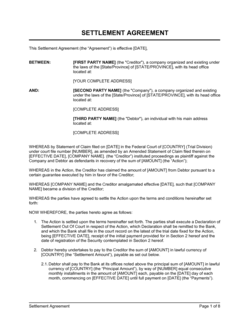
Severance Package Template

Free Word download • Edit online • Save & share with Drive • Export to PDF

3 pages25–30 min to fillDifficulty: ComplexSignature requiredLegal review recommended
Learn more ↓
FreeSeverance Package Template

At a glance

What it is
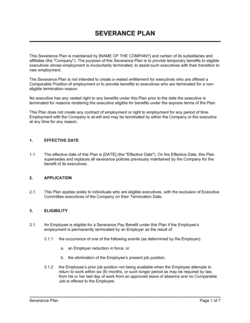
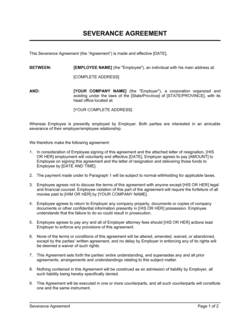
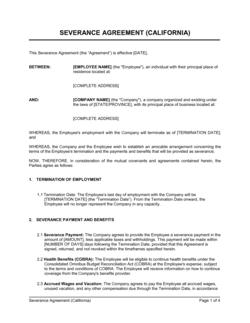
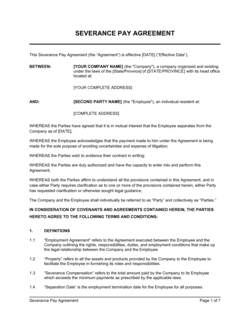
A Severance Package is a legally binding agreement between an employer and a departing employee that documents the compensation, benefits, and conditions attached to the end of employment. This free Word download covers separation pay, benefits continuation, a release of claims, non-disparagement, confidentiality, and return-of-property obligations in a single structured document you can edit online and export as PDF.
When you need it
Use it when terminating an employee without cause, conducting a reduction in force, or negotiating a mutual separation — any situation where you are offering compensation in exchange for a clean, documented end to the employment relationship. It is also used when an employee negotiates departure terms after a constructive dismissal claim.
What's inside
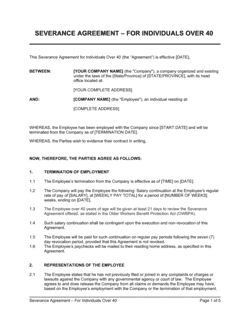
Separation date and final pay details, severance formula and payment schedule, COBRA or benefits continuation terms, a mutual release of claims, non-disparagement and confidentiality obligations, return-of-property requirements, and governing law with a 21- or 45-day review period as required under US federal law for employees 40 and older.

What is a Severance Package?

A Severance Package is a legally binding agreement executed at the end of employment in which an employer provides compensation and benefits to a departing employee in exchange for a signed release of legal claims arising from the employment relationship. It documents the severance pay amount and payment schedule, benefits continuation terms, post-separation obligations such as confidentiality and non-disparagement, property return requirements, and the governing law that controls the agreement. Unlike a termination letter — which simply notifies the employee that employment is ending — a severance package creates enforceable contractual obligations on both sides and, when properly executed, closes out the legal relationship cleanly and completely.

Why You Need This Document

Without a properly drafted severance agreement, every departure is a potential lawsuit waiting to be filed. An employee who receives a check with no corresponding release retains the right to sue for wrongful termination, discrimination, unpaid wages, harassment, or any other employment claim — for the full statutory limitations period, which runs two to five years in most US states and longer in some jurisdictions. A signed release of claims, supported by documented consideration and executed in compliance with the ADEA for employees aged 40 or older, eliminates that exposure in exchange for a payment you control. The agreement also preserves your confidentiality and non-disparagement protections, ensures company property and data access are returned on a defined schedule, and creates a clear paper trail if post-separation disputes arise. For HR teams managing multiple separations, a standard template also enforces consistency — preventing the ad hoc variation in severance terms that generates disparate-impact claims. This template gives you a compliant, complete starting point that covers every material obligation in a single Word document you can execute and store in minutes.

Which variant fits your situation?

If your situation is…Use this template
Laying off multiple employees simultaneously in a RIFGroup Severance Agreement (RIF)
Separating a C-suite executive with equity and enhanced severanceExecutive Severance Agreement
Mutually ending employment where both parties have claimsMutual Separation Agreement
Terminating an employee for cause with no severance paymentEmployee Termination Letter
Documenting a voluntary resignation with a transition agreementResignation Acceptance Letter
Settling an active employment discrimination or harassment claimSettlement Agreement
Offering a retirement incentive package to eligible employeesEarly Retirement Incentive Agreement

Common mistakes to avoid

❌ Using a 21-day period for a group RIF instead of 45 days

Why it matters: The Older Workers Benefit Protection Act requires a 45-day consideration period any time two or more employees aged 40 or older are terminated in the same decisional unit. Using 21 days invalidates every ADEA waiver in the group, exposing the employer to class age-discrimination claims.

Fix: Identify the decisional unit before drafting, confirm whether the OWBPA 45-day rule applies, and attach the required statistical disclosure listing job titles and ages of affected and retained employees.

❌ Conditioning final wages on signing the severance agreement

Why it matters: In most US states, Canada, and the UK, final wages — including accrued vacation — are a statutory entitlement that cannot be withheld or delayed pending execution of a release. Doing so invalidates the release and exposes the employer to wage-theft claims.

Fix: Pay all earned wages and accrued benefits on the statutory deadline, separately and unconditionally. The severance payment is the new consideration for the release — not the wages already owed.

❌ Omitting the no-admission-of-liability clause

Why it matters: Without explicit language denying liability, opposing counsel in any related litigation can argue the payment itself is evidence of wrongdoing — complicating settlement of related claims and increasing insurance exposure.

Fix: Include a standard no-admission clause in the recitals and again near the signature block so its prominence is clear in the document.

❌ Introducing new restrictive covenants without fresh consideration

Why it matters: Courts in most jurisdictions will not enforce a non-compete or expanded non-solicitation clause added at termination if the only consideration is severance the employee was already owed or entitled to expect.

Fix: If new restrictions are necessary, document a specific additional payment — separate from and on top of the base severance — as the explicit consideration for those restrictions.

❌ Making the non-disparagement clause employee-only

Why it matters: California SB 331 (effective 2022) and similar statutes in other states require non-disparagement obligations to be mutual. A one-sided clause may be unenforceable and can trigger regulatory scrutiny.

Fix: Draft non-disparagement as mutual, binding both the employee and the company's officers and directors, while preserving both parties' right to provide truthful testimony in legal proceedings.

❌ Failing to attach the OWBPA statistical disclosure for group layoffs

Why it matters: For any RIF involving employees aged 40 or older, the OWBPA requires a written disclosure listing the ages and job titles of all employees in the decisional unit selected and not selected for the layoff. Missing this document voids the ADEA waiver for every affected employee, regardless of whether they individually reviewed the disclosure.

Fix: Prepare and attach the OWBPA disclosure as an exhibit before presenting any agreements to employees aged 40 or older in a group termination. Have employment counsel review it before distribution.

The 10 key clauses, explained

Parties, separation date, and recitals

In plain language: Identifies the employer and employee as legal entities, states the effective separation date, and briefly sets out the background — why the agreement is being entered into.

Sample language
This Severance Agreement and General Release ('Agreement') is entered into as of [DATE] between [EMPLOYER LEGAL NAME], a [STATE] [ENTITY TYPE] ('Company'), and [EMPLOYEE FULL NAME] ('Employee'). Employee's employment with the Company will end effective [SEPARATION DATE].

Common mistake: Using the employer's trade name instead of the registered legal entity name — creating enforceability ambiguity if the operating name and legal name differ.

Severance pay and payment schedule

In plain language: States the total severance amount, how it is calculated, and whether it is paid as a lump sum or in regular installments on the normal payroll cycle.

Sample language
In consideration of Employee's execution of this Agreement, Company agrees to pay Employee a severance of $[AMOUNT], equivalent to [X] weeks of base salary, payable in [lump sum on / installments beginning] [DATE], less applicable withholdings and deductions.

Common mistake: Failing to specify whether payment is a lump sum or installment — which matters significantly for income tax timing and for what triggers clawback if the employee breaches the agreement.

Benefits continuation

In plain language: Addresses what happens to health insurance, life insurance, and other benefits after the separation date — including COBRA election rights and any employer subsidy of premiums.

Sample language
Employee's participation in the Company's group health plan will cease on [DATE]. The Company will [subsidize Employee's COBRA premiums for [X] months / provide Employee with [X] months of continued health coverage at no cost to Employee], after which Employee is responsible for all continuation costs.

Common mistake: Promising a specific dollar subsidy of COBRA premiums without confirming the current plan premium — the amount changes annually and the contract may understate or overstate the actual cost.

General release of claims

In plain language: The employee releases all known and unknown claims against the employer — including wrongful termination, discrimination, harassment, and wage-and-hour claims — in exchange for the severance consideration.

Sample language
In exchange for the consideration described herein, Employee hereby releases and forever discharges the Company and its officers, directors, employees, and agents from any and all claims, demands, causes of action, and liabilities of any kind, known or unknown, arising out of or relating to Employee's employment or the termination thereof, including but not limited to claims under Title VII, the ADEA, the ADA, the FMLA, and applicable state law.

Common mistake: Including an overly broad release that purports to waive future claims or claims that cannot be waived by law — such as the right to file an EEOC charge — which can render the entire release void in some jurisdictions.

ADEA-compliant waiver and revocation rights

In plain language: For employees aged 40 or older, a specific acknowledgment that the employee has 21 days to consider the agreement (45 days for group layoffs) and 7 days to revoke after signing.

Sample language
Employee acknowledges that: (a) this Agreement includes a waiver of claims under the ADEA; (b) Employee has been advised to consult an attorney; (c) Employee has [21 / 45] days to consider this Agreement; and (d) Employee may revoke this Agreement within 7 days of signing by providing written notice to [HR CONTACT / EMAIL].

Common mistake: Using a 21-day period for a group RIF instead of the required 45-day period — invalidating the ADEA waiver for every employee in the group, even those who have already signed.

Non-disparagement

In plain language: Prohibits both the employee and the employer's representatives from making public statements that harm the reputation of the other party after separation.

Sample language
Employee agrees not to make any statement, written or oral, that disparages the Company, its products, services, or current or former employees. The Company agrees to instruct its officers and directors not to make disparaging statements about Employee. Neither party is prevented from providing truthful testimony in a legal proceeding.

Common mistake: Making the non-disparagement clause one-sided (employee only) without considering that some states — including California — require mutual non-disparagement to be enforceable as of 2022.

Confidentiality and return of property

In plain language: Requires the employee to maintain confidentiality of the agreement's terms and the company's trade secrets, and to return all company property — devices, documents, access credentials — by a specified date.

Sample language
Employee shall keep the terms of this Agreement strictly confidential, except as required by law or to consult with an attorney or tax advisor. Employee shall return all Company property — including laptops, access badges, and confidential documents — no later than [DATE].

Common mistake: Setting a property return deadline that falls after the separation date but before any severance payment — giving the employee an incentive to delay return without creating a clear breach trigger.

Post-employment restrictions

In plain language: Incorporates or restates any surviving non-compete, non-solicitation, or IP assignment obligations from the original employment contract, confirming they survive separation.

Sample language
Employee acknowledges that the non-solicitation and confidentiality provisions set forth in the Employment Agreement dated [DATE] survive the termination of employment and remain in full force and effect. [If applicable: Employee's non-compete obligation of [X] months commences on the Separation Date.]

Common mistake: Attempting to introduce new restrictive covenants in the severance agreement that were never in the original employment contract — courts in most jurisdictions will not enforce them without new independent consideration beyond the severance already being paid.

No admission of liability

In plain language: States explicitly that the agreement and the payment are not an admission by either party that any wrongdoing or legal violation occurred.

Sample language
This Agreement does not constitute an admission by the Company of any wrongdoing, liability, or violation of law. Employee likewise does not admit to any breach of duty or policy.

Common mistake: Omitting this clause entirely — without it, plaintiffs' attorneys can argue in subsequent litigation that the severance payment itself is evidence of liability.

Governing law, integration, and dispute resolution

In plain language: Specifies which jurisdiction's law governs the agreement, confirms this document supersedes all prior agreements, and sets the mechanism for resolving disputes.

Sample language
This Agreement is governed by the laws of [STATE / PROVINCE]. This Agreement constitutes the entire agreement between the parties regarding its subject matter and supersedes all prior representations and agreements. Any dispute shall be resolved by binding arbitration in [CITY], except claims for injunctive relief.

Common mistake: Choosing a governing law with no connection to where the employee actually worked — many jurisdictions, including California, apply local employment law regardless of the contract's choice-of-law clause.

How to fill it out

  1. 1

    Enter the employer's legal entity name and the employee's details

    Use the full registered corporate name of the employer — not a brand or DBA — and the employee's legal name as it appears on employment records. Include the employee's job title and department for context.

    💡 Cross-check the entity name against your state or provincial corporate registry before the employee signs — a name mismatch can void the release.

  2. 2

    Set the separation date and confirm final pay logistics

    State the exact last day of employment. Confirm that final wages, accrued vacation, and expense reimbursements will be paid by the date required under applicable state or provincial law — separately from and in addition to the severance.

    💡 In California, final wages must be paid on the last day of employment for involuntary terminations — the severance agreement cannot delay or condition this payment.

  3. 3

    Calculate and document the severance amount

    Enter the total severance, the formula used (e.g., 2 weeks per year of service), and whether it will be paid as a lump sum or in regular installments. Specify the start date for installment payments.

    💡 Lump-sum payments are cleaner to administer and reduce clawback complexity — but installments preserve leverage if the employee breaches post-separation obligations.

  4. 4

    Address benefits continuation and COBRA

    State the date benefits terminate, whether the employer will subsidize COBRA premiums and for how many months, and the contact for COBRA election paperwork. If offering continued coverage, specify the dollar cap or duration clearly.

    💡 Do not promise a specific monthly subsidy without confirming the current plan premium — health insurance costs change annually and an understated figure creates a breach risk.

  5. 5

    Tailor the release of claims to the employee's profile

    If the employee is 40 or older, include the full ADEA waiver language with a 21-day consideration period (45 days for a group RIF) and a 7-day revocation window. For younger employees, the standard general release applies without the extended timeline.

    💡 For any group layoff involving two or more employees aged 40 or older, you must also attach the OWBPA disclosure listing job titles and ages of all employees in the decisional unit — failure to do so invalidates every ADEA waiver in the group.

  6. 6

    Review and incorporate post-employment restrictions

    If the original employment contract contained a non-compete, non-solicitation, or IP assignment clause, reference it explicitly and confirm it survives. Do not attempt to introduce new restrictions at this stage without providing separate additional consideration.

    💡 If you need a new non-compete signed at separation, consider adding a modest additional payment — even $500–$1,000 — as documented fresh consideration to support enforceability.

  7. 7

    Set the property return deadline and revocation mechanics

    Specify the exact date by which company devices, documents, and credentials must be returned. State the revocation address and method clearly so the 7-day window is unambiguous for ADEA-covered employees.

    💡 Tie the first severance installment date to a date after the revocation period expires — this prevents payment before the agreement becomes irrevocable.

  8. 8

    Have both parties sign before the separation date

    Present the agreement early enough that the employee has meaningful time to review it within the consideration period — not on their last day. Both parties must sign for the agreement to be binding.

    💡 Use a timestamped e-signature platform to document when the agreement was presented and when it was signed, creating a clear record of the consideration period.

Frequently asked questions

What is a severance package?

A severance package is a legally binding agreement between an employer and a departing employee that sets out the compensation, benefits, and obligations attached to the end of employment. It typically includes a severance payment calculated on years of service, continued health coverage or COBRA subsidy, a release of legal claims, and post-separation obligations such as confidentiality and non-disparagement. The employer pays severance in exchange for the employee's release of claims and agreement to cooperate with transition.

Is severance pay legally required?

In the United States, federal law does not require severance pay — it is a matter of contract or company policy. However, if a company policy or employment contract promises severance, that promise is generally enforceable. In Canada, provincial employment standards laws set minimum notice or termination pay requirements that function as a statutory floor on severance. In the UK and EU, statutory redundancy pay and notice entitlements are legally mandated regardless of whether a written severance agreement exists.

What is typically included in a severance package?

A complete severance package covers: the separation date and final pay logistics, severance pay calculated on a defined formula (commonly 1–4 weeks per year of service), benefits continuation or a COBRA subsidy, a general release of all employment-related claims, ADEA waiver language for employees aged 40 or older, non-disparagement and confidentiality obligations, return-of-property requirements, and governing law with an integration clause. Packages for senior employees often add extended vesting acceleration, bonus proration, and outplacement services.

How is severance pay typically calculated?

The most common formula in the US is one to two weeks of base salary per year of service, with a minimum of two to four weeks. Senior employees typically negotiate higher multiples — four to eight weeks per year is not unusual at the director level or above. In Canada, common-law notice obligations (which severance is meant to satisfy) can reach one month per year of service for long-tenured employees. UK statutory redundancy pay uses a tiered formula based on age and years of service, with a weekly pay cap updated annually.

Can an employee negotiate a severance package?

Yes. Severance offers are negotiable, particularly for senior employees, long-tenured staff, or in situations involving potential legal claims. Common negotiating points include increasing the severance multiplier, extending the COBRA subsidy period, accelerating vesting on unvested equity, adding outplacement services, and modifying the scope of the non-disparagement clause. Employees aged 40 or older have a statutory 21-day consideration period specifically to allow time for negotiation and legal review.

What is an ADEA waiver and when is it required?

An ADEA waiver is a specific release of age discrimination claims under the Age Discrimination in Employment Act. It is required — and must meet specific statutory standards — any time the severance agreement releases claims for employees aged 40 or older. The waiver must be written in plain language, must specifically reference the ADEA, must advise the employee to consult an attorney, must provide a 21-day consideration period (45 days for group layoffs), and must allow a 7-day revocation window after signing. Agreements that omit any of these elements cannot release ADEA claims.

Does a severance agreement prevent an employee from filing an EEOC charge?

No. A severance agreement cannot lawfully prohibit an employee from filing a charge with the EEOC or equivalent state agency, cooperating with an EEOC investigation, or participating in EEOC proceedings. However, a valid release can waive the employee's right to receive monetary damages from any resulting lawsuit. Include explicit carve-out language preserving these rights — omitting it risks the EEOC treating the release as unlawfully coercive, potentially voiding the entire agreement.

What happens if an employee revokes a severance agreement?

For employees aged 40 or older, the ADEA provides an absolute 7-day revocation right after signing. If the employee revokes within that window, the agreement is void and no severance is owed — the employer keeps its money and the employee retains all claims. To protect the employer, structure the first severance payment to fall after the revocation window closes. For employees under 40, there is no statutory revocation right, though many agreements include a shorter contractual cooling-off period as a matter of fairness.

Should a severance package be reviewed by a lawyer?

For most standard terminations involving salaried employees with no active legal claims, a high-quality template reviewed by HR is sufficient. Legal review is strongly recommended for terminations involving employees aged 40 or older (ADEA compliance), group layoffs triggering OWBPA and WARN Act obligations, executives with equity and complex severance entitlements, employees in heavily regulated industries, or any situation where the employee has already filed a complaint or hinted at litigation. A focused employment attorney review typically costs $400–$900 and is a sound investment against a wrongful termination claim.

How this compares to alternatives

vs Separation agreement

A separation agreement documents the mutual end of an employment relationship and may or may not include a severance payment. A severance package specifically exchanges compensation for a release of claims and is typically employer-initiated. When both parties have unresolved grievances, a mutual separation agreement is the more appropriate vehicle; when the employer is simply offering a clean exit with pay, a severance package is the right document.

vs Employee termination letter

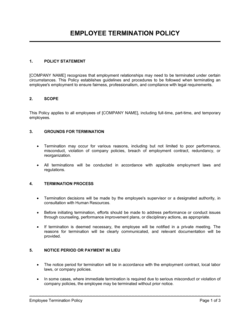
A termination letter notifies the employee that employment is ending and states the reason and effective date — it does not create a binding release of claims or document any consideration. A severance package is the binding agreement that follows a termination decision when compensation is being offered. Both documents are typically issued together, but they serve entirely different legal functions.

vs Settlement agreement

A settlement agreement resolves a specific existing or threatened legal dispute — discrimination, harassment, or wage claims — and is typically negotiated adversarially with both sides represented. A severance package is issued proactively at the point of separation, before a dispute is filed, to prevent litigation. Settlement agreements typically involve higher payments and more complex mutual releases than standard severance packages.

vs Employment contract

An employment contract governs the entire employment relationship from hire through termination, and may include a pre-agreed severance formula as one of its clauses. A severance package is executed at the end of the relationship and operationalizes those terms — or negotiates new ones. The severance package supersedes the employment contract's termination provisions and should explicitly state this in the integration clause.

Industry-specific considerations

Technology / SaaS

Equity vesting acceleration clauses are standard for engineering and product leaders; IP assignment survival and source-code return obligations require explicit language in the agreement.

Financial Services

Bonus clawback provisions, FINRA and FCA registration transition obligations, and garden leave during notice periods are common features that require tailored drafting.

Healthcare

HIPAA confidentiality obligations survive separation and must be incorporated by reference; clinical licensing and credentialing conditions may affect the separation date logistics.

Manufacturing

Plant-closing and mass-layoff scenarios trigger WARN Act notice requirements; union collective bargaining agreements often set minimum severance formulas that override individually negotiated packages.

Professional Services

Client non-solicitation obligations are critical given direct client relationships; billing adjustment and timesheet finalization deadlines need to be addressed alongside the separation date.

Retail / Hospitality

High-volume RIF events require group OWBPA compliance; tip and gratuity accounting for final pay, and scheduling of final paychecks across multiple locations require operational coordination.

Jurisdictional notes

United States

Federal law does not mandate severance pay, but the OWBPA and ADEA impose strict procedural requirements for releasing age discrimination claims for employees aged 40 or older, including 21-day (or 45-day for group layoffs) consideration periods and a 7-day revocation window. The WARN Act requires 60 days' written notice for mass layoffs involving 100 or more employees. State laws vary sharply — California requires final wages on the last day of involuntary termination and restricts non-disparagement clauses under SB 331.

Canada

Each province's Employment Standards Act sets minimum termination notice or pay in lieu — typically one week per year of service up to a provincial cap. Common-law notice obligations for long-tenured employees can significantly exceed statutory minimums and may reach one month per year of service in Ontario. Severance agreements must not pay less than the statutory floor, and releases of human rights claims require independent legal advice to be enforceable in most provinces. Quebec contracts must be in French for provincially regulated employers.

United Kingdom

Statutory redundancy pay applies to employees with at least two years' continuous service, calculated on a tiered formula based on age and weekly pay up to a statutory cap updated annually. Settlement agreements (the UK equivalent of a US severance agreement with a release) must be in writing and the employee must receive independent legal advice for the waiver of tribunal claims to be valid — employers typically contribute to the cost of that advice. The first £30,000 of a genuine redundancy payment is generally tax-free.

European Union

Severance entitlements vary widely by member state — France, Spain, and Italy mandate statutory severance calculated on years of service and salary, while Germany relies on social plan negotiations for collective redundancies. Most member states require works council consultation before individual or collective dismissals. Post-employment non-compete clauses generally require ongoing compensation paid to the employee during the restricted period — typically 25–100% of prior salary — to be enforceable. GDPR applies to any personal data processed in connection with the separation.

Template vs lawyer — what fits your deal?

PathBest forCostTime
Use the templateStandard at-will terminations for employees under 40 with no active claims and no equity complicationsFree30–60 minutes
Template + legal reviewEmployees aged 40 or older, group layoffs of any size, or senior roles with equity and complex benefits$400–$9002–5 business days
Custom draftedExecutive separations with equity acceleration and enhanced severance, WARN Act-triggering RIFs, or situations involving an active or threatened legal claim$2,000–$8,000+1–3 weeks

Glossary

Severance Pay
Compensation paid by an employer to a departing employee beyond their final paycheck, typically calculated as a number of weeks' pay per year of service.
Release of Claims
A contractual provision in which the employee waives the right to sue the employer for any claims arising out of or related to the employment relationship.
ADEA Waiver
A release that specifically waives age discrimination claims under the Age Discrimination in Employment Act, requiring a 21-day consideration period and 7-day revocation window for employees aged 40 or older.
COBRA
The Consolidated Omnibus Budget Reconciliation Act — a US federal law allowing departing employees to continue employer-sponsored health coverage for up to 18 months at their own cost.
Non-Disparagement Clause
A mutual or one-sided provision prohibiting the parties from making negative or harmful public statements about each other after separation.
Consideration
Something of value given in exchange for the employee's agreement — typically the severance payment itself — without which the release is unenforceable.
Garden Leave
A notice period during which the employee is paid their regular salary but not required — or permitted — to perform work, preventing access to clients or confidential information.
Constructive Dismissal
A situation in which an employer's unilateral and significant change to employment conditions effectively forces the employee to resign, treated legally as a termination.
Reduction in Force (RIF)
An employer-initiated elimination of positions, typically for economic or restructuring reasons rather than individual performance, often triggering severance obligations.
WARN Act
The US Worker Adjustment and Retraining Notification Act, requiring employers with 100 or more employees to give 60 days' advance written notice before a mass layoff or plant closing.
Pay in Lieu of Notice
A lump-sum payment equal to the salary the employee would have earned during a required notice period, given instead of requiring the employee to work that period out.
Clawback Provision
A clause requiring the employee to repay some or all severance if they breach a post-separation obligation such as non-disparagement or confidentiality.

Part of your Business Operating System

This document is one of 3,000+ business & legal templates included in Business in a Box.

  • Fill-in-the-blanks — ready in minutes
  • 100% customizable Word document
  • Compatible with all office suites
  • Export to PDF and share electronically

Create your document in 3 simple steps.

From template to signed document — all inside one Business Operating System.
1
Download or open template

Access over 3,000+ business and legal templates for any business task, project or initiative.

2
Edit and fill in the blanks with AI

Customize your ready-made business document template and save it in the cloud.

3
Save, Share, Send, Sign

Share your files and folders with your team. Create a space of seamless collaboration.

Save time, save money, and create top-quality documents.

★★★★★

"Fantastic value! I'm not sure how I'd do without it. It's worth its weight in gold and paid back for itself many times."

Managing Director · Mall Farm
Robert Whalley
Managing Director, Mall Farm Proprietary Limited
★★★★★

"I have been using Business in a Box for years. It has been the most useful source of templates I have encountered. I recommend it to anyone."

Business Owner · 4+ years
Dr Michael John Freestone
Business Owner
★★★★★

"It has been a life saver so many times I have lost count. Business in a Box has saved me so much time and as you know, time is money."

Owner · Upstate Web
David G. Moore Jr.
Owner, Upstate Web

Run your business with a system — not scattered tools

Stop downloading documents. Start operating with clarity. Business in a Box gives you the Business Operating System used by over 250,000 companies worldwide to structure, run, and grow their business.

Free Forever Plan · No credit card required