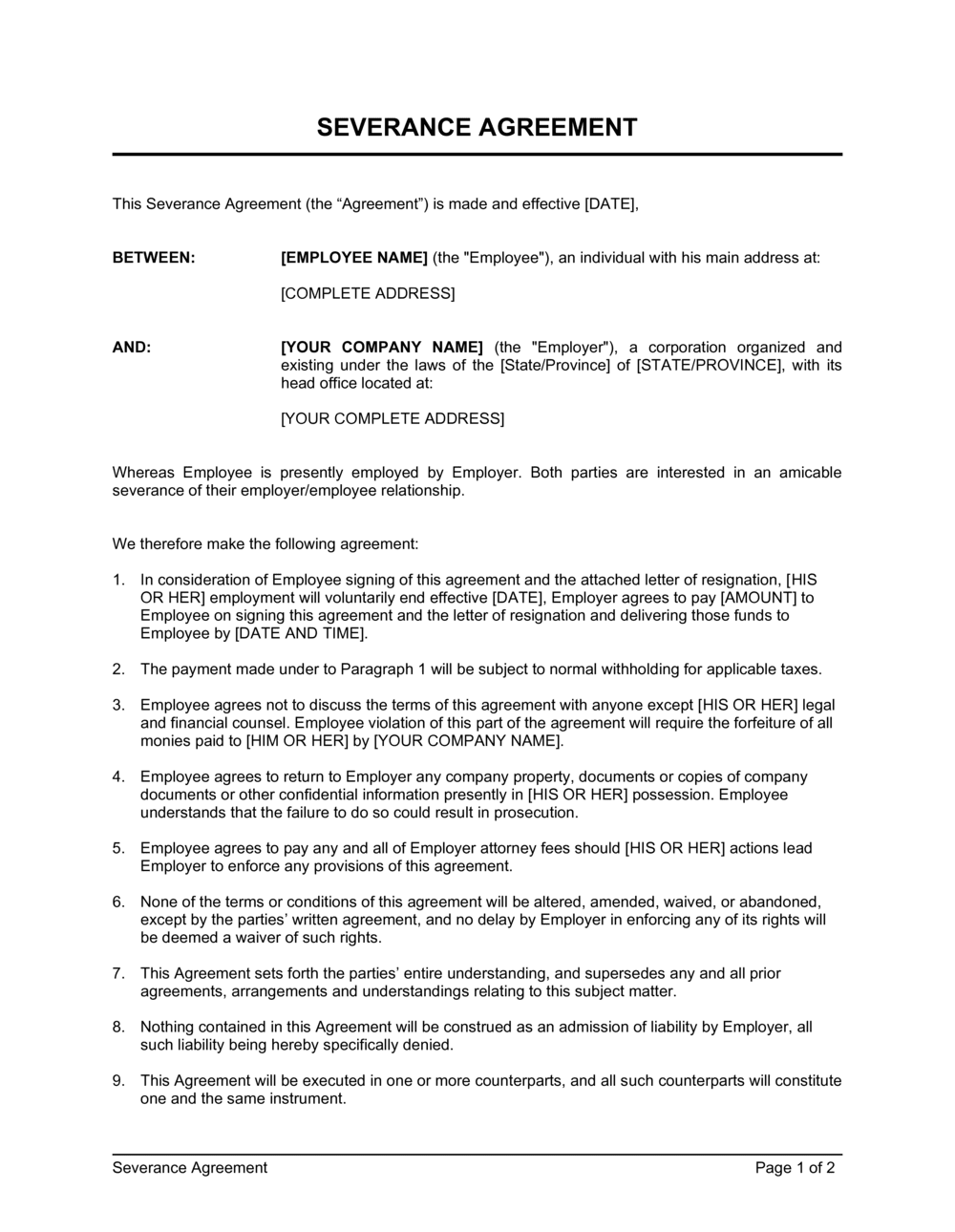
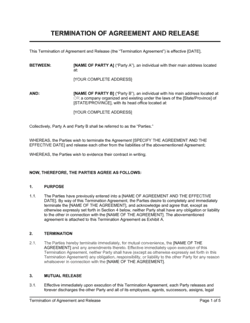
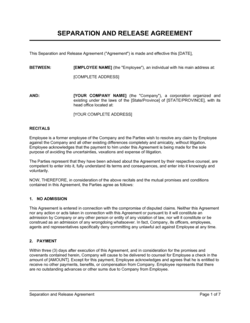
Severance Agreement Template

Free Word download β€’ Edit online β€’ Save & share with Drive β€’ Export to PDF

2 pagesβ€’25–30 min to fillβ€’Difficulty: Standardβ€’Signature requiredβ€’Legal review recommended
Learn more ↓
FreeSeverance Agreement Template

At a glance

What it is
A Severance Agreement is a legally binding contract between an employer and a departing employee that sets out the terms of separation β€” including severance pay, continuation of benefits, and any post-employment restrictions β€” in exchange for the employee's release of legal claims against the company. This free Word download is editable online and exportable as PDF, covering all standard provisions in a single document ready for attorney review and execution.
When you need it
Use it when separating an employee β€” whether through layoff, reduction in force, or negotiated departure β€” where you want a clean legal release of claims in exchange for severance compensation. It is also appropriate when an employee resigns under a negotiated arrangement or when a fixed-term contract ends and the parties agree to additional departure terms.
What's inside
Separation date and final pay details, severance amount and payment schedule, benefits continuation terms, a mutual release of all employment-related claims, confidentiality and non-disparagement obligations, return of company property, and post-employment restrictions including non-compete and non-solicitation where applicable.

What is a Severance Agreement?

A Severance Agreement is a legally binding contract between an employer and a departing employee that sets out the terms of separation β€” severance pay, benefits continuation, and post-employment obligations β€” in exchange for the employee's release of all employment-related legal claims against the company. Unlike a dismissal letter, which is a one-way notice with no binding force, a severance agreement is a bilateral contract: the employer provides financial consideration, and the employee waives the right to pursue claims arising from the employment relationship. It is the legal mechanism that converts a potentially contentious separation into a clean, documented conclusion. This free Word download covers every standard provision in a single editable document you can customize, have reviewed by counsel, and execute via eSignature.

Why You Need This Document

Without a signed severance agreement, a departing employee retains the full right to file a discrimination charge, wrongful termination lawsuit, or wage claim β€” regardless of how much the company pays them on the way out. Severance payments made without a corresponding release provide zero legal protection. Beyond litigation risk, an undocumented separation leaves critical questions unanswered: when does the employee's access to systems terminate, what happens to unvested equity, and what stops them from calling your top ten clients next Monday? A properly drafted severance agreement closes all of those gaps in a single document. For employers managing a reduction in force, standardizing on a compliant template ensures consistent treatment across affected employees β€” which itself reduces discrimination exposure. For individual managers handling a difficult departure, it provides a defensible, documented process that stands up to scrutiny.

Which variant fits your situation?

If your situation is…Use this template
Laying off a non-executive employee as part of a reduction in forceSeverance Agreement (Standard)
Separating a C-suite or VP-level executive with equity and enhanced benefitsExecutive Severance Agreement
Separating an employee who is 40 or older under ADEA requirementsSeverance Agreement with OWBPA Disclosures
Conducting a group layoff involving 50 or more employeesWARN Act Compliant RIF Severance Package
Ending employment by mutual agreement with no severance paymentMutual Separation Agreement
Settling an existing employment dispute or EEOC chargeEmployment Settlement Agreement
Ending an independent contractor relationshipContract Termination Agreement

Common mistakes to avoid

❌ Paying severance before the revocation window closes

Why it matters: For employees 40 and over, paying within the 7-day OWBPA revocation period means the employer has provided full consideration before the release is binding β€” the employee can revoke, keep the money, and still sue.

Fix: Hold all severance payments until the revocation period expires and you have written confirmation no revocation was submitted. For employees under 40, payment on the effective date of signing is acceptable.

❌ Using a one-size-fits-all release for all departing employees

Why it matters: A standard release that omits OWBPA disclosures is unenforceable against employees aged 40 and over for ADEA claims β€” the most frequently litigated category of employment discrimination.

Fix: Maintain two template variants β€” standard and ADEA-compliant β€” and check the employee's age before issuing. If in doubt, use the ADEA-compliant version for all employees.

❌ Attempting to waive claims that cannot legally be released

Why it matters: Including a release of EEOC charge rights, NLRA protected-activity rights, or workers' compensation claims can void the entire release agreement, not just the impermissible provision.

Fix: Limit the release to claims arising from the employment relationship and separate out any claims the employee retains by law. An employment attorney can confirm which claims are non-waivable in your jurisdiction.

❌ Omitting a clawback provision for post-separation covenant violations

Why it matters: Without a clawback, an employee who immediately joins a competitor or solicits clients has already received full severance with no practical remedy beyond costly litigation.

Fix: Include a clawback clause requiring repayment of severance (net of taxes paid) if the employee materially breaches the non-compete, non-solicitation, or confidentiality obligations within the restriction period.

❌ Failing to address equity, commissions, and bonus entitlements

Why it matters: Silence on unvested equity, outstanding commissions, or a pro-rated bonus creates disputes that can escalate into litigation, even after a signed release, if the employee argues these were earned pre-separation.

Fix: Expressly state the treatment of all equity awards, commissions owed through the separation date, and any bonus eligibility β€” even if the answer is that none are owed β€” so there is no room for ambiguity.

❌ Including non-compete restrictions without jurisdiction-checking

Why it matters: Unenforceable non-compete clauses do not simply disappear β€” in states like California, including one can expose the employer to unfair business practices claims under state law.

Fix: Verify enforceability for the employee's specific work state or country before including any post-employment competition restriction. Remove or narrow the clause where required by applicable law.

The 10 key clauses, explained

Parties and separation date

In plain language: Identifies the employer and employee as legal entities and states the official last day of employment.

Sample language
This Severance Agreement is entered into as of [DATE] by and between [EMPLOYER LEGAL NAME], a [STATE] [ENTITY TYPE] ('Company'), and [EMPLOYEE FULL NAME] ('Employee'). Employee's last day of employment is [SEPARATION DATE].

Common mistake: Using the employer's trade name instead of its registered legal entity name β€” this can complicate enforcement and create ambiguity about which entity is bound by the release.

Severance pay and payment schedule

In plain language: States the total severance amount, how it will be paid (lump sum or installments), the payment dates, and that payment is contingent on the agreement becoming effective.

Sample language
Provided this Agreement becomes effective and Employee has not revoked it, Company shall pay Employee severance of $[AMOUNT], less applicable withholdings, in [a lump sum on / equal installments beginning] [DATE(S)], corresponding to [X] weeks of base salary.

Common mistake: Failing to condition payment on the agreement becoming irrevocable β€” paying before the revocation window closes means the employer has provided consideration without a binding release.

Benefits continuation

In plain language: Describes any continued health, dental, or vision coverage after separation, including whether the employer will subsidize COBRA premiums and for how long.

Sample language
Company will pay the employer portion of Employee's health insurance premiums under COBRA for [X] months following the Separation Date, after which Employee is responsible for the full premium to maintain coverage.

Common mistake: Promising specific benefits continuation terms that conflict with the employer's actual plan documents β€” insurance carriers control COBRA eligibility, and over-promising here creates breach exposure.

General release of claims

In plain language: The employee releases all known and unknown employment-related legal claims against the employer β€” the core provision that makes the severance payment worthwhile to the employer.

Sample language
Employee unconditionally releases and forever discharges the Company, its officers, directors, employees, and successors from any and all claims, known or unknown, arising out of or related to Employee's employment or separation through the date of this Agreement, including but not limited to claims under [TITLE VII / ADEA / ADA / applicable state law].

Common mistake: Using a release that attempts to cover future claims or claims that cannot legally be waived β€” such as EEOC charges, NLRA rights, or workers' compensation claims β€” which can void the entire release in some jurisdictions.

ADEA and OWBPA compliance language

In plain language: For employees aged 40 or older, includes the mandatory disclosures, the 21-day review period, and the 7-day revocation right required to make the ADEA waiver enforceable.

Sample language
Employee acknowledges that: (a) this Agreement specifically releases claims under the ADEA; (b) Employee has 21 days to consider this Agreement; (c) Employee may revoke this Agreement within 7 days of signing by written notice to [HR CONTACT / EMAIL]; and (d) Employee is advised to consult an attorney.

Common mistake: Using a single generic release template for all employees regardless of age β€” omitting OWBPA disclosures for employees 40 and over renders the ADEA release unenforceable, exposing the company to age discrimination claims.

Confidentiality and non-disparagement

In plain language: Prohibits both parties from disclosing the terms of the agreement or making negative statements about each other after separation.

Sample language
Employee agrees to keep the terms of this Agreement confidential and not to disclose them to any third party except Employee's attorneys, financial advisors, or immediate family on a need-to-know basis. Neither party shall make disparaging statements about the other to third parties.

Common mistake: Making non-disparagement one-sided (binding only the employee) without disclosing this asymmetry clearly β€” in some jurisdictions this affects enforceability, and in all cases it creates negotiating friction.

Return of company property

In plain language: Requires the employee to return all company property β€” devices, documents, access credentials, and confidential data β€” by a specified date.

Sample language
On or before [DATE], Employee shall return to Company all property belonging to Company, including laptop, mobile devices, access cards, client files, and any copies of Confidential Information in any format, and shall certify in writing that no copies have been retained.

Common mistake: Not specifying a hard return date or omitting digital property (cloud files, email archives, code repositories) β€” departing employees with lingering system access create ongoing data security and IP exposure.

Non-compete and non-solicitation

In plain language: Restricts the employee from joining competitors or soliciting the company's customers or employees for a defined period and geography after separation.

Sample language
For [12] months following the Separation Date, Employee shall not (a) engage in a Competing Business within [GEOGRAPHIC AREA], or (b) solicit, divert, or hire any customer, client, or employee of the Company with whom Employee had material contact during the [24]-month period preceding separation.

Common mistake: Copying the non-compete language from the original employment contract without checking whether the same terms remain proportionate given the circumstances of the separation and the applicable jurisdiction's current enforcement standards.

Cooperation clause

In plain language: Requires the employee to assist the company with ongoing litigation, regulatory matters, or transition activities after separation, typically with expense reimbursement.

Sample language
For [12] months following the Separation Date, Employee agrees to cooperate reasonably with Company in connection with any litigation, investigation, or transition matter in which Employee's knowledge is relevant, provided Company reimburses Employee's reasonable out-of-pocket expenses and, for matters requiring more than [4] hours, compensates Employee at $[HOURLY RATE] per hour.

Common mistake: Including an open-ended cooperation obligation with no time limit or compensation provision β€” courts and employees both view unlimited unpaid cooperation as unreasonable, which can color how a court reads the rest of the agreement.

Governing law, dispute resolution, and integration

In plain language: Specifies which jurisdiction's law governs the agreement, how disputes are resolved (arbitration or court), and confirms the written agreement is the entire understanding between the parties.

Sample language
This Agreement is governed by the laws of [STATE / PROVINCE / COUNTRY]. Any dispute shall be resolved by binding arbitration administered by [AAA / JAMS] in [CITY]. This Agreement constitutes the entire understanding between the parties and supersedes all prior representations, offers, and agreements.

Common mistake: Choosing a governing law state with no meaningful connection to the employee's work location β€” California, for example, applies its own law regardless of a contrary governing-law clause for employees who worked in California.

How to fill it out

  1. 1

    Enter the parties' full legal names and separation date

    Use the employer's registered corporate entity name and the employee's legal name as it appears on payroll records. Confirm the exact separation date β€” this date triggers benefits cutoff, the start of restriction periods, and the review clock.

    πŸ’‘ Cross-reference the separation date with your payroll system to ensure final pay, accrued PTO, and any outstanding commissions are settled on or before that date.

  2. 2

    Calculate and document the severance amount

    Enter the total severance payment, the calculation basis (e.g., 2 weeks per year of service), and the payment schedule. State whether payment is a lump sum or installments and on which specific dates payments will be made.

    πŸ’‘ Condition payment explicitly on the agreement becoming irrevocable β€” for employees under 40 this is upon signing; for employees 40 and over this is 7 days after signing.

  3. 3

    Specify benefits continuation terms

    Confirm with your insurance carrier which benefits can continue post-separation and for how long. Enter the COBRA subsidy period and end date, and note which benefits terminate on the separation date.

    πŸ’‘ Do not promise coverage continuation for benefits your carrier does not allow post-separation β€” verify with HR or your broker before completing this section.

  4. 4

    Tailor the release of claims to the employee's age

    For employees under 40, a standard general release is sufficient. For employees 40 or older, add the full OWBPA block β€” 21-day review period, 7-day revocation right, and a written advisory to consult an attorney.

    πŸ’‘ If conducting a group RIF with employees 40 and over, OWBPA requires a 45-day review period and a disclosure listing the ages and job titles of all employees in the decisional unit β€” consult an employment attorney before issuing.

  5. 5

    Set non-compete and non-solicitation scope

    Confirm that non-compete and non-solicitation restrictions are enforceable in the employee's work jurisdiction before including them. Set geographic scope and duration proportionate to the employee's actual access to competitive information.

    πŸ’‘ Several US states β€” including California, Minnesota, and North Dakota β€” prohibit most post-employment non-competes; remove the clause entirely for employees in those jurisdictions.

  6. 6

    Define the property return deadline and method

    Set a specific return date no later than the separation date for physical items and within 24 hours for remote access revocation. List all property categories explicitly, including digital files, credentials, and cloud-stored documents.

    πŸ’‘ For remote employees, arrange a prepaid shipping label in advance β€” a specific logistics plan dramatically increases timely compliance.

  7. 7

    Have both parties sign before any severance is paid

    Both the authorized employer representative and the employee must sign before any payment is issued. For employees 40 and over, do not countersign until the 7-day revocation period has expired.

    πŸ’‘ Use a timestamped eSignature platform to create an audit trail of when the agreement was sent, signed, and when the revocation window closed.

  8. 8

    Retain the executed agreement and notify relevant departments

    Store the fully signed agreement in the employee's personnel file and notify payroll, IT, and benefits administration of the separation date and any post-separation obligations the company must fulfill.

    πŸ’‘ Create a calendar reminder for each payment date and benefits cutoff date so no obligation is missed β€” missed payments can void the agreement in some jurisdictions.

Frequently asked questions

What is a severance agreement?

A severance agreement is a legally binding contract between an employer and a departing employee that sets out the terms of separation β€” typically including severance pay, benefits continuation, and post-employment restrictions β€” in exchange for the employee's release of all employment-related legal claims. It gives the employer a clean legal break from the separation and gives the employee financial support and clarity about what they are entitled to receive.

Is a severance agreement required by law?

In the United States, no federal law requires employers to offer severance pay or a severance agreement. However, if an employer's written policy, employment contract, or collective bargaining agreement promises severance, that promise is generally enforceable. In Canada, the UK, and the EU, statutory termination pay and notice requirements apply regardless of whether a severance agreement exists β€” an agreement typically provides additional consideration above the statutory floor.

What should a severance agreement include?

At minimum: a clearly identified separation date, the severance amount and payment schedule, benefits continuation terms, a general release of claims, confidentiality and non-disparagement obligations, a return-of- property clause, post-employment restrictions (non-compete and non-solicitation where enforceable), a cooperation clause, and governing law. For employees aged 40 and over in the US, OWBPA disclosures β€” including the 21-day review period and 7-day revocation right β€” are also legally required.

Do employees have to sign a severance agreement?

No. Employees are never legally required to sign a severance agreement. The agreement is voluntary β€” the employee exchanges their right to sue for the severance benefits offered. If an employee declines to sign, they typically receive only whatever compensation is owed by law (final wages, accrued PTO) and no additional severance. Employees have the right to take time to review the agreement and consult an attorney before deciding.

How long does an employee have to review a severance agreement?

For employees under 40 in the US, there is no federal minimum review period, but giving at least 5–7 business days is standard practice. For employees aged 40 or older, the OWBPA requires a minimum 21-day review period and a 7-day revocation window after signing before the agreement becomes irrevocable. For group layoffs involving employees 40 and over, the review period extends to 45 days and additional disclosures are required.

What is the difference between a severance agreement and a separation agreement?

The terms are often used interchangeably, but there is a subtle distinction in practice. A severance agreement typically focuses on the employer's payment obligations and the employee's release of claims. A separation agreement is sometimes used as a broader term covering all terms of the end of the employment relationship, including severance, reference arrangements, equity treatment, and transition obligations. Both documents serve the same core legal function β€” trading compensation for a release of claims.

How much severance should I offer?

There is no universal formula in the US, but one to two weeks of base salary per year of service β€” with a minimum of two to four weeks total β€” is a widely used benchmark for non-executive employees. Executives typically receive one to three months per year of service. The appropriate amount depends on the employee's tenure, the reason for separation, the risk of litigation, and the terms of any pre-existing employment contract. In Canada and the UK, statutory minimums set a floor that the offer must meet or exceed.

Do I need a lawyer to draft a severance agreement?

For straightforward separations of non-executive employees in a single US state or Canadian province, a high-quality template reviewed by HR is often sufficient. Legal review is strongly recommended when the employee is aged 40 or older (OWBPA compliance), when the separation involves equity, outstanding litigation, or an existing employment contract, when the employee works across multiple jurisdictions, or when the separation carries significant discrimination or retaliation risk. A one-hour employment attorney review typically costs $300–$600 and is worthwhile for any departure with material legal exposure.

How this compares to alternatives

vs Employment Contract

An employment contract governs the beginning and ongoing terms of the working relationship β€” compensation, duties, IP, and restrictions during employment. A severance agreement governs the end of that relationship, trading post-employment compensation for a release of claims. The severance agreement typically overrides or supplements the termination provisions in the employment contract.

vs Mutual Termination Agreement

A mutual termination agreement documents a consensual end to an employment relationship, often without a severance payment or formal release of claims. A severance agreement is used when the employer is providing financial consideration specifically in exchange for a legally binding release. Use a severance agreement when litigation risk or claim exposure is the primary concern.

vs Employee Dismissal Letter

A dismissal letter is a non-binding notice document informing an employee of termination β€” it creates no contractual obligations and does not release any claims. A severance agreement is a binding bilateral contract. The dismissal letter may accompany the severance agreement as the formal notice of termination, but it cannot substitute for the agreement's legal protections.

vs Non-Disclosure Agreement

A standalone NDA is a focused confidentiality agreement covering specific information. A severance agreement typically includes confidentiality provisions as one clause among many, covering both the agreement's own terms and the company's broader confidential information. Use a standalone NDA when confidentiality obligations need to persist across multiple contexts beyond the separation itself.

Industry-specific considerations

Technology / SaaS

Equity treatment at separation β€” accelerated vesting, exercise window extensions, and RSU proration β€” must be addressed alongside cash severance to avoid post-departure disputes.

Financial Services

Regulatory licensing obligations, clawback provisions tied to deferred compensation, and garden leave arrangements are standard features for departing bankers and advisors.

Healthcare

Patient non-solicitation clauses, HIPAA confidentiality obligations that survive separation, and credentialing hand-off requirements distinguish healthcare severance from standard agreements.

Professional Services

Client non-solicitation is the central concern given fee-based relationships; restricting client contact for 12–24 months post-separation is common and more consistently enforced than broad non-competes.

Manufacturing

Trade secret and process confidentiality provisions carry particular weight; departing engineers or plant managers with access to proprietary formulations or production methods require tightly scoped IP protections.

Retail / Hospitality

High turnover and hourly workforce separations favor simple, short-form agreements; the key focus is final wage compliance, PTO payout, and a clean EEOC release rather than extensive restrictive covenants.

Jurisdictional notes

United States

Federal law (OWBPA) requires a 21-day review period, 7-day revocation window, and written attorney advisement for employees aged 40 and over; group RIFs require 45 days. Non-compete enforceability varies sharply by state β€” California, Minnesota, and North Dakota prohibit most post-employment restrictions. Several states also require specific wage payment timing on separation, and failure to comply can trigger waiting-time penalties.

Canada

Common-law reasonable notice can reach one month per year of service for long-tenured employees, far exceeding Employment Standards Act minimums. Severance agreements must provide at least the statutory floor; anything less is unenforceable. Ontario requires 'fresh consideration' beyond the statutory entitlement for a release to be binding. Quebec agreements must be available in French for provincially regulated employers.

United Kingdom

Settlement agreements (formerly compromise agreements) must be in writing, and the employee must receive independent legal advice β€” paid for by the employer, typically Β£350–£500 β€” for the release of statutory claims to be valid. The first Β£30,000 of a severance payment is generally tax-free. Post-employment restrictive covenants are enforceable only if they are reasonable in scope and supported by adequate consideration at the time of the original employment agreement.

European Union

Member state employment law governs most severance terms, and statutory notice and redundancy pay entitlements vary significantly β€” France, Germany, and Spain impose lengthy notice periods and require consultation processes before mass layoffs. The EU's GDPR requires that any data processing of the employee's personal information post-separation be addressed in or alongside the agreement. Non-compete clauses in several member states require ongoing financial compensation β€” typically 25–50% of base salary β€” during the restriction period to be enforceable.

Template vs lawyer β€” what fits your deal?

PathBest forCostTime
Use the templateNon-executive employees under 40, straightforward separations in a single domestic jurisdiction, low litigation riskFree30–60 minutes
Template + legal reviewEmployees aged 40 or older, cross-state or cross-border separations, departures involving equity or an existing employment contract$300–$6001–3 days
Custom draftedExecutive separations with equity acceleration and enhanced severance, group RIFs, active litigation or EEOC charges, regulated industries$1,500–$5,000+1–2 weeks

Glossary

Release of Claims
A contractual provision in which the employee gives up the right to sue the employer for any employment-related legal claims arising before the separation date.
Consideration
Something of value β€” typically severance pay or benefits continuation β€” that the employer provides in exchange for the employee's release, making the agreement legally binding.
COBRA
A US federal law allowing departing employees to continue employer-sponsored health coverage for up to 18 months by paying the full premium themselves.
ADEA (Age Discrimination in Employment Act)
A US federal law protecting workers 40 and older from age discrimination; severance agreements covering this group must include a 21-day review period and a 7-day revocation window.
OWBPA (Older Workers Benefit Protection Act)
A US law setting specific disclosure and timing requirements that must be met before a release of ADEA claims is enforceable against employees aged 40 or older.
Non-Disparagement Clause
A mutual or one-sided restriction prohibiting the parties from making negative public statements about each other after the separation.
Clawback Provision
A clause requiring the employee to repay severance if they violate a post-separation obligation such as confidentiality, non-compete, or non-solicitation.
Garden Leave
A notice period during which the employee is paid but required to stay away from the workplace and clients, typically used to protect confidential information and customer relationships.
Separation Date
The official last day of employment stated in the agreement, which determines final pay, benefits cutoff, and the start of any post-employment restriction periods.
Pay in Lieu of Notice
A lump-sum payment equal to the salary the employee would have earned during a required notice period, used when the employer waives the working notice period.
Net Operating Period
The window between the separation date and the date severance payments end, during which the employee typically cannot collect unemployment benefits in some jurisdictions.

Part of your Business Operating System

This document is one of 3,000+ business & legal templates included in Business in a Box.

  • Fill-in-the-blanks β€” ready in minutes
  • 100% customizable Word document
  • Compatible with all office suites
  • Export to PDF and share electronically

Create your document in 3 simple steps.

From template to signed document β€” all inside one Business Operating System.
1
Download or open template

Access over 3,000+ business and legal templates for any business task, project or initiative.

2
Edit and fill in the blanks with AI

Customize your ready-made business document template and save it in the cloud.

3
Save, Share, Send, Sign

Share your files and folders with your team. Create a space of seamless collaboration.

Save time, save money, and create top-quality documents.

β˜…β˜…β˜…β˜…β˜…

"Fantastic value! I'm not sure how I'd do without it. It's worth its weight in gold and paid back for itself many times."

Managing Director Β· Mall Farm
Robert Whalley
Managing Director, Mall Farm Proprietary Limited
β˜…β˜…β˜…β˜…β˜…

"I have been using Business in a Box for years. It has been the most useful source of templates I have encountered. I recommend it to anyone."

Business Owner Β· 4+ years
Dr Michael John Freestone
Business Owner
β˜…β˜…β˜…β˜…β˜…

"It has been a life saver so many times I have lost count. Business in a Box has saved me so much time and as you know, time is money."

Owner Β· Upstate Web
David G. Moore Jr.
Owner, Upstate Web

Run your business with a system β€” not scattered tools

Stop downloading documents. Start operating with clarity. Business in a Box gives you the Business Operating System used by over 250,000 companies worldwide to structure, run, and grow their business.

Start freeΒ Β·Β No credit card required