Business Requirements Document Template

Free Word download • Edit online • Save & share with Drive • Export to PDF

3 pages20–30 min to fillDifficulty: StandardSignature requiredLegal review recommended
Learn more ↓
FreeBusiness Requirements Document Template

At a glance

What it is
A Business Requirements Document (BRD) is a formal agreement between a business and its technology, development, or implementation partner that captures exactly what a project must deliver — scope, objectives, functional requirements, constraints, and acceptance criteria — in a single binding reference. This free Word download gives you a structured starting point you can edit online and export as PDF to align stakeholders, govern delivery, and resolve scope disputes.
When you need it
Use it at the start of any software build, system implementation, or business transformation project where two or more parties must agree on what success looks like before work begins. It is also the reference point throughout delivery whenever scope, priority, or interpretation is disputed.
What's inside
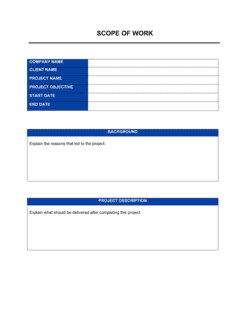
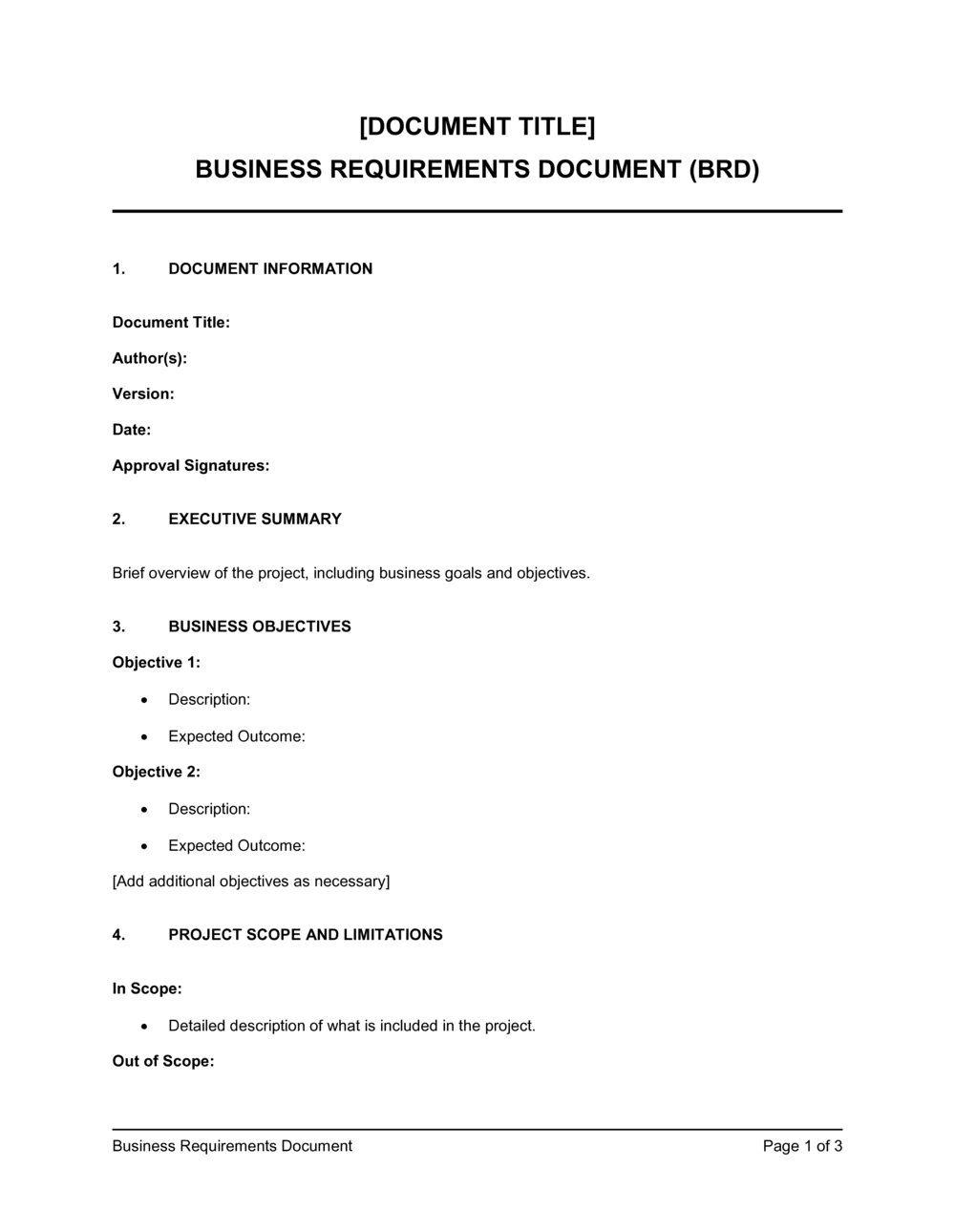
Project background and business objectives, stakeholder register, in-scope and out-of-scope definitions, detailed functional and non-functional requirements, assumptions and dependencies, constraints, acceptance criteria, approval signatures, and a change-control procedure.

What is a Business Requirements Document?

A Business Requirements Document (BRD) is a formal, signed agreement between a business and its delivery partner — whether an internal IT team, an external software vendor, or a systems integrator — that defines exactly what a project must achieve before a single line of code is written or a single process is changed. It translates high-level business objectives into numbered, testable requirements covering scope boundaries, functional behaviors, non-functional quality standards, assumptions, constraints, and the acceptance criteria that determine when delivery is complete. Unlike a project charter or a scope statement, a BRD goes deep enough that a developer can build from it and a tester can verify against it, making it the single authoritative reference for the entire delivery lifecycle.

Why You Need This Document

Projects that begin without a signed BRD consistently end the same way: disputed change orders, failed acceptance tests, and both parties convinced the other is at fault. Without a documented scope baseline, every informal email, meeting note, or whiteboard sketch becomes a competing version of the requirements — and vendors bill for all of them at project close. The absence of numbered, testable requirements means acceptance is a matter of opinion rather than a matter of pass/fail testing, leaving you legally exposed whether you are the business commissioning the work or the firm delivering it. A signed BRD changes the dynamic entirely: scope disputes resolve to a document rather than a conversation, change requests are priced against a known baseline rather than inflated at delivery, and acceptance is objective rather than contested. This template gives you that baseline in a structured Word format you can complete in one to three days, adapt to your industry's compliance requirements, and execute as a binding part of your vendor or development agreement.

Which variant fits your situation?

If your situation is…Use this template
Early-stage product with loosely defined requirements needing agile iterationProduct Requirements Document
Technical specification for a software system or API integrationSoftware Requirements Specification
Formal vendor engagement requiring a structured requirements submissionRequest for Proposal (RFP)
Defining the scope of a single project phase or workstreamProject Scope Statement
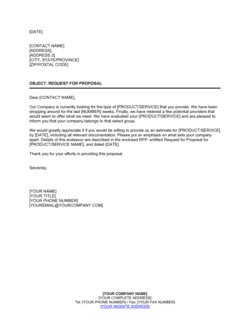
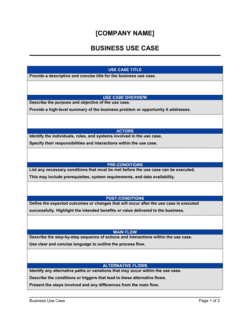
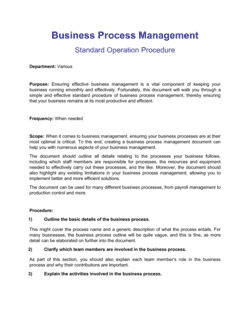
Documenting a new system process or operational workflowBusiness Process Document
High-level feasibility assessment before requirements are definedBusiness Case
Capturing user stories and acceptance tests for an agile sprint teamUser Story Template

Common mistakes to avoid

❌ Using ambiguous requirement verbs

Why it matters: Words like 'support,' 'handle,' and 'manage' have no agreed technical meaning. Vendors interpret them minimally; business stakeholders expect them maximally — and acceptance disputes follow.

Fix: Rewrite every requirement using 'shall' and a specific, observable action. If a test cannot be designed to verify the statement, rewrite it until one can.

❌ No explicit out-of-scope list

Why it matters: Anything not stated as excluded is implicitly assumed included by the party doing the work. Omitting the out-of-scope list is the single most common source of scope-creep change orders.

Fix: Add a dedicated out-of-scope section listing every item that was considered but excluded, with a one-line rationale for each exclusion.

❌ Omitting non-functional requirements

Why it matters: A system can satisfy every functional requirement and still fail by running too slowly, failing a security audit, or being unavailable during peak hours. NFR failures generate rejection at acceptance with no contractual remedy.

Fix: Require every BRD to include at minimum five NFRs covering performance, availability, security, scalability, and the primary applicable compliance standard.

❌ Signing the BRD after development begins

Why it matters: Requirements discovered or clarified after work starts are treated as changes by the vendor, generating change orders. An unsigned BRD at the start of a project means the scope baseline was never formally agreed.

Fix: Make BRD signature a hard prerequisite — no sprint kickoff, no vendor purchase order, and no development environment setup until all authorized signatories have signed.

❌ Treating the BRD as a one-time document

Why it matters: Requirements evolve. Without a change-control procedure tied to the signed BRD, informal requirement changes accumulate invisibly — and vendors bill for all of them at project close as undocumented extras.

Fix: Activate the change-control procedure immediately after signing. Log every verbal or email-based requirement change as a formal change request within 48 hours of the conversation.

❌ No numbered traceability for requirements

Why it matters: Unnumbered requirements cannot be referenced in test cases, change requests, or defect reports. When disputes arise, the parties cannot agree on which requirement was or was not met.

Fix: Number every requirement with a unique ID (FR-001, NFR-001, etc.) from the first draft. IDs must never be reused or renumbered after stakeholder review begins.

The 10 key clauses, explained

Project background and business objectives

In plain language: Explains why the project exists, what business problem or opportunity it addresses, and what measurable outcomes define success.

Sample language
[COMPANY NAME] is initiating the [PROJECT NAME] project to [BUSINESS PROBLEM/OPPORTUNITY]. The primary objectives are: (1) [OBJECTIVE 1 WITH TARGET METRIC], (2) [OBJECTIVE 2 WITH TARGET METRIC]. Success will be measured by [KPI] reaching [TARGET] by [DATE].

Common mistake: Writing objectives in unmeasurable terms like 'improve efficiency' — without a quantified target, no one can agree whether the project succeeded, and acceptance disputes become inevitable.

Scope definition — in scope and out of scope

In plain language: Explicitly lists what the project will and will not deliver, covering systems, processes, user groups, geographies, and integrations.

Sample language
In Scope: [SYSTEM/MODULE/PROCESS LIST]. Out of Scope: [EXCLUSION LIST — e.g., legacy system decommissioning, training for users in [REGION], integration with [THIRD-PARTY SYSTEM] are expressly excluded from this engagement.

Common mistake: Describing only what is in scope without explicitly listing exclusions. Anything not stated as out of scope is interpreted by vendors and developers as implicitly included, generating change orders.

Stakeholder register and approval authority

In plain language: Identifies every individual or group with an interest in the project, their role, and who holds sign-off authority for requirements and changes.

Sample language
The following stakeholders are identified for this project: [NAME/ROLE] — Business Sponsor (final approval authority); [NAME/ROLE] — Business Analyst (requirements owner); [NAME/ROLE] — Technical Lead (solution authority); [NAME/ROLE] — End User Representative (UAT authority).

Common mistake: Listing stakeholders without specifying approval authority. When multiple people claim veto power, change-control decisions stall and project timelines slip.

Functional requirements

In plain language: Details every specific capability, behavior, or function the solution must perform, numbered for traceability and written in testable language.

Sample language
FR-001: The system shall allow [USER ROLE] to [ACTION] within [TIMEFRAME]. FR-002: The system shall generate a [REPORT TYPE] containing [DATA FIELDS] exportable to [FORMAT]. FR-003: The system shall enforce [RULE] when [CONDITION] is met.

Common mistake: Writing requirements using vague verbs like 'support,' 'handle,' or 'manage' instead of 'shall.' Non-prescriptive language creates a subjective standard that cannot be tested or enforced at acceptance.

Non-functional requirements

In plain language: Specifies quality attributes the solution must meet — performance benchmarks, security standards, availability targets, scalability limits, and regulatory compliance obligations.

Sample language
NFR-001: System availability shall be no less than [X]% measured monthly, excluding pre-approved maintenance windows. NFR-002: All data at rest shall be encrypted using [STANDARD, e.g., AES-256]. NFR-003: The system shall support [X] concurrent users without degradation in response time below [Y] seconds.

Common mistake: Omitting non-functional requirements entirely. Vendors deliver a system that functions correctly but runs too slowly, fails security audits, or cannot scale — and technically met every written requirement.

Assumptions and dependencies

In plain language: Lists every condition assumed to be true and every external factor the project relies on, so that if assumptions change, scope and cost adjustments are formally triggered.

Sample language
This document assumes: (1) [THIRD-PARTY SYSTEM] API documentation will be available to the development team by [DATE]; (2) [BUSINESS UNIT] will complete data cleansing of [DATASET] by [DATE]; (3) [STAKEHOLDER NAME] will be available for weekly reviews throughout the project. Dependencies: [DEPENDENCY LIST].

Common mistake: Burying assumptions in narrative prose rather than numbering them in a dedicated section. Unstated assumptions are invisible until they fail — at which point cost and schedule disputes follow.

Constraints

In plain language: Documents fixed limitations the solution must work within — budget ceiling, go-live date, mandated technology platform, regulatory requirements, or resource availability.

Sample language
Project constraints include: (1) Total project budget shall not exceed [$AMOUNT]; (2) The solution must be live in production no later than [DATE]; (3) The solution must operate on [APPROVED TECHNOLOGY PLATFORM] as mandated by [POLICY/REGULATION]; (4) Development resources are limited to [X] FTEs.

Common mistake: Treating constraints as aspirational guidance rather than hard limits. When constraints are soft, vendors bid to the constraint and then routinely exceed it, creating contested invoices.

Acceptance criteria and sign-off procedure

In plain language: States the specific, measurable conditions each deliverable must satisfy before the business will formally accept it, and the process for documenting acceptance.

Sample language
Deliverable acceptance requires: (1) all functional requirements in Section [X] pass user acceptance testing with a defect rate below [X] critical bugs; (2) all non-functional benchmarks in Section [X] are validated by [METHOD]; (3) written acceptance sign-off is provided by [AUTHORIZED STAKEHOLDER] within [X] business days of test completion.

Common mistake: Defining acceptance criteria only at the final deliverable level rather than per milestone. Projects that fail a single final UAT after months of delivery have no partial-acceptance framework, leaving both parties exposed.

Change control procedure

In plain language: Defines how any proposed change to the approved scope baseline must be submitted, evaluated, priced, approved, and documented to become part of the contract.

Sample language
All proposed changes to this BRD must be submitted via a Change Request Form to [CHANGE CONTROL AUTHORITY]. Changes will be evaluated for impact on scope, cost, and schedule within [X] business days. No change shall be implemented without written approval from [AUTHORIZED SIGNATORIES]. Approved changes become addenda to this document.

Common mistake: A change-control section that requires unanimous approval from all stakeholders. A single holdout can block legitimate, business-critical changes — define a clear decision hierarchy instead.

Governing law, confidentiality, and dispute resolution

In plain language: Specifies which jurisdiction's law governs the document, how confidential requirements information is protected, and how disagreements over interpretation or delivery are resolved.

Sample language
This document is governed by the laws of [STATE/PROVINCE/COUNTRY]. All requirements, designs, and project materials are confidential and may not be disclosed to third parties without prior written consent. Any dispute arising under this document shall be escalated first to [EXECUTIVE LEVEL] and, if unresolved within [X] days, to [ARBITRATION/MEDIATION/COURT] in [VENUE].

Common mistake: Omitting a governing law clause on the assumption that the master services agreement covers it. If the BRD is executed as a standalone document, a missing governing law clause leaves interpretation disputes with no agreed legal framework.

How to fill it out

  1. 1

    Define the business problem and measurable objectives

    Write a two-to-three paragraph background that explains what prompted the project, what the current state is, and what specific, quantified outcomes the project must achieve. Tie every objective to a KPI and a target date.

    💡 If you cannot express an objective as a number, it is not specific enough. 'Reduce order processing time from 4 hours to 45 minutes by Q4' is testable; 'improve operations' is not.

  2. 2

    Build the scope boundary — in and out

    List every system, module, user group, geography, and integration explicitly included. Then write a second list of items that are explicitly excluded. Both lists must be reviewed and confirmed by the business sponsor before proceeding.

    💡 Ask the vendor or development team to read the out-of-scope list first — anything they assumed was included but is excluded will surface as a commercial issue before signatures, not after.

  3. 3

    Populate the stakeholder register with approval levels

    List every person who will influence requirements, decisions, or acceptance. Assign each a role (author, reviewer, approver) and specify who has final authority to sign off on requirements and on changes.

    💡 Limit final approval authority to no more than two named individuals. More approvers mean more veto points and slower change control.

  4. 4

    Write functional requirements in testable 'shall' statements

    Number each requirement (FR-001, FR-002, etc.) and write it as '[Actor] shall [action] [object] [condition/constraint].' Every requirement must be testable — meaning a pass/fail test can be designed for it.

    💡 Run each requirement through the SMART test: is it Specific, Measurable, Achievable, Relevant, and Time-bound? Fail on any criterion and rewrite before circulating.

  5. 5

    Add non-functional requirements with numeric benchmarks

    Cover at minimum: performance (response time and throughput), availability (uptime percentage and maintenance windows), security (encryption standard and access controls), and compliance (applicable regulations or standards).

    💡 Pull NFR benchmarks from your existing IT security policy or enterprise architecture standards — they should not be invented per project.

  6. 6

    Number and document all assumptions and dependencies

    List every condition you are assuming to be true and every external deliverable the project depends on. Assign an owner and a date to each dependency so accountability is clear.

    💡 Review the assumptions list with the vendor before signing. Any assumption the vendor disputes should be resolved in writing now — it will otherwise become a change request later.

  7. 7

    Define acceptance criteria per deliverable, not just for final sign-off

    Write pass/fail acceptance criteria for each major milestone or deliverable, not only for the final system. Include defect tolerance thresholds, test methods, and the name of the person authorized to sign acceptance.

    💡 Specifying 'zero critical defects at go-live' is too strict and invites gaming. Specify 'no open Severity-1 defects; Severity-2 defects below five with agreed remediation dates.'

  8. 8

    Obtain signatures from all authorized approvers before work begins

    Route the completed BRD to every named approver for review and wet or electronic signature. Record the date of each signature. No development or implementation work should commence until all signatures are in place.

    💡 Use a signature block that includes name, title, signature, and date — not just a name. An undated signature creates ambiguity about when the scope baseline was established.

Frequently asked questions

What is a Business Requirements Document?

A Business Requirements Document (BRD) is a formal document that captures what a project must achieve from the business's perspective — objectives, scope, functional requirements, non-functional requirements, constraints, assumptions, and acceptance criteria. Once signed by authorized stakeholders, it becomes the binding scope baseline that governs delivery, change control, and acceptance throughout the project lifecycle.

What is the difference between a BRD and a functional specification?

A BRD defines what the business needs — stated from the business's perspective, independent of how any system will deliver it. A functional specification (or functional design document) defines how a system will be built to meet those needs — written by a technical team and describing system behavior, data flows, and UI design. The BRD is written first and signed by business stakeholders; the functional spec is derived from it and signed by the technical team.

Is a Business Requirements Document legally binding?

A BRD is generally enforceable as a binding document when it is executed (signed) by authorized parties as part of or in conjunction with a master services agreement or project contract. When the BRD is incorporated by reference into a signed contract, its scope, acceptance criteria, and change-control provisions typically carry the same legal weight as the contract itself. Consider having legal counsel review the document when the project value exceeds $100K or when multi-party delivery arrangements are involved.

Who should sign a Business Requirements Document?

At minimum, the business sponsor (who owns the budget and outcome), the project manager or delivery lead, and the senior technical representative on the vendor or development side should sign. For enterprise projects, include a compliance or security representative if regulated data or systems are in scope. The key principle is that every party who can authorize a change to scope should appear in the signature block.

What is the difference between a BRD and a project charter?

A project charter authorizes a project to proceed and names its sponsor, manager, and high-level objectives — typically one to two pages. A BRD is the detailed requirements document that follows, defining exactly what the project must deliver in testable, numbered statements. The charter opens the project; the BRD governs what gets built.

How detailed should functional requirements in a BRD be?

Detailed enough that a developer can build to the requirement and a tester can write a pass/fail test case for it — without asking a clarifying question. Each requirement should specify the actor, the action, the object, and any condition or constraint. If a single requirement takes more than three sentences to state, split it into two numbered requirements. Typical enterprise BRDs contain 30–150 numbered functional requirements.

When should a Business Requirements Document be updated?

The signed BRD should be updated only through the formal change-control procedure defined in the document itself. Every approved change request becomes a numbered addendum to the BRD, and the scope baseline version number is incremented. Informal updates — via email, meeting notes, or verbal agreement — are not valid changes to the scope baseline and expose the business to disputes at acceptance.

What happens if a project proceeds without a signed BRD?

Without a signed BRD, there is no agreed scope baseline. The vendor builds to their interpretation of requirements; the business accepts to their interpretation. At delivery, the gap between the two surfaces as disputed change orders, failed acceptance tests, or project overruns. Courts and arbitrators in scope disputes consistently look for a signed requirements document as the authoritative reference — its absence leaves both parties with weak positions.

What is change control in the context of a BRD?

Change control is the formal process for proposing, evaluating, approving, and documenting any modification to the signed scope baseline. A change request form is submitted, the change is assessed for impact on cost, schedule, and risk, and an authorized approver either accepts or rejects it in writing. Approved changes are appended to the BRD as addenda. Without this process, scope grows informally until budget and schedule are exhausted.

How this compares to alternatives

vs Project Scope Statement

A project scope statement defines the boundaries of the project at a high level — deliverables, exclusions, and milestones. A BRD goes deeper, translating that scope into numbered, testable functional and non-functional requirements. The scope statement is typically written before the BRD and governs what the BRD must cover, but it cannot substitute for detailed requirements at the delivery level.

vs Request for Proposal (RFP)

An RFP is issued to vendors before selection to solicit bids; it describes high-level needs and evaluation criteria. A BRD is written after vendor selection and defines requirements in binding, testable detail. The BRD is derived from, but substantially more detailed than, the requirements section of the RFP that vendors responded to.

vs Business Case

A business case justifies why a project should be approved and funded, presenting costs, benefits, risks, and ROI. A BRD defines what the approved project must actually deliver. The business case comes first and sets strategic objectives; the BRD translates those objectives into specific requirements that delivery teams can build and test against.

vs Software Requirements Specification

A Software Requirements Specification (SRS) is a technical document written by or with engineers that specifies system behavior in design-level detail — data models, system interfaces, and algorithm logic. A BRD is a business-layer document written before technical design begins. The SRS is derived from the BRD; if the two conflict, the BRD governs what the business agreed to.

Industry-specific considerations

Financial Services

Regulatory compliance requirements (SOX, PCI-DSS, Basel III) must be embedded as non-functional requirements, and all data-handling requirements must reference applicable data governance policies and audit trail obligations.

Healthcare / MedTech

HIPAA security and privacy requirements must appear as mandatory non-functional requirements, and FDA software validation obligations apply to systems used in clinical workflows, requiring IQ/OQ/PQ acceptance criteria.

Retail / E-commerce

Peak-load performance requirements must be defined against specific traffic scenarios (e.g., Black Friday volumes), and payment processing requirements must reference PCI-DSS compliance standards explicitly.

SaaS / Technology

API integration requirements, uptime SLAs, multi-tenancy data isolation rules, and release cadence constraints are distinctive to SaaS BRDs and must be specified in both functional and non-functional sections.

Government / Public Sector

Accessibility standards (WCAG 2.1 AA or Section 508), procurement regulations, mandatory audit trails, and Freedom of Information Act data-handling rules add a compliance layer to every functional and non-functional requirement.

Manufacturing

ERP and MES integration requirements, real-time production data throughput benchmarks, and ISO 9001 quality management traceability requirements distinguish manufacturing BRDs from standard IT projects.

Jurisdictional notes

United States

In the US, a signed BRD incorporated into a master services agreement is generally enforceable as a binding contract under the Uniform Commercial Code for goods and common law for services. State law governs enforceability of dispute-resolution and limitation-of-liability clauses — Delaware and New York are the most common governing law choices for enterprise technology contracts. California's unfair business practices statutes add extra scrutiny to one-sided acceptance criteria provisions.

Canada

Canadian courts treat a signed BRD incorporated by reference into a services contract as binding. Provincial differences matter: Ontario and British Columbia are the most common governing law choices for technology projects. Quebec's civil law framework requires that contracts be interpreted in light of the parties' common intent, which makes precise requirement language especially important. PIPEDA and provincial privacy laws impose data-handling obligations that must appear as explicit non-functional requirements for any system processing personal information.

United Kingdom

Under English law, a BRD forms part of the contract when incorporated by reference and supported by consideration. The Unfair Contract Terms Act 1977 and the Consumer Rights Act 2015 limit the enforceability of exclusion clauses and unreasonable limitation-of-liability provisions. UK GDPR requirements must be embedded as non-functional requirements for any system handling personal data of UK residents. The Technology and Construction Court (TCC) handles complex IT procurement disputes and gives significant weight to signed requirements documents.

European Union

GDPR Article 25 (data protection by design and by default) requires that privacy requirements be built into systems from the outset — they must appear as mandatory non-functional requirements in any BRD involving personal data of EU residents. Member states apply contract law differently: German law favors strict interpretation of written terms; French law gives courts wider latitude to imply obligations. Cross-border EU projects should specify a governing law and venue explicitly to avoid jurisdictional uncertainty at dispute.

Template vs lawyer — what fits your deal?

PathBest forCostTime
Use the templateInternal IT projects, low-to-medium complexity system implementations, and projects under $100K where the vendor relationship is establishedFree1–3 days to complete with stakeholder input
Template + legal reviewProjects above $100K, multi-vendor engagements, regulated industries, or where the BRD is incorporated into a binding contract$500–$1,500 for a legal or contracts specialist review3–5 business days
Custom draftedEnterprise programs above $1M, government contracts, heavily regulated systems (healthcare, fintech), or cross-border engagements with jurisdictional complexity$2,000–$8,000+2–4 weeks

Glossary

Business Requirement
A high-level statement of what the business needs to achieve, independent of how any system or process will deliver it.
Functional Requirement
A specific behavior or function a system must perform — for example, 'the system shall send an automated confirmation email within 60 seconds of order placement.'
Non-Functional Requirement
A quality attribute a system must meet — such as availability of 99.9% uptime, page-load time under 2 seconds, or compliance with SOC 2 Type II.
Scope Baseline
The approved, signed version of the requirements document that defines what is and is not included in the project, against which all change requests are measured.
Change Control
A formal process for proposing, evaluating, approving, and documenting any modification to the agreed scope baseline after the BRD is signed.
Acceptance Criteria
Specific, measurable conditions that a deliverable must satisfy before the business stakeholder will formally accept it as complete.
Assumption
A stated condition believed to be true at the time of requirements definition, on which the project plan relies — if the assumption proves false, scope or cost may change.
Constraint
A limitation that restricts solution design choices — such as a fixed go-live date, a budget ceiling, or a mandatory technology platform.
Stakeholder Register
A list of individuals and groups with an interest in the project outcome, their roles, and their level of authority to approve requirements or changes.
Traceability Matrix
A table that maps each business requirement to its functional specifications, test cases, and delivered components, confirming nothing was missed or added without authorization.
Gap Analysis
A structured comparison of the current state and desired future state that identifies the specific capabilities or processes a project must deliver to close the gap.

Part of your Business Operating System

This document is one of 3,000+ business & legal templates included in Business in a Box.

  • Fill-in-the-blanks — ready in minutes
  • 100% customizable Word document
  • Compatible with all office suites
  • Export to PDF and share electronically

Create your document in 3 simple steps.

From template to signed document — all inside one Business Operating System.
1
Download or open template

Access over 3,000+ business and legal templates for any business task, project or initiative.

2
Edit and fill in the blanks with AI

Customize your ready-made business document template and save it in the cloud.

3
Save, Share, Send, Sign

Share your files and folders with your team. Create a space of seamless collaboration.

Save time, save money, and create top-quality documents.

★★★★★

"Fantastic value! I'm not sure how I'd do without it. It's worth its weight in gold and paid back for itself many times."

Managing Director · Mall Farm
Robert Whalley
Managing Director, Mall Farm Proprietary Limited
★★★★★

"I have been using Business in a Box for years. It has been the most useful source of templates I have encountered. I recommend it to anyone."

Business Owner · 4+ years
Dr Michael John Freestone
Business Owner
★★★★★

"It has been a life saver so many times I have lost count. Business in a Box has saved me so much time and as you know, time is money."

Owner · Upstate Web
David G. Moore Jr.
Owner, Upstate Web

Run your business with a system — not scattered tools

Stop downloading documents. Start operating with clarity. Business in a Box gives you the Business Operating System used by over 250,000 companies worldwide to structure, run, and grow their business.

Free Forever Plan · No credit card required