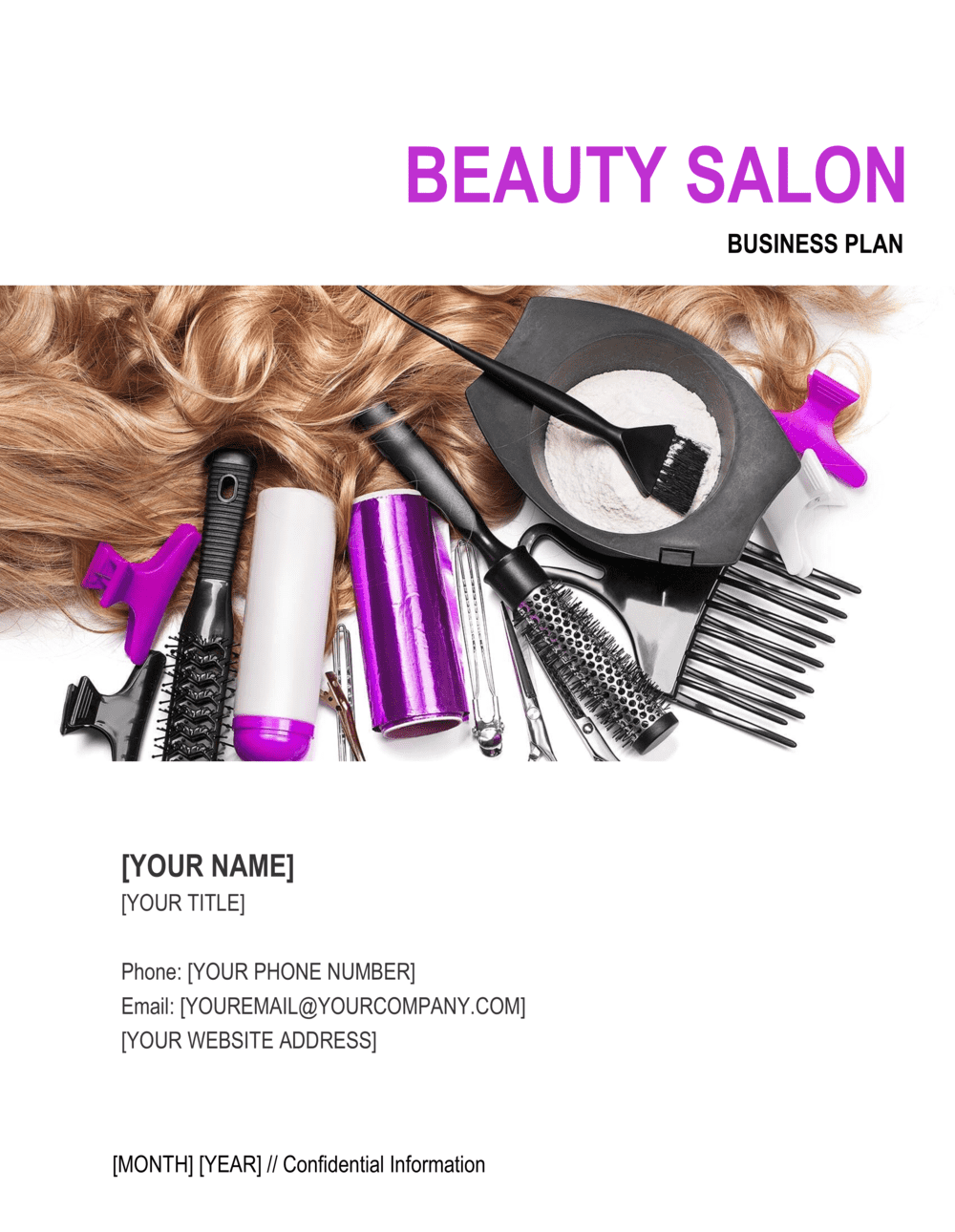
Beauty Salon Business Plan 3 Template

Free Word download β€’ Edit online β€’ Save & share with Drive β€’ Export to PDF

32 pagesβ€’2h 40m – 3h 35m to fillβ€’Difficulty: Expert
Learn more ↓
FreeBeauty Salon Business Plan 3 Template

At a glance

What it is
A Beauty Salon Business Plan is a structured document that maps your salon's concept, target clientele, service menu, pricing strategy, staffing model, and 3-year financial projections into a single investor- and lender-ready file. This free Word download gives you a pre-formatted starting point you can edit online and export as PDF to share with banks, landlords, or potential business partners.
When you need it
Use it when opening a new salon, applying for a small business loan or SBA financing, pitching an investor or silent partner, or formalizing a growth strategy for an existing location. Landlords of commercial salon suites often request a business plan as part of the lease application.
What's inside
Executive summary, salon concept and ownership structure, market and competitor analysis, services and pricing menu, marketing and client acquisition strategy, operations and staffing plan, and three-year financial projections including startup costs, monthly P&L, and break-even analysis.

What is a Beauty Salon Business Plan?

A Beauty Salon Business Plan is a structured operational and financial document that maps every dimension of a salon venture β€” concept and positioning, target clientele, service menu and pricing, staffing model, marketing strategy, and three-year financial projections β€” into a single file a lender, landlord, or investor can evaluate. It functions as both an internal roadmap that keeps the owner accountable to concrete milestones and an external credibility document that demonstrates market research and financial discipline. This free Word download provides a pre-formatted template you can edit online, populate with your own local market data and pricing, and export as a PDF for any financing or leasing application.

Why You Need This Document

Opening a beauty salon without a written business plan is one of the most common reasons new salons fail within the first two years β€” not because of poor service quality, but because of avoidable financial miscalculations. Without a bottom-up revenue model built on chair count and utilization rate, owners routinely sign leases with monthly rents that cannot be covered at realistic client volumes. Without a detailed startup cost schedule, they run out of working capital before the client base is large enough to cover payroll. Banks and SBA lenders require a formal plan for any loan application, and commercial landlords in high-traffic salon corridors increasingly request one before signing a lease. Beyond securing capital, a completed business plan forces you to confront the numbers β€” break-even point, required chair utilization, average ticket needed β€” before you spend a dollar on a build-out, turning blind spots into decisions you can act on while they are still inexpensive to fix.

Which variant fits your situation?

If your situation is…Use this template
Opening a full-service hair and color salonBeauty Salon Business Plan
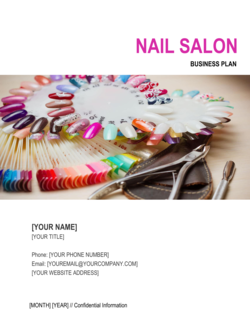
Launching a nail-only or nail-and-spa hybrid studioNail Salon Business Plan
Starting a mobile or freelance beauty services businessMobile Beauty Services Business Plan
Opening a barbershop or men's grooming studioBarbershop Business Plan
Launching a medical or aesthetic spa with clinical servicesMedical Spa Business Plan
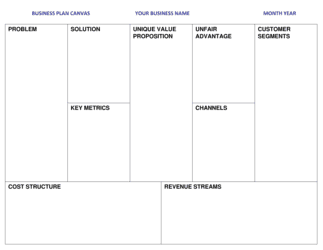
Creating a quick internal roadmap before committing to a full planOne-Page Business Plan
Raising equity capital from an angel investor or silent partnerInvestor Business Plan

Common mistakes to avoid

❌ Revenue projections not tied to chair utilization

Why it matters: A Year 1 revenue target that isn't backed by chair count Γ— hours Γ— utilization rate Γ— average ticket is unverifiable. SBA lenders and commercial landlords will ask for the math.

Fix: Build a capacity model first: state the number of chairs, operating hours per day, target utilization percentage, and average ticket. Let revenue flow from those inputs.
❌ No local competitor analysis

Why it matters: Claiming you have researched the market without naming nearby competitors signals to lenders that you have not actually walked the neighborhood or checked pricing.

Fix: Visit or call at least four nearby salons, record their service menu and price points, and include a comparison table in the competitive analysis section.

❌ Omitting startup cost detail

Why it matters: A single lump-sum startup figure with no line-item breakdown raises red flags. Lenders need to verify that build-out, equipment, inventory, permits, and working capital reserves are all accounted for.

Fix: Break startup costs into at least six categories: leasehold improvements, equipment and furniture, initial product inventory, licenses and permits, marketing, and working capital reserve.

❌ Ignoring licensing and permit timelines

Why it matters: State cosmetology board approvals and local health department permits routinely take 4–12 weeks. Excluding them from the opening timeline leads to costly delays and potential lease default.

Fix: Research the exact permit requirements and processing times for your city and state, and add those milestones β€” with buffer weeks β€” to the operations section timeline.

❌ No client retention strategy

Why it matters: Acquiring a new salon client costs 5–7Γ— more than retaining an existing one. A plan that only addresses new-client acquisition will require unsustainably high marketing spend by Year 2.

Fix: Add a specific retention mechanism β€” automated rebooking reminders, a loyalty punch card, or a prepaid service package β€” with a target retention rate and its revenue impact.

❌ Writing the executive summary first

Why it matters: An executive summary written before the body sections will contradict details developed later, making the plan feel inconsistent and uncoordinated to a careful reader.

Fix: Complete every other section first, then distill the executive summary from the finished document using the strongest data point from each section.

The 8 key sections, explained

Executive Summary

Salon Concept and Ownership Structure

Market Analysis

Competitive Analysis

Services and Pricing Menu

Marketing and Client Acquisition Strategy

Operations and Staffing Plan

Financial Projections

How to fill it out

  1. 1

    Define your salon concept and legal structure

    Decide on the service tier (budget, mid-market, or premium), the legal entity (LLC is standard for salon owners), and ownership percentages if there are co-owners. Enter these in the Salon Concept section.

    πŸ’‘ Anchor the concept to a specific price point β€” 'mid-market haircut at $55–$75' β€” rather than a feel ('upscale but approachable'). Lenders need numbers.

  2. 2

    Research your local market and pull demographic data

    Use US Census Bureau data, Google Maps, and Yelp to count competitors within 2 miles and profile the surrounding neighborhood's median income, age, and population density.

    πŸ’‘ Screenshot and cite your sources directly in the plan. A market claim supported by a footnote carries more weight with an SBA lender than an unsupported assertion.

  3. 3

    Build the services and pricing menu with time estimates

    List every service you will offer, set a price range for each, and estimate appointment duration. Use these numbers to calculate daily and monthly client capacity.

    πŸ’‘ Model two scenarios: a conservative 50% chair utilization and an optimistic 75%. Show both in your revenue projections.

  4. 4

    Define your marketing channels and pre-opening budget

    Choose two or three primary acquisition channels β€” Instagram/Facebook geo ads, Google Business Profile, and a referral incentive program are the most cost-effective for salons. Assign a dollar budget and expected client yield to each.

    πŸ’‘ A $500 pre-opening Instagram campaign targeting women aged 25–45 within 3 miles typically generates 40–80 bookings at a CPL of $6–$12 in mid-size US markets.

  5. 5

    Map the staffing model and opening timeline

    Decide whether to hire employees on commission or offer booth rentals. List every hire you need at opening with their role, hours, and compensation. Build a week-by-week timeline from lease signing to soft opening.

    πŸ’‘ Build the cosmetology board inspection and health permit into the timeline with a 6-week buffer β€” delays here are the most common reason salon openings slip.

  6. 6

    Build the financial model from the bottom up

    Start with chair count Γ— daily hours Γ— utilization rate Γ— average ticket to derive monthly revenue. Layer in payroll, rent, product costs, and G&A to reach net income. Build a separate startup cost schedule.

    πŸ’‘ Rent should not exceed 10–12% of projected gross revenue. If the math doesn't work at your target location, recalibrate the concept tier or negotiate a rent abatement period.

  7. 7

    Write the executive summary last

    Pull the single strongest data point from each section β€” location, target demographic, Year 1 revenue projection, and funding ask β€” and compress them into one to two pages.

    πŸ’‘ Lead the executive summary with your most compelling number. If you are projecting 200 client visits per month by Month 3, say that in the first sentence.

Frequently asked questions

What is a beauty salon business plan?

A beauty salon business plan is a structured document that defines your salon's concept, target clientele, service menu, pricing, staffing model, marketing strategy, and 3-year financial projections. It serves as both an internal operating roadmap and an external document used to secure bank loans, SBA financing, commercial leases, or investor capital.

Do I need a business plan to open a beauty salon?

Any bank or SBA lender will require a formal business plan before approving financing. Many commercial landlords for salon suites and strip-mall spaces also request one as part of the lease application. Even if you are self-funding, a written plan forces you to stress-test your revenue assumptions and startup cost estimates before you commit to a lease and equipment purchases.

How much does it cost to open a beauty salon?

Startup costs for a salon in the United States typically range from $75,000 to $250,000 depending on location, square footage, and fit-out quality. Major cost categories are leasehold improvements ($30,000–$100,000), styling chairs and shampoo bowls ($5,000–$20,000), reception and retail furniture ($5,000–$15,000), initial product inventory ($3,000–$8,000), licenses and permits ($500–$3,000), and 3–6 months of working capital.

What financial projections should a salon business plan include?

A complete financial section includes a startup cost schedule, a monthly P&L for Year 1, annual P&L for Years 2 and 3, a cash flow statement, and a break-even analysis. Revenue projections must be built bottom-up from chair count, operating hours, utilization rate, and average ticket value β€” not from a target revenue figure worked backward.

Should I hire employees or use a booth rental model?

Both models have merit depending on your goals. The booth rental model reduces payroll risk and administrative overhead β€” stylists pay a weekly or monthly fee and keep all client revenue. The employee model gives you more control over service quality, scheduling, and upselling, but requires managing payroll, benefits, and commission structures. Most lenders prefer to see the employee model for a startup because it produces more predictable revenue projections.

How long should a beauty salon business plan be?

A plan intended for an SBA lender or commercial landlord typically runs 15–25 pages, excluding the financial model appendix. Internal operating plans can be shorter. The financial projections are the section readers scrutinize most closely β€” a thorough model matters more than page count.

What makes a salon business plan credible to an SBA lender?

SBA lenders look for four things: a realistic revenue model built from chair utilization and average ticket data, a detailed startup cost schedule with vendor quotes where possible, evidence of relevant industry experience in the owner's background, and proof that the owner has researched the local competitive landscape with named competitors and local pricing data.

How often should I update my salon business plan?

Review and update the plan at least once per year, aligning it with your fiscal year-end actuals. Update it immediately before any capital raise, lease renewal negotiation, or new-location decision. A plan more than 18 months old should be treated as a historical baseline, not a live strategy document.

Can I write a salon business plan myself without a consultant?

Yes β€” a structured template handles the format and section logic, leaving you to supply local market research, your specific service menu, and your financial model assumptions. Hire a consultant ($1,000–$5,000) only if you are applying for an SBA 7(a) loan over $350,000 or if you have no prior experience building a three-statement financial model.

How this compares to alternatives

vs One-Page Business Plan

A one-page plan is a rapid-alignment tool for internal brainstorming or early-stage ideation. It lacks the financial depth, market evidence, and competitive detail that banks and landlords require. Use the one-page format to test your concept quickly, then build the full salon business plan before any financing application.

vs Restaurant Business Plan

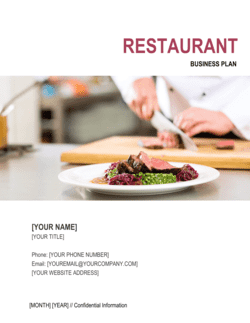
Restaurant and salon business plans share a similar structure, but key metrics differ sharply. Restaurants model covers per day and food cost as a percentage of revenue; salon plans model chair utilization rate, average ticket, and stylist commission. Use the salon-specific template to avoid generic assumptions that don't map to beauty industry economics.

vs Marketing Plan

A marketing plan covers client acquisition channels, campaign budgets, and brand strategy in detail, but contains no financial projections, staffing model, or operational timeline. It is one section of a full business plan. Use the marketing plan as a standalone document after the business plan is complete and you need deeper tactical detail on a single channel.

vs Financial Projections Template

A financial projections template produces the P&L, cash flow, and balance sheet that form the financial section of the business plan. On its own it lacks the market context, concept description, and competitive analysis that lenders require. Build the financial model in the projections template, then embed the outputs in the full salon business plan.

Industry-specific considerations

Hair and Color Salons

Chair utilization, colorist booking ratios, and retail product margin are the primary KPIs; plans must address the commission vs. booth-rental staffing decision explicitly.

Nail and Spa Studios

Higher throughput per station than hair salons but lower average ticket; plans emphasize repeat-visit frequency (every 2–3 weeks) and membership or prepaid package revenue.

Med-Spa and Aesthetic Clinics

Requires licensed medical oversight and adds regulatory compliance sections covering state medical spa laws, malpractice insurance, and equipment certification.

Franchise Beauty Concepts

Franchisor royalty fees (typically 5–8% of gross revenue) and national marketing fund contributions must be factored into the P&L; franchise disclosure documents replace the competitive analysis section.

Template vs pro β€” what fits your needs?

PathBest forCostTime
Use the templateFirst-time salon owners applying for SBA microloans, booth-to-owner transitions, or internal planningFree1–3 weeks (20–40 hours)
Template + professional reviewSBA 7(a) loans up to $350K, commercial lease applications, or plans reviewed by a SCORE mentor$300–$1,500 for an accountant or small business advisor review2–4 weeks
Custom draftedMulti-location rollouts, franchise territory acquisition, or equity raises above $500K$2,000–$7,000 for a professional business plan writer3–6 weeks

Glossary

Service Menu
The complete list of treatments a salon offers, each with a defined price and estimated time, used for scheduling and revenue forecasting.
Booth Rental Model
An arrangement where stylists rent a station from the salon owner and keep all client revenue, rather than working as employees on commission.
Chair Utilization Rate
The percentage of available styling-chair hours that are booked with paying clients in a given period β€” the core capacity metric for salon revenue.
Average Ticket Value
Total revenue divided by the number of client visits in a period; raising average ticket value through upselling retail and add-on services is the primary margin lever.
Client Retention Rate
The percentage of clients who return for a repeat visit within a defined window, typically 90 days for haircut clients and 6–8 weeks for color clients.
Startup Costs
One-time pre-opening expenses including leasehold improvements, equipment, furniture, licenses, initial inventory, and working capital reserves.
Break-Even Point
The monthly revenue level at which total sales exactly cover all fixed and variable costs, with zero net profit or loss.
Retail Revenue
Income from selling hair care, skin care, or beauty products in the salon β€” typically higher-margin than service revenue and a key profitability driver.
Commission Structure
The percentage of service revenue paid to an employed stylist, typically ranging from 40–60% depending on experience level and target performance.
Soft Opening
A limited-capacity launch β€” often by appointment only for existing clients β€” used to test operations before a full public opening.

Part of your Business Operating System

This document is one of 3,000+ business & legal templates included in Business in a Box.

  • Fill-in-the-blanks β€” ready in minutes
  • 100% customizable Word document
  • Compatible with all office suites
  • Export to PDF and share electronically

Create your document in 3 simple steps.

From template to signed document β€” all inside one Business Operating System.
1
Download or open template

Access over 3,000+ business and legal templates for any business task, project or initiative.

2
Edit and fill in the blanks with AI

Customize your ready-made business document template and save it in the cloud.

3
Save, Share, Send, Sign

Share your files and folders with your team. Create a space of seamless collaboration.

Save time, save money, and create top-quality documents.

β˜…β˜…β˜…β˜…β˜…

"Fantastic value! I'm not sure how I'd do without it. It's worth its weight in gold and paid back for itself many times."

Managing Director Β· Mall Farm
Robert Whalley
Managing Director, Mall Farm Proprietary Limited
β˜…β˜…β˜…β˜…β˜…

"I have been using Business in a Box for years. It has been the most useful source of templates I have encountered. I recommend it to anyone."

Business Owner Β· 4+ years
Dr Michael John Freestone
Business Owner
β˜…β˜…β˜…β˜…β˜…

"It has been a life saver so many times I have lost count. Business in a Box has saved me so much time and as you know, time is money."

Owner Β· Upstate Web
David G. Moore Jr.
Owner, Upstate Web

Run your business with a system β€” not scattered tools

Stop downloading documents. Start operating with clarity. Business in a Box gives you the Business Operating System used by over 250,000 companies worldwide to structure, run, and grow their business.

Free Forever PlanΒ Β·Β No credit card required