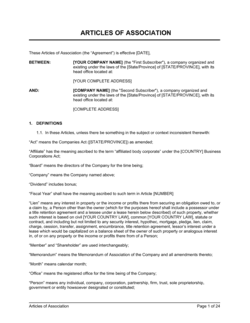
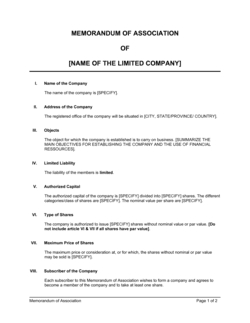
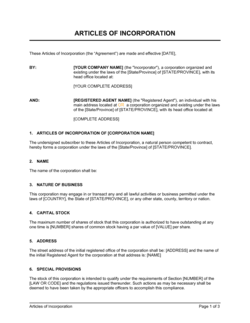
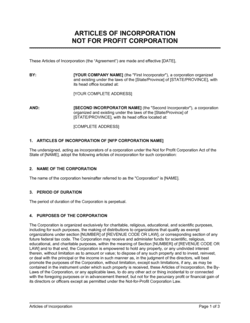
Articles of Association Template

Free Word download • Edit online • Save & share with Drive • Export to PDF

2 pages20–30 min to fillDifficulty: StandardSignature requiredLegal review recommended
Learn more ↓
FreeArticles of Association Template

At a glance

What it is
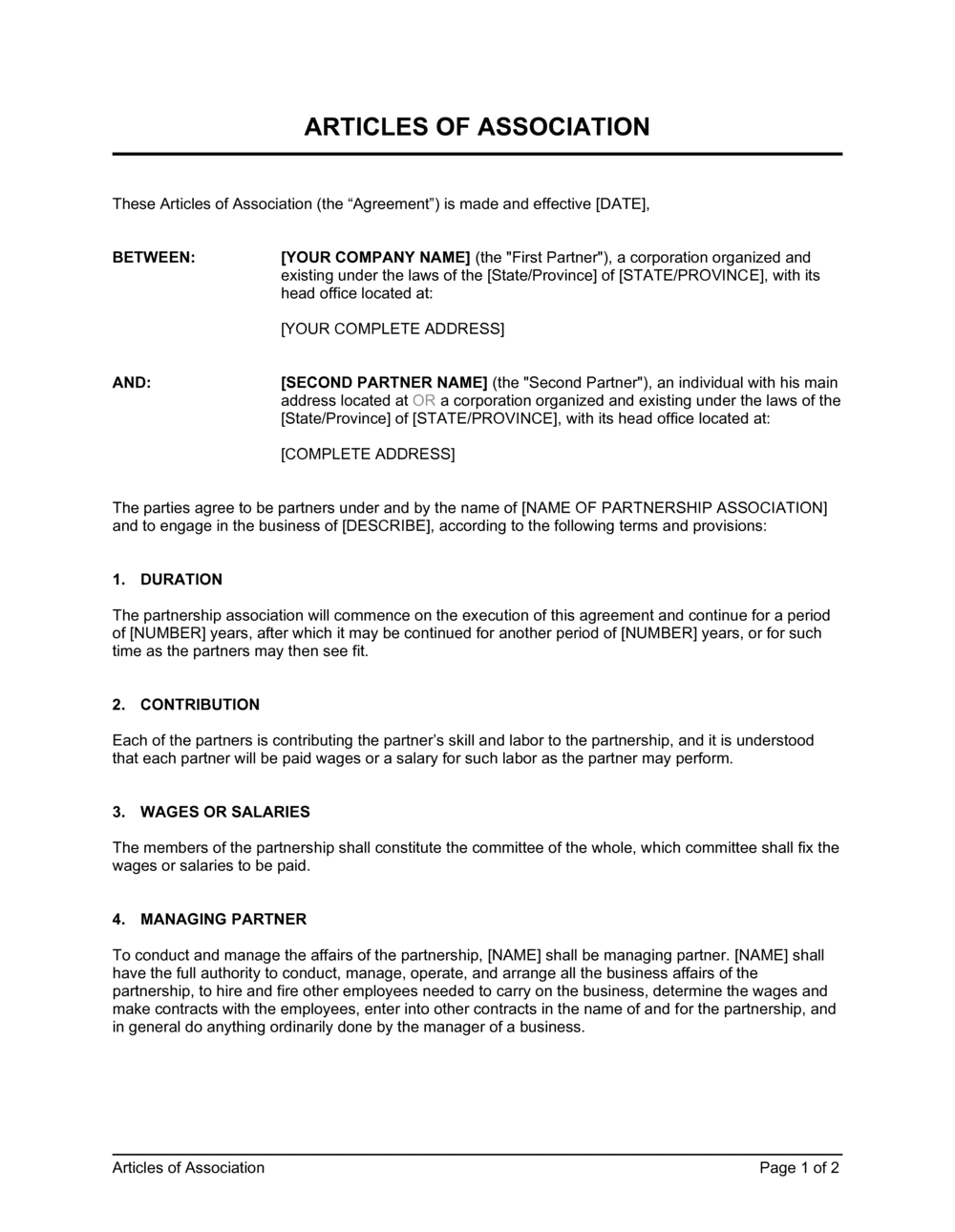
Articles of Association are the internal constitutional rulebook of a company, setting out how the business is governed day-to-day — from shareholder rights and share transfers to board composition, director powers, meetings, dividends, and dispute resolution. This free Word download gives you a jurisdiction-ready starting point you can edit online and export as PDF before filing with your companies registry.
When you need it
Use it when incorporating a new limited company, restructuring an existing company's governance, admitting new shareholders, or replacing outdated articles that no longer reflect how the business operates.
What's inside
Share capital and classes, transfer and pre-emption rights, board appointment and removal, director powers and conflicts of interest, general meeting procedures, quorum and voting rules, dividend declarations, indemnification of officers, and dispute resolution mechanisms — all in a single document that operates alongside the Memorandum of Association.

What is an Articles of Association?

Articles of Association are the internal constitutional rulebook of a limited company, setting out the rules by which the business is governed from the moment of incorporation. The document covers the full range of governance mechanics: how shares are issued, transferred, and valued; the rights attached to each class of shareholder; how directors are appointed and removed; the scope of board authority; how meetings are called and decisions taken; when and how dividends are declared; and how disputes between shareholders are resolved. In most common-law jurisdictions — including the United Kingdom, Canada, Australia, and the majority of Commonwealth countries — some form of constitutional document is required to incorporate and must be filed with the relevant companies registry before the entity can legally operate.

Why You Need This Document

Operating without properly drafted Articles of Association — or relying unmodified on the statutory model articles — creates four compounding risks. First, model articles contain no investor protections: no pre-emption rights on share transfers, no drag-along or tag-along provisions, and no reserved matters requiring shareholder consent before the board commits the company to major decisions. By the time an investor or acquirer identifies these gaps, correcting them typically requires a special resolution and a costly legal amendment exercise under time pressure. Second, without a defined share transfer procedure and valuation mechanism, a departing co-founder or shareholder can hold the company hostage in a price dispute with no contractual resolution path. Third, vague or absent conflict-of-interest provisions expose director-shareholders to personal liability claims that a single well-drafted clause would have prevented. Fourth, in the UK and most Commonwealth jurisdictions, filing defective or incomplete Articles stalls the certificate of incorporation entirely, delaying the legal existence of the business. This template gives you a complete, filing-ready starting point for all of those provisions — structured for the jurisdiction where it matters most.

Which variant fits your situation?

If your situation is…Use this template
Single-founder company with no outside investorsArticles of Association (Sole Shareholder)
Multi-founder startup with a seed investor taking preference sharesArticles of Association (Investor Edition)
Private limited company in the UK using Companies Act 2006 model articles as a baseModel Articles for Private Companies Limited by Shares
US corporation requiring equivalent governance documentationCorporate Bylaws
Non-profit or charitable company needing governance rulesNon-Profit Articles of Incorporation
Company undergoing a shareholder agreement alongside constitutional documentsShareholders Agreement
Partnership seeking governance rules without incorporationPartnership Agreement

Common mistakes to avoid

❌ Using unmodified model articles for a company with investors

Why it matters: Model articles contain no investor protections — no drag-along rights, no pre-emption on transfers, no reserved matters. Investors who discover this post-funding typically require an expensive article amendment before closing.

Fix: Draft bespoke articles before the first external investment round, addressing investor consent rights, share transfer restrictions, and any protective provisions specific to the funding structure.

❌ Leaving the reserved matters schedule blank

Why it matters: Without reserved matters, directors can bind the company to major acquisitions, debt, or asset disposals without shareholder consent — exposing minority shareholders to decisions they had no vote on.

Fix: Include a reserved matters schedule listing decisions that require ordinary or special shareholder resolution, with clear monetary or strategic thresholds.

❌ Omitting a valuation mechanism for share transfers

Why it matters: When a shareholder wants to exit and no valuation method is defined, the parties must negotiate from scratch. Disagreements frequently result in litigation or a complete deadlock on the transfer.

Fix: Include a default valuation procedure — typically an independent accountant determination or an agreed formula — that applies automatically when the parties cannot agree on fair value.

❌ Failing to align the Articles with the shareholders' agreement

Why it matters: Conflicting provisions in the two documents create ambiguity about which governs. In a dispute, a court may apply the Articles — the public document — over a private shareholders' agreement, voiding negotiated protections.

Fix: Draft or review both documents simultaneously and include a hierarchy clause in the shareholders' agreement confirming that, in the event of conflict, one document prevails.

❌ Declaring dividends without checking distributable reserves

Why it matters: A dividend paid out of capital rather than distributable profit is unlawful in most jurisdictions. Directors who authorise an unlawful dividend face personal liability to repay it even if the company is later solvent.

Fix: Before each dividend declaration, obtain a written confirmation from the company's accountant that sufficient distributable reserves exist, and record this in the board minutes.

❌ Executing the Articles after the date of incorporation

Why it matters: Articles must be filed on or before the date of incorporation in most jurisdictions. Late or backdated execution can invalidate the constitutional documents and require a costly re-registration process.

Fix: Sign and file the Articles simultaneously with all other incorporation documents. Use the template's pre-fill checklist to confirm all fields are complete before submission.

The 10 key clauses, explained

Share capital and classes of shares

In plain language: Defines the total number of shares the company may issue, the classes (ordinary, preference, etc.), and the specific rights — voting, dividend, and liquidation preferences — attached to each class.

Sample language
The share capital of [COMPANY NAME] is [AMOUNT] divided into [NUMBER] ordinary shares of [PAR VALUE] each and [NUMBER] preference shares of [PAR VALUE] each, carrying the rights set out in Schedule [X].

Common mistake: Failing to define the rights of each share class in the Articles and instead leaving them to a separate side letter — if the side letter is lost or disputed, the share rights revert to statutory defaults.

Pre-emption rights on new share issuances

In plain language: Requires the company to offer new shares to existing shareholders in proportion to their current holdings before offering them to outside investors, preventing dilution without consent.

Sample language
Before allotting any new shares, the Directors shall offer such shares to existing shareholders on a pro-rata basis at the proposed issue price, giving not less than [14] days' written notice to accept.

Common mistake: Using a blanket opt-out of pre-emption rights at incorporation to save time. This gives directors unchecked power to dilute founders and early investors without a shareholder vote.

Transfer of shares and right of first refusal

In plain language: Sets the procedure for transferring shares between shareholders or to third parties, including the obligation to offer shares to existing members first and the board's power to approve or refuse transfers.

Sample language
A shareholder wishing to transfer shares ('Transferor') shall serve a Transfer Notice on the Company. Existing shareholders shall have [30] days to purchase such shares at the Fair Value determined under Article [X] before any transfer to a third party is permitted.

Common mistake: Omitting a valuation mechanism for determining 'Fair Value' on a transfer. Without one, a deadlock between buyer and seller can halt a transfer indefinitely.

Appointment, removal, and number of directors

In plain language: Specifies the minimum and maximum number of directors, how they are appointed (by shareholders or the board), and the conditions under which a director may be removed or vacates office.

Sample language
The Company shall have a minimum of [1] and maximum of [X] Directors. A Director may be appointed by ordinary resolution or by the remaining Directors. A Director shall vacate office if they become bankrupt, are prohibited by law, or are removed by ordinary resolution with special notice.

Common mistake: Setting a minimum director count of two in a sole-director company — the company then cannot act if one director resigns, because quorum can never be met.

Powers of the board of directors

In plain language: Sets out the scope of the board's authority to manage the company's business, delegate powers to individual directors or committees, and take binding decisions on behalf of the company.

Sample language
Subject to the Articles and any direction given by special resolution, the business of [COMPANY NAME] shall be managed by the Directors, who may exercise all the powers of the Company. The Directors may delegate any of their powers to any Director, committee, or agent.

Common mistake: No reserved matters clause limiting the board's powers. Without reserved matters, a single director can commit the company to major liabilities — acquisitions, debt, or property — without shareholder approval.

General meetings: notice, quorum, and voting

In plain language: Governs how shareholder meetings are called — the notice period, who may attend, the quorum required for decisions to be valid, and whether votes are cast by show of hands or poll.

Sample language
An Annual General Meeting shall be called by not less than [21] days' written notice. A quorum of [2] shareholders holding not less than [X]% of issued share capital must be present. On a poll, each share carries one vote.

Common mistake: Setting quorum as a fixed number of shareholders rather than a percentage of share capital. In a company where one shareholder holds 95% of shares, quorum based on headcount gives minority shareholders veto power over every meeting.

Dividend rights and distribution of profits

In plain language: Defines when and how dividends may be declared, who has the right to receive them, whether interim dividends are permitted, and the priority order if different share classes carry different dividend entitlements.

Sample language
The Company may by ordinary resolution declare dividends not exceeding the amount recommended by the Directors. The Directors may pay interim dividends. Preference shareholders shall be entitled to a fixed cumulative dividend of [X]% per annum before any dividend is paid to ordinary shareholders.

Common mistake: Declaring dividends without confirming the company has distributable reserves. Paying a dividend out of capital rather than profits is unlawful in most jurisdictions and personally liable directors must repay it.

Conflicts of interest and director duties

In plain language: Requires directors to disclose interests in transactions that conflict with the company's interests, sets out the circumstances where a conflicted director may or may not vote, and records the authorisation process.

Sample language
A Director who has, directly or indirectly, an interest in a proposed transaction or arrangement with the Company shall declare the nature and extent of that interest at the first Directors' meeting at which it is discussed. An interested Director shall not vote on any resolution relating to that matter unless [CONDITIONS].

Common mistake: Permitting interested directors to vote without any restriction. In closely held companies, this creates related-party transaction risk and potential personal liability under directors' duty laws.

Indemnity and insurance for officers

In plain language: Authorises the company to indemnify directors and officers against personal liability for actions taken in good faith within their authority, and permits the company to purchase directors' and officers' liability insurance.

Sample language
To the extent permitted by law, the Company shall indemnify every Director and officer of the Company against all costs, charges, losses, and expenses incurred in connection with the execution of their duties. The Company may purchase and maintain D&O insurance for any Director or officer.

Common mistake: Relying on the indemnity without purchasing D&O insurance. Indemnification is only as good as the company's ability to pay — if the company is insolvent when a claim arises, the indemnity is worthless.

Amendment of articles and governing law

In plain language: States the procedure for changing the Articles — typically a special resolution of shareholders — and the legal jurisdiction whose company law governs the document's interpretation and enforcement.

Sample language
These Articles may be amended by special resolution of the shareholders. These Articles are governed by and construed in accordance with the laws of [JURISDICTION]. Any dispute arising under these Articles shall be referred to [COURTS / ARBITRATION] in [CITY].

Common mistake: Omitting the governing law clause entirely and relying on the jurisdiction of incorporation. For companies with shareholders in multiple countries, this creates ambiguity about which court has authority to interpret the Articles.

How to fill it out

  1. 1

    Identify the company's legal name, registered address, and jurisdiction

    Enter the full registered company name exactly as it will appear on the certificate of incorporation, the registered office address, and the jurisdiction of incorporation. These must match the Memorandum of Association and the companies registry filing exactly.

    💡 Confirm the registered address is a physical address accepted by your companies registry — PO boxes are not accepted in most jurisdictions.

  2. 2

    Define the share capital structure and classes

    Set the total authorised share capital, the number and nominal value of each share, and the rights attached to each class — including voting rights, dividend entitlement, and liquidation preference. If issuing only one class of ordinary shares, state that explicitly.

    💡 Keep the authorised share capital higher than the shares you intend to issue immediately — leaving headroom avoids a special resolution every time you want to issue new shares in future funding rounds.

  3. 3

    Set pre-emption and transfer restrictions

    Decide whether existing shareholders have pre-emption rights on new issuances and on transfers between shareholders. Set the notice period, the valuation method for determining fair value, and whether the board has discretion to refuse a transfer.

    💡 For early-stage companies with investor shareholders, align the pre-emption and transfer provisions in the Articles with the shareholders' agreement to avoid contradictory obligations.

  4. 4

    Specify board composition and director appointment rules

    Enter the minimum and maximum number of directors, who can appoint and remove them (shareholders by ordinary resolution, or the board itself for casual vacancies), and any specific reserved roles such as a chair or investor-nominated director.

    💡 If an investor has the right to appoint a director, state that right explicitly in the Articles rather than only in the shareholders' agreement — the Articles bind all future shareholders automatically.

  5. 5

    Define reserved matters requiring shareholder approval

    List the decisions that require shareholder approval beyond the statutory minimum — for example, acquisitions above a threshold, incurring debt over a set amount, or changing the business's principal activity. Link each reserved matter to the required resolution type (ordinary or special).

    💡 Cap the reserved-matters threshold at a level that captures material decisions without requiring shareholder votes for routine operational expenditure.

  6. 6

    Set meeting, quorum, and voting rules

    Specify the notice periods for board and general meetings, the quorum (expressed as a percentage of share capital rather than a headcount), the voting method (show of hands or poll), and whether written resolutions are permitted in lieu of a meeting.

    💡 Permitting written resolutions for routine decisions saves significant administrative time in companies with a small number of shareholders.

  7. 7

    Complete the dividend, indemnity, and governing law provisions

    Confirm the dividend declaration process, any preference share dividend rates, the indemnity and D&O insurance authorisation, and the governing law and dispute resolution clause. Ensure the governing jurisdiction matches where the company is being incorporated.

    💡 Have the dividend clause reviewed by an accountant to confirm it aligns with distributable reserves rules in your jurisdiction before the first dividend is declared.

  8. 8

    Execute and file before or at incorporation

    Have all initial subscribers sign the Articles. File the signed document with the relevant companies registry — Companies House in the UK, SEDAR in Canada, or the relevant state secretary of state's office in the US. Retain a certified copy in the company's statutory books.

    💡 In the UK, the Articles must be filed at Companies House simultaneously with the Memorandum of Association and form IN01 — late filing stalls the certificate of incorporation.

Frequently asked questions

What are Articles of Association?

Articles of Association are the internal constitutional document of a company that sets out the rules for how the business is governed. They cover shareholder rights, share transfers, director powers, board composition, meeting procedures, dividends, and dispute resolution. In most common-law jurisdictions they must be filed at incorporation and are publicly accessible at the companies registry.

Are Articles of Association required by law?

In the UK, Canada, Australia, and most Commonwealth jurisdictions, some form of constitutional document is required to incorporate a company. In the UK, every private limited company must have Articles filed at Companies House. In the US, the equivalent document is called Corporate Bylaws; it is not always filed publicly but is required internally and by lenders, investors, and banks before any significant transaction.

What is the difference between Articles of Association and a Memorandum of Association?

The Memorandum of Association is a short external-facing document signed by the initial subscribers confirming they agree to form the company. The Articles of Association are the detailed internal rulebook covering governance, rights, and procedures. Both are required at incorporation in the UK and Commonwealth jurisdictions; under the UK Companies Act 2006 the Memorandum is a minimal one-page document while the Articles carry all the substantive governance content.

What is the difference between Articles of Association and Corporate Bylaws?

Articles of Association and Corporate Bylaws serve the same functional purpose — they are the internal governance rules of a company. The terminology differs by jurisdiction: Articles of Association is the standard term in the UK, Canada, Australia, and most Commonwealth countries; Corporate Bylaws is the term used in the United States. Content, structure, and the specific statutory requirements differ between jurisdictions but the governance objectives are equivalent.

Can Articles of Association be changed after incorporation?

Yes. Articles can typically be amended by a special resolution of shareholders — requiring at least 75% of votes cast in most jurisdictions. The amended Articles must be filed with the companies registry within the required period after passing the resolution (21 days in the UK). Some provisions, such as class rights, may require the additional consent of the affected class of shareholders before they can be varied.

What happens if a company does not file Articles of Association?

In the UK and most Commonwealth jurisdictions, if a company does not file its own Articles, the statutory model articles prescribed by the applicable Companies Act apply automatically. Model articles are designed for simple companies with a single share class and no investors — they contain no pre-emption protections on transfers, no drag-along or tag-along rights, and no reserved matters. For any company with multiple shareholders or outside investment, model articles create significant governance gaps.

Do Articles of Association need to be signed by all shareholders?

At incorporation, the Articles must be signed by the initial subscribers — the founding shareholders. Subsequent shareholders who acquire shares after incorporation are automatically bound by the existing Articles and do not need to re-sign them, though they often sign a deed of adherence confirming they have read and accept the terms. When Articles are amended by special resolution, a copy of the amended Articles must be filed at the registry; individual shareholder re-signatures are not required.

How do Articles of Association interact with a shareholders' agreement?

Articles of Association are a public document that binds all current and future shareholders automatically. A shareholders' agreement is a private contract between specific shareholders that can contain more commercially sensitive terms — deadlock mechanisms, detailed exit rights, and information rights. Where both documents exist, they must be consistent; in the event of conflict, most lawyers recommend a hierarchy clause in the shareholders' agreement confirming which document prevails, as courts in some jurisdictions will apply the public Articles over a private agreement.

Do I need a lawyer to draft Articles of Association?

For a simple single-class company with one or two founders and no outside investors, a high-quality template is generally sufficient. Engaging a lawyer is strongly recommended when the company has multiple share classes, external investors with negotiated rights, cross-border shareholders, or complex exit and drag-along provisions. A template review by a corporate solicitor typically costs £500–£1,500 or $500–$2,000 and is worthwhile before any funding round or significant shareholder change.

How this compares to alternatives

vs Corporate Bylaws

Corporate Bylaws are the US equivalent of Articles of Association — both serve as the internal governance rulebook of a company. The key difference is jurisdictional: Articles of Association apply in the UK, Canada, Australia, and most Commonwealth countries, while Bylaws are used in US corporations. Content is broadly similar, but the specific statutory requirements, filing obligations, and required clauses differ significantly by jurisdiction. Use Articles of Association for non-US entities and Corporate Bylaws for US corporations.

vs Shareholders Agreement

Articles of Association are a public constitutional document that automatically binds all shareholders and is filed at the companies registry. A Shareholders Agreement is a private contract between specific shareholders covering commercially sensitive matters — exit rights, drag-along mechanics, information rights, and deadlock procedures. Most companies with more than two shareholders need both: Articles for the legal framework and a Shareholders Agreement for negotiated commercial protections.

vs Memorandum of Association

The Memorandum of Association is the short external-facing founding document signed by initial subscribers confirming they agree to form the company. The Articles of Association contain all the substantive governance rules. In the UK under the Companies Act 2006, the Memorandum is a minimal one-page document and the Articles carry the entire governance framework. Both must be filed simultaneously at incorporation — the Memorandum alone is insufficient.

vs Partnership Agreement

A Partnership Agreement governs an unincorporated partnership — there is no separate legal entity and partners are personally liable for the business's obligations. Articles of Association govern a limited company, which is a separate legal entity that limits shareholder liability. Choose Articles of Association when incorporation is required for liability protection, investor readiness, or regulatory reasons; choose a Partnership Agreement for informal business arrangements where full incorporation is not necessary.

Industry-specific considerations

Technology / SaaS

Preference share structures for VC rounds, anti-dilution provisions, and IP assignment confirmations incorporated by reference alongside the Articles.

Professional Services

Director-shareholder overlap common in law firms and accountancies; Articles must address conflict of interest procedures and share transfer restrictions to protect client relationships.

Retail / E-commerce

Family-owned businesses frequently use Articles to restrict share transfers to non-family members, with specific valuation mechanisms and board composition rules for succession planning.

Manufacturing

Joint venture manufacturing entities require bespoke Articles addressing reserved matters for capital expenditure, technology licensing approvals, and deadlock resolution between equal shareholders.

Jurisdictional notes

United States

US corporations do not use Articles of Association — the equivalent governance document is called Corporate Bylaws. Bylaws are required internally and by lenders, investors, and banks but are typically not filed publicly. Formation documents filed at the state level are called Articles of Incorporation (the constitutional charter). Delaware, Wyoming, and Nevada are the most common incorporation states for startups due to flexible corporate law and established court precedents.

Canada

Federally incorporated companies under the Canada Business Corporations Act use 'By-laws' alongside 'Articles of Incorporation' — the By-laws function as the internal governance document equivalent to Articles of Association. Provincially incorporated companies in Ontario, British Columbia, and Alberta have similar two-document structures. Quebec corporations must comply with the Business Corporations Act (Quebec) and any governance documents must be available in French for Quebec-domiciled entities.

United Kingdom

Under the Companies Act 2006, every UK private limited company must file Articles of Association at Companies House on incorporation alongside the Memorandum of Association and form IN01. If bespoke Articles are not filed, the Model Articles for Private Companies Limited by Shares apply automatically. Amended Articles must be filed at Companies House within 15 days of a special resolution passing. Articles are a public document accessible to anyone via the Companies House register.

European Union

EU member states each have their own corporate law framework. Germany uses Gesellschaftsvertrag (articles of association) for GmbHs, which must be notarised. France requires Statuts filed with the Greffe du Tribunal de Commerce. The EU Digitalisation Directive (2019/1151) requires member states to allow fully online incorporation by 2025, but constitutional document requirements and formalities still vary significantly. GDPR considerations apply where Articles reference shareholder registers containing personal data.

Template vs lawyer — what fits your deal?

PathBest forCostTime
Use the templateSingle-class companies with one or two founders and no outside investors incorporating in a standard jurisdictionFree1–2 hours
Template + legal reviewCompanies with multiple shareholders, a pending seed round, or shareholders in more than one country$500–$2,000 (corporate solicitor template review)3–5 days
Custom draftedVC-backed companies with preference shares, cross-border joint ventures, or regulated industry incorporations$2,000–$8,000+2–4 weeks

Glossary

Articles of Association
The internal constitutional document that governs how a company is run, covering shareholder rights, director powers, meetings, and share transfers.
Memorandum of Association
The external-facing founding document signed by initial subscribers confirming they wish to form a company — distinct from the Articles, which govern internal operations.
Share Capital
The total value of shares a company is authorised to issue, divided into classes (e.g., ordinary and preference) with defined rights attached to each class.
Pre-emption Rights
The right of existing shareholders to be offered new shares pro-rata before they are sold to outside parties, protecting against dilution of ownership.
Ordinary Resolution
A shareholder vote that passes with a simple majority (more than 50%) of votes cast — used for routine company decisions.
Special Resolution
A shareholder vote requiring at least 75% of votes cast — needed for major changes such as amending the Articles or changing the company name.
Quorum
The minimum number of shareholders or directors who must be present at a meeting for any decisions taken to be legally valid.
Drag-Along Rights
A provision allowing majority shareholders to compel minority shareholders to sell their shares on the same terms when the company is being sold.
Tag-Along Rights
A provision giving minority shareholders the right to join a sale initiated by a majority shareholder and receive the same price and terms.
Dividend
A distribution of profits to shareholders, declared by the board and approved by ordinary resolution, in proportion to the class and number of shares held.
Indemnification
A clause in the Articles protecting directors and officers from personal liability for acts taken in good faith within the scope of their authority.
Model Articles
Default Articles prescribed by statute (e.g., the UK Companies Act 2006) that apply automatically if a company does not file its own bespoke Articles.

Part of your Business Operating System

This document is one of 3,000+ business & legal templates included in Business in a Box.

  • Fill-in-the-blanks — ready in minutes
  • 100% customizable Word document
  • Compatible with all office suites
  • Export to PDF and share electronically

Create your document in 3 simple steps.

From template to signed document — all inside one Business Operating System.
1
Download or open template

Access over 3,000+ business and legal templates for any business task, project or initiative.

2
Edit and fill in the blanks with AI

Customize your ready-made business document template and save it in the cloud.

3
Save, Share, Send, Sign

Share your files and folders with your team. Create a space of seamless collaboration.

Save time, save money, and create top-quality documents.

★★★★★

"Fantastic value! I'm not sure how I'd do without it. It's worth its weight in gold and paid back for itself many times."

Managing Director · Mall Farm
Robert Whalley
Managing Director, Mall Farm Proprietary Limited
★★★★★

"I have been using Business in a Box for years. It has been the most useful source of templates I have encountered. I recommend it to anyone."

Business Owner · 4+ years
Dr Michael John Freestone
Business Owner
★★★★★

"It has been a life saver so many times I have lost count. Business in a Box has saved me so much time and as you know, time is money."

Owner · Upstate Web
David G. Moore Jr.
Owner, Upstate Web

Run your business with a system — not scattered tools

Stop downloading documents. Start operating with clarity. Business in a Box gives you the Business Operating System used by over 250,000 companies worldwide to structure, run, and grow their business.

Start free · No credit card required