Anti-Bribery and Anti Corruption Policy Template

Free Word download β€’ Edit online β€’ Save & share with Drive β€’ Export to PDF

3 pagesβ€’20–30 min to fillβ€’Difficulty: Standard
Learn more ↓
FreeAnti-Bribery and Anti Corruption Policy Template

At a glance

What it is
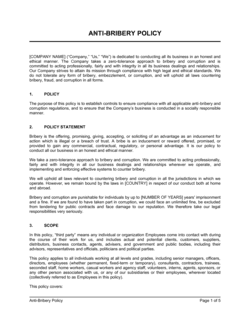
An Anti Bribery and Anti Corruption Policy is a formal written statement that defines what constitutes bribery and corruption, prohibits related conduct by all employees and third parties, and establishes the procedures for reporting, investigating, and disciplining violations. This free Word download gives businesses a structured, compliance-ready starting point that can be edited online and exported as PDF for distribution to staff, contractors, and business partners.
When you need it
Use it when your business operates in regulated industries, engages government officials, works with third-party agents or intermediaries, or operates across multiple countries where bribery risk is elevated. It is also commonly required as part of ISO certification, lender due diligence, or supply-chain compliance programs.
What's inside
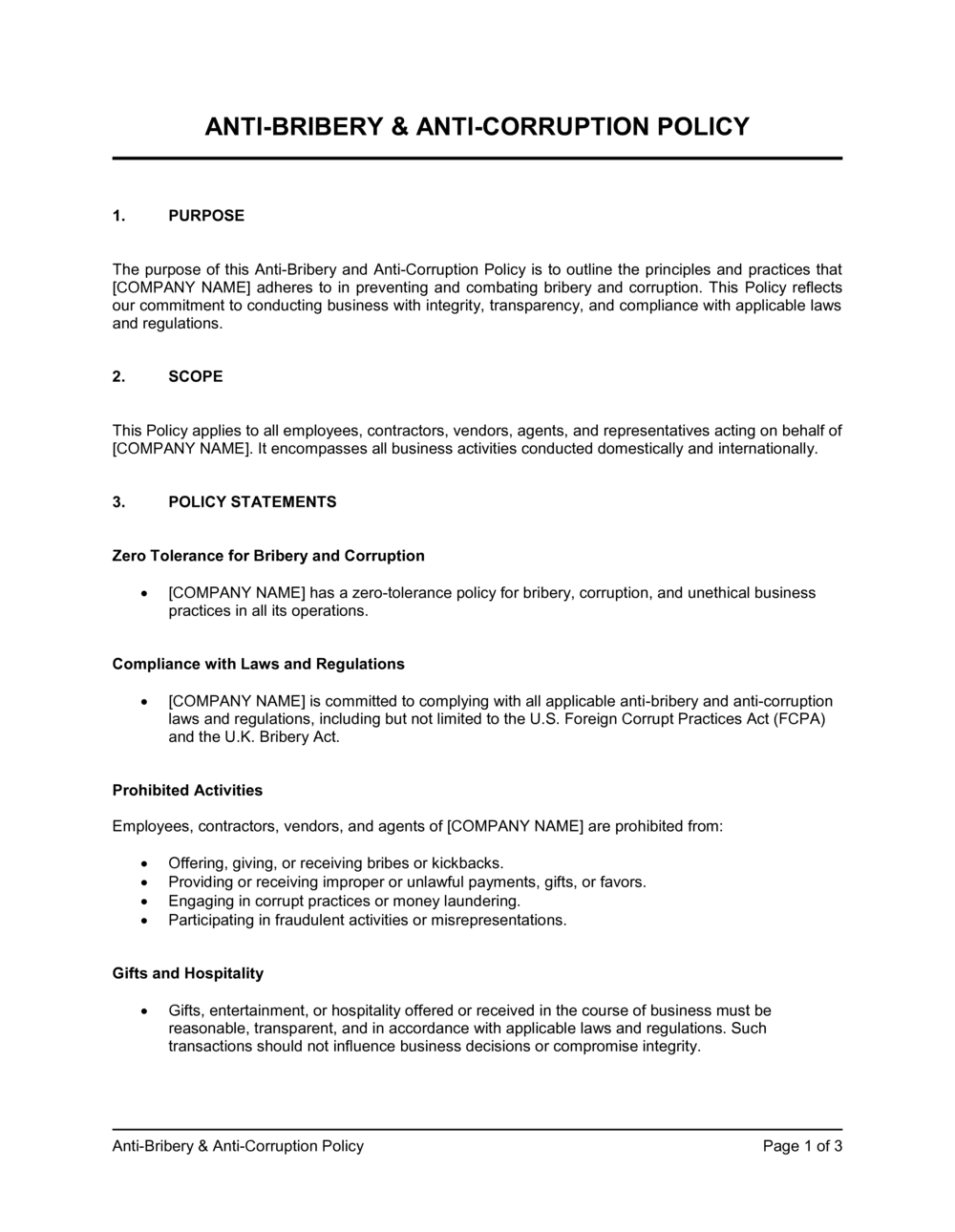
A policy statement and scope, definitions of bribery and corruption, prohibited conduct covering gifts, hospitality, facilitation payments and political donations, third-party due diligence requirements, a reporting and whistleblower procedure, investigation and disciplinary provisions, and an employee acknowledgment section.

What is an Anti Bribery and Anti Corruption Policy?

An Anti Bribery and Anti Corruption Policy is a formal written document that defines what constitutes bribery and corruption, prohibits those behaviors by all employees and third parties acting on behalf of the organization, and establishes clear procedures for reporting, investigating, and disciplining violations. It typically references the specific laws applicable to the business β€” most commonly the US Foreign Corrupt Practices Act (FCPA), the UK Bribery Act 2010, or equivalent local statutes β€” and covers prohibited conduct ranging from cash payments to public officials through to gifts, entertainment, facilitation payments, and charitable donations made to gain business advantage. This free Word download gives organizations a structured, compliance-ready starting point that can be edited online and exported as PDF for company-wide distribution and acknowledgment.

Why You Need This Document

Operating without a written anti bribery and anti corruption policy exposes your business to criminal liability, regulatory fines, and reputational damage that can be difficult to recover from. Under the UK Bribery Act, an organization that fails to prevent bribery by an associated person β€” including a third-party agent β€” commits a strict-liability offense, and the only statutory defense is demonstrating that adequate procedures were in place. Under the FCPA, a documented compliance program is a key factor in whether prosecutors pursue charges and how significant any resulting penalty is. Beyond legal exposure, many corporate customers, government procurement offices, and lenders now require a written policy as a condition of contract or credit. A clear policy also protects employees: it tells them exactly what is prohibited, gives them a safe channel to report concerns without fear of retaliation, and ensures that the few who choose to act improperly cannot later claim ignorance of the rules.

Which variant fits your situation?

If your situation is…Use this template
Business with significant international operations and government-facing contractsAnti Bribery and Anti Corruption Policy (Enterprise)
Small domestic business needing a lightweight written policy for supplier onboardingAnti Bribery and Anti Corruption Policy
Business that also needs to govern whistleblower reporting separatelyWhistleblower Policy
Procurement team needing a vendor-facing code of conductSupplier Code of Conduct
Company requiring a broader ethical governance documentCode of Ethics and Business Conduct
Organization needing a gift and entertainment register alongside the policyGifts and Hospitality Register

Common mistakes to avoid

❌ Excluding third-party agents from policy scope

Why it matters: The majority of FCPA and UK Bribery Act enforcement actions involve payments made through intermediaries, not directly by employees. A policy that only covers staff provides no protection.

Fix: Explicitly name the categories of third parties covered β€” agents, distributors, consultants, joint venture partners β€” and require anti-corruption representations in all third-party contracts.

❌ Carving out facilitation payments as acceptable

Why it matters: Facilitation payments are prohibited under the UK Bribery Act regardless of amount or local custom. Including a carve-out invalidates this section and creates regulatory exposure.

Fix: State an unconditional prohibition on facilitation payments, acknowledge they may be demanded locally, and provide employees with a clear escalation path when faced with such demands.

❌ Setting gift thresholds with no gifts register

Why it matters: Without a log, serial small-value gifts to the same recipient accumulate below the radar. Regulators and auditors look for patterns, not individual incidents.

Fix: Implement a mandatory gifts register β€” even a shared spreadsheet β€” and require entries for all gifts above a minimal de minimis amount, regardless of whether pre-approval was needed.

❌ One-time onboarding training with no annual refresh

Why it matters: A single training session at hire does not demonstrate an ongoing compliance culture. Regulators explicitly look for annual training records when evaluating whether a company had adequate procedures.

Fix: Schedule annual refresher training, track completion in the HR system, and update training content whenever the policy or applicable law changes materially.

❌ No named reporting channel independent of management

Why it matters: If the only reporting path runs through a direct supervisor, employees with concerns about management will stay silent β€” and the policy fails its core detection purpose.

Fix: Provide at least one independent channel β€” a compliance officer, legal counsel, or third-party ethics hotline β€” that employees can access without informing their manager.

❌ Failing to review and re-approve the policy periodically

Why it matters: An undated or years-old policy signals that anti-corruption is not a living compliance priority. It also fails to reflect regulatory and legal changes since it was first drafted.

Fix: Set a formal review cycle β€” every one to two years β€” with a version number, review date, and approver name on the cover page of every revision.

The 10 key sections, explained

Policy statement and purpose

Scope and who is covered

Definitions of prohibited conduct

Gifts, hospitality, and entertainment

Facilitation payments and political donations

Third-party due diligence

Reporting and whistleblower procedure

Investigation and disciplinary action

Training and communication

Employee acknowledgment

How to fill it out

  1. 1

    Insert company name and governing law references

    Replace all [COMPANY NAME] placeholders and identify the specific anti-bribery laws applicable to your jurisdiction and industry β€” FCPA for US-connected businesses, UK Bribery Act for UK-nexus entities, or local equivalents.

    πŸ’‘ If your company operates in multiple countries, list each applicable statute by name β€” regulators look for specific legal references, not generic 'applicable law' language.

  2. 2

    Define scope and covered persons

    Confirm that the scope section explicitly covers employees at all levels, board members, temporary and contract staff, and all third parties acting on the company's behalf.

    πŸ’‘ Add a non-exhaustive list of third-party types β€” agents, distributors, joint venture partners, lobbyists β€” so there is no ambiguity about who is covered.

  3. 3

    Set gift and hospitality thresholds

    Enter specific monetary thresholds for gifts and entertainment β€” per-occasion and annual caps β€” that reflect your industry norms and the strictest law applicable to your operations.

    πŸ’‘ When unsure, err lower: a $50 per-occasion threshold is harder to challenge than a $200 one, and the difference rarely affects business relationships.

  4. 4

    Complete the third-party due diligence procedure

    Describe your risk-tiering approach β€” low, medium, and high risk β€” and specify what actions are required at each level, including who approves high-risk engagements.

    πŸ’‘ Reference a due diligence questionnaire or third-party screening tool by name so the procedure is operationally actionable, not just aspirational.

  5. 5

    Identify reporting channels and the compliance owner

    Name the specific person, role, or hotline that receives reports, and confirm that at least one channel is accessible independently of the employee's direct manager.

    πŸ’‘ If you do not yet have a formal ethics hotline, a dedicated compliance email address monitored by legal counsel is a workable minimum for small businesses.

  6. 6

    Set training frequency and acknowledgment process

    Specify how often training is required, who tracks completion, and how signed acknowledgments are stored and audited.

    πŸ’‘ A simple annual e-signature acknowledgment tied to the employee's HR record satisfies most regulatory audit requests and takes minutes to set up.

  7. 7

    Have the policy approved and dated by senior leadership

    The policy should be signed or formally approved by the CEO, board, or equivalent governance body to demonstrate organizational commitment.

    πŸ’‘ Board approval β€” even by written resolution rather than in-person vote β€” significantly strengthens the policy's defensibility in a regulatory investigation.

Frequently asked questions

What is an anti bribery and anti corruption policy?

An anti bribery and anti corruption policy is a formal written document that defines what constitutes bribery and corruption within an organization, prohibits those behaviors by employees and third parties, and establishes procedures for reporting, investigating, and disciplining violations. It typically references specific laws β€” such as the US Foreign Corrupt Practices Act or the UK Bribery Act β€” and forms the cornerstone of a company's broader compliance program.

Does my business legally need an anti bribery policy?

In the UK, the Bribery Act 2010 creates a strict-liability offense for organizations that fail to prevent bribery by associated persons β€” having adequate procedures, including a written policy, is the primary statutory defense. Under the FCPA, a documented compliance program is not a legal requirement but is a material factor in prosecutorial discretion and penalty calculation. Even outside these regimes, many corporate customers, lenders, and procurement programs require a written policy as a condition of doing business.

What is the difference between an anti bribery policy and a code of ethics?

A code of ethics is a broad document covering the full range of expected business conduct β€” honesty, conflicts of interest, fair dealing, and environmental responsibility. An anti bribery and anti corruption policy is a focused compliance document dealing specifically with bribery, corrupt payments, gifts, facilitation payments, and related conduct. Most organizations maintain both: the code of ethics sets the tone, while the anti bribery policy provides the specific rules and procedures.

What are facilitation payments, and why does the policy prohibit them?

Facilitation payments are small unofficial payments made to low-level government officials to speed up routine administrative tasks β€” customs clearance, permit issuance, or utility connections. Although historically treated as a minor practical necessity in some markets, they are prohibited under the UK Bribery Act regardless of amount or local custom, and increasingly scrutinized under the FCPA. Allowing them creates a precedent for larger payments and exposes the company to enforcement risk.

Who should be covered by the policy?

The policy should cover all employees regardless of seniority, board members, temporary and contract staff, and β€” critically β€” all third parties acting on the company's behalf, including agents, distributors, consultants, joint venture partners, and lobbyists. Enforcement actions consistently involve payments made through intermediaries, making third-party coverage as important as internal coverage.

How do gift thresholds work in practice?

Most policies set a per-occasion monetary cap β€” commonly between $25 and $150 depending on industry and jurisdiction β€” below which gifts may be given or received without pre-approval. Gifts above that threshold require written approval from a designated compliance officer or manager. All gifts above a minimal de minimis amount should be logged in a gifts register regardless of whether approval was required, so patterns can be identified and audited.

How often should the policy be updated?

Most compliance professionals recommend a formal review every one to two years, or immediately following a material change in applicable law, a regulatory investigation, or a significant change in business model such as entering a new market or completing an acquisition. Each version should carry a review date and approver name, and all employees should re-acknowledge the updated policy.

What happens if an employee violates the policy?

The policy should specify that violations are subject to disciplinary action up to and including termination of employment, and that cases may be referred to law enforcement or regulatory authorities. Personal criminal liability for bribery is separate from any employer discipline β€” individuals can be prosecuted regardless of whether the company itself faces charges. Prompt self-reporting to regulators following an internal investigation can materially reduce corporate penalties in most jurisdictions.

Can a small business use this template without a lawyer?

Yes, for most domestic small businesses a well-completed template provides a solid compliance foundation. Consider engaging a lawyer if your business contracts with government entities, operates in countries with elevated corruption risk, uses agents or intermediaries in foreign markets, or is subject to sector-specific regulatory requirements such as financial services or defense contracting. A 1–2 hour legal review typically costs $200–$500 and is worthwhile before the policy is distributed company-wide.

How this compares to alternatives

vs Code of Ethics

A code of ethics addresses the full spectrum of expected business conduct β€” honesty, fairness, conflicts of interest, and environmental responsibility. An anti bribery and anti corruption policy is a focused compliance instrument dealing specifically with prohibited payments and related conduct. Organizations typically need both: the code sets the ethical culture, while this policy provides actionable rules and procedures for bribery risk specifically.

vs Whistleblower Policy

A whistleblower policy governs the process for reporting any form of misconduct β€” financial fraud, safety violations, harassment β€” and the legal protections for reporters. An anti bribery policy includes a reporting mechanism specifically for bribery concerns but does not cover the broader categories of wrongdoing a standalone whistleblower policy addresses. High-risk organizations benefit from having both documents.

vs Conflict of Interest Policy

A conflict of interest policy addresses situations where an employee's personal interests could improperly influence their professional decisions β€” investments in competitors, undisclosed relationships with suppliers. An anti bribery policy addresses outright corrupt payments. The two overlap when undisclosed personal relationships are used to direct contracts, but each document serves a distinct governance function.

vs Supplier Code of Conduct

A supplier code of conduct sets expectations for vendors across multiple areas β€” labor standards, environmental practices, data security, and ethical conduct. An anti bribery policy is an internal document governing employee and company conduct. Together they form a complete third-party governance framework: the anti bribery policy governs due diligence and contract requirements; the supplier code governs how vendors must behave.

Industry-specific considerations

Financial services

FCA, SEC, and FinCEN oversight means financial firms face enhanced scrutiny of third-party payments, political donations, and hiring of government-connected individuals.

Construction and infrastructure

High exposure to government permitting and procurement processes in multiple jurisdictions means facilitation payment risks and agent oversight are critical policy components.

Professional services

Client entertainment and referral arrangements require clearly defined hospitality thresholds and conflict-of-interest rules to avoid improper inducements.

Manufacturing and supply chain

Complex multi-tier supply chains and cross-border procurement create third-party due diligence obligations that must be operationalized through the policy's vendor screening procedures.

Technology / SaaS

Government contracts, data licensing deals, and international expansion into high-risk markets elevate FCPA and local anti-corruption compliance requirements.

Healthcare

Pharmaceutical and medical device sectors face strict restrictions on physician gifts, speaker fees, and research sponsorships under anti-kickback statutes and transparency laws.

Template vs pro β€” what fits your needs?

PathBest forCostTime
Use the templateDomestic small and mid-size businesses needing a documented policy for supplier onboarding, certification, or HR governanceFree1–2 hours
Template + professional reviewBusinesses with government contracts, international operations, or third-party agents in higher-risk markets$200–$600 (1–2 hour legal review)2–5 business days
Custom draftedMultinational corporations, regulated industries, or businesses under active regulatory scrutiny requiring a bespoke compliance program$2,000–$10,000+2–6 weeks

Glossary

Bribery
Offering, giving, receiving, or soliciting something of value to improperly influence a decision made by a person in a position of authority.
Corruption
The abuse of entrusted power for private gain, including bribery, fraud, embezzlement, and conflicts of interest.
Facilitation Payment
A small unofficial payment made to a government official to speed up a routine administrative process β€” prohibited under most anti-bribery laws regardless of amount.
Public Official
Any person holding a legislative, executive, judicial, or administrative office of a government, state-owned enterprise, or international public organization.
Third Party
Any external individual or organization acting on behalf of the company, including agents, distributors, joint venture partners, consultants, and contractors.
Due Diligence
A documented process of assessing the integrity, background, and bribery risk of third parties before engaging them and periodically throughout the relationship.
Whistleblower
An employee or third party who reports suspected wrongdoing in good faith, typically protected from retaliation under the policy and applicable law.
Hospitality Threshold
The maximum value of a gift or entertainment item an employee may give or receive without prior approval, as set by company policy.
FCPA
The US Foreign Corrupt Practices Act β€” a federal law that prohibits US persons and companies from bribing foreign government officials to obtain or retain business.
UK Bribery Act
A UK statute that prohibits bribery of any person (not just public officials) and imposes strict liability on organizations that fail to prevent bribery by associated persons.

Part of your Business Operating System

This document is one of 3,000+ business & legal templates included in Business in a Box.

  • Fill-in-the-blanks β€” ready in minutes
  • 100% customizable Word document
  • Compatible with all office suites
  • Export to PDF and share electronically

Create your document in 3 simple steps.

From template to signed document β€” all inside one Business Operating System.
1
Download or open template

Access over 3,000+ business and legal templates for any business task, project or initiative.

2
Edit and fill in the blanks with AI

Customize your ready-made business document template and save it in the cloud.

3
Save, Share, Send, Sign

Share your files and folders with your team. Create a space of seamless collaboration.

Save time, save money, and create top-quality documents.

β˜…β˜…β˜…β˜…β˜…

"Fantastic value! I'm not sure how I'd do without it. It's worth its weight in gold and paid back for itself many times."

Managing Director Β· Mall Farm
Robert Whalley
Managing Director, Mall Farm Proprietary Limited
β˜…β˜…β˜…β˜…β˜…

"I have been using Business in a Box for years. It has been the most useful source of templates I have encountered. I recommend it to anyone."

Business Owner Β· 4+ years
Dr Michael John Freestone
Business Owner
β˜…β˜…β˜…β˜…β˜…

"It has been a life saver so many times I have lost count. Business in a Box has saved me so much time and as you know, time is money."

Owner Β· Upstate Web
David G. Moore Jr.
Owner, Upstate Web

Run your business with a system β€” not scattered tools

Stop downloading documents. Start operating with clarity. Business in a Box gives you the Business Operating System used by over 250,000 companies worldwide to structure, run, and grow their business.

Free Forever PlanΒ Β·Β No credit card required