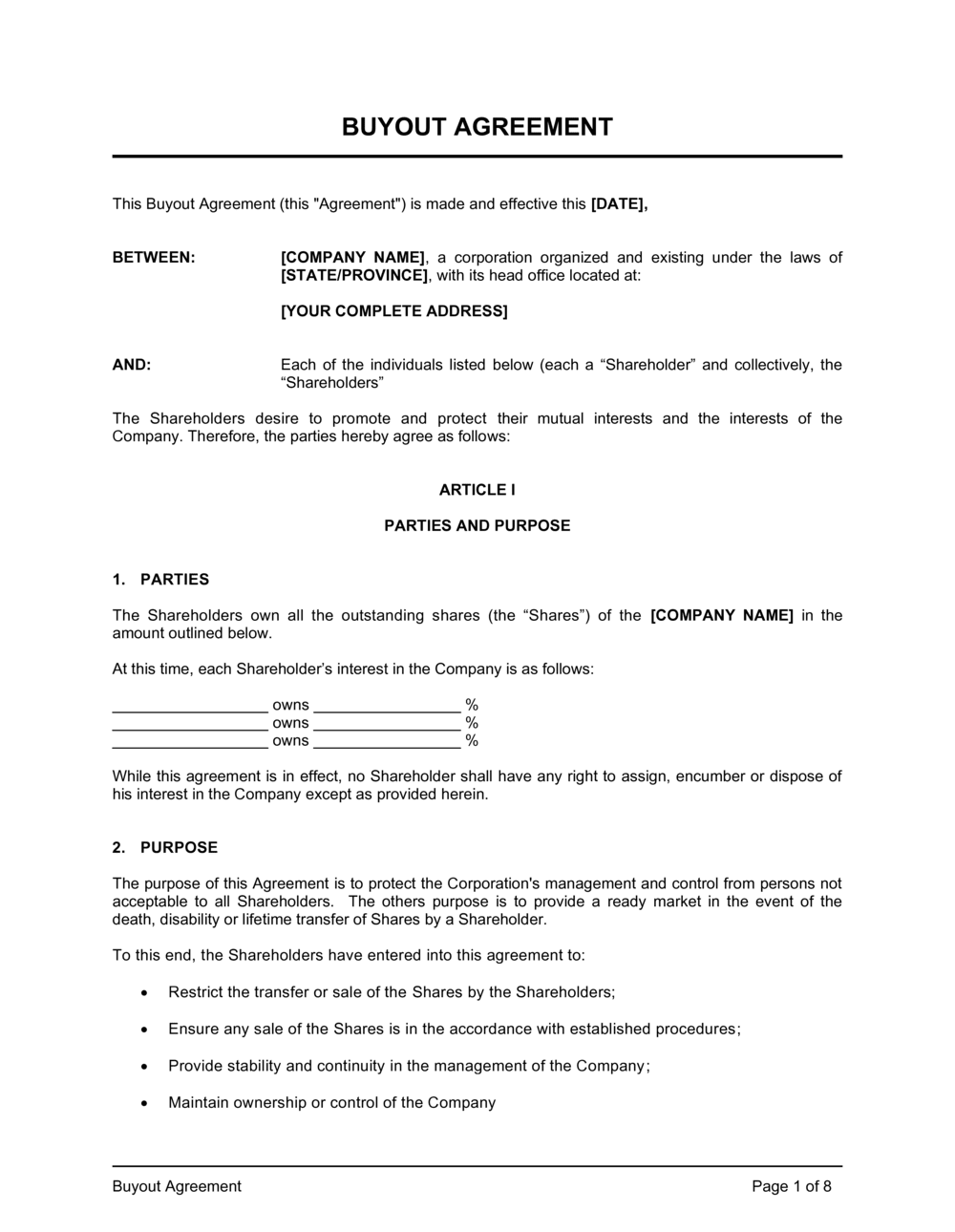
Buyout Agreement Template

Free Word download β€’ Edit online β€’ Save & share with Drive β€’ Export to PDF

8 pagesβ€’30–40 min to fillβ€’Difficulty: Complexβ€’Signature requiredβ€’Legal review recommended
Learn more ↓
FreeBuyout Agreement Template

At a glance

What it is
A Buyout Agreement is a legally binding contract under which one party purchases the ownership interest of another in a partnership, LLC, or corporation. This free Word download covers valuation methodology, purchase price, payment schedule, mutual releases, representations and warranties, and post-buyout restrictive covenants β€” giving both sides a clear, enforceable record of the transaction.
When you need it
Use it when a co-founder, business partner, or co-owner is exiting and the remaining owners are buying out their interest β€” whether driven by retirement, dispute, strategic realignment, or a negotiated departure. It is also used when a single incoming buyer acquires a minority or majority stake from an existing owner outside a full business sale.
What's inside
Party identification and ownership details, purchase price and valuation basis, payment terms and schedule, representations and warranties from both sides, mutual release of claims, transition obligations, and post-buyout non-compete and non-solicitation restrictions.

What is a Buyout Agreement?

A Buyout Agreement is a legally binding contract under which one party β€” the buyer β€” purchases the full ownership interest of another party in a partnership, LLC, or corporation. It governs every material dimension of the ownership transfer: how the interest is valued, how much is paid and when, what the seller represents about the interest being clean and transferable, what claims both sides release against each other, and what restrictions apply to the departing owner after closing. Unlike a general business sale, a buyout agreement is used when only one owner's interest is changing hands and the business continues operating under the remaining or incoming ownership.

Why You Need This Document

Without a written buyout agreement, a departing owner's exit leaves every critical question unanswered in writing β€” and unanswered questions become expensive disputes. An undocumented buyout exposes the buyer to unknown liabilities the seller failed to disclose, leaves the seller without enforceable payment terms if the buyer defaults on installments, and gives the departing owner no restrictions that prevent them from immediately competing with the business they just sold. Tax authorities, banks, and future investors also require a documented transfer of ownership to recognize the change in the cap table. A properly drafted buyout agreement, executed before the closing payment is made, eliminates all four of these risks and gives both parties a clean, auditable record of the transaction that protects them long after the deal closes.

Which variant fits your situation?

If your situation is…Use this template
Buying out a partner in a general or limited partnershipPartnership Buyout Agreement
Buying out a member's interest in an LLCLLC Member Buyout Agreement
Purchasing a co-founder's shares in a corporationShareholder Buyout Agreement
Full acquisition of all shares and assets of a businessBusiness Purchase Agreement
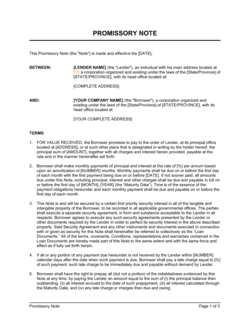
Structured installment buyout with a promissory notePromissory Note
Pre-negotiating buyout terms before a dispute arisesBuy-Sell Agreement
Buying out a shareholder following a deadlock or disputeShareholders Agreement

Common mistakes to avoid

❌ Agreeing on a price with no documented valuation basis

Why it matters: A purchase price unsupported by any valuation methodology is vulnerable to post-closing claims of duress, fraud, or undervaluation β€” particularly in closely-held businesses where the parties had unequal access to financial information.

Fix: Document the valuation method in the agreement itself and attach any supporting appraisal, financial model, or formula as an exhibit. Even a one-paragraph explanation is substantially better than a bare number.

❌ Deferring payment with no promissory note or security

Why it matters: An installment purchase price with no promissory note is difficult to enforce if the buyer defaults, especially after the seller has already transferred the ownership interest and vacated management roles.

Fix: Execute a promissory note for any deferred balance simultaneously with the buyout agreement, and negotiate a security interest in the transferred interest as collateral.

❌ Releasing the other party but not the company entity

Why it matters: A departing owner who releases the buyer personally but not the Company retains the ability to sue the entity for unpaid distributions, loans, or expense reimbursements β€” undermining the clean break the buyout was designed to achieve.

Fix: Draft the mutual release to cover the other party, the Company, and each of their respective affiliates, officers, and representatives, with a single unified release clause.

❌ No carve-out for claims discovered after closing

Why it matters: A mutual release with no survival or exception carve-out can inadvertently release fraudulent conduct, criminal activity, or breach of warranty claims that neither party knew about at the time of signing.

Fix: Carve out fraud, intentional misconduct, and breaches of representations and warranties from the scope of the mutual release, and set an explicit survival period during which warranty claims may be brought.

❌ One-size-fits-all non-compete regardless of seller's role

Why it matters: Applying the same two-year, nationwide non-compete to a passive minority investor and to a founder with active client relationships is both overkill for one party and potentially underprotective for the other β€” courts strike down disproportionate restrictions rather than narrowing them.

Fix: Calibrate the non-compete's duration, geography, and scope to the seller's actual competitive knowledge and customer relationships. A 12-month restriction limited to the business's primary service area is more consistently enforced than a broad national ban.

❌ Failing to confirm transfer restrictions in the underlying entity documents

Why it matters: Most operating agreements, partnership agreements, and shareholders agreements include rights of first refusal, consent requirements, or lock-up periods. Transferring an interest without following those procedures can void the transfer entirely.

Fix: Before executing the buyout agreement, review the entity's governing documents for transfer restrictions and either obtain any required consents or amend the governing documents to permit the transfer.

The 10 key clauses, explained

Parties and ownership recitals

In plain language: Identifies the buyer, the seller, and the business entity; states the seller's current ownership percentage or unit count; and confirms the seller has authority to transfer the interest.

Sample language
This Buyout Agreement ('Agreement') is entered into on [DATE] between [BUYER FULL NAME / ENTITY] ('Buyer') and [SELLER FULL NAME / ENTITY] ('Seller'). Seller currently holds [X]% of the membership interests / [X] shares of [COMPANY LEGAL NAME] (the 'Company'). Seller represents that the Interest is free and clear of all liens and encumbrances.

Common mistake: Describing the seller's interest by percentage without confirming the total capitalization table. If the cap table is disputed, the percentage means nothing β€” state both the percentage and the absolute unit or share count.

Purchase price and valuation basis

In plain language: States the total consideration, explains how the number was reached (appraisal, EBITDA multiple, book value, or negotiated), and confirms what the price includes or excludes.

Sample language
Buyer agrees to purchase the Interest for an aggregate purchase price of $[AMOUNT] ('Purchase Price'), determined by [VALUATION METHOD β€” e.g., independent appraisal dated [DATE] / agreed EBITDA multiple of [X]x trailing twelve months]. The Purchase Price is inclusive of [INCLUSIONS] and exclusive of [EXCLUSIONS].

Common mistake: Agreeing on a lump-sum price without documenting the valuation basis. When disputes arise post-closing, a price with no documented rationale invites claims that the figure was coerced or based on misrepresentation.

Payment terms and schedule

In plain language: Sets out when and how the purchase price will be paid β€” lump sum at closing, staged installments, or a combination β€” and specifies the payment method and any interest on deferred amounts.

Sample language
Buyer shall pay the Purchase Price as follows: (a) $[AMOUNT] at Closing by [wire transfer / certified check]; (b) the balance of $[AMOUNT] in [X] equal monthly installments of $[AMOUNT] commencing [DATE], bearing interest at [X]% per annum on the outstanding balance. Buyer's payment obligations under (b) shall be evidenced by a Promissory Note in the form attached as Exhibit A.

Common mistake: Deferring a large portion of the purchase price with no promissory note and no security. An unsecured verbal installment promise is nearly unenforceable if the buyer defaults or the business deteriorates.

Representations and warranties of the seller

In plain language: The seller confirms they own the interest free and clear, have authority to sell it, have disclosed all material liabilities, and are not subject to any restriction that would prevent the transfer.

Sample language
Seller represents and warrants that: (a) Seller has full legal authority to sell and transfer the Interest; (b) the Interest is free and clear of all liens, pledges, and encumbrances; (c) Seller has not entered into any agreement that conflicts with this transaction; and (d) Seller has disclosed to Buyer all material liabilities of the Company known to Seller as of the date hereof.

Common mistake: Using generic representations without tailoring them to the entity type. A seller in an LLC should warrant compliance with the operating agreement's transfer restrictions; a shareholder should warrant compliance with any right-of-first-refusal in the shareholders agreement.

Representations and warranties of the buyer

In plain language: The buyer confirms they have authority to enter the agreement, have the financial capacity to complete the purchase, and are acquiring the interest for their own account.

Sample language
Buyer represents and warrants that: (a) Buyer has full legal authority to enter into this Agreement and consummate the purchase; (b) Buyer has or will have the financial resources to pay the Purchase Price on the terms set forth herein; and (c) Buyer is acquiring the Interest for Buyer's own account and not with a view to distribution.

Common mistake: Omitting buyer-side representations entirely on the assumption that 'the buyer is just paying money.' Buyer representations on financial capacity and authority are critical if the seller is accepting a promissory note or earn-out.

Mutual release of claims

In plain language: Both parties release all known and unknown claims against each other arising from the ownership relationship, management of the business, and any related dealings, up to and including the closing date.

Sample language
Effective upon Closing, each party hereby irrevocably releases and forever discharges the other party and the Company from any and all claims, demands, causes of action, and liabilities of any nature, known or unknown, arising out of or relating to the ownership of the Interest or the operation of the Company on or before the Closing Date.

Common mistake: Releasing claims against the other party but not against the Company entity itself. A departing partner who retains the right to sue the Company β€” for unpaid distributions, for example β€” creates ongoing exposure even after the buyout closes.

Transition obligations

In plain language: Sets out what the seller must do to facilitate an orderly handover β€” returning property, resigning from roles, signing transfer documents, and cooperating with third-party notifications.

Sample language
At Closing, Seller shall: (a) execute all transfer instruments required to vest the Interest in Buyer; (b) resign from all officer, director, and management positions with the Company; (c) return all Company property, equipment, and credentials; and (d) cooperate reasonably with Buyer in notifying suppliers, customers, and government authorities of the ownership change.

Common mistake: No transition timeline or consequences for delay. A seller who drags their feet on signing transfer documents or returning credentials can hold the new ownership structure hostage β€” specify a deadline and a per-diem remedy.

Post-closing non-compete and non-solicitation

In plain language: Restricts the departing owner from competing with the business or poaching its customers and employees for a defined period and within a defined geography after closing.

Sample language
For [24] months following the Closing Date, Seller shall not: (a) directly or indirectly engage in, own, manage, or advise any business that competes with the Company within [GEOGRAPHIC AREA]; or (b) solicit, recruit, or hire any customer, client, or employee of the Company.

Common mistake: Applying a single non-compete term regardless of the seller's role or competitive knowledge. A passive minority investor warrants a narrower restriction than a founder with deep customer relationships and proprietary know-how β€” courts scrutinize proportionality.

Indemnification

In plain language: Each party agrees to compensate the other for losses caused by a breach of their representations, warranties, or obligations under the agreement, subject to a survival period and liability caps.

Sample language
Each party ('Indemnifying Party') shall indemnify and hold harmless the other party ('Indemnified Party') from any losses, damages, and costs arising from a breach of the Indemnifying Party's representations, warranties, or covenants herein. Indemnification claims must be brought within [24] months of Closing. Total indemnification liability of either party shall not exceed the Purchase Price.

Common mistake: No survival period for representations and warranties. Without one, courts in some jurisdictions apply a default limitations period that may be far longer than either party intended β€” specify 12–24 months explicitly.

Governing law and dispute resolution

In plain language: Specifies which jurisdiction's law governs the agreement and how disputes are resolved β€” typically arbitration for speed and confidentiality, with a carve-out for injunctive relief.

Sample language
This Agreement is governed by the laws of [STATE / PROVINCE / COUNTRY]. Any dispute shall be resolved by binding arbitration in [CITY] under the rules of [AAA / JAMS / applicable body], except that either party may seek injunctive relief in any court of competent jurisdiction to prevent irreparable harm.

Common mistake: Choosing a governing jurisdiction with no connection to where the business operates or the parties reside. Courts in the business's home jurisdiction routinely override a foreign governing-law clause when local mandatory rules apply.

How to fill it out

  1. 1

    Identify the parties and the business entity

    Enter the full legal names of the buyer and seller β€” individuals or entities β€” and the registered legal name of the business whose interest is being transferred. Confirm entity type (partnership, LLC, or corporation) and the seller's current ownership percentage and absolute unit or share count.

    πŸ’‘ Pull the exact ownership figures from the most recent operating agreement, partnership agreement, or shareholders register β€” discrepancies between the agreement and the register create title defects.

  2. 2

    Establish and document the purchase price

    Record the agreed total consideration and document the valuation method used β€” independent appraisal, EBITDA multiple, net asset value, or negotiated figure. Attach the appraisal or valuation report as an exhibit if one was commissioned.

    πŸ’‘ Even if both parties have verbally agreed on a number, write a one-paragraph summary of how it was calculated. The documented rationale prevents post-closing disputes far more effectively than the number alone.

  3. 3

    Set the payment schedule and prepare a promissory note

    Specify the closing payment amount and method, and if any portion is deferred, set out the installment amounts, dates, interest rate, and default consequences. Prepare a separate promissory note for any deferred balance and attach it as Exhibit A.

    πŸ’‘ If the deferred balance exceeds 30% of the purchase price, consider taking a security interest in the acquired ownership stake as collateral against buyer default.

  4. 4

    Tailor the representations and warranties to the entity type

    Confirm that the seller's representations address the specific transfer restrictions in the operating agreement, partnership agreement, or shareholders agreement. Add any entity-specific warranties β€” for example, that no right of first refusal was triggered, or that all distributions to which the seller was entitled have been paid.

    πŸ’‘ Have both parties' lawyers review the representations against the underlying entity documents before signing β€” undisclosed transfer restrictions discovered post-closing can void the deal.

  5. 5

    Draft the mutual release with specificity

    Identify any known disputes or claims between the parties and confirm they are included in the release. For states that require it, include a specific waiver of unknown claims (California Civil Code Section 1542 or equivalent).

    πŸ’‘ If there are active disputes or claims you want to carve out of the release, list them explicitly in a schedule β€” a general release that inadvertently covers a pending claim can extinguish valuable rights.

  6. 6

    Set the transition obligations and closing checklist

    List every document the seller must execute at or before closing β€” assignment of interest, resignation letters, consent forms β€” and every action they must take, such as returning access credentials and equipment. Set a deadline for each.

    πŸ’‘ Prepare a closing checklist as a separate one-page exhibit and have both parties initial it β€” this converts transition obligations into a concrete, auditable to-do list.

  7. 7

    Calibrate and finalize the non-compete and non-solicitation terms

    Set the duration and geographic scope of the non-compete proportionate to the seller's role, the industry's competitive dynamics, and the jurisdiction's enforceability standards. For most businesses, 12–24 months within the business's primary trading area is the defensible range.

    πŸ’‘ Check current law for the governing jurisdiction before finalizing β€” California bans most post-sale non-competes for employment relationships, though business-sale non-competes are generally permitted with proper structure.

  8. 8

    Execute before or simultaneously with the closing payment

    Both parties must sign the agreement and all exhibits on or before the date the closing payment is made. Conditional or unwitnessed signatures made after funds transfer create enforceability questions in several jurisdictions.

    πŸ’‘ Use a simultaneous exchange where the signed agreement and the closing funds transfer on the same day β€” neither party should hand over their performance before receiving the other's.

Frequently asked questions

What is a buyout agreement?

A buyout agreement is a legally binding contract under which one party purchases the ownership interest β€” shares, LLC membership units, or a partnership stake β€” of another party in a business. It sets out the purchase price, valuation basis, payment terms, mutual releases, and post-closing restrictions, giving both the buyer and the departing owner a clear, enforceable record of the transaction.

When do I need a buyout agreement?

You need a buyout agreement whenever a co-owner exits a business and their interest is being purchased rather than simply extinguished. Common triggers include a co-founder departure, a partner reaching retirement age, a dispute resolution where one party buys the other out, or a strategic decision to consolidate ownership. A buyout agreement is distinct from a full business sale β€” only the departing owner's interest changes hands, not the entire business.

What is the difference between a buyout agreement and a buy-sell agreement?

A buy-sell agreement is a pre-agreed framework β€” typically drafted when the business is formed β€” that defines the triggering events and pricing mechanisms that will govern any future ownership transfer. A buyout agreement is the transaction document executed when an actual transfer occurs. Think of the buy-sell agreement as the rulebook and the buyout agreement as the specific deal that follows those rules; in practice, the buyout agreement often implements the terms the buy-sell agreement pre-negotiated.

How is the buyout price determined?

The purchase price in a buyout agreement can be determined in several ways: a formal independent business valuation, a formula defined in the company's operating or partnership agreement (such as a multiple of trailing EBITDA or net asset value), a negotiated lump sum agreed between the parties, or a combination of a base price plus an earn-out tied to future performance. Whatever method is used, the agreement should document the basis so that the figure is defensible if challenged post-closing.

Does a buyout agreement need to be notarized?

In most jurisdictions, a buyout agreement does not require notarization to be legally enforceable β€” valid signatures from parties with legal capacity are generally sufficient. However, some states and provinces require notarized signatures for transfers of real property interest, and some entity transfer documents (such as stock powers) are customarily notarized. Check the requirements of the governing jurisdiction and the entity's own transfer documents before closing.

Can I pay the buyout price in installments?

Yes β€” installment buyouts are common, particularly in small business and family business contexts where the buyer may not have access to a lump sum. The deferred portion of the purchase price should be documented in a separate promissory note specifying the payment schedule, interest rate, and default consequences. If the deferred balance is substantial, consider securing it with a pledge of the acquired interest as collateral so the seller retains leverage if the buyer defaults.

What happens if the buyer defaults on installment payments?

The consequences depend on what the buyout agreement and any accompanying promissory note specify. Typical remedies include accelerating the full outstanding balance, charging default interest, and β€” if the interest was pledged as security β€” retaking the ownership interest. Without a promissory note and security agreement, a defaulting buyer may force the seller to pursue expensive litigation with limited enforcement tools. Always document deferred payment obligations in writing and specify default remedies explicitly.

Are non-compete clauses enforceable in a buyout agreement?

Enforceability depends on the jurisdiction and the scope of the restriction. Post-sale non-competes in the context of a genuine business buyout are generally more enforceable than post-employment non-competes, because courts recognize a legitimate interest in protecting the goodwill purchased. However, restrictions that are unreasonable in duration, geographic scope, or breadth of activity are still subject to challenge. California permits business-sale non-competes under Business & Professions Code Section 16601 even though it bans most employment non-competes. Calibrate the restriction to the seller's actual competitive knowledge and the business's trading area.

Do I need a lawyer to complete a buyout agreement?

For a straightforward buyout between two domestic parties with no disputed valuation, a high-quality template is a sound starting point. Engage a lawyer when the transaction involves significant deferred consideration, disputed valuation, complex entity structures, cross-border parties, or a seller who had access to sensitive IP and customer relationships. A transactional attorney review typically runs $750–$2,500 for a buyout of this type and is strongly recommended when the purchase price exceeds $100,000 or the departing owner held a senior operational role.

How this compares to alternatives

vs Buy-Sell Agreement

A buy-sell agreement is a pre-agreed framework β€” usually adopted at formation β€” that defines the triggers, pricing mechanisms, and procedures for any future ownership transfer. A buyout agreement is the specific transaction document executed when a transfer actually happens. Both documents are needed: the buy-sell agreement sets the rules; the buyout agreement executes a specific deal under those rules.

vs Business Purchase Agreement

A business purchase agreement transfers the entire business β€” all assets or all shares β€” from one owner to another. A buyout agreement transfers only a departing owner's interest in a company that continues to operate with the remaining or new owners in place. Use a buyout agreement when the business is not being sold outright and at least one original or incoming owner will remain.

vs Shareholders Agreement

A shareholders agreement governs the ongoing relationship between shareholders β€” voting rights, dividend policy, transfer restrictions, and drag-along/tag-along rights. A buyout agreement is a one-time transaction document for a specific ownership transfer. The shareholders agreement may dictate terms that the buyout agreement must follow; reviewing both before executing either is essential.

vs Partnership Agreement

A partnership agreement establishes the ongoing rights and obligations of partners in a business, including how interests may be transferred. A buyout agreement is the document that executes a specific transfer when a partner exits. The partnership agreement typically contains withdrawal and buyout provisions that define what the buyout agreement must reflect.

Industry-specific considerations

Professional Services

Client book valuations, non-solicitation of clients served by the departing partner, and transition of professional licenses or certifications are central considerations.

Technology / SaaS

IP assignment confirmation at closing, vesting acceleration clauses for unvested founder equity, and non-competes calibrated to the fast-moving competitive landscape.

Retail and Hospitality

Lease assignment or landlord consent requirements, inventory valuation as of closing, and transfer of liquor or operating licenses that may require regulatory approval.

Construction and Trades

Bonding and contractor license continuity, transfer of equipment liens, and non-solicitation of subcontractor and supplier relationships built by the departing owner.

Healthcare

Patient record transfer obligations, HIPAA compliance continuity, credentialing and licensing conditions, and non-solicitation covering patient relationships.

Manufacturing

Equipment appraisal in the valuation, supplier and distribution contract assignment, and workforce non-solicitation protecting key skilled trades employees.

Jurisdictional notes

United States

Buyout agreements are governed by state law, which varies significantly for LLCs, partnerships, and corporations. Many operating and partnership agreements include mandatory transfer restrictions β€” right-of-first-refusal, consent requirements β€” that must be honored before the buyout closes. California permits business-sale non-competes under Business & Professions Code Section 16601 even as it bans most employment non-competes; other states apply different enforceability standards. Tax treatment of the payment β€” ordinary income vs. capital gain β€” varies by entity type and should be reviewed with a CPA.

Canada

Buyouts of partnership and corporate interests are governed by provincial corporate and partnership statutes. In Ontario and most common-law provinces, the articles of incorporation or partnership agreement control transfer restrictions and any right-of-first-refusal that must be waived or exercised before closing. Quebec's Civil Code imposes distinct rules on contracts and business transfers for provincially regulated entities, and any agreement intended to operate in Quebec should be reviewed for French-language compliance under the Charter of the French Language.

United Kingdom

Share transfers in UK private limited companies require a stock transfer form and compliance with any pre-emption rights set out in the company's articles of association or shareholders agreement β€” failure to follow these procedures renders the transfer ineffective. Partnership interest transfers are governed by the Partnership Act 1890 and any bespoke partnership deed. Post-closing non-competes in the business-sale context are generally enforceable if reasonable in scope and duration; courts apply a reasonableness test and will not rewrite overbroad restrictions.

European Union

Ownership transfer rules for EU companies vary by member state and entity type β€” German GmbH transfers require notarization; French SAS transfers must comply with shareholders-agreement pre-emption procedures. Post-closing non-competes in a business-sale context are generally permitted across the EU, but competition law scrutiny increases for transactions involving significant market share. GDPR obligations attached to customer data should be addressed in the transition provisions if the departing owner had access to personal data processed by the business.

Template vs lawyer β€” what fits your deal?

PathBest forCostTime
Use the templateStraightforward domestic buyouts with an agreed valuation, no active disputes, and a purchase price under $100,000Free1–2 hours
Template + legal reviewBuyouts with deferred payment, complex non-compete requirements, or a departing owner who held an operational role$750–$2,5003–7 days
Custom draftedLarge or contested buyouts, cross-border parties, disputed valuations, or businesses with significant IP, regulatory licenses, or third-party consent requirements$3,000–$10,000+2–6 weeks

Glossary

Buyout
The purchase of one owner's equity interest in a business by the remaining owners or a third party, resulting in the seller relinquishing all ownership rights.
Purchase Price
The total agreed consideration paid to the selling owner in exchange for their interest, which may be based on a formal valuation, a formula, or a negotiated lump sum.
Valuation Methodology
The method used to calculate the fair value of the ownership interest being sold, such as a multiple of EBITDA, net asset value, or an independent third-party appraisal.
Membership Interest
An owner's proportional stake in an LLC, expressed as a percentage or unit count, entitling them to profits, losses, and voting rights as defined in the operating agreement.
Promissory Note
A written promise by the buyer to pay the purchase price β€” or a portion of it β€” in defined installments over time, often secured against the acquired interest.
Mutual Release
A clause in which both the buyer and seller waive all known and unknown claims against each other arising from the ownership relationship up to the closing date.
Representations and Warranties
Factual statements made by each party at signing β€” such as authority to transfer the interest and absence of undisclosed liabilities β€” that survive closing and can give rise to indemnification claims if false.
Non-Compete Clause
A post-closing restriction preventing the selling owner from starting or joining a competing business within a defined geographic area and time period.
Non-Solicitation Clause
A restriction preventing the departing owner from poaching the business's customers, clients, or employees after the buyout closes.
Closing
The moment at which all conditions of the buyout agreement are satisfied, the purchase price (or first installment) is paid, and ownership of the interest formally transfers.
Indemnification
A contractual obligation by one party to compensate the other for losses arising from a breach of representations, warranties, or covenants in the agreement.
Good Faith Estimate
An honest, reasonable approximation of a value or amount β€” such as a business valuation figure β€” used when an independent appraisal is not completed before signing.

Part of your Business Operating System

This document is one of 3,000+ business & legal templates included in Business in a Box.

  • Fill-in-the-blanks β€” ready in minutes
  • 100% customizable Word document
  • Compatible with all office suites
  • Export to PDF and share electronically

Create your document in 3 simple steps.

From template to signed document β€” all inside one Business Operating System.
1
Download or open template

Access over 3,000+ business and legal templates for any business task, project or initiative.

2
Edit and fill in the blanks with AI

Customize your ready-made business document template and save it in the cloud.

3
Save, Share, Send, Sign

Share your files and folders with your team. Create a space of seamless collaboration.

Save time, save money, and create top-quality documents.

β˜…β˜…β˜…β˜…β˜…

"Fantastic value! I'm not sure how I'd do without it. It's worth its weight in gold and paid back for itself many times."

Managing Director Β· Mall Farm
Robert Whalley
Managing Director, Mall Farm Proprietary Limited
β˜…β˜…β˜…β˜…β˜…

"I have been using Business in a Box for years. It has been the most useful source of templates I have encountered. I recommend it to anyone."

Business Owner Β· 4+ years
Dr Michael John Freestone
Business Owner
β˜…β˜…β˜…β˜…β˜…

"It has been a life saver so many times I have lost count. Business in a Box has saved me so much time and as you know, time is money."

Owner Β· Upstate Web
David G. Moore Jr.
Owner, Upstate Web

Run your business with a system β€” not scattered tools

Stop downloading documents. Start operating with clarity. Business in a Box gives you the Business Operating System used by over 250,000 companies worldwide to structure, run, and grow their business.

Start freeΒ Β·Β No credit card required