An Introduction To Coaching For Coaches Template

Free Word download β€’ Edit online β€’ Save & share with Drive β€’ Export to PDF

4 pagesβ€’25–30 min to fillβ€’Difficulty: Standardβ€’Signature requiredβ€’Legal review recommended
Learn more ↓
FreeAn Introduction To Coaching For Coaches Template

At a glance

What it is
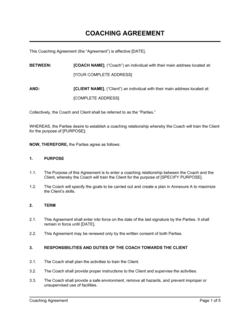
An Introduction to Coaching for Coaches is a legally binding agreement that formalizes the relationship between a coach and a new client at the outset of an engagement. This free Word download covers scope of services, session structure, fees, confidentiality, and termination in a single document you can edit online and export as PDF before your first session.
When you need it
Use it before beginning any paid coaching engagement β€” life, executive, business, or performance coaching β€” where you need enforceable terms in writing and a shared understanding of what the coaching relationship does and does not include.
What's inside
Definitions of the coaching relationship, session frequency and format, fees and payment schedule, confidentiality obligations, client responsibilities, limitation of liability, and termination provisions.

What is an Introduction to Coaching for Coaches?

An Introduction to Coaching for Coaches is a legally binding agreement that formalizes the professional relationship between a coach and a new client at the start of an engagement. It defines what coaching is and, critically, what it is not β€” distinguishing the coach's role from that of a therapist, consultant, or medical advisor. The agreement sets out session structure, fees, confidentiality obligations, the client's responsibilities for their own decisions and outcomes, and the conditions under which either party may end the engagement. Signed before the first session, it gives both coach and client a shared, written understanding of the relationship they are entering.

Why You Need This Document

Without a signed coaching agreement, you have no contractual basis to enforce payment, charge for last-minute cancellations, protect client disclosures, or limit your liability if a client later claims the coaching caused financial or personal harm. The absence of a non-therapy disclaimer is particularly dangerous β€” coaching conversations frequently surface emotional and psychological material, and a client who believes they were receiving therapy can bring complaints to licensing boards or initiate civil claims. A clear, signed agreement closes these gaps before the first word of a session is spoken. For coaches building a practice at any scale, this template is the foundation that makes every client relationship professionally and legally defensible from day one.

Which variant fits your situation?

If your situation is…Use this template
One-on-one life or personal development coachingLife Coaching Agreement
Corporate or organizational executive coaching engagementExecutive Coaching Agreement
Group coaching program with multiple participantsGroup Coaching Agreement
Single introductory or discovery session onlyAn Introduction to Coaching for Coaches
Health, wellness, or nutrition coaching with medical disclaimer needsHealth Coaching Services Agreement
Business coaching with consulting deliverables alongside session workBusiness Coaching and Consulting Agreement
Online or virtual coaching delivered via video platformVirtual Coaching Services Agreement

Common mistakes to avoid

❌ Guaranteeing specific results in the agreement

Why it matters: A written guarantee of income growth, career advancement, or a personal outcome is a contractual promise β€” one a coaching relationship structurally cannot assure, exposing the coach to breach-of-contract claims.

Fix: Use language that describes the client's potential and the coach's process ('Client will have the opportunity to...') rather than outcome language. Remove any guarantee phrasing from both the contract and marketing materials.

❌ No cancellation or no-show policy

Why it matters: Without a written policy, coaches have no contractual basis to charge for last-minute cancellations or missed sessions, effectively providing those hours for free.

Fix: Add a cancellation clause specifying at least 24–48 hours' notice and the fee for late cancellations. Reference this clause explicitly during onboarding.

❌ Omitting the non-therapy and scope disclaimer

Why it matters: Coaching conversations frequently surface emotional and psychological content. Without a clear disclaimer, clients may later claim they believed they were receiving therapy, creating professional liability exposure.

Fix: Include a prominent, plain-English clause stating that coaching is not therapy, counseling, or medical treatment, and that clients with clinical needs will be referred to licensed professionals.

❌ Signing the agreement after the first session has already taken place

Why it matters: In common-law jurisdictions, consideration must exist at the time of signing. A client who has already received a session may argue they received nothing new, weakening enforceability of liability caps and confidentiality terms.

Fix: Make agreement execution a prerequisite for any session β€” including discovery calls where a fee is charged. Send the document at booking confirmation, not after.

❌ No refund policy for prepaid retainers

Why it matters: Ambiguity on whether a retainer is refundable is the single most common source of disputes when a client terminates early β€” and consumer protection laws in several jurisdictions may require a refund regardless of contract silence.

Fix: State explicitly whether the retainer is refundable, the refund formula (e.g., unused sessions Γ— per-session rate, less a 10% admin fee), and the deadline after which no refund applies.

❌ No liability cap or an uncapped liability clause

Why it matters: An uncapped liability exposure on a $5,000 coaching retainer could theoretically expose a coach to claims worth multiples of their fee if a client suffers financial or personal harm they attribute to coaching guidance.

Fix: Insert a limitation of liability clause capping total liability at fees paid in the 30–90 days prior to the claim, and confirm your professional liability insurance aligns with this cap.

The 9 key clauses, explained

Parties and nature of the coaching relationship

In plain language: Identifies the coach and client, states that the relationship is a professional coaching engagement and not therapy, consulting, or legal advice, and acknowledges both parties' understanding of that distinction.

Sample language
This Agreement is entered into between [COACH FULL NAME / BUSINESS NAME] ('Coach') and [CLIENT FULL NAME] ('Client'). Coaching is a professional partnership distinct from therapy, counseling, or consulting. Coach does not provide mental health treatment, legal advice, or medical guidance.

Common mistake: Omitting the non-therapy disclaimer entirely. In jurisdictions where unlicensed therapy practice is regulated, a missing disclaimer exposes the coach to professional liability claims.

Scope of services and session structure

In plain language: Defines what coaching will cover, the number and frequency of sessions, the format (video, phone, in-person), and the typical session length.

Sample language
Coach shall provide [X] coaching sessions per [week/month], each approximately [DURATION] minutes in length, delivered via [PLATFORM / IN-PERSON at LOCATION]. Sessions will focus on [COACHING FOCUS AREA] as agreed by the parties.

Common mistake: Writing the scope so broadly ('all aspects of the client's life') that there is no practical limit on what the client can demand, leading to scope creep and burnout.

Fees, payment schedule, and retainer terms

In plain language: States the total fee or per-session rate, when payment is due, acceptable payment methods, and whether a block retainer is required upfront.

Sample language
Client shall pay Coach [$X] per session / [$X] for a [N]-session retainer, due [in advance / within [X] days of invoice date]. Accepted payment methods: [METHODS]. Retainer fees are non-refundable after [DATE / session commencement].

Common mistake: Not specifying whether retainer fees are refundable if the client terminates early. Ambiguity here generates the majority of fee disputes in coaching engagements.

Cancellation and rescheduling policy

In plain language: Sets out the notice period required to cancel or reschedule without penalty, and the fee (if any) that applies to late cancellations or no-shows.

Sample language
Client may cancel or reschedule a session with at least [48 hours'] written notice at no charge. Sessions cancelled with less than [48 hours'] notice will be charged at [100% / 50%] of the session fee.

Common mistake: Having no cancellation policy at all. Without one, coaches frequently absorb the cost of no-shows with no contractual basis to charge the client.

Confidentiality obligations

In plain language: Requires the coach to keep all client disclosures confidential, with carve-outs for mandatory disclosure obligations such as risk of harm to self or others.

Sample language
Coach shall keep all information shared by Client strictly confidential and shall not disclose it to any third party without Client's prior written consent, except as required by law or where Client discloses an imminent risk of harm to themselves or others.

Common mistake: Failing to include the risk-of-harm carve-out. Without it, the coach may face liability for not disclosing a serious safety concern when a legal or ethical duty exists.

Client responsibilities and acknowledgments

In plain language: Confirms that the client is responsible for their own decisions, will engage honestly and actively, and understands that results depend on their effort and commitment.

Sample language
Client acknowledges that coaching outcomes depend on Client's own active engagement and effort. Client is solely responsible for all decisions made as a result of or during the coaching engagement. Coach makes no guarantee of specific outcomes.

Common mistake: Guaranteeing specific outcomes β€” 'you will double your income in 90 days' β€” in the agreement or marketing materials. Express guarantees create contractual obligations that coaching relationships structurally cannot deliver.

Limitation of liability and disclaimer of warranties

In plain language: Caps the coach's liability for any claim arising from the engagement and disclaims implied warranties, protecting the coach from outsized damages claims.

Sample language
To the fullest extent permitted by law, Coach's total liability to Client shall not exceed the fees paid by Client in the [30 / 90] days preceding the claim. Coach makes no warranties, express or implied, regarding coaching outcomes.

Common mistake: Setting no liability cap at all, or setting one that equals the full contract value. For multi-session retainers, an uncapped or full-contract-value cap exposes the coach to significant financial risk.

Termination

In plain language: Allows either party to end the engagement at any time with written notice, states what happens to prepaid but unused sessions, and confirms that confidentiality obligations survive termination.

Sample language
Either party may terminate this Agreement at any time by providing [X days'] written notice. Upon termination, Coach shall refund fees for any unused sessions, less a [CANCELLATION FEE / pro-rated administrative charge]. Confidentiality obligations survive termination.

Common mistake: Not stating what happens to prepaid, unused sessions on early termination. Without this clause, disputes over refund entitlement are the most common post-termination conflict.

Governing law and dispute resolution

In plain language: Specifies which jurisdiction's law governs the agreement and how disputes will be resolved β€” arbitration, mediation, or litigation in a named court.

Sample language
This Agreement shall be governed by the laws of [STATE / PROVINCE / COUNTRY]. Any dispute arising under this Agreement shall first be submitted to non-binding mediation before either party may initiate legal proceedings in [COURT / JURISDICTION].

Common mistake: Choosing a governing law in a state or country where neither the coach nor client is located. Courts may decline jurisdiction, or the chosen law may not align with consumer protection rules in the client's actual location.

How to fill it out

  1. 1

    Enter the coach's and client's legal names

    Use your full registered business name or legal name as the coach, and the client's legal name as it appears on government ID. If the client is a corporate sponsor paying for an employee's coaching, identify both the sponsor entity and the individual coachee.

    πŸ’‘ For executive coaching where an employer pays for an employee's sessions, add a separate clause clarifying what (if anything) the sponsor employer may learn about session content.

  2. 2

    Define the scope and session structure precisely

    Specify the number of sessions, frequency (e.g., twice monthly), duration (e.g., 60 minutes), and delivery format (video call, phone, in-person). List the broad focus areas β€” career transition, leadership development, business growth β€” without guaranteeing specific outcomes.

    πŸ’‘ Attaching a brief Schedule A with session focus areas and agreed milestones lets you update the scope for a renewal without rewriting the main agreement.

  3. 3

    Set the fee structure and payment terms

    Choose a per-session rate or block retainer. Specify the exact amount, due date (e.g., first session of each month, or 100% upfront), and accepted payment methods. State clearly whether the retainer is refundable and under what conditions.

    πŸ’‘ Charging 50–100% upfront for a block of sessions significantly reduces late payment and no-show rates β€” include a refund policy to make clients comfortable with prepayment.

  4. 4

    Set the cancellation and rescheduling terms

    Choose a notice window (24 or 48 hours is standard) and the fee for late cancellations. Most coaches charge 50–100% of the session fee for same-day cancellations and nothing for cancellations with adequate notice.

    πŸ’‘ Build the cancellation policy into your onboarding call, not just the contract β€” clients who hear it verbally are less likely to dispute it later.

  5. 5

    Review and tailor the confidentiality and non-therapy clauses

    Confirm the confidentiality carve-outs match your jurisdiction's mandatory reporting requirements. Ensure the non-therapy and non-medical disclaimer is prominent and uses plain language the client will understand before signing.

    πŸ’‘ Health and wellness coaches should add a specific disclaimer that coaching does not substitute for advice from a licensed physician, dietitian, or mental health professional.

  6. 6

    Set the limitation of liability cap

    Enter the cap amount β€” typically fees paid in the prior 30 to 90 days β€” and confirm the mutual disclaimer of consequential and punitive damages. Align this with your professional liability insurance coverage limits.

    πŸ’‘ Check whether your jurisdiction permits limitation of liability clauses in consumer contracts β€” some EU member states and Canadian provinces restrict them for personal services.

  7. 7

    Confirm the termination and refund terms

    Enter the notice period for termination (7 to 14 days is typical for individual coaching), the refund formula for unused prepaid sessions, and confirm that confidentiality survives the end of the agreement.

    πŸ’‘ For block retainers, a 'use it or lose it after 6 months' expiry clause motivates clients to complete sessions and reduces long-tail administrative obligations.

  8. 8

    Sign before the first session begins

    Both parties must sign the agreement before the first coaching session β€” including a discovery or introductory call for which you intend to charge. A post-session signature creates enforcement gaps on restrictive clauses.

    πŸ’‘ Use an e-signature tool to timestamp execution and send a copy to both parties automatically β€” this eliminates 'I never received a contract' disputes.

Frequently asked questions

What is a coaching introduction agreement?

A coaching introduction agreement is a legally binding contract between a coach and a new client that defines the terms of their coaching engagement before the first session begins. It covers the scope of services, session frequency, fees, cancellation policy, confidentiality, the client's responsibilities, limitations on liability, and termination rights. It establishes mutual expectations and provides a clear basis for resolving disputes if they arise.

Do coaches need a formal contract with clients?

Yes. A signed agreement is essential for any paid coaching engagement, regardless of whether it is a single session or a year-long retainer. Without one, coaches have no contractual basis to enforce payment terms, cancellation fees, or confidentiality obligations. In several jurisdictions, consumer protection regulations require service providers to give clients written terms before taking payment for personal services.

What should a coaching contract include?

A complete coaching contract covers eight core elements: a description of the parties and nature of the coaching relationship, scope and session structure, fees and payment terms, cancellation and rescheduling policy, confidentiality obligations with appropriate carve-outs, a non-therapy disclaimer, limitation of liability, and termination provisions including what happens to prepaid sessions. Missing any of these creates gaps that courts will fill with jurisdiction-specific defaults.

Is coaching covered by therapist-client privilege?

No. Coaching is not a licensed mental health profession in most jurisdictions, and communications between a coach and client are not protected by therapist-client privilege. A confidentiality clause in the coaching agreement creates a contractual obligation of confidence, but it does not carry the same legal weight as statutory privilege. Coaches should make this distinction clear to clients in the agreement.

Can a coaching contract limit the coach's liability?

In most jurisdictions, yes β€” coaches can contractually cap their liability to fees paid over a defined prior period, typically 30–90 days. However, some EU member states and Canadian provinces restrict limitation of liability clauses in consumer contracts for personal services. Courts also will not enforce liability caps that attempt to exclude liability for gross negligence, fraud, or personal injury. A lawyer review is advisable if you operate across multiple jurisdictions.

What happens to prepaid sessions if a client terminates early?

The answer depends entirely on what the contract says. Without a refund clause, consumer protection laws in many jurisdictions β€” including several US states, UK consumer regulations, and EU directives β€” may entitle the client to a refund of unused services regardless of a 'no-refund' policy. The safest approach is to specify a clear refund formula: unused sessions Γ— per-session rate, less a documented administrative fee.

Does a coaching agreement need to comply with GDPR?

If you coach clients in the EU or UK, or if you process personal data of EU or UK residents, GDPR and the UK GDPR apply. Your coaching agreement should reference your privacy policy, state your lawful basis for processing client data, and explain how session notes are stored and for how long. A standalone data processing addendum or a GDPR clause within the agreement is recommended for coaches with EU or UK clients.

What is the difference between a coaching agreement and a coaching proposal?

A coaching proposal outlines the coach's recommended approach, session plan, and pricing for a prospective client β€” it is a sales document, not a binding contract. A coaching agreement is the signed legal document that formalizes the relationship once the client has accepted the proposal. The proposal generates interest; the agreement creates enforceable obligations on both sides.

Can a coaching contract be signed electronically?

Yes. Electronic signatures are legally valid in the United States under the ESIGN Act, in Canada under PIPEDA and provincial e-commerce statutes, in the UK under the Electronic Communications Act 2000, and across the EU under the eIDAS Regulation. An e-signature timestamp also provides useful evidence that the client signed before the first session began, which can be important if enforceability is later challenged.

How this compares to alternatives

vs Independent Contractor Agreement

An independent contractor agreement governs the relationship between a business and a self-employed service provider β€” it is employer-focused and covers project deliverables, IP assignment, and tax status. A coaching agreement is client-focused, covering the therapeutic-adjacent nature of coaching, session confidentiality, and the non-therapy disclaimer. Coaches who also perform consulting should use both documents, not one in place of the other.

vs Service Agreement

A general service agreement covers the delivery of any professional service and is primarily concerned with deliverables, timelines, and payment. A coaching agreement adds coaching-specific terms β€” the non-therapy disclaimer, duty to refer, client responsibility for outcomes, and the confidentiality carve-outs required for a conversational, goal-oriented relationship. A service agreement alone leaves material gaps for a coaching context.

vs Consulting Agreement

A consulting agreement assumes the service provider will deliver expert analysis, recommendations, and often concrete work product. Coaching explicitly does not involve the coach directing the client's decisions β€” the distinction matters legally and professionally. Using a consulting agreement for a coaching engagement may imply a level of expert advisory duty that creates liability exposure if outcomes do not materialize.

vs Non-Disclosure Agreement

An NDA is a standalone confidentiality instrument protecting a disclosing party's proprietary information. A coaching agreement includes confidentiality provisions but also covers the full scope of the coaching relationship, fees, and termination. For high-stakes executive coaching where the client or sponsor has significant commercial sensitivity, a separate NDA alongside the coaching agreement provides an additional layer of protection.

Industry-specific considerations

Professional services

Executive and leadership coaching engagements often involve a corporate sponsor paying for an employee coachee, requiring a three-party confidentiality structure that limits what the sponsor may learn about session content.

Health and wellness

Health and wellness coaches need an expanded non-medical disclaimer and a duty-to-refer clause directing clients to licensed practitioners for clinical issues, reducing exposure to unauthorized practice of medicine claims.

Technology / SaaS

Coaching engagements for tech founders and product leaders frequently touch commercially sensitive roadmap and investor information, making a robust confidentiality clause and an IP non-use provision essential.

Education and career development

Career coaches working with students and early-career professionals must clearly disclaim any guarantee of employment outcomes and distinguish coaching from recruitment or career placement services.

Jurisdictional notes

United States

Coaching is not a licensed profession at the federal level, but some states β€” including California and New York β€” regulate activities that overlap with therapy. A clear non-therapy disclaimer is essential. Limitation of liability clauses are generally enforceable in most states; California and Louisiana impose additional restrictions for consumer contracts. The FTC's updated endorsement and testimonial guidance applies to any outcome-based marketing tied to the agreement.

Canada

Provincial consumer protection legislation β€” including Ontario's Consumer Protection Act and BC's Business Practices and Consumer Protection Act β€” may require mandatory cancellation rights and impose limits on non-refundable retainers. Coaching agreements with Quebec clients must comply with the Consumer Protection Act (French language requirements apply for provincially-regulated consumer contracts). Limitation of liability clauses may be unenforceable against consumers in some provinces.

United Kingdom

The Consumer Rights Act 2015 applies to coaching contracts with individuals β€” terms must be fair, transparent, and not create a significant imbalance in the parties' rights. Blanket non-refundable retainer clauses may be considered unfair terms and struck down. UK GDPR requires a lawful basis for processing session notes and personal data disclosed during coaching. Coaches should reference their privacy notice within the agreement.

European Union

The EU Unfair Contract Terms Directive and national consumer protection laws in each member state restrict one-sided terms in consumer services contracts. Consumers typically retain a 14-day withdrawal right for services contracts under the Consumer Rights Directive, which may apply to individual coaching retainers unless the client expressly waives it after being informed. GDPR requires explicit consent or legitimate interest for processing client personal data, and session notes must be stored securely with defined retention limits.

Template vs lawyer β€” what fits your deal?

PathBest forCostTime
Use the templateIndependent coaches with straightforward individual client engagements in a single jurisdictionFree20–30 minutes
Template + legal reviewCoaches operating across multiple jurisdictions, corporate executive coaching, or health and wellness coaching with medical adjacency$300–$7002–5 days
Custom draftedCoaching firms with multiple coaches, high-value retainers exceeding $20,000, or regulated industries where practice scope is contested$1,000–$3,500+1–3 weeks

Glossary

Coaching Relationship
A professional, co-creative partnership between coach and client aimed at achieving the client's personal or professional goals through structured conversation and accountability.
Scope of Services
The specific coaching activities, session formats, frequency, and outcomes covered by the agreement β€” defining what is and is not included.
Coachee
The individual receiving coaching services; the client whose goals and development are the focus of each session.
Confidentiality Clause
A contractual provision requiring the coach to keep all client disclosures private, except in defined circumstances such as risk of harm.
Limitation of Liability
A clause capping the coach's financial exposure for claims arising from the engagement, typically limited to fees paid in the prior 30–90 days.
Cancellation Policy
The terms governing how and when either party may cancel or reschedule a session, and what fees apply to late cancellations.
Duty to Refer
The coach's obligation to recommend professional referral β€” to a therapist, doctor, or lawyer β€” when a client's needs fall outside the scope of coaching.
Termination for Convenience
A provision allowing either party to end the coaching engagement at any time with written notice, without needing to establish cause.
Session Retainer
An upfront payment securing a defined block of coaching sessions, typically non-refundable after a specified period.
ICF (International Coaching Federation)
The leading global professional body for coaches, whose ethical standards and competency framework are widely referenced in coaching agreements.
Non-Therapy Disclaimer
Language clarifying that coaching is not psychotherapy, counseling, or medical treatment and does not create a clinical relationship.

Part of your Business Operating System

This document is one of 3,000+ business & legal templates included in Business in a Box.

  • Fill-in-the-blanks β€” ready in minutes
  • 100% customizable Word document
  • Compatible with all office suites
  • Export to PDF and share electronically

Create your document in 3 simple steps.

From template to signed document β€” all inside one Business Operating System.
1
Download or open template

Access over 3,000+ business and legal templates for any business task, project or initiative.

2
Edit and fill in the blanks with AI

Customize your ready-made business document template and save it in the cloud.

3
Save, Share, Send, Sign

Share your files and folders with your team. Create a space of seamless collaboration.

Save time, save money, and create top-quality documents.

β˜…β˜…β˜…β˜…β˜…

"Fantastic value! I'm not sure how I'd do without it. It's worth its weight in gold and paid back for itself many times."

Managing Director Β· Mall Farm
Robert Whalley
Managing Director, Mall Farm Proprietary Limited
β˜…β˜…β˜…β˜…β˜…

"I have been using Business in a Box for years. It has been the most useful source of templates I have encountered. I recommend it to anyone."

Business Owner Β· 4+ years
Dr Michael John Freestone
Business Owner
β˜…β˜…β˜…β˜…β˜…

"It has been a life saver so many times I have lost count. Business in a Box has saved me so much time and as you know, time is money."

Owner Β· Upstate Web
David G. Moore Jr.
Owner, Upstate Web

Run your business with a system β€” not scattered tools

Stop downloading documents. Start operating with clarity. Business in a Box gives you the Business Operating System used by over 250,000 companies worldwide to structure, run, and grow their business.

Start freeΒ Β·Β No credit card required