Initial Coaching Questions Template

Free Word download • Edit online • Save & share with Drive • Export to PDF

1 page20–25 min to fillDifficulty: StandardSignature requiredLegal review recommended
Learn more ↓
FreeInitial Coaching Questions Template

At a glance

What it is
An Initial Coaching Questions document is a structured intake and consent form that a professional coach uses to gather essential information about a new client before the first coaching session begins. This free Word download covers goals, background, availability, confidentiality consent, and scope of engagement in a single document you can edit online and export as PDF to send to clients during onboarding.
When you need it
Use it when onboarding any new coaching client — whether for life coaching, executive coaching, career coaching, or business coaching — before the first paid session takes place. It establishes the foundation for the coaching relationship and creates a documented record of the client's stated objectives and agreed boundaries.
What's inside
Client background and contact details, presenting challenges and goals, prior coaching or therapy history, preferred coaching style and availability, confidentiality acknowledgment, scope of engagement, and client signature confirming informed consent to the coaching process.

What is an Initial Coaching Questions Document?

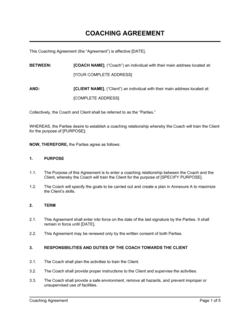
An Initial Coaching Questions document is a structured intake and consent form that a professional coach uses to gather essential information about a new client before the first coaching session takes place. It captures the client's presenting challenges, goals, prior coaching or therapy history, preferred working style, and availability, and concludes with a signed acknowledgment that the client understands the scope, confidentiality terms, and limitations of the coaching relationship. Unlike a casual pre-call email exchange, a properly completed intake form creates a documented record of informed consent that protects both the coach and the client from the outset of the engagement.

Why You Need This Document

Starting a coaching engagement without a completed intake form is the single fastest way to waste your first session and expose yourself to professional risk. Without documented goals, you have no baseline against which to measure progress or demonstrate value. Without a signed non-therapy disclaimer, a client who needed clinical support — not coaching — can hold the coach responsible for outcomes that were never within the scope of coaching to deliver. Regulatory bodies in the United States, Canada, and the United Kingdom have taken disciplinary action against coaches who crossed into unlicensed counseling territory precisely because no written scope boundary existed. A signed intake form also creates the foundation your coaching agreement builds on — together, they constitute the complete onboarding record every professional coaching engagement requires. This template gives you that foundation in 20 minutes, formatted and ready to customize for your niche.

Which variant fits your situation?

If your situation is…Use this template
Onboarding a new life coaching client for personal developmentInitial Coaching Questions (Life Coaching)
Onboarding a senior leader or C-suite executive for leadership developmentExecutive Coaching Agreement
Formalizing the overall coaching engagement terms and feesCoaching Agreement
Gathering ongoing session notes and progress after intake is completeCoaching Session Notes Template
Conducting a mid-engagement review of client progress and goal alignmentCoaching Progress Report
Ending a coaching engagement with a formal summary of outcomesCoaching Termination Summary
Assessing a business owner's operational challenges before engagementBusiness Coaching Needs Assessment

Common mistakes to avoid

❌ Promising absolute confidentiality without exceptions

Why it matters: If a client discloses intent to harm themselves or others, an unqualified confidentiality promise forces the coach to choose between their legal duty and a written commitment they cannot honor.

Fix: Always include a confidentiality clause that explicitly carves out exceptions for imminent risk of harm and legal compulsion, and ensure the client signs acknowledgment of those limits.

❌ Omitting the non-therapy disclaimer

Why it matters: Without a written scope boundary, a coach can inadvertently cross into unlicensed counseling territory — which regulatory bodies in the US, Canada, and the UK have acted on in disciplinary proceedings.

Fix: Include a plain-language statement clarifying that coaching is not therapy, is not a substitute for medical or mental health treatment, and that the client is responsible for their own decisions.

❌ Skipping the client signature

Why it matters: An unsigned intake form is a worksheet, not a consent record. Without a client signature, the coach cannot demonstrate that the client understood and agreed to the terms if a dispute or complaint arises.

Fix: Require a handwritten or verified electronic signature on the completed intake document before the first paid session begins, and retain a timestamped copy.

❌ Using identical intake questions across every coaching niche

Why it matters: Generic questions produce surface-level answers that don't give the coach enough context to design a purposeful first session, signaling a lack of specialization to the client.

Fix: Customize at least the goals and presenting-challenge sections to reflect the specific coaching context — leadership, career, health, or business — so responses are actionable before session one.

The 9 key clauses, explained

Client identification and contact details

In plain language: Records the client's full name, preferred contact method, time zone, and any organizational affiliation relevant to the coaching context.

Sample language
Client Name: [FULL LEGAL NAME] | Organization (if applicable): [ORGANIZATION NAME] | Preferred Contact: [EMAIL / PHONE] | Time Zone: [TIME ZONE]

Common mistake: Collecting only a first name and email. Without a full legal name and time zone, scheduling, invoicing, and any formal correspondence become error-prone.

Presenting challenge and background

In plain language: Captures the client's self-described primary challenge, the context surrounding it, and how long the issue has been present.

Sample language
Describe the primary challenge or situation that has brought you to coaching at this time: [CLIENT RESPONSE]. How long have you been experiencing this challenge? [CLIENT RESPONSE].

Common mistake: Asking only 'what do you want to work on?' without probing context or duration. Shallow intake data makes it harder to design a purposeful first session.

Goals and desired outcomes

In plain language: Documents the specific, observable results the client wants to achieve by the end of the engagement or within a defined timeframe.

Sample language
What does success look like for you at the end of this coaching engagement? [CLIENT RESPONSE]. What will be different in your life or work in [X] months? [CLIENT RESPONSE].

Common mistake: Accepting vague aspirations like 'feel better' without pushing for specificity. Goals that cannot be measured cannot be tracked or verified as achieved.

Prior coaching or therapy history

In plain language: Asks whether the client has worked with a coach or therapist previously, what was helpful or unhelpful, and whether any relevant therapeutic work is ongoing.

Sample language
Have you worked with a coach or therapist previously? [YES / NO]. If yes, what approaches did you find most effective? [CLIENT RESPONSE]. Are you currently working with a therapist or counselor? [YES / NO].

Common mistake: Skipping this section to avoid awkwardness. Undisclosed concurrent therapy can create conflicting guidance and expose the coach to complaints if the client's mental health situation escalates.

Preferred coaching style and availability

In plain language: Establishes how the client prefers to receive coaching — structured or exploratory — and captures availability for scheduling recurring sessions.

Sample language
Do you prefer sessions that are highly structured with a set agenda, or open and exploratory? [CLIENT RESPONSE]. Available days and times: [CLIENT RESPONSE]. Preferred session format: [VIDEO / PHONE / IN-PERSON].

Common mistake: Leaving scheduling logistics out of the intake form and handling them separately by email. This creates a second back-and-forth that delays session booking and reduces the professional impression of the onboarding process.

Strengths and resources

In plain language: Asks the client to identify their own assets — skills, support networks, past wins — that can be drawn on during the coaching work.

Sample language
What do you consider your greatest strengths or personal resources as you approach this work? [CLIENT RESPONSE]. Who in your life currently supports your growth and development? [CLIENT RESPONSE].

Common mistake: Starting intake exclusively with problems and challenges. Failing to document strengths creates a deficit-only framing that can limit the coaching approach and overlooks assets the coach should be leveraging.

Scope of engagement and non-therapy disclaimer

In plain language: Defines what coaching is and is not, clarifying that the coach does not provide therapy, medical advice, or legal counsel, and that the client accepts responsibility for their own decisions.

Sample language
Coaching is a forward-focused developmental process and is not a substitute for psychotherapy, medical treatment, or legal advice. [CLIENT NAME] acknowledges that all decisions made during or as a result of coaching sessions are the client's sole responsibility.

Common mistake: Omitting the non-therapy disclaimer entirely or burying it in fine print. Regulatory bodies in multiple jurisdictions have sanctioned coaches for inadvertently providing unlicensed counseling when no scope boundary was established in writing.

Confidentiality acknowledgment

In plain language: Commits the coach to keeping session content confidential, lists the narrow exceptions (risk of harm, legal compulsion), and confirms the client's understanding of those limits.

Sample language
All information shared in coaching sessions is treated as confidential. Exceptions include: (a) imminent risk of harm to the client or others; (b) a court order requiring disclosure. Client acknowledges these limitations by signing below.

Common mistake: Promising absolute confidentiality without carving out mandatory reporting exceptions. An unqualified confidentiality promise cannot be honored if the client discloses intent to harm themselves or others, exposing the coach to legal liability.

Client acknowledgment and signature

In plain language: A signature block confirming the client has read and understood the intake document, consented to the coaching process, and agreed to the terms stated.

Sample language
By signing below, [CLIENT NAME] confirms that the information provided is accurate and that they have read, understood, and agreed to the terms of this intake document. Signature: ___________ Date: [DATE].

Common mistake: Collecting the signature by email reply or checkbox without retaining a timestamped copy. Without a signed, stored record, the coach cannot demonstrate informed consent if a dispute arises later.

How to fill it out

  1. 1

    Customize the header with your coaching practice details

    Replace the placeholder practice name, logo, contact information, and coach credentials at the top of the document. Include your professional certification body (e.g., ICF, BCC) if applicable.

    💡 Adding your certification body's name and your credential level (ACC, PCC, MCC) immediately signals professional credibility to new clients.

  2. 2

    Tailor the presenting challenge and goals questions to your niche

    Adjust the open-ended questions in sections 2 and 3 to reflect your coaching specialty — leadership, career, health, or business. Generic questions produce generic answers.

    💡 Limit open-ended questions to no more than eight across the entire form. More than that causes intake fatigue and incomplete submissions.

  3. 3

    Add or remove the prior coaching history section based on your practice type

    Keep this section for life, health, and wellness coaches where overlap with therapy is a risk. It may be abbreviated for pure business or skills coaching where mental health crossover is unlikely.

    💡 If your practice regularly serves clients who may also be in therapy, add a release-of-information option so you can coordinate with their therapist if needed.

  4. 4

    Review and localize the non-therapy disclaimer

    Confirm the disclaimer language is appropriate for your jurisdiction. In the US, state-level counseling boards have specific language requirements; in the UK, the BACP and ICF UK have published guidance on scope statements.

    💡 If you are ICF-credentialed, align the disclaimer language with the ICF Code of Ethics definition of coaching to ensure consistency.

  5. 5

    Complete the confidentiality acknowledgment with jurisdiction-specific exceptions

    Add any mandatory reporting obligations that apply in your location — for example, child protection reporting requirements differ between the US, Canada, the UK, and EU member states.

    💡 Consult your professional liability insurer's recommended confidentiality language. Most coaching insurers provide a template clause that meets their coverage requirements.

  6. 6

    Set up the signature and date fields

    Include a signature line, printed name field, and date for both the client and the coach. Both signatures create a bilateral record, not just a client acknowledgment.

    💡 Use Business in a Box eSign to timestamp execution and store the completed intake form in a client file automatically.

  7. 7

    Send the form before the discovery call, not after

    Distribute the intake document at least 48 hours before the first session so you can review responses and prepare tailored questions. Reading it cold during the call wastes session time.

    💡 Include a one-sentence instruction in your onboarding email explaining why the form matters — clients who understand the purpose complete it more thoroughly.

  8. 8

    Archive the completed form in a secure client record

    Store the signed intake document in a password-protected client file or secure practice management system. Retain it for the duration of the coaching relationship plus the minimum period required by your jurisdiction's data protection rules.

    💡 Under GDPR, client intake data is personal data — storing it in an unencrypted email folder is non-compliant. Use a dedicated coaching platform or encrypted cloud storage.

Frequently asked questions

What are initial coaching questions?

Initial coaching questions are the structured set of questions a professional coach sends to a new client before their first session to gather essential background information. They typically cover the client's presenting challenges, goals, prior coaching or therapy history, preferred working style, and consent to the coaching process. The completed form gives the coach a factual baseline to work from and creates a signed record of the client's informed consent.

Why does a coaching intake form need a signature?

A signature transforms the intake form from an informal worksheet into a binding consent record. It documents that the client has read and understood the scope of coaching, the confidentiality terms, the non-therapy disclaimer, and the coach's limitations. Without a signed copy on file, a coach has no documentary evidence to rely on if a client later disputes what was agreed or files a complaint with a professional body.

Is an initial coaching questions form legally binding?

The consent and acknowledgment sections of a properly executed intake form are generally enforceable in most jurisdictions when both parties sign and the terms are clearly stated. However, the form is typically used alongside a separate coaching agreement that governs fees, cancellation, and engagement terms. The intake form establishes informed consent; the coaching agreement establishes the commercial relationship. Together, they constitute the full onboarding documentation.

What is the difference between an initial coaching questions form and a coaching agreement?

An initial coaching questions form is a client intake and consent document focused on gathering information about the client's background, goals, and needs before coaching begins. A coaching agreement is a commercial contract governing fees, session frequency, cancellation policy, payment terms, and intellectual property. Most professional coaches use both: the intake form captures who the client is and what they need; the agreement governs how the engagement is structured and paid for.

How detailed should initial coaching questions be?

Detailed enough to give the coach actionable context before session one, but not so lengthy that clients abandon the form before finishing. A well-designed intake document typically runs 8–12 open-ended questions covering presenting challenge, goals, history, strengths, and logistics, plus the consent and signature sections. Anything beyond 15 questions risks intake fatigue and incomplete submissions.

Should I include mental health screening in my coaching intake form?

Coaches are not licensed to diagnose mental health conditions, so clinical screening instruments (such as PHQ-9 or GAD-7) are outside a coach's scope of practice in most jurisdictions. However, it is appropriate to ask whether the client is currently working with a therapist or mental health provider and to include a clear non-therapy disclaimer. If a client's responses suggest they may need clinical support, the coach's ethical obligation is to refer them to a qualified professional rather than proceed with coaching.

Do coaching intake forms need to comply with data protection laws?

Yes. Coaching intake forms collect personal data — names, contact details, health-adjacent information, and sensitive personal circumstances — which is subject to data protection regulations in most jurisdictions. In the EU and UK, GDPR requires coaches to state a lawful basis for processing, retain data only as long as necessary, and store it securely. In Canada, PIPEDA and provincial privacy laws apply. In the US, there is no single federal standard, but state laws such as California's CCPA may apply depending on the coach's client base.

What confidentiality exceptions should a coaching intake form include?

At minimum, the confidentiality section should carve out two exceptions: imminent risk of harm to the client or a third party, and legal compulsion such as a court order or subpoena. Coaches working with minors, or in jurisdictions with mandatory reporting obligations for child or elder abuse, should add those exceptions explicitly. Stating these limits in writing and obtaining the client's signature protects the coach legally and ensures the client enters the relationship with realistic expectations.

Can I use the same intake form for group coaching and individual coaching?

A standard individual intake form is not directly transferable to group coaching without modification. Group coaching adds complexity around intra-group confidentiality — each participant needs to acknowledge that other group members will hear their contributions, and the coach should address how confidentiality obligations apply between participants, not just between client and coach. A separate group coaching intake section or addendum is recommended when running cohorts or group programs.

How this compares to alternatives

vs Coaching Agreement

A coaching agreement is the commercial contract that governs fees, session frequency, cancellation policy, and payment terms. An initial coaching questions form is an intake and consent document that captures client background, goals, and acknowledgment of scope before coaching begins. Both are required for a fully documented coaching engagement — the intake form informs the work; the agreement governs the commercial relationship.

vs Consulting Agreement

A consulting agreement governs a deliverable-based professional services relationship where the consultant provides expert advice or output. Coaching is a facilitated developmental process — the coach does not provide answers or deliverables. The intake questions form reflects this distinction by focusing on client goals and self-discovery rather than project scope or deliverables.

vs Therapy Intake Form

A therapy intake form is a clinical document used by licensed mental health professionals to assess diagnoses, treatment history, and risk factors. A coaching intake form explicitly excludes clinical assessment and includes a non-therapy disclaimer to establish that the relationship is developmental, not therapeutic. Using a therapy-style intake form for coaching can inadvertently imply a clinical scope the coach is not qualified to deliver.

vs Client Onboarding Checklist

A client onboarding checklist is an operational tool listing the administrative tasks to complete when a new client is added — sending contracts, setting up billing, booking sessions. An initial coaching questions form is a substantive document the client completes themselves, capturing their goals and consenting to the coaching process. The checklist manages the coach's workflow; the intake form establishes the client relationship.

Industry-specific considerations

Professional coaching practices

ICF-credentialed coaches use intake forms to satisfy competency requirements around establishing the coaching agreement and creating client awareness from the first interaction.

HR and talent development

Internal coaches and L&D teams use standardized intake forms to ensure consistent onboarding across leadership development programs and maintain confidentiality within the organization.

Healthcare and wellness

Health and wellness coaches require intake forms that include explicit non-medical disclaimers and data handling provisions aligned with HIPAA (US) or equivalent privacy rules.

Education and academic coaching

Academic and student success coaches use intake forms to document learning goals, academic history, and any accessibility accommodations relevant to the coaching approach.

Jurisdictional notes

United States

Coaching is not a licensed profession at the federal level, but coaches working in health-adjacent niches must comply with FTC truth-in-advertising rules and, where applicable, HIPAA if they handle protected health information. State-level counseling board regulations vary — some states have taken action against individuals providing services resembling therapy without a license. The non-therapy disclaimer and scope clause are particularly important in states with active counseling licensure enforcement such as California and New York.

Canada

Coaching is unregulated federally and provincially in Canada, but provincial privacy laws — including PIPEDA and Quebec's Law 25 — apply to any personal data collected during intake. Quebec's Law 25 imposes consent and data minimization requirements stricter than PIPEDA, and coaches with Quebec-based clients should ensure their intake form includes a compliant consent statement in French. The non-therapy disclaimer should reference that coaching is distinct from services provided under provincial regulated health professions acts.

United Kingdom

UK GDPR and the Data Protection Act 2018 apply to all personal data collected in coaching intake forms. Coaches must identify a lawful basis for processing (typically legitimate interests or contract performance), provide a privacy notice, and store data securely. The ICF UK and EMCC have published ethical guidelines recommending written scope-of-coaching statements. Coaches affiliated with the BACP should ensure their intake forms align with BACP's Ethical Framework for the Helping Professions where applicable.

European Union

GDPR applies to all personal data collected from EU-based clients, including intake forms sent by coaches based outside the EU. Coaches must state a lawful basis for processing, provide a data subject rights notice, and not transfer data to non-adequate third countries without safeguards. Sensitive personal data disclosed by clients during intake — health information, mental health history — requires explicit consent under Article 9 GDPR. Data minimization principles mean coaches should collect only information directly necessary for the coaching engagement.

Template vs lawyer — what fits your deal?

PathBest forCostTime
Use the templateIndependent coaches onboarding individual clients for standard life, career, or business coachingFree15–20 minutes to customize
Template + legal reviewCoaches working in regulated-adjacent fields (health, mental wellness) or onboarding corporate clients with data protection obligations$200–$500 for a one-hour legal or compliance review1–3 days
Custom draftedCoaching practices scaling to multiple coaches, group programs, or corporate enterprise clients with GDPR or HIPAA data processing agreements$800–$2,500+1–2 weeks

Glossary

Coaching Intake
The structured process of gathering background information from a new client before coaching begins, covering goals, history, and logistical preferences.
Informed Consent
A client's documented acknowledgment that they understand the nature, scope, limitations, and confidentiality terms of the coaching relationship before it begins.
Scope of Engagement
A clear statement of what the coaching relationship covers — and what it does not — distinguishing coaching from therapy, counseling, or medical advice.
Presenting Challenge
The specific issue, problem, or gap a client identifies as the primary reason for seeking coaching at the time of intake.
Coaching Goals
The measurable or observable outcomes a client wants to achieve through the coaching engagement, used to guide session design and track progress.
Confidentiality Clause
A binding commitment by the coach not to disclose client information to third parties, except in defined circumstances such as imminent risk of harm.
Non-Therapy Disclaimer
A statement clarifying that coaching is not a substitute for licensed mental health treatment, medical care, or legal advice.
Coaching Style Preference
The client's stated preference for how the coach delivers sessions — directive vs. exploratory, structured vs. open-ended — used to calibrate the approach.
Prior Coaching History
A record of any previous coaching or therapeutic relationships, used to identify existing frameworks, unresolved patterns, or ingrained expectations.
Client Acknowledgment
A signed statement confirming the client has read, understood, and agreed to the intake terms, creating a baseline record for the engagement.

Part of your Business Operating System

This document is one of 3,000+ business & legal templates included in Business in a Box.

  • Fill-in-the-blanks — ready in minutes
  • 100% customizable Word document
  • Compatible with all office suites
  • Export to PDF and share electronically

Create your document in 3 simple steps.

From template to signed document — all inside one Business Operating System.
1
Download or open template

Access over 3,000+ business and legal templates for any business task, project or initiative.

2
Edit and fill in the blanks with AI

Customize your ready-made business document template and save it in the cloud.

3
Save, Share, Send, Sign

Share your files and folders with your team. Create a space of seamless collaboration.

Save time, save money, and create top-quality documents.

★★★★★

"Fantastic value! I'm not sure how I'd do without it. It's worth its weight in gold and paid back for itself many times."

Managing Director · Mall Farm
Robert Whalley
Managing Director, Mall Farm Proprietary Limited
★★★★★

"I have been using Business in a Box for years. It has been the most useful source of templates I have encountered. I recommend it to anyone."

Business Owner · 4+ years
Dr Michael John Freestone
Business Owner
★★★★★

"It has been a life saver so many times I have lost count. Business in a Box has saved me so much time and as you know, time is money."

Owner · Upstate Web
David G. Moore Jr.
Owner, Upstate Web

Run your business with a system — not scattered tools

Stop downloading documents. Start operating with clarity. Business in a Box gives you the Business Operating System used by over 250,000 companies worldwide to structure, run, and grow their business.

Free Forever Plan · No credit card required