Request for Extension of Time on Promissory Note Template

Free Word download β€’ Edit online β€’ Save & share with Drive β€’ Export to PDF

1 pageβ€’15–20 min to fillβ€’Difficulty: Standard
Learn more ↓
FreeRequest for Extension of Time on Promissory Note Template

At a glance

What it is
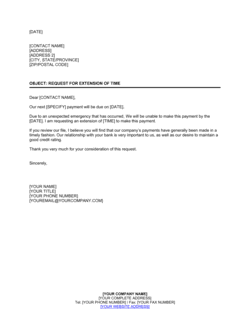
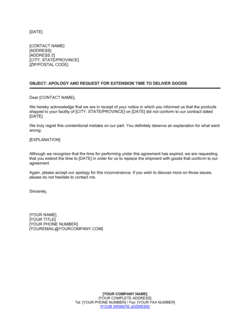
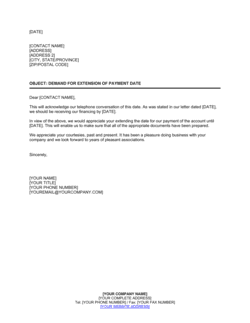
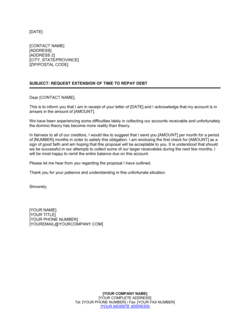
A Request for Extension of Time on a Promissory Note is a formal business letter a borrower sends to a lender asking to extend the repayment deadline, defer one or more scheduled payments, or modify the maturity date of an existing promissory note. This free Word download gives you a ready-to-edit template you can personalize and send in under 15 minutes.
When you need it
Use it when cash flow constraints, an unexpected expense, or a business setback makes it impossible β€” or inadvisable β€” to meet the original repayment schedule before the due date arrives.
What's inside
Borrower and lender identification, the original note details (amount, date, current maturity), a clear statement of the extension request, a brief explanation of the reason, proposed new repayment terms, and a closing that invites confirmation of the lender's agreement.

What is a Request for Extension of Time on a Promissory Note?

A Request for Extension of Time on a Promissory Note is a formal business letter a borrower sends to a lender asking to postpone the repayment deadline on an existing promissory note. It identifies the original note by date and amount, proposes a specific new maturity date, briefly explains the reason the extension is needed, and outlines what payments the borrower will make in the interim. While the letter itself does not legally alter the note's terms, it initiates the formal process that typically leads to a signed extension agreement β€” and, critically, it demonstrates good faith before a default occurs.

Why You Need This Document

Failing to communicate with a lender before a promissory note matures is one of the most avoidable ways to trigger a default. Once a note is past due, the lender can invoke acceleration clauses β€” making the entire balance immediately due β€” and begin reporting the default to credit bureaus or pursuing legal remedies. A well-written extension request sent at least two weeks before the due date changes the dynamic entirely: it shows the lender you are tracking your obligations, have a concrete repayment plan, and are acting in good faith. Most lenders prefer a structured extension over the costs of collections or litigation, and a professional letter is the starting point for that conversation. This template gives you the correct structure, the right balance-acknowledgment language, and a clear closing that moves the lender toward a written response β€” without requiring legal expertise to complete.

Which variant fits your situation?

If your situation is…Use this template
Requesting a single extended maturity date with no change to interestRequest for Extension of Time on Promissory Note
Proposing a revised full repayment schedule with new installment amountsLoan Modification Agreement
Acknowledging a missed payment and committing to a catch-up planPromissory Note β€” Past Due Notice Response
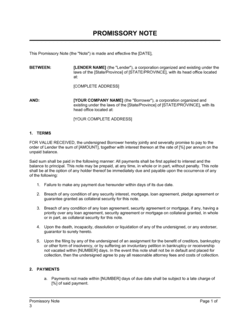
Replacing an existing promissory note with updated terms entirelyPromissory Note
Formally agreeing in writing after the lender approves the extensionPromissory Note Extension Agreement
Requesting a temporary pause on all principal and interest paymentsLoan Forbearance Request Letter

Common mistakes to avoid

❌ Requesting an extension after the note has already matured

Why it matters: Once a note is past due, the borrower is technically in default. A post-maturity request is treated as a cure attempt, not a proactive extension, and carries less goodwill with the lender.

Fix: Send the request at least 14 days before the maturity date so the lender has time to review and respond before a default occurs.

❌ Proposing no payments during the extension period

Why it matters: A request to defer everything β€” principal and interest β€” for several months looks indistinguishable from a request to walk away from the debt.

Fix: Always propose at least continued interest payments during the extension window to demonstrate ongoing good faith and financial engagement.

❌ Using vague language instead of a specific new date

Why it matters: Phrases like 'a few more months' or 'until business improves' give the lender nothing concrete to approve and often result in no response at all.

Fix: Name a specific calendar date as the proposed new maturity date, calculated from your realistic cash flow recovery timeline.

❌ Omitting the outstanding balance acknowledgment

Why it matters: Skipping this clause leaves the balance disputed or unclear, which can complicate the formal extension agreement and give the lender grounds to demand full repayment instead.

Fix: State the current principal balance and accrued interest as of the letter date explicitly, even if the amounts are approximate pending a lender statement.

The 8 key clauses, explained

Date and parties header

In plain language: States the date the letter is written, the borrower's full legal name and address, and the lender's full legal name and address.

Sample language
[DATE] | To: [LENDER FULL NAME], [LENDER ADDRESS] | From: [BORROWER FULL NAME], [BORROWER ADDRESS]

Common mistake: Using a trade name or nickname instead of the legal entity name β€” if the names don't match the note, the lender may reject the request as misaddressed.

Reference to the original promissory note

In plain language: Identifies the specific note by its execution date, original principal amount, and current maturity date so there is no ambiguity about which obligation the request applies to.

Sample language
Re: Promissory Note dated [ORIGINAL DATE] in the original principal amount of $[AMOUNT], currently due and payable on [CURRENT MATURITY DATE].

Common mistake: Omitting the note's original date or amount, which forces the lender to search their files and delays a response.

Statement of the extension request

In plain language: Clearly asks the lender to extend the maturity date to a specific new date, or to defer a defined number of payments to a stated future date.

Sample language
I am writing to respectfully request an extension of the maturity date of the above-referenced note from [CURRENT DATE] to [PROPOSED NEW DATE], a period of [X] days/months.

Common mistake: Asking vaguely for 'more time' without proposing a specific new date β€” lenders cannot approve an undefined term.

Reason for the request

In plain language: Provides a brief, factual explanation of why the extension is needed β€” cash flow disruption, delayed receivable, or an unforeseen expense β€” without excessive detail or apology.

Sample language
This request is due to [BRIEF REASON β€” e.g., a delay in the receipt of a substantial receivable from [CLIENT NAME] expected on or before [DATE]], which has temporarily affected our ability to retire the balance on schedule.

Common mistake: Over-explaining or offering emotional context instead of factual business reasons β€” it shifts focus away from the credible repayment plan.

Proposed repayment plan

In plain language: States what the borrower commits to under the new timeline β€” full balloon payment by the new date, continued interest payments during the extension, or a revised installment schedule.

Sample language
During the extension period, I propose to continue making monthly interest payments of $[AMOUNT] on the [DAY] of each month, with the full outstanding principal of $[BALANCE] due on [NEW MATURITY DATE].

Common mistake: Proposing no payments at all during the extension period β€” this signals disinterest in good faith and is rarely accepted.

Acknowledgment of current balance

In plain language: Confirms the outstanding principal and accrued interest as of the letter date, demonstrating that the borrower has accurate records and is not disputing the debt.

Sample language
As of [DATE], the outstanding principal balance is $[AMOUNT] and accrued but unpaid interest totals $[AMOUNT], for a combined outstanding balance of $[TOTAL].

Common mistake: Skipping this clause β€” without a balance acknowledgment, the lender has no confirmation the borrower agrees on what is owed, which complicates any formal extension agreement.

Commitment to cooperate on documentation

In plain language: Expresses the borrower's willingness to sign a formal extension agreement, amended note, or any other document the lender requires to formalize the arrangement.

Sample language
I am prepared to execute any amendment, extension agreement, or restated promissory note that you require to formalize this arrangement at your earliest convenience.

Common mistake: Leaving this out β€” some borrowers assume a letter alone is sufficient, but most lenders will require a signed extension agreement before they agree the deadline has moved.

Closing and response request

In plain language: Thanks the lender for their consideration, provides the borrower's contact information, and asks for a written response by a specific date.

Sample language
I would appreciate your written confirmation of this request by [RESPONSE DATE]. Please contact me at [PHONE] or [EMAIL] with any questions. Thank you for your consideration.

Common mistake: Failing to set a response-by date, which leaves the request open-ended and makes it harder to follow up professionally.

How to fill it out

  1. 1

    Gather the original promissory note details

    Locate the original signed promissory note and note the execution date, original principal, current outstanding balance, accrued interest, and the current maturity date. You will need all of these to complete the reference clause accurately.

    πŸ’‘ Calculate the outstanding balance as of the letter date β€” not the original date β€” so the lender sees you have current, accurate records.

  2. 2

    Enter borrower and lender legal names

    Use the exact legal entity names as they appear on the original promissory note. For individuals, use full legal name; for businesses, use the registered entity name including entity type (LLC, Inc., etc.).

    πŸ’‘ Cross-check the note itself β€” even a minor name variation can cause the lender to treat the letter as referring to a different obligation.

  3. 3

    Propose a specific new maturity date

    Calculate a realistic extension period based on your expected cash flow recovery timeline and enter the exact calendar date. Common extension periods are 30, 60, or 90 days.

    πŸ’‘ Ask for slightly more time than you think you need β€” it is easier to pay early and demonstrate reliability than to send a second extension request.

  4. 4

    Write a brief, factual reason for the request

    Summarize the business reason in two to three sentences β€” a delayed receivable, a deferred contract payment, or an unexpected expense. Avoid emotional language; focus on the concrete cause and the expected resolution date.

    πŸ’‘ Attaching a brief supporting document β€” e.g., a client invoice showing the expected payment date β€” strengthens your credibility significantly.

  5. 5

    Describe your proposed payments during the extension

    Specify whether you will continue paying interest, make partial principal payments, or hold all payments until the new maturity date. The more structured your proposal, the easier it is for the lender to say yes.

    πŸ’‘ Offering to continue interest payments β€” even if small β€” signals good faith and distinguishes this from a default scenario.

  6. 6

    Set a response-by date and add your contact details

    Choose a response deadline that gives the lender sufficient time to review β€” typically 7 to 10 business days from the letter date β€” and include a direct phone number and email address.

    πŸ’‘ Send the letter by email with a read receipt and follow up with a hard copy by certified mail if the amount involved is material.

Frequently asked questions

What is a request for extension of time on a promissory note?

It is a formal letter a borrower sends to a lender asking to move the repayment deadline on an existing promissory note to a later date. The letter identifies the original note, states the proposed new maturity date, explains the reason for the request, and describes what payments the borrower will make during the extension period. It is not a legally binding modification on its own β€” a separate extension agreement is typically required to formally change the note's terms.

Does a promissory note extension request need to be signed?

The request letter itself does not require a signature to be sent, but it is standard practice to sign it to show authenticity and commitment. The lender's approval β€” and the formal change to the note's terms β€” typically requires a signed extension agreement or an amended promissory note executed by both parties. A letter alone is generally not sufficient to legally modify the maturity date.

How long before the due date should I send an extension request?

Send the request at least 14 business days before the maturity date. This gives the lender time to review the request, seek internal approval, and respond before the note comes due. Requests sent after the due date are treated as default cure attempts, not proactive extensions, and receive less favorable treatment in most cases.

What happens if the lender does not respond to my extension request?

Silence from the lender is not approval. If you receive no response before the maturity date, you are still obligated to pay on the original schedule. Follow up in writing by the response deadline stated in your letter, then by phone. If the lender is unresponsive and the maturity date passes, seek legal advice promptly β€” you may be in default regardless of your good-faith efforts.

Can a lender refuse a promissory note extension request?

Yes. A lender has no obligation to grant an extension and may require full repayment on the original maturity date. That said, most lenders prefer a structured extension to the costs of default, collections, or litigation β€” so a well-documented, good-faith request with a realistic repayment plan is frequently approved, particularly for borrowers with a clean payment history.

Does requesting an extension affect my credit?

The request letter itself does not affect credit. However, if the maturity date passes without an approved extension and you have not paid, the lender may report a default to credit bureaus. Securing a formal written extension agreement before the due date prevents a default classification from appearing on your credit record.

What is the difference between a loan extension request and a forbearance request?

A loan extension request moves the maturity date to a new date β€” the borrower continues under the original terms, just longer. A forbearance request asks the lender to temporarily suspend or reduce required payments without formally changing the maturity date. Forbearance is typically used for hardship situations; an extension is used when the borrower expects to repay in full, just on a slightly later timeline.

Should I attach anything to the extension request letter?

Supporting documentation strengthens the request significantly. Consider attaching a copy of the outstanding receivable or contract that will fund repayment, a brief cash flow summary showing when funds will be available, or a signed client payment commitment letter. The more concrete evidence you provide for your repayment timeline, the more likely the lender is to approve the extension without requiring collateral or additional conditions.

How this compares to alternatives

vs Promissory Note

A promissory note is the original legally binding payment commitment between borrower and lender that creates the debt obligation. A request for extension is a letter asking to modify one specific term of that note β€” the repayment deadline. The note is the obligation; the extension request is the formal ask to adjust it. You need both: the note to establish the debt and the letter to initiate a change.

vs Loan Modification Agreement

A loan modification agreement is a signed bilateral document that formally and permanently changes the terms of the original loan β€” interest rate, payment schedule, or maturity date. An extension request letter is a unilateral communication initiating the conversation. The letter comes first; if the lender agrees, a modification agreement is what actually changes the binding terms.

vs Loan Forbearance Request Letter

A forbearance request asks the lender to pause or reduce payments temporarily due to hardship, without moving the maturity date. An extension request moves the maturity date to a specific new date with the expectation of full repayment. Forbearance is a short-term hardship relief tool; an extension is a repayment timeline adjustment for a borrower who expects to repay in full.

vs Debt Settlement Offer Letter

A debt settlement offer proposes paying less than the full amount owed in exchange for discharge of the remaining balance β€” used when full repayment is not feasible. An extension request confirms the borrower intends to repay every dollar owed and simply needs more time. These two letters send opposite signals to a lender about the borrower's financial condition and intentions.

Industry-specific considerations

Real estate

Investors use extension requests to bridge delayed property sale closings or refinancing timelines when hard-money loan maturities arrive before a transaction closes.

Construction and trades

Contractors request extensions when project payment delays from owners push expected receivables past the loan repayment date, particularly on equipment financing notes.

Professional services

Consulting and advisory firms use extension letters when a large client invoice is outstanding and the firm financed startup costs or equipment through a promissory note.

Retail and e-commerce

Retail businesses seek extensions around seasonal cash-flow troughs β€” particularly between a slow season and the expected recovery period β€” to avoid liquidating inventory at a loss.

Template vs pro β€” what fits your needs?

PathBest forCostTime
Use the templateBorrowers with a straightforward extension request on a standard short-term business or personal promissory noteFree15–20 minutes
Template + professional reviewExtension requests on notes with complex terms, significant balances over $50,000, or where a formal extension agreement will follow$150–$400 (attorney or financial advisor review)1–2 business days
Custom draftedHigh-value commercial notes, notes with acceleration clauses or cross-default provisions, or situations already approaching default$500–$1,500+3–5 business days

Glossary

Promissory Note
A written, signed commitment by one party (the borrower) to pay a specific sum of money to another party (the lender) by a defined date or on demand.
Maturity Date
The date on which the full outstanding balance of a promissory note becomes due and payable.
Extension
A lender-approved postponement of the maturity date or scheduled payment deadline of an existing obligation.
Forbearance
A lender's agreement to temporarily suspend or reduce required payments without classifying the borrower as in default.
Default
Failure to meet the repayment obligations stated in a promissory note, which typically triggers penalty interest, acceleration, or legal action.
Acceleration Clause
A provision in a promissory note that makes the entire outstanding balance immediately due if the borrower misses a payment or breaches the agreement.
Principal
The original borrowed amount, excluding interest and fees.
Accrued Interest
Interest that has accumulated on the outstanding principal balance since the last payment date but has not yet been paid.
Consideration
Something of value exchanged between parties to make an agreement legally binding β€” in an extension, this is often continued interest accrual or a fee.
Modification
A formal, agreed change to the terms of an existing loan agreement, including amount, rate, schedule, or maturity date.

Part of your Business Operating System

This document is one of 3,000+ business & legal templates included in Business in a Box.

  • Fill-in-the-blanks β€” ready in minutes
  • 100% customizable Word document
  • Compatible with all office suites
  • Export to PDF and share electronically

Create your document in 3 simple steps.

From template to signed document β€” all inside one Business Operating System.
1
Download or open template

Access over 3,000+ business and legal templates for any business task, project or initiative.

2
Edit and fill in the blanks with AI

Customize your ready-made business document template and save it in the cloud.

3
Save, Share, Send, Sign

Share your files and folders with your team. Create a space of seamless collaboration.

Save time, save money, and create top-quality documents.

β˜…β˜…β˜…β˜…β˜…

"Fantastic value! I'm not sure how I'd do without it. It's worth its weight in gold and paid back for itself many times."

Managing Director Β· Mall Farm
Robert Whalley
Managing Director, Mall Farm Proprietary Limited
β˜…β˜…β˜…β˜…β˜…

"I have been using Business in a Box for years. It has been the most useful source of templates I have encountered. I recommend it to anyone."

Business Owner Β· 4+ years
Dr Michael John Freestone
Business Owner
β˜…β˜…β˜…β˜…β˜…

"It has been a life saver so many times I have lost count. Business in a Box has saved me so much time and as you know, time is money."

Owner Β· Upstate Web
David G. Moore Jr.
Owner, Upstate Web

Run your business with a system β€” not scattered tools

Stop downloading documents. Start operating with clarity. Business in a Box gives you the Business Operating System used by over 250,000 companies worldwide to structure, run, and grow their business.

Free Forever PlanΒ Β·Β No credit card required