- Affinity Diagram
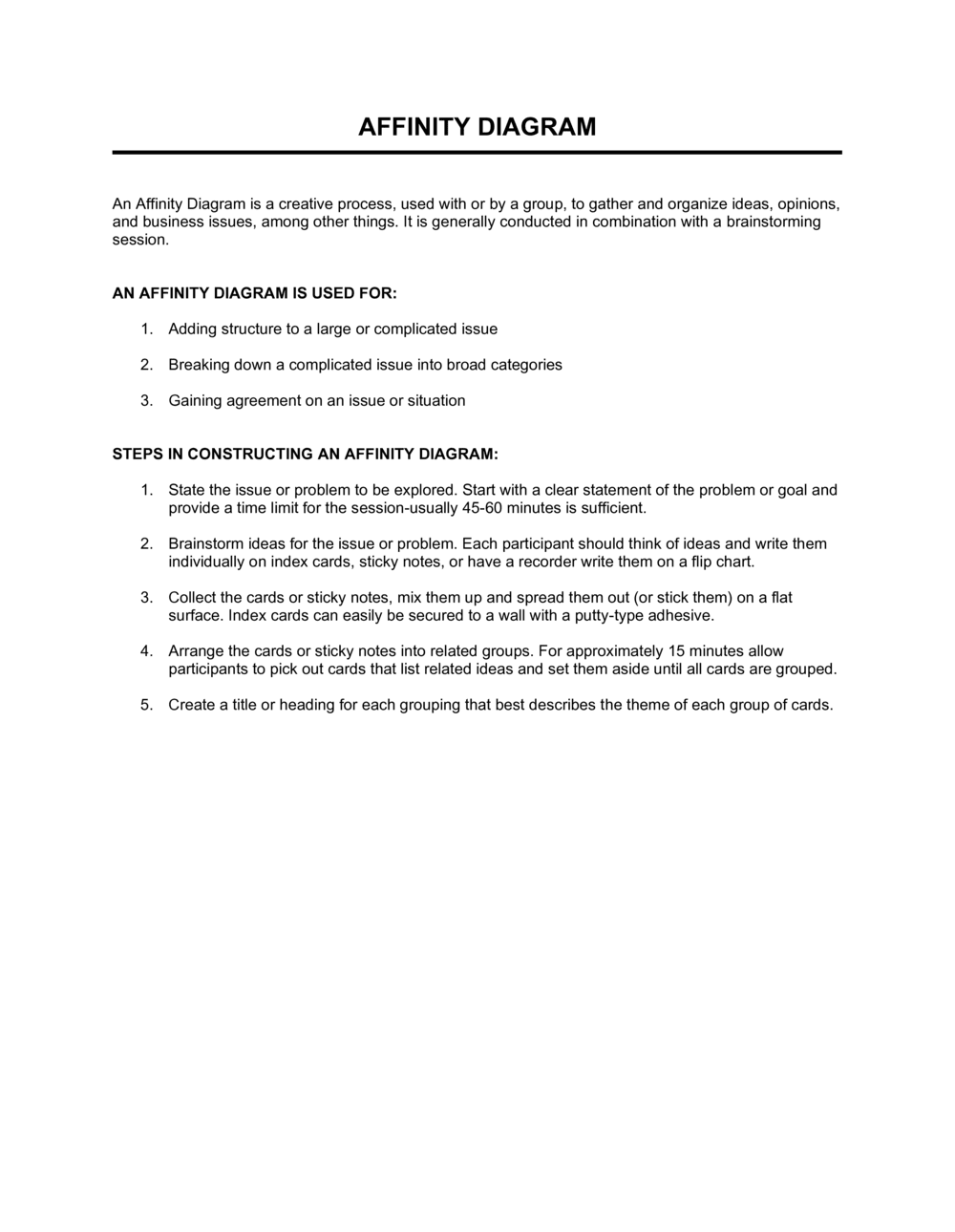
- A tool for grouping large sets of qualitative data — ideas, observations, or feedback — into natural thematic clusters to reveal patterns.
- Affinity Mapping
- The facilitated process of sorting individual data points into groups, typically done collaboratively using sticky notes or a digital equivalent.
- Theme / Cluster
- A labeled group of related data points that share a common characteristic, insight, or problem area identified during the sorting process.
- Qualitative Data
- Non-numerical research data — quotes, observations, and descriptions — that captures context, behavior, and meaning rather than frequency or scale.
- Synthesis
- The process of combining raw research findings into higher-level insights, patterns, or themes that can inform decisions.
- Insight Statement
- A one-sentence declaration that captures a pattern observed across multiple data points and implies a direction for action or design.
- Facilitator
- The person who guides the affinity mapping session — defining rules, keeping the group moving, and ensuring all voices contribute to the sorting process.
- Dot Voting
- A rapid group decision technique where participants place a limited number of dot stickers on their preferred items to surface collective priorities.
- Saturation
- The point in qualitative research at which new data points stop generating new themes — a signal that enough data has been collected.
- How Might We (HMW)
- A question format used to reframe a problem cluster as a design opportunity: 'How might we [verb] [outcome] for [user]?'
- Silent Sorting
- An affinity mapping technique where participants group data points independently and without discussion to reduce groupthink before a collective review.