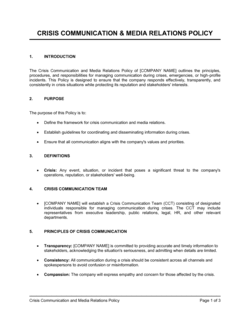
Media Relations Policy Template

Free Word download β€’ Edit online β€’ Save & share with Drive β€’ Export to PDF

1 pageβ€’20–25 min to fillβ€’Difficulty: Standard
Learn more ↓
FreeMedia Relations Policy Template

At a glance

What it is
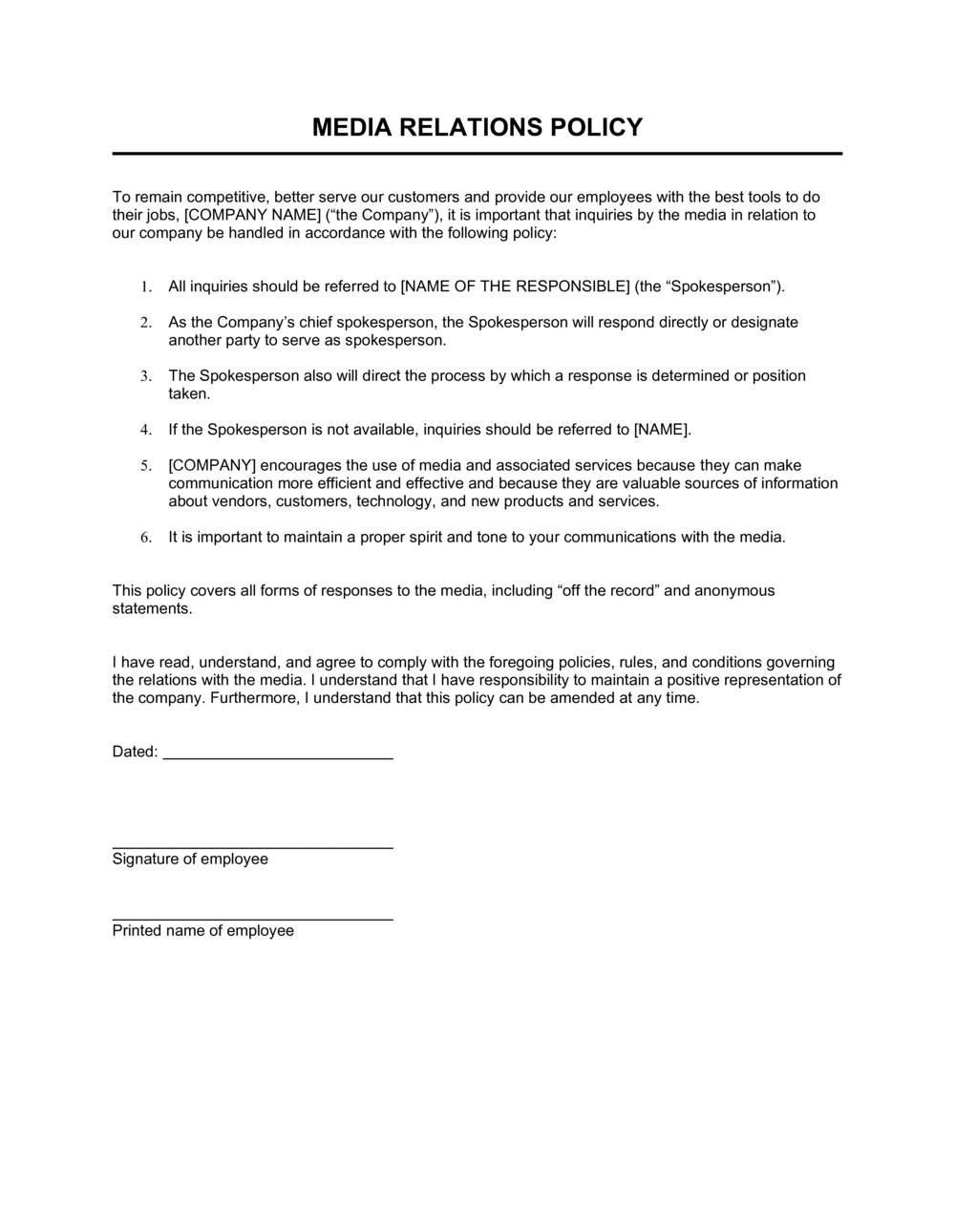
A Media Relations Policy is a formal internal document that defines how an organization communicates with journalists, broadcasters, and other media outlets. This free Word download establishes who is authorized to speak on behalf of the company, how media inquiries are routed and responded to, and what approval process governs statements and interviews β€” giving every employee a clear framework for handling press contact.
When you need it
Use it before your first significant media contact, when onboarding a communications or PR function, or after an incident where an unauthorized employee spoke to the press and created message inconsistency. Any organization with more than a handful of employees benefits from a written policy before a story breaks.
What's inside
Designated spokesperson rules, media inquiry routing procedures, message approval and review steps, social media interaction boundaries, crisis communications protocols, confidentiality and embargo handling, and employee conduct guidelines for press contact.

What is a Media Relations Policy?

A Media Relations Policy is a formal internal document that defines how an organization manages every point of contact with journalists, broadcasters, bloggers, and other media representatives. It identifies who is authorized to speak on the organization's behalf, how incoming media inquiries are routed and acknowledged, what approval process governs statements and interviews, and what consequences apply when an employee speaks to the press without authorization. Rather than leaving these decisions to individual judgment in the moment, the policy creates a consistent, repeatable process that protects the organization's reputation regardless of who picks up the phone.

Why You Need This Document

Without a written media relations policy, a single unplanned comment from an employee β€” to a reporter on deadline, in a LinkedIn reply, or at a public event β€” can generate coverage the organization never intended and cannot easily retract. The damage is not hypothetical: misattributed statements trigger legal inquiries, contradict pending announcements, or reveal confidential information that was never meant to be public. Organizations with multiple locations, remote teams, or high employee turnover face compounded risk because there is no shared understanding of the rules. A documented policy removes ambiguity before a journalist calls, giving every employee a clear answer to the most important question in any media situation: "What do I do right now?" This template gives you a structured, professional starting point you can adapt in hours rather than building from scratch when the need is already urgent.

Which variant fits your situation?

If your situation is…Use this template
Organization needs a full communications governance document covering internal and external messagingCorporate Communications Policy
Company managing an active crisis or reputation-threatening incidentCrisis Communication Plan
Defining rules for employee use of social media on behalf of the brandSocial Media Policy
Preparing spokespeople for specific media interviews or press eventsPress Release Template
Setting out the broader brand voice and messaging frameworkBrand Communications Guidelines
Managing investor and analyst communications alongside mediaInvestor Relations Policy
Documenting the process for issuing official company statementsPublic Statement Template

Common mistakes to avoid

❌ Naming only one spokesperson with no backup

Why it matters: When the primary spokesperson is unreachable during a breaking story, there is no authorized voice β€” employees fill the gap themselves or the organization appears unresponsive.

Fix: Designate at least one backup spokesperson with equivalent authority and include their direct contact details in the policy document.

❌ Vague routing instructions referencing a job title instead of a person

Why it matters: A journalist on a 30-minute deadline will not wait for a chain of 'contact your manager who contacts the communications team.' The inquiry gets answered by whoever is available.

Fix: Provide a specific name, email address, and direct phone number for media inquiries, with a second contact if the first is unreachable.

❌ Excluding social media from the policy scope

Why it matters: An employee tweet or LinkedIn post about an organizational matter can generate press coverage within minutes, bypassing every other procedure in the document.

Fix: Add an explicit social media section that sets a clear default rule and requires approval before any employee posts about organizational matters on personal accounts.

❌ No defined turnaround time for message approvals

Why it matters: A multi-day approval process on a news story with a same-day deadline means the organization either misses the story or a spokesperson improvises without approved language.

Fix: Set specific approval turnaround targets β€” for example, 2 business hours for standard inquiries and 1 hour for crisis situations β€” and assign a tiebreaker if an approver is unavailable.

❌ Relying on employee judgment to identify confidential information

Why it matters: What is obvious to senior leadership is often not obvious to a junior employee receiving a first press call β€” they may confirm a rumor or share financial detail without realizing it was sensitive.

Fix: List specific confidential categories by name in the policy so employees can apply a checklist rather than making a real-time judgment call under pressure.

❌ No version control or annual review schedule

Why it matters: Outdated policies with stale spokesperson names and obsolete approval chains circulate indefinitely, and employees follow superseded procedures during live media situations.

Fix: Assign a named policy owner, record the version number and effective date in the document footer, and calendar an annual review in the communications team's planning cycle.

The 10 key sections, explained

Purpose and scope

Designated spokesperson authority

Media inquiry intake and routing procedure

Message development and approval process

Interview and media engagement guidelines

Confidential information and embargo handling

Social media and public commentary boundaries

Crisis communications activation

Employee conduct and non-compliance consequences

Policy review and version control

How to fill it out

  1. 1

    Define scope and identify all covered parties

    Enter the organization's full legal name and list every category of person the policy covers β€” employees, contractors, board members, interns, and volunteers. Be explicit rather than defaulting to 'all staff.'

    πŸ’‘ Review your stakeholder list against recent media incidents β€” if a board member or contractor has ever been quoted, they belong in scope.

  2. 2

    Name primary and backup spokespeople

    Enter the full name and title of at least one primary spokesperson and one backup. If the organization operates across multiple regions or divisions, assign spokespeople at each level.

    πŸ’‘ Choose backups who hold the same level of message authority as the primary β€” a junior PR coordinator cannot fill in for a CEO during a crisis story.

  3. 3

    Document the media inquiry routing path

    Write the exact steps an employee should take from the moment a journalist makes contact β€” including a specific escalation email address or phone number, not just a job title.

    πŸ’‘ Test the routing path by sending a test inquiry. If it takes more than 15 minutes to reach the communications lead, the path is too long.

  4. 4

    Build the message approval chain

    List each role in the approval sequence, specify who can approve standard inquiries versus crisis statements, and set a maximum turnaround time for each category.

    πŸ’‘ Pre-approve a library of holding statements for your three most likely crisis scenarios β€” having them ready cuts crisis response time from hours to minutes.

  5. 5

    List confidential information categories explicitly

    Name every category of information employees cannot disclose: financial results, litigation, personnel decisions, client identities, product roadmaps, and regulatory matters.

    πŸ’‘ Walk through a recent all-hands meeting agenda β€” anything discussed there that isn't already public should appear in the confidential categories list.

  6. 6

    Set social media boundaries

    Specify whether employees may comment on company matters via personal accounts, what approval is required if they do, and what the default rule is when in doubt.

    πŸ’‘ A simple default β€” 'when in doubt, do not post and ask your manager first' β€” prevents most social media incidents without requiring employees to memorize a long list of prohibited topics.

  7. 7

    Define crisis trigger conditions and escalation contacts

    List the specific types of events that activate crisis communications (safety incident, legal action, regulatory inquiry, significant negative coverage) and the name and direct number of the crisis lead.

    πŸ’‘ Store crisis contact details outside your company intranet β€” employees may need them when systems are down or during a breaking incident outside business hours.

  8. 8

    Assign a policy owner and set the review date

    Name the individual responsible for maintaining the policy, record the current version number and effective date, and schedule the next review β€” typically 12 months out or after any significant media event.

    πŸ’‘ Calendar the annual review 30 days before the anniversary date so the update is complete before the policy technically lapses.

Frequently asked questions

What is a media relations policy?

A media relations policy is a formal internal document that defines how an organization manages all contact with journalists and media outlets. It designates authorized spokespeople, establishes the procedure for routing and responding to media inquiries, sets message approval requirements, and defines consequences for unauthorized press contact. It gives every employee a clear, consistent framework so the organization speaks with one voice.

Who should have a media relations policy?

Any organization that could attract media attention β€” which includes most businesses, nonprofits, government agencies, and educational institutions beyond a handful of employees. The policy is most critical before a significant product launch, during litigation or regulatory scrutiny, or whenever the organization employs people whose personal views might be mistaken for official positions. The cost of not having one typically surfaces at the worst possible moment.

What is the difference between a media relations policy and a crisis communications plan?

A media relations policy governs all day-to-day and ongoing media interactions β€” who speaks, how inquiries are routed, and how messages are approved. A crisis communications plan is activated only during an unexpected negative event and focuses on rapid response, holding statements, and stakeholder escalation. The two documents work together: the policy references the crisis plan and defines the trigger conditions that activate it.

Who is a designated spokesperson and how should one be chosen?

A designated spokesperson is the person formally authorized to make statements to the media on behalf of the organization. Typically this is the CEO, a VP of Communications, or a department head for subject-specific inquiries. Choose spokespeople based on message authority, media training, and availability β€” and always designate at least one backup for each primary in case of unavailability during a breaking story.

What should employees do if a journalist contacts them directly?

Under a standard media relations policy, an employee who receives a direct media inquiry should acknowledge receipt politely, collect the journalist's name, outlet, contact information, and deadline, and then immediately route the inquiry to the designated communications contact without providing any comment, confirming any facts, or agreeing to an interview. The policy should include a short script employees can use in the moment so they do not have to improvise.

Does a media relations policy need to cover social media?

Yes. A media relations policy that covers only traditional press contact is incomplete. Employee posts on LinkedIn, X, Reddit, or personal blogs can generate media coverage within minutes. The policy should specify whether employees may comment on organizational matters via personal accounts, what approval is required, and what the default rule is when in doubt. Cross-reference the organization's standalone social media policy if one exists.

How often should a media relations policy be reviewed?

At minimum, annually β€” and immediately following any significant media incident, spokesperson change, organizational restructuring, or major shift in the company's public profile. The policy owner should confirm that spokesperson names and contact details are current, approval chains reflect the current org chart, and the confidential information list matches what the organization is actually protecting.

What happens if an employee violates the media relations policy?

The policy should state that unauthorized media contact, unauthorized disclosure of confidential information, or other violations may result in disciplinary action up to and including termination, consistent with the employee handbook. For incidents involving material non-public financial information, legal counsel should also assess whether securities or defamation exposure applies.

Can a small business use this template without a dedicated PR team?

Yes. The template scales down easily for small businesses. The CEO or owner typically serves as the sole designated spokesperson, the routing procedure is a single step to one inbox, and the approval process is the owner's direct sign-off. Even a simplified one-page version of the policy gives employees a clear answer to 'what do I do if a reporter calls?' β€” which is the most important function the document serves.

How this compares to alternatives

vs Crisis Communications Plan

A crisis communications plan activates only during a specific negative event and provides a step-by-step rapid-response framework including holding statements and stakeholder escalation. A media relations policy governs all ongoing media contact and defines the baseline rules that apply every day. The two documents are complementary β€” the media policy should reference the crisis plan and define the conditions that trigger it.

vs Social Media Policy

A social media policy governs how employees use social platforms in general β€” personal conduct, brand representation, and content guidelines. A media relations policy is specifically focused on journalist interactions and official organizational statements. For organizations where employee social posts frequently generate press coverage, the two policies should cross-reference each other explicitly.

vs Press Release

A press release is a specific outbound communication document used to announce news to journalists. A media relations policy is the governance framework that determines who approves press releases, who distributes them, and how incoming journalist responses are handled. The policy enables the press release to be used consistently and within authorized boundaries.

vs Corporate Communications Policy

A corporate communications policy covers the full spectrum of internal and external communications β€” employee announcements, executive messaging, investor relations, and media contact. A media relations policy is a focused subset that addresses only journalist and press interactions. Organizations with active PR functions typically need both, with the media policy operating as a detailed operational annex to the broader communications policy.

Industry-specific considerations

Technology / SaaS

Product launches, data breach disclosures, and acquisition rumors require fast, consistent messaging β€” the policy defines who can confirm or deny and under what conditions.

Healthcare

HIPAA confidentiality obligations intersect directly with media inquiries involving patients or clinical incidents, making explicit confidentiality categories in the policy legally critical.

Nonprofit and Education

Volunteers and program staff regularly interact with community journalists, making a clear scope definition and routing procedure essential to prevent unauthorized statements.

Manufacturing

Workplace safety incidents attract immediate media attention; the policy must define crisis activation triggers and holding statement procedures specific to safety events.

Financial Services

Regulatory actions, earnings releases, and merger activity carry material non-public information risks that require strict confidentiality rules and legal-team approval in the message chain.

Retail / Consumer Brands

Product recalls, customer complaints going viral, and influencer controversies require social media and traditional media procedures to be tightly integrated in the policy.

Template vs pro β€” what fits your needs?

PathBest forCostTime
Use the templateSmall and mid-sized businesses establishing a media policy for the first time without a dedicated PR teamFree2–4 hours to complete and distribute
Template + professional reviewOrganizations in regulated industries, those with active litigation exposure, or companies preparing for a significant media event such as a funding announcement or product launch$300–$800 for a communications consultant or legal review2–5 business days
Custom draftedPublicly traded companies, organizations in active regulatory proceedings, or enterprises with dedicated communications departments requiring multi-region policy frameworks$2,000–$8,000 for a PR agency or corporate communications specialist2–4 weeks

Glossary

Designated Spokesperson
The individual or individuals formally authorized to speak on behalf of the organization to journalists and media outlets.
Media Inquiry
Any request from a journalist, broadcaster, or blogger for comment, information, or an interview related to the organization.
On the Record
A statement made with the understanding that it may be quoted and attributed to the speaker by name and title.
Off the Record
Information shared with a journalist on the condition it is not published or attributed β€” only valid when explicitly agreed before the statement is made.
On Background
Information a journalist may use in reporting but may not directly attribute to the named source β€” typically attributed to 'a company spokesperson' or 'a source familiar with the matter'.
Embargo
An agreement between an organization and a journalist to withhold publishing specific information until a defined date and time.
Holding Statement
A brief, pre-approved response issued to the media while a fuller statement is being prepared β€” acknowledges the inquiry without confirming or denying specifics.
Key Message
A concise, pre-approved statement that communicates the organization's core position on a topic and is used consistently across all media interactions.
Crisis Communications
The specific protocols activated when an unexpected event β€” an accident, legal action, or public controversy β€” requires rapid, coordinated media response.
Media Monitoring
The systematic tracking of news coverage, broadcast mentions, and online discussion to identify how the organization is being represented in the media.
Press Office
The internal function or team responsible for managing all media inquiries, press releases, and journalist relationships on behalf of the organization.

Part of your Business Operating System

This document is one of 3,000+ business & legal templates included in Business in a Box.

  • Fill-in-the-blanks β€” ready in minutes
  • 100% customizable Word document
  • Compatible with all office suites
  • Export to PDF and share electronically

Create your document in 3 simple steps.

From template to signed document β€” all inside one Business Operating System.
1
Download or open template

Access over 3,000+ business and legal templates for any business task, project or initiative.

2
Edit and fill in the blanks with AI

Customize your ready-made business document template and save it in the cloud.

3
Save, Share, Send, Sign

Share your files and folders with your team. Create a space of seamless collaboration.

Save time, save money, and create top-quality documents.

β˜…β˜…β˜…β˜…β˜…

"Fantastic value! I'm not sure how I'd do without it. It's worth its weight in gold and paid back for itself many times."

Managing Director Β· Mall Farm
Robert Whalley
Managing Director, Mall Farm Proprietary Limited
β˜…β˜…β˜…β˜…β˜…

"I have been using Business in a Box for years. It has been the most useful source of templates I have encountered. I recommend it to anyone."

Business Owner Β· 4+ years
Dr Michael John Freestone
Business Owner
β˜…β˜…β˜…β˜…β˜…

"It has been a life saver so many times I have lost count. Business in a Box has saved me so much time and as you know, time is money."

Owner Β· Upstate Web
David G. Moore Jr.
Owner, Upstate Web

Run your business with a system β€” not scattered tools

Stop downloading documents. Start operating with clarity. Business in a Box gives you the Business Operating System used by over 250,000 companies worldwide to structure, run, and grow their business.

Start freeΒ Β·Β No credit card required