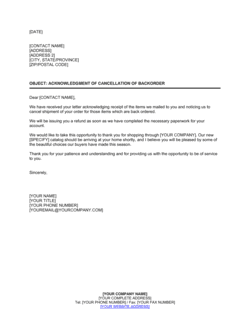
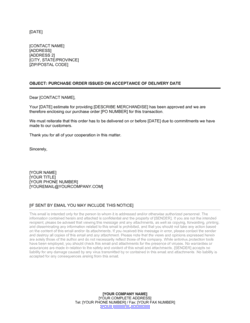
Acknowledgment and Acceptance of Order Template

Free Word download β€’ Edit online β€’ Save & share with Drive β€’ Export to PDF

1 pageβ€’15–20 min to fillβ€’Difficulty: Standard
Learn more ↓
FreeAcknowledgment and Acceptance of Order Template

At a glance

What it is
An Acknowledgment and Acceptance of Order is a formal letter a seller sends to a buyer confirming that a purchase order has been received and that its terms β€” quantities, pricing, delivery dates, and any special conditions β€” are accepted. This free Word download gives you a ready-to-send template you can edit online and export as PDF in minutes.
When you need it
Send it as soon as a buyer submits a purchase order you intend to fulfill. It is especially important when the order involves custom goods, long lead times, significant dollar values, or conditions that need clarification before production or shipment begins.
What's inside
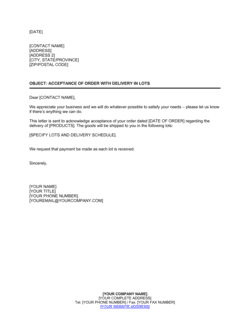
Seller and buyer identification, reference to the original purchase order number and date, confirmed quantities and pricing, agreed delivery date and shipping method, any clarifications or modifications accepted, and a closing statement of intent to perform.

What is an Acknowledgment and Acceptance of Order?

An Acknowledgment and Acceptance of Order is a formal letter a seller sends to a buyer after receiving a purchase order, confirming both that the order was received and that its terms β€” quantities, pricing, delivery dates, and any special conditions β€” are accepted. Under the Uniform Commercial Code (UCC) and most international commercial codes, the buyer's purchase order is an offer, and the seller's written acceptance is what transforms that offer into a binding contract. This template is a free Word download you can complete in minutes, export as PDF, and send on company letterhead to close the loop on any purchase order professionally.

Why You Need This Document

Relying on informal confirmations β€” a quick reply email, a phone call, or a system-generated auto-response β€” leaves both parties exposed. Without a clear written acceptance, there is no documented record of the agreed delivery date, the exact quantities, or which set of terms governs the transaction. Disputes over mismatched PO terms, late deliveries, or substituted products are significantly harder to resolve when there is no acknowledgment letter to reference. For sellers, the acknowledgment also provides an early opportunity to flag discrepancies β€” a discontinued SKU, an unreachable delivery date, a pricing error β€” before production begins and costs accumulate. This template gives you a structured, consistent format that satisfies the legal requirements for contract formation, reduces the risk of order disputes, and signals to buyers that your fulfillment process is reliable and professionally managed.

Which variant fits your situation?

If your situation is…Use this template
Accepting a standard purchase order with no modificationsAcknowledgment and Acceptance of Order
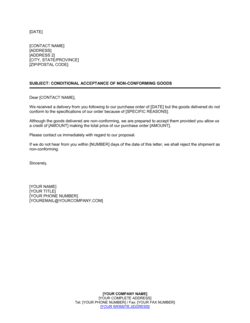
Accepting an order but proposing a change to quantity or delivery dateCounter Offer Letter
Declining an order from a buyerRejection of Order Letter
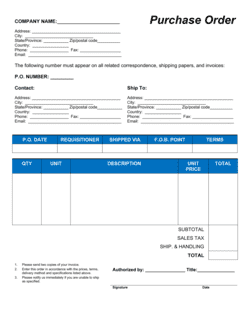
Requesting a deposit or advance payment before fulfilling the orderProforma Invoice
Confirming a recurring or blanket purchase order arrangementPurchase Order Agreement
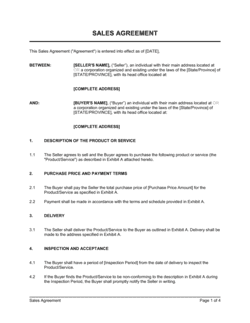
Documenting the underlying terms governing all future ordersSales Agreement
Confirming receipt and acceptance of a service engagement orderService Order Confirmation Letter

Common mistakes to avoid

❌ Using ambiguous acceptance language

Why it matters: Phrases like 'thank you for your order' or 'we will do our best to fulfill it' may not constitute legal acceptance under the UCC or applicable commercial code, leaving the contract formation in doubt.

Fix: Use explicit language β€” 'Seller hereby accepts the terms of Purchase Order No. [X]' β€” so there is no ambiguity about whether a binding agreement was formed.

❌ Omitting the PO number and date

Why it matters: Without the reference PO number, the acknowledgment cannot be matched to the correct order in the buyer's system, causing payment delays and fulfillment confusion.

Fix: Include the PO number and PO date in both the subject line and the opening paragraph of every acknowledgment letter.

❌ Confirming an estimate as a guaranteed delivery date

Why it matters: A committed delivery date becomes a contractual obligation β€” missing it exposes the seller to breach-of-contract claims, even when the delay is caused by a carrier or supplier.

Fix: Always label delivery dates as 'estimated' unless you have a production and logistics commitment that makes the date certain, and include a force majeure carve-out for circumstances beyond your control.

❌ Failing to address unresolved modifications from the buyer's PO

Why it matters: If the buyer's PO includes non-standard terms your standard T&Cs don't cover, ignoring them does not make them disappear β€” a court may find those terms govern the contract.

Fix: Explicitly state in the acknowledgment which terms govern and note any buyer-proposed terms that are not accepted, so both parties know exactly what they agreed to.

The 8 key clauses, explained

Header and reference identification

In plain language: Identifies both parties, states the date of the acknowledgment letter, and cites the buyer's original purchase order number and date for traceability.

Sample language
Re: Acknowledgment and Acceptance of Purchase Order No. [PO NUMBER] dated [PO DATE] Dear [BUYER CONTACT NAME], on behalf of [SELLER COMPANY NAME] ('Seller'), we hereby acknowledge receipt of your Purchase Order No. [PO NUMBER] submitted by [BUYER COMPANY NAME] ('Buyer') on [PO DATE].

Common mistake: Omitting the original PO number and date. Without this reference, both parties' accounting and fulfillment systems cannot match the acknowledgment to the correct order, causing delays and disputes.

Acceptance of terms

In plain language: Formally states that the seller accepts the purchase order and its terms as submitted, creating a binding commercial agreement.

Sample language
Seller hereby accepts the terms and conditions of Purchase Order No. [PO NUMBER] as set forth therein and agrees to fulfill the order in accordance with those terms.

Common mistake: Using vague language such as 'we look forward to fulfilling your order' instead of an explicit acceptance statement. Ambiguous language may not constitute legal acceptance under the UCC or applicable commercial code.

Confirmed quantities and product description

In plain language: Restates the specific items, SKUs or part numbers, and quantities ordered to confirm the seller's understanding matches the buyer's PO.

Sample language
Seller confirms the following order: [PRODUCT NAME / SKU], Quantity: [NUMBER] units at [UNIT PRICE] per unit, for a total order value of [TOTAL AMOUNT].

Common mistake: Restating quantities without referencing the unit of measure. An order for '500 units' confirmed as '500 cases' creates a material discrepancy that can lead to over-shipment or underpayment.

Confirmed pricing and payment terms

In plain language: Restates the agreed unit price, total order value, applicable taxes, and the payment terms that govern when the invoice is due.

Sample language
Unit price: [UNIT PRICE]. Total order value: [TOTAL AMOUNT] [CURRENCY]. Payment terms: Net [30/60] days from invoice date. Applicable taxes: [AMOUNT / RATE or 'as per applicable law'].

Common mistake: Omitting the currency when the buyer and seller operate in different countries. USD and CAD, or EUR and GBP, are easily confused and the error only surfaces at settlement.

Delivery date and shipping terms

In plain language: States the committed delivery or shipment date, the shipping method, and the FOB point that determines where risk of loss transfers.

Sample language
Estimated ship date: [DATE]. Estimated delivery date: [DATE]. Shipping method: [CARRIER / METHOD]. Shipping terms: FOB [ORIGIN / DESTINATION], [CITY, STATE].

Common mistake: Confirming an estimated ship date as a guaranteed delivery date. If production delays arise, a committed delivery date creates a breach β€” always distinguish 'estimated' from 'guaranteed' in the letter.

Clarifications and modifications

In plain language: Documents any corrections, substitutions, or clarifications to the original PO that both parties have agreed to before acceptance.

Sample language
The following clarifications apply to this order: [ITEM β€” e.g., 'Item #3 (SKU [SKU]) is substituted with [ALTERNATE SKU] at the same unit price, as agreed by [BUYER CONTACT] on [DATE]'].

Common mistake: Noting a modification in the acknowledgment without confirming the buyer's prior consent. An unilateral change to the order terms makes the acknowledgment a counteroffer, not an acceptance, which the buyer must separately accept.

Seller's performance commitment

In plain language: A brief statement confirming the seller's intent and ability to fulfill the order as described, and a point of contact for questions.

Sample language
Seller confirms it has the capacity and resources to fulfill this order as described above. For questions regarding this order, please contact [CONTACT NAME] at [EMAIL] or [PHONE].

Common mistake: Skipping the contact detail. Buyers who discover an issue β€” wrong delivery address, customs documentation gap β€” need to reach someone immediately; a generic company email slows resolution.

Governing terms and closing

In plain language: States which terms govern the transaction (seller's standard terms, buyer's PO terms, or a master agreement) and closes the letter professionally.

Sample language
This order is governed by [Seller's standard Terms and Conditions / the Master Purchase Agreement dated [DATE] / Buyer's Purchase Order terms], except as modified above. We appreciate your business and look forward to a successful fulfillment. Sincerely, [SELLER AUTHORIZED REPRESENTATIVE NAME] [TITLE] [COMPANY NAME]

Common mistake: Not specifying which terms govern when both parties' standard forms are in play. Failing to address the 'battle of the forms' question upfront means a dispute will be resolved by statute β€” usually in ways neither party anticipated.

How to fill it out

  1. 1

    Enter seller and buyer details

    Fill in the seller's full legal company name, address, and contact information at the top of the letter. Add the buyer's legal entity name, billing address, and the name of their purchasing contact.

    πŸ’‘ Use the buyer's legal entity name exactly as it appears on the purchase order β€” mismatches create accounting issues on the buyer's end.

  2. 2

    Reference the original purchase order

    Enter the buyer's PO number and the date the PO was issued in the subject line and the opening paragraph. This ties the acknowledgment to a specific document in both parties' systems.

    πŸ’‘ If the buyer uses a PO management system, include the PO number in your email subject line as well as the letter body β€” it ensures automatic matching in their system.

  3. 3

    Confirm quantities, SKUs, and product descriptions

    Restate each line item from the PO with the product name or SKU, quantity ordered, and unit of measure. Cross-check against your own inventory or production records before confirming.

    πŸ’‘ If even one SKU differs from your catalog, flag it explicitly in the clarifications clause rather than silently substituting.

  4. 4

    State the agreed price and payment terms

    Enter the unit price, total order value, applicable currency, any taxes, and the payment terms (e.g., Net 30 from invoice date). Confirm these match the PO exactly.

    πŸ’‘ If your PO includes a prompt-payment discount (e.g., 2/10 Net 30), restate it here β€” it is a pricing term, not just a courtesy.

  5. 5

    Confirm the delivery date and shipping method

    Enter your estimated ship date, the expected delivery date, the carrier or shipping method, and the FOB point. Use 'estimated' unless you are prepared to guarantee the date contractually.

    πŸ’‘ Check with your warehouse or production team before entering a delivery date β€” committing to an unrealistic date creates a breach before the order is even shipped.

  6. 6

    Document any clarifications or substitutions

    If anything in the PO needs correction β€” a discontinued SKU, a revised quantity, a changed delivery address β€” record the change in the clarifications clause with a note of the buyer's prior verbal or written consent.

    πŸ’‘ Send a separate email confirming the buyer's consent to any modification before issuing the final acknowledgment letter, so you have a documented paper trail.

  7. 7

    Specify governing terms and send

    Confirm which set of terms governs the transaction β€” your standard T&Cs, a master purchase agreement, or the buyer's PO terms β€” then print on company letterhead, sign, and send by email or post.

    πŸ’‘ PDF and retain a timestamped copy the moment you send it. If a delivery dispute arises months later, the acknowledgment and its send timestamp are your first line of defense.

Frequently asked questions

What is an acknowledgment and acceptance of order?

An acknowledgment and acceptance of order is a formal letter a seller sends to a buyer confirming that a purchase order has been received and that its terms β€” quantities, pricing, and delivery conditions β€” are accepted. Unlike a simple receipt confirmation, it constitutes the seller's acceptance of the buyer's offer, which under most commercial codes creates a binding contract between the two parties.

Is an order acknowledgment legally binding?

In most jurisdictions, a written acknowledgment that explicitly accepts the terms of a purchase order is legally binding β€” it forms a contract by pairing the buyer's offer (the PO) with the seller's acceptance (the acknowledgment). Under the UCC in the US, an acknowledgment that adds minor additional terms may still be an acceptance unless the buyer objects. If the acknowledgment proposes material changes, it becomes a counteroffer that the buyer must separately accept.

What is the difference between an order acknowledgment and an order confirmation?

The terms are often used interchangeably, but they can mean different things in practice. An acknowledgment confirms that the order was received; a confirmation (or acceptance) confirms that the seller agrees to fulfill it on the stated terms. This template combines both functions in a single letter, which is the clearest and most commercially sound approach.

Does an order acknowledgment need to be signed?

A signature is not legally required for an order acknowledgment to be enforceable in most jurisdictions β€” a written letter sent on company letterhead by an authorized representative is typically sufficient. However, including the name and title of the person issuing the acknowledgment strengthens the document's authority and makes it easier to enforce if a dispute arises.

What happens if the acknowledgment changes a term from the original PO?

Under the UCC and most commercial codes, a material change to the PO terms in the acknowledgment β€” such as a different price, quantity, or delivery date β€” converts the acknowledgment into a counteroffer rather than an acceptance. The original contract is not formed until the buyer separately accepts the modified terms. To avoid ambiguity, document any agreed changes in a dedicated clarifications clause and confirm the buyer's prior consent before sending.

How quickly should a seller send an order acknowledgment?

Best practice is to send the acknowledgment within one to two business days of receiving the purchase order. For orders involving custom manufacturing, long lead times, or significant value, a prompt acknowledgment signals reliability and gives both parties an early opportunity to resolve any discrepancies before production or procurement begins.

Can an order acknowledgment be sent by email?

Yes β€” emailing a PDF of the signed acknowledgment letter is standard practice and is generally sufficient for legal purposes, provided the sender is an authorized representative and the email can be retrieved later as evidence. Retain both the sent email and a copy of the PDF in your records. For high-value or legally sensitive orders, some sellers also send a hard copy by post.

What is the 'battle of the forms' and how does it affect my acknowledgment?

The battle of the forms arises when a buyer's PO and a seller's acknowledgment each reference different sets of standard terms and conditions. Under the UCC, additional or different terms in the acknowledgment may or may not become part of the contract depending on whether they materially alter the deal and whether the other party objects. To avoid uncertainty, your acknowledgment should explicitly state which terms govern the transaction and flag any terms in the buyer's PO that are not accepted.

How this compares to alternatives

vs Purchase Order

A purchase order is the document the buyer issues to initiate the transaction β€” it is the buyer's offer to purchase. The acknowledgment and acceptance of order is the seller's response that closes the loop and forms the contract. Without the acknowledgment, the seller has not formally committed to the terms of the PO.

vs Sales Agreement

A sales agreement is a comprehensive contract negotiated in advance to govern all future transactions between the parties β€” pricing frameworks, warranties, returns, and dispute resolution. An order acknowledgment is a transaction-level document that confirms one specific PO. Where a master sales agreement exists, the acknowledgment operates within that framework.

vs Invoice

An invoice is a payment request issued after delivery; an order acknowledgment is a pre-fulfillment commitment issued at order receipt. The acknowledgment confirms what will be delivered and when; the invoice confirms what was delivered and requests payment. Both documents should reference the same PO number for a clean audit trail.

vs Proforma Invoice

A proforma invoice estimates the cost and terms of an order before fulfillment and is often used to request a deposit or support import/export documentation. An order acknowledgment confirms acceptance of an existing PO and does not request payment. Use a proforma when payment or customs documentation is needed upfront; use an acknowledgment when you are simply confirming an accepted order.

Industry-specific considerations

Manufacturing

Production scheduling and raw material procurement depend on confirmed orders β€” an acknowledgment locks in quantities and delivery dates before the production run begins.

Wholesale and Distribution

High-volume retailers issue blanket POs with release schedules; an acknowledgment confirms each release's quantities and ship dates to prevent fulfillment errors.

Professional Services

Agencies and consultancies use order acknowledgments to formally accept SOW-backed POs from corporate clients, establishing the scope and billing terms before work begins.

Retail and E-commerce

B2B e-commerce platforms auto-generate acknowledgments, but high-value or custom orders benefit from a personalized letter that addresses any buyer-specific delivery or labeling requirements.

Template vs pro β€” what fits your needs?

PathBest forCostTime
Use the templateSellers issuing standard domestic order acknowledgments for straightforward POsFree5–10 minutes per letter
Template + professional reviewHigh-value orders, custom goods, or acknowledgments that introduce modifications to the buyer's PO terms$100–$300 (legal or contracts advisor review)1–2 business days
Custom draftedComplex international supply agreements, highly regulated goods, or transactions governed by a negotiated master purchase agreement$500–$2,000+3–7 business days

Glossary

Purchase Order (PO)
A buyer-issued commercial document authorizing a purchase from a seller at agreed quantities, prices, and terms.
Order Acknowledgment
A seller's written confirmation that a purchase order has been received β€” distinct from acceptance, which confirms agreement to fulfill it.
Acceptance
The seller's agreement to the terms of the buyer's offer (the PO), which together with the offer forms a binding contract under most commercial codes.
Mirror Image Rule
A contract principle requiring that acceptance match the offer exactly β€” any material change in the acknowledgment may constitute a counteroffer rather than acceptance.
Battle of the Forms
A commercial law scenario where buyer and seller use their own standard terms; the UCC and CISG have specific rules for determining which terms govern the contract.
Lead Time
The time between order placement and the date goods are ready for shipment or delivery.
FOB (Free on Board)
A shipping term specifying the point at which risk of loss transfers from seller to buyer β€” FOB Origin means risk transfers at shipment; FOB Destination means at delivery.
Net Payment Terms
The number of days from invoice date within which the buyer must remit payment β€” for example, Net 30 means full payment is due 30 days after the invoice date.
Backorder
A status indicating that ordered goods are temporarily out of stock but will be fulfilled when inventory is replenished.
Material Adverse Change
A significant change in circumstances β€” such as a supplier failure or force majeure event β€” that may excuse or delay performance under a commercial agreement.

Part of your Business Operating System

This document is one of 3,000+ business & legal templates included in Business in a Box.

  • Fill-in-the-blanks β€” ready in minutes
  • 100% customizable Word document
  • Compatible with all office suites
  • Export to PDF and share electronically

Create your document in 3 simple steps.

From template to signed document β€” all inside one Business Operating System.
1
Download or open template

Access over 3,000+ business and legal templates for any business task, project or initiative.

2
Edit and fill in the blanks with AI

Customize your ready-made business document template and save it in the cloud.

3
Save, Share, Send, Sign

Share your files and folders with your team. Create a space of seamless collaboration.

Save time, save money, and create top-quality documents.

β˜…β˜…β˜…β˜…β˜…

"Fantastic value! I'm not sure how I'd do without it. It's worth its weight in gold and paid back for itself many times."

Managing Director Β· Mall Farm
Robert Whalley
Managing Director, Mall Farm Proprietary Limited
β˜…β˜…β˜…β˜…β˜…

"I have been using Business in a Box for years. It has been the most useful source of templates I have encountered. I recommend it to anyone."

Business Owner Β· 4+ years
Dr Michael John Freestone
Business Owner
β˜…β˜…β˜…β˜…β˜…

"It has been a life saver so many times I have lost count. Business in a Box has saved me so much time and as you know, time is money."

Owner Β· Upstate Web
David G. Moore Jr.
Owner, Upstate Web

Run your business with a system β€” not scattered tools

Stop downloading documents. Start operating with clarity. Business in a Box gives you the Business Operating System used by over 250,000 companies worldwide to structure, run, and grow their business.

Free Forever PlanΒ Β·Β No credit card required