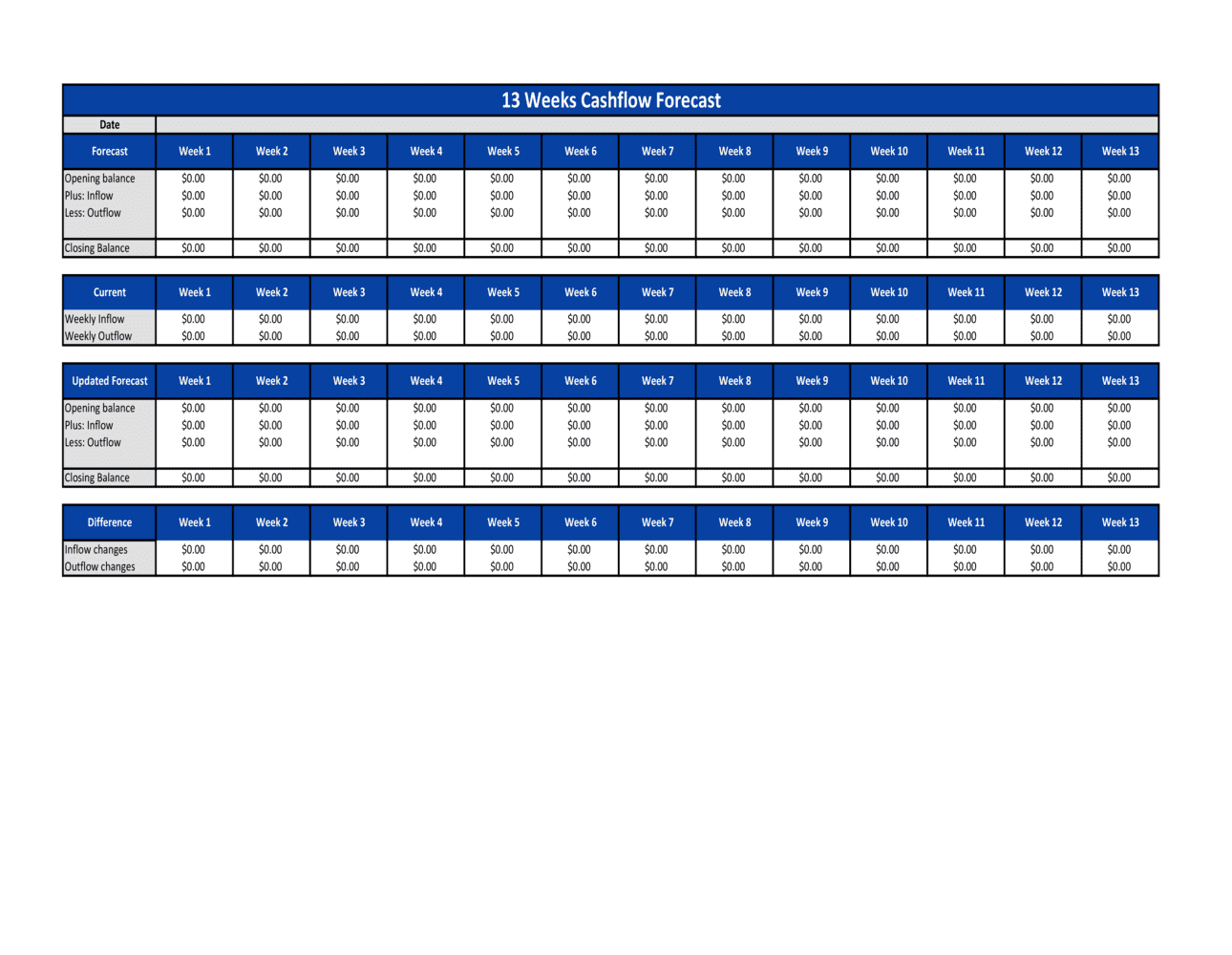
13 Weeks Cashflow Forecast Template

Free Excel download β€’ Use online β€’ Print or share

5 pagesβ€’25–35 min to useβ€’Difficulty: Complex
Learn more ↓
FreeXLS13 Weeks Cashflow Forecast Template

At a glance

What it is
A 13 Weeks Cashflow Forecast is a short-term financial planning document that maps every expected cash inflow and outflow across the next 91 days on a week-by-week basis. This free Word download gives you a structured starting point to model your opening cash balance, operating receipts, disbursements, and closing weekly position β€” ready to edit and export as PDF for lenders, investors, or internal management reviews.
When you need it
Use it when cash reserves are tight, when a lender or restructuring advisor requires a near-term liquidity view, or when the business is entering a high-spend period and needs visibility into upcoming shortfalls at least three months out. It is also standard practice for any business undergoing a turnaround, distressed financing, or covenant compliance review.
What's inside
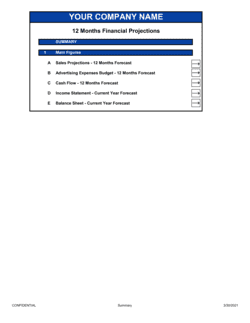
Opening cash balance, weekly operating receipts by revenue stream, fixed and variable disbursements, payroll and tax obligations, debt service, capital expenditures, net weekly cash movement, and closing cash balance with a running cumulative variance against forecast.

What is a 13 Weeks Cashflow Forecast?

A 13 Weeks Cashflow Forecast is a short-term financial planning document that maps every expected cash inflow and outflow across the next 91 days, broken down week by week. Starting from a verified bank balance, it models customer collections by due date, fixed and variable disbursements, payroll, debt service, and capital expenditures β€” producing a closing cash balance for each of the 13 weeks and a clear picture of where the business will be liquid, constrained, or at risk. Unlike a P&L or annual budget, which operate on an accrual basis, a cashflow forecast records only actual cash movements: money entering and leaving the bank account on the days it actually clears.

Why You Need This Document

A business can show a profit on its P&L and still run out of cash in Week 6 if customer collections cluster after a large payroll run. Without a week-level cash model, these gaps are invisible until they become emergencies β€” and by then the options for addressing them are far more limited and expensive. Lenders, restructuring advisors, and private equity owners standardised on the 13-week format because it is precise enough to be actionable and short enough to be built from confirmed data rather than assumptions. For a business navigating tight liquidity, a covenant waiver, or a high-spend seasonal period, a current 13-week forecast is the difference between managing a cash constraint deliberately and discovering it the Friday before payroll. This template gives you the structure to build that forecast in hours, update it weekly, and present it credibly to any internal or external audience that needs visibility into your near-term cash position.

Which variant fits your situation?

If your situation is…Use this template
Presenting to a bank or lender during a distressed credit situation13 Weeks Cashflow Forecast (Lender Format)
Monthly cash planning for a stable operating business12-Month Cash Flow Forecast
Rolling weekly forecast updated each MondayRolling 13-Week Cash Flow Forecast
Annual cash flow as part of a full business planBusiness Plan Financial Projections
Tracking cash against budget for an ongoing projectProject Budget Template
Monitoring liquidity at department level rather than company levelDepartmental Budget vs Actual Report
Presenting cash position to a board alongside P&LBoard of Directors Report

Common mistakes to avoid

❌ Using accrual revenue instead of cash collection dates

Why it matters: Accrual revenue is recognised when earned, not when cash arrives. Placing revenue in the week it is invoiced rather than the week it is collected produces a falsely optimistic cash position and misses real funding gaps.

Fix: Build inflows from the aged receivables report and actual due dates, adjusted for your historical collection rate. Revenue recognition is irrelevant to a cash forecast.

❌ Ignoring the payroll tax remittance schedule

Why it matters: Payroll tax remittances are a separate cash outflow that clears the bank on a schedule set by the tax authority β€” often the week after payroll. Missing them understates outflows by 8–15% of gross payroll each period.

Fix: Confirm remittance dates with your payroll provider and enter employer taxes as a separate line item on their actual clearing date.

❌ Overwriting forecast cells with actuals as weeks complete

Why it matters: Replacing forecast figures with actuals destroys the variance record. You lose the ability to measure forecast accuracy, identify systematic errors, and demonstrate to lenders that the model is reliable.

Fix: Maintain separate forecast and actual columns side by side. The forecast column should never change once the week begins.

❌ Treating all 13 weeks as equally uncertain

Why it matters: Weeks 1–4 should be based on confirmed invoices, payroll runs, and scheduled payments β€” not estimates. Using the same level of uncertainty across all 13 weeks causes you to under-plan the near term, where precision matters most.

Fix: Segment the forecast into three bands: Weeks 1–4 (high confidence, based on confirmed data), Weeks 5–9 (medium confidence), and Weeks 10–13 (working assumptions). Label each band so readers understand the reliability gradient.

❌ Excluding contingent inflows entirely

Why it matters: Omitting a probable loan draw or near-certain customer payment because it isn't 100% confirmed produces an artificially distressed forecast that misrepresents the decision space for management and advisors.

Fix: Include contingent inflows as a separate labelled line with a probability estimate (e.g., '80% probable') and a note. Show a base case and a downside case if the inflow does not materialise.

❌ Building the forecast once and never rolling it forward

Why it matters: A static 13-week forecast becomes stale within two weeks. By Week 3 it no longer reflects current payables, updated receivables aging, or changes in revenue momentum β€” and lenders will notice immediately.

Fix: Update the forecast every Monday: drop the completed week, add a new Week 13, enter last week's actuals, and refresh the receivables and payables data from current reports.

The 10 key sections, explained

Header and forecast period

Opening cash balance

Cash inflows β€” operating receipts

Cash inflows β€” non-operating and financing

Cash outflows β€” fixed operating disbursements

Cash outflows β€” payroll and employer taxes

Cash outflows β€” variable and discretionary disbursements

Cash outflows β€” debt service and capital expenditures

Net cash movement and closing balance

Variance tracking and commentary

How to fill it out

  1. 1

    Set the forecast period and confirm the opening balance

    Enter the company name, currency, and the exact 13-week date range. Pull the opening cash balance from a same-day bank statement β€” not the accounting system β€” and enter it as Week 1's opening figure.

    πŸ’‘ If you have multiple bank accounts, sum all operating account balances but exclude restricted or trust accounts that are not available for general operating use.

  2. 2

    Map accounts receivable collections to due dates

    Pull your aged receivables report and place each outstanding invoice in the week it is contractually due to be paid. Apply a collection adjustment factor based on your historical on-time payment rate β€” if 20% of invoices are consistently late by one week, shift 20% of each week's collections forward by one week.

    πŸ’‘ Segment receivables by customer if you have concentration risk β€” one customer representing more than 20% of collections deserves its own line.

  3. 3

    Enter fixed disbursements on their actual payment dates

    List every contractually fixed payment β€” rent, insurance, lease, SaaS subscriptions β€” and place each in the week the cash actually leaves the bank, confirmed by reviewing prior bank statements for payment timing.

    πŸ’‘ Set up a recurring payment calendar alongside the forecast so nothing is missed in future rolling updates.

  4. 4

    Build out the payroll schedule

    Enter gross payroll, net payroll, employer payroll taxes, and benefits contributions for each pay date that falls within the 13 weeks. Confirm payroll tax remittance dates with your payroll provider β€” they often differ from the payroll payment date.

    πŸ’‘ If you have a bi-weekly payroll, two months in the 13-week window will have three pay periods β€” check the calendar before building the payroll rows.

  5. 5

    Schedule variable disbursements using vendor terms

    For each major supplier, enter payment amounts in the week the invoice is due based on agreed terms (Net 30, Net 60). Flag any payments you have discretion to defer and mark them as 'deferrable' so management can scenario-plan.

    πŸ’‘ Sort suppliers by payment size and flag the top five β€” these are your first lever if you need to free up cash in a specific week.

  6. 6

    Add debt service and approved capital expenditures

    Enter each scheduled loan payment β€” principal and interest separately β€” on its contractual due date. Add any approved CapEx purchases by their expected payment date, not the order date.

    πŸ’‘ Cross-reference your loan agreement amortization schedule directly rather than relying on memory β€” payment amounts often change after a rate reset or partial prepayment.

  7. 7

    Calculate net movement and closing balances, then review for negative weeks

    Let the model sum each week's inflows and outflows to produce net movement and closing balance. Identify any week where the closing balance goes negative or drops below a management-defined minimum threshold.

    πŸ’‘ Highlight negative or near-zero closing balance weeks in red. These are the decision points β€” management needs to act on them before they arrive, not after.

  8. 8

    Update actuals weekly and record variances

    Every Monday, enter the prior week's actual cash receipts and payments. Record the variance between forecast and actual closing balance and add a one-line commentary for any variance above your threshold (e.g., more than $5,000 or 5%).

    πŸ’‘ Never overwrite the original forecast cells β€” use a separate 'actual' column so the forecast vs. actual comparison remains intact for review by management and lenders.

Frequently asked questions

What is a 13-week cashflow forecast?

A 13-week cashflow forecast is a short-term financial planning document that projects every expected cash inflow and outflow for the next 91 days on a week-by-week basis. It starts from a verified bank balance, models customer collections, payroll, supplier payments, debt service, and other disbursements, and produces a closing cash balance for each week. It is the standard tool for managing near-term liquidity in both stable and distressed business situations.

Why 13 weeks specifically?

Thirteen weeks equals one fiscal quarter β€” long enough to capture a full operating cycle including monthly fixed costs, quarterly tax payments, and supplier payment cycles, but short enough that the data inputs are based on confirmed invoices and scheduled payments rather than projections. Lenders and restructuring advisors standardised on 13 weeks because it provides a credible, auditable near-term view without the speculative assumptions that weaken longer-range models.

Who typically requires a 13-week cashflow forecast?

Secured lenders often require a 13-week forecast as a condition of forbearance or covenant waiver agreements. Restructuring advisors and turnaround professionals use it as their primary diagnostic tool. Private equity owners frequently require weekly or bi-weekly updates during high-burn periods. Even without external pressure, CFOs and business owners in seasonal or cash-intensive industries run one proactively to avoid preventable shortfalls.

What is the difference between a cashflow forecast and a P&L?

A P&L records revenue and expenses on an accrual basis β€” when they are earned or incurred, regardless of when cash moves. A cashflow forecast records only actual cash movements β€” when money enters or leaves the bank account. A profitable business on the P&L can still run out of cash if customers pay slowly or large disbursements cluster in the same week. The 13-week forecast captures this gap; the P&L does not.

How do I handle uncertain inflows in the forecast?

Uncertain inflows should not be excluded β€” they should be labelled and probability-weighted. Create a separate 'contingent inflows' line for each uncertain item, note the probability and expected timing, and produce two scenarios: a base case including the inflow and a downside case excluding it. This gives decision-makers the full picture rather than a single falsely precise number.

How often should the 13-week forecast be updated?

Weekly β€” every Monday before the start of the business day. Drop the completed week, add a new Week 13 at the end, enter last week's actual cash receipts and payments, and refresh the receivables aging and payables schedules. A forecast updated less frequently than weekly loses the precision that makes it useful and will not satisfy lender reporting requirements in most restructuring situations.

Can I use this template for a startup with irregular revenue?

Yes, and it is especially valuable in that context. For startups with irregular or unpredictable revenue, the forecast should conservatively model collections only from confirmed purchase orders or signed contracts. Unconfirmed pipeline should be excluded from the base case and shown separately as a sensitivity. The result is a realistic runway figure that helps founders time fundraising conversations before cash is exhausted.

What is a rolling 13-week forecast?

A rolling forecast is updated each week so that it always shows the next 13 weeks forward from today, rather than a fixed window that shrinks over time. Each Monday, the prior week is dropped and a new Week 13 is added. This approach gives management a perpetually current forward view and is the format most lenders and investors prefer because it never becomes stale.

How does a 13-week forecast differ from a 12-month cash flow projection?

A 12-month projection is built on monthly estimates and is typically part of a business plan or annual budget β€” it uses assumptions about growth rates and seasonal patterns rather than confirmed invoice data. A 13-week forecast is built from actual open invoices, scheduled payroll runs, and confirmed payment obligations, making it far more precise in the near term. Use the 13-week forecast for operational cash management and the 12-month projection for strategic planning and fundraising narratives.

How this compares to alternatives

vs 12-Month Cash Flow Forecast

A 12-month forecast uses monthly estimates based on growth assumptions and is designed for strategic planning, fundraising, and annual budgets. A 13-week forecast is built from confirmed invoices and scheduled payments and is designed for week-level operational cash management. The 12-month model answers 'where are we heading?'; the 13-week model answers 'can we make payroll on Friday?'

vs Annual Budget

An annual budget allocates revenue and expense targets by month across the fiscal year and is the primary tool for P&L planning and departmental spending control. It does not show week-level cash timing or identify weeks where the closing balance goes negative. The 13-week cashflow forecast is the operational complement that translates budget assumptions into actual bank balance movements.

vs Break-Even Analysis

A break-even analysis identifies the revenue level at which total costs are covered β€” it is a static profitability diagnostic. The 13-week forecast is a dynamic, time-specific cash model. A business can be above breakeven on a P&L basis and still have a cash crisis in Week 6 if collections lag. These two tools answer completely different questions and are both necessary.

vs Board of Directors Report

A board report aggregates operational, financial, and strategic performance data for director oversight β€” it may include a summary cash position but does not provide week-level disbursement detail. The 13-week forecast is a supporting schedule that feeds the liquidity section of a board report. Use the forecast to build the numbers; use the board report to present them.

Industry-specific considerations

Retail and e-commerce

Seasonal inventory build-up creates large disbursement clusters weeks before the corresponding sales receipts arrive, making week-level cash visibility critical during peak buying periods.

Construction and contracting

Progress billing cycles, retainage holdbacks, and subcontractor payment schedules create wide gaps between revenue recognition and actual cash receipt that only a weekly cash model surfaces accurately.

Manufacturing

Raw material purchases on Net 30 terms against customer collections on Net 60 terms creates a structural working capital gap that the 13-week forecast quantifies and allows management to plan around.

Professional services

Payroll is the dominant weekly outflow and is largely fixed, while collections from time-and-materials clients are lumpy and often late β€” the forecast identifies which weeks require a line of credit draw before payroll clears.

Hospitality and food service

Daily cash receipts combined with weekly food and labour costs make this sector well-suited to weekly cash modelling, particularly during seasonal slow periods when reserves deplete quickly.

Healthcare and medical practices

Insurance reimbursement lags of 30–90 days against weekly payroll for clinical staff create predictable cash gaps that the 13-week forecast makes visible and manageable.

Template vs pro β€” what fits your needs?

PathBest forCostTime
Use the templateBusiness owners, CFOs, and controllers managing cash week-to-week without lender reporting requirementsFree3–5 hours initial build; 30–60 minutes per weekly update
Template + professional reviewBusinesses under lender scrutiny, covenant compliance reporting, or entering a distressed financing discussion$500–$2,000 for a CFO or accountant review and model validation1–3 days
Custom draftedFormal restructuring, Chapter 11 or CCAA proceedings, or private equity portfolio reporting with defined lender templates$3,000–$15,000+ for a restructuring advisor or turnaround firm1–2 weeks

Glossary

Opening Cash Balance
The verified cash in bank accounts at the start of the forecast period, taken directly from the most recent bank statement.
Closing Cash Balance
The projected cash remaining at the end of each forecast week, calculated as the opening balance plus net cash movement for that week.
Cash Inflows
All cash expected to be received in a given week β€” customer payments, loan proceeds, asset sales, or tax refunds β€” not revenue recognised on an accrual basis.
Cash Outflows (Disbursements)
All cash payments expected to leave the business in a given week, including payroll, rent, supplier payments, debt service, and tax remittances.
Net Cash Movement
Total inflows minus total outflows for a single week β€” a positive number increases the closing balance; a negative number draws it down.
Variance
The difference between the forecasted cash position and the actual cash position for a completed week, used to assess forecast accuracy and identify surprises.
Runway
The number of weeks remaining before the closing cash balance reaches zero at the current projected net cash movement, assuming no new financing.
Burn Rate
Average weekly net cash outflow, calculated over the forecast period, showing how quickly the business is consuming its cash reserves.
Rolling Forecast
A forecast updated each week by dropping the completed week and adding a new week at the end, always maintaining a 13-week forward view.
Covenant Compliance
A contractual obligation to a lender that requires the borrower to maintain minimum cash balances or meet other financial thresholds β€” a 13-week forecast is often the reporting tool used to demonstrate compliance.

Part of your Business Operating System

This document is one of 3,000+ business & legal templates included in Business in a Box.

  • Fill-in-the-blanks β€” ready in minutes
  • 100% customizable Word document
  • Compatible with all office suites
  • Export to PDF and share electronically

Create your document in 3 simple steps.

From template to signed document β€” all inside one Business Operating System.
1
Download or open template

Access over 3,000+ business and legal templates for any business task, project or initiative.

2
Edit and fill in the blanks with AI

Customize your ready-made business document template and save it in the cloud.

3
Save, Share, Send, Sign

Share your files and folders with your team. Create a space of seamless collaboration.

Save time, save money, and create top-quality documents.

β˜…β˜…β˜…β˜…β˜…

"Fantastic value! I'm not sure how I'd do without it. It's worth its weight in gold and paid back for itself many times."

Managing Director Β· Mall Farm
Robert Whalley
Managing Director, Mall Farm Proprietary Limited
β˜…β˜…β˜…β˜…β˜…

"I have been using Business in a Box for years. It has been the most useful source of templates I have encountered. I recommend it to anyone."

Business Owner Β· 4+ years
Dr Michael John Freestone
Business Owner
β˜…β˜…β˜…β˜…β˜…

"It has been a life saver so many times I have lost count. Business in a Box has saved me so much time and as you know, time is money."

Owner Β· Upstate Web
David G. Moore Jr.
Owner, Upstate Web

Run your business with a system β€” not scattered tools

Stop downloading documents. Start operating with clarity. Business in a Box gives you the Business Operating System used by over 250,000 companies worldwide to structure, run, and grow their business.

Start freeΒ Β·Β No credit card required