Shipping and Logistics Templates
★★★★★4.7from 280+ reviews· Trusted by 20M+ businesses
Manage every shipment, delay, claim, and carrier relationship with ready-to-use documents.
WordEditable onlinePDF10+ shipping and logistics templates
Other Production & Operations categories
Delay and dispute communications
250K+Clients
20M+Free users
20+Years
190+Countries
10,000+Law firms
50M+Downloads
Trusted across review platforms
- Capterra★★★★☆4.649 reviews
- G2★★★★☆4.713 reviews
- GetApp★★★★☆4.649 reviews
- Google Play★★★★☆4.6179 ratings
- Google Reviews★★★★☆4.567 reviews
Frequently asked questions
What documents are required for a shipment?
The minimum set for a domestic shipment typically includes a packing slip, a bill of lading (for freight), and a shipping manifest. International shipments add a commercial invoice, a certificate of origin, and any export or import licenses required by the destination country. The templates in this folder cover the business side of that documentation.
Is a shipping policy legally required?
A written shipping policy is not required by law in most jurisdictions, but it is effectively required in practice. E-commerce regulations in the US, EU, and many other markets require you to disclose delivery timelines at checkout, and disputes with customers or payment processors are far easier to resolve when you have a documented policy to point to.
What's the difference between a shipper and a carrier?
The shipper is the party sending the goods — typically the seller or manufacturer. The carrier is the transportation company physically moving the goods from origin to destination. A freight broker or 3PL may sit between them, arranging the movement without owning the trucks or planes. All three roles should be clearly identified in any logistics contract.
How do I file a claim for damaged goods?
Inspect all deliveries immediately on arrival, note any damage on the delivery receipt before the driver leaves, and photograph the damage. Submit a written claim to the carrier within the time limit in your contract — typically 9 months for domestic freight under standard carrier tariffs, but shorter periods may apply. Use the Claim for Damage on Shipped Goods template to ensure you include all required information.
Can I charge back a supplier for a late delivery?
Yes, if your purchase order or supply agreement includes a late-delivery penalty clause. The chargeback must be documented in writing and applied in accordance with the agreed formula — typically a percentage of the invoice value per day of delay. The Charge Back Application of Discount on Delayed Shipment template provides the correct structure for this communication.
What should a contract with a logistics provider include?
At minimum: scope of services, pricing and billing terms, service-level commitments (transit times, on-time delivery rates), liability limits, insurance requirements, a claims process, confidentiality obligations, and termination rights. A well-drafted Contract for Logistics Services also includes KPIs and a process for reviewing performance.
Do I need a separate agreement for each carrier I use?
Not necessarily. Many businesses use carrier tariffs or rate confirmations for spot shipments, reserving formal agreements for high-volume or ongoing carrier relationships. When a carrier handles a significant portion of your freight or stores your goods, a written Agreement Between Carrier and Shipper is worth the effort — it clarifies liability and prevents misunderstandings at scale.
Are these templates suitable for international shipping?
The templates provide a solid starting framework, but international shipments involve additional layers: customs classifications, Incoterms allocation (EXW, FOB, CIF, DDP), import/export licensing, and the laws of multiple jurisdictions. Use the templates as a base, then have a trade or logistics lawyer review the final document for cross-border deals.
Shipping And Logistic vs. related documents
A Shipping Policy is a customer-facing document that explains delivery timelines, carrier options, and your liability for lost or damaged orders. A Transport Policy is an internal document governing how your company manages its own vehicles, drivers, and compliance obligations. Both may coexist in the same business — one faces outward, the other faces inward.
A Contract for Logistics Services covers an ongoing relationship with a third-party logistics provider (3PL) — including warehousing, fulfilment, and value-added services. An Agreement Between Carrier and Shipper is narrower, focused on freight movement: rates, transit times, and liability for a single lane or mode. Choose the broader contract when the provider does more than just haul freight.
Both templates communicate a late delivery, but the Notice of Delayed Shipment is typically sent to the recipient (buyer or customer) to manage expectations. The Explanation for Delay of Shipment is more often sent by a supplier or carrier to a business partner, providing a detailed operational reason for the delay. Use the notice for customer-facing communication, the explanation for B2B accountability.
A Shipping Manifest is an internal or operational document listing all packages or items in a shipment — useful for warehouse staff, customs, and internal audits. A Bill of Lading is a formal legal contract between a shipper and carrier that also serves as a receipt for goods and a document of title. The manifest supports the Bill of Lading but does not replace it.
Key clauses every Shipping And Logistic contains
Across all shipping and logistics documents, a core set of clauses determines who is responsible for what, when, and at what cost.
- Parties and roles. Identifies the shipper, carrier, consignee, and any third-party logistics providers by full legal name and role.
- Description of goods. Specifies what is being shipped — type, quantity, weight, dimensions, and any hazardous or fragile classifications.
- Delivery terms and schedule. States agreed pickup and delivery dates, transit timelines, and what happens when those dates are missed.
- Freight rates and payment. Sets the agreed rates, billing cycle, fuel surcharges, and any penalties for late payment.
- Liability and risk of loss. Defines which party bears the risk if goods are lost, damaged, or destroyed in transit and up to what dollar limit.
- Claims procedure. Outlines the process for filing a damage or shortage claim, including notice deadlines and required documentation.
- Force majeure. Excuses a party from liability for delays caused by events outside its control — weather, strikes, regulatory changes.
- Governing law and dispute resolution. Names the jurisdiction whose laws apply and how disputes will be resolved — litigation, arbitration, or mediation.
How to write a shipping and logistics document
The type of document determines the details, but every shipping and logistics document follows the same underlying structure.
1
Identify the document type you need
Decide whether you're setting policy, forming a contract, communicating a problem, or recording a transaction — each requires a different template.
2
Name all parties with precision
Use full registered legal names for every company or individual involved — carrier, shipper, consignee, and any broker or 3PL.
3
Describe the goods in detail
Include item descriptions, SKUs or commodity codes, quantities, weight, dimensions, and any special handling requirements.
4
Set dates and milestones
Specify pickup date, expected delivery date, and any intermediate checkpoints — vague timelines invite disputes.
5
Assign liability and insurance
State who is responsible for loss or damage, the dollar limit of that liability, and which party carries cargo insurance.
6
Include a claims and remedies procedure
Define how a claim must be submitted — format, deadline, supporting documents — so both parties know what to do when something goes wrong.
7
Add governing law and signatures
Name the applicable jurisdiction, have authorized representatives sign, and retain a copy in your operations records.
At a glance
- What it is
- Shipping and logistics documents are the written records and agreements that govern how goods move from origin to destination — covering contracts with carriers, shipment schedules, delay notices, damage claims, and internal policies that keep fulfilment operations consistent and defensible.
- When you need one
- Any time goods change hands — whether you're shipping to a customer, contracting a third-party carrier, or managing a supplier relationship — you need a paper trail that protects your business if something goes wrong.
Which Shipping And Logistic do I need?
The right template depends on whether you're setting policy, formalizing a carrier relationship, communicating a problem, or resolving a dispute. Match your situation below.
Your situation
Recommended template
Setting customer-facing delivery rules for an e-commerce store
Documents your processing times, carrier options, and liability limits in one place.Contracting a third-party logistics provider for ongoing services
Covers service scope, rates, KPIs, and liability between shipper and LSP.Formalizing the terms between a carrier and a shipper
Defines freight rates, transit times, and responsibility for loss or damage.Notifying a customer or partner of an unexpected shipping delay
Provides a professional, documented explanation to limit customer disputes.Filing a claim after goods arrive damaged in transit
Provides the structured format carriers and insurers require for damage claims.Documenting what's in an outbound shipment for compliance or customs
Lists contents, quantities, and weights so every party agrees on what was shipped.Establishing rules for how your company uses transport and vehicles
Sets internal standards for vehicle use, driver conduct, and compliance.Applying a chargeback discount after a supplier delivered late
Formally records the penalty deduction so both parties have written evidence.Glossary
- Shipper
- The party who originates a shipment and tenders goods to a carrier for transport.
- Carrier
- The company physically transporting goods — a trucking company, airline, shipping line, or rail operator.
- Consignee
- The party named as the recipient of a shipment.
- Bill of lading
- A legal document issued by a carrier that serves as a receipt for goods, a contract of carriage, and a document of title.
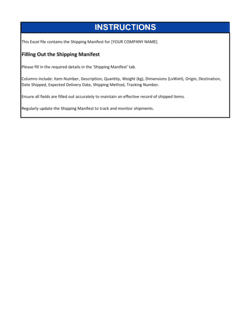
- Shipping manifest
- An itemized list of all packages or items in a shipment, including weights, dimensions, and contents.
- 3PL (third-party logistics)
- An external company that handles some or all of a business's logistics functions — warehousing, fulfilment, transportation, or customs brokerage.
- Freight broker
- An intermediary who arranges transportation between shippers and carriers without taking physical possession of the goods.
- Incoterms
- Internationally recognised trade terms (published by the ICC) that define which party bears cost and risk at each stage of a shipment.
- Chargeback
- A deduction applied by a buyer to a supplier's invoice as a penalty for a failure — such as late delivery or incorrect labelling.
- Force majeure
- A contract clause that excuses a party from performance obligations when extraordinary events outside their control prevent delivery.
- Claims period
- The window of time within which a shipper or consignee must file a claim for lost or damaged goods — missing this deadline typically voids the claim.
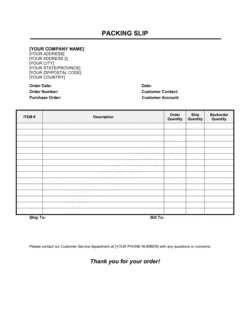
- Back order
- A customer order for goods that are currently out of stock and will be fulfilled when inventory is replenished.
What is a shipping and logistics document?
A shipping and logistics document is any written record, agreement, notice,
or policy that governs the movement of physical goods — from the moment an
order is placed through to final delivery and any post-delivery resolution.
These documents serve three practical functions: they create a clear agreement
between parties about what will be shipped, when, and under what conditions;
they provide an auditable trail when something goes wrong; and they establish
the legal basis for any claim, chargeback, or dispute that follows.
The category spans a wide range of document types. Contracts and agreements —
such as a Contract for Logistics Services or an Agreement Between Carrier and
Shipper — set the commercial terms of the relationship. Policy documents —
like a Shipping Policy or Transport Policy — establish consistent internal and
external rules. Operational documents — manifests, order acknowledgments,
shipment schedules — record what was agreed and what actually happened.
Communications — delay notices, damage claims, apology letters — manage the
relationship when reality diverges from the plan.
When you need a shipping or logistics document
If your business ships products, contracts carriers, or manages a supply chain,
you need shipping and logistics documents at every stage of the process. The
absence of written records is one of the most common reasons businesses lose
disputes with carriers, suppliers, and customers — because without
documentation, every conversation becomes a question of whose memory to trust.
Common triggers:
- You're launching an online store and need a customer-facing shipping policy
- You're contracting a 3PL or trucking company for the first time
- A shipment arrived late and you need to notify the buyer formally
- Goods arrived damaged and you need to file a carrier claim
- A supplier shipped the wrong items and you need written authorization to return them
- A customer's order is back-ordered and needs a documented cancellation or delay notice
- You're hiring a logistics coordinator and need a job description and interview guide
- You want to standardize how your team handles shipment schedules and acknowledgments
Every day without proper documentation is a day when a single disputed delivery
can become a costly, unwinnable argument. A library of ready-to-use shipping
and logistics templates means the right document is minutes away — before the
problem, not after.
Award-winning platform
- Great Place to Work 2025
- BIG Award — Product of the Year 2025
- Smartest Companies 2025
- Global 100 Excellence 2026
- Best of the Best 2025