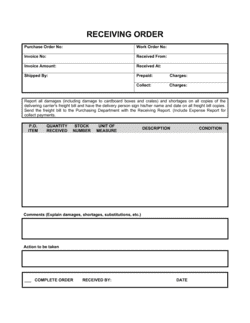
Packing List of Order Template

Free Word download β€’ Edit online β€’ Save & share with Drive β€’ Export to PDF

1 pageβ€’20–30 min to fillβ€’Difficulty: Standardβ€’Signature requiredβ€’Legal review recommended
Learn more ↓
FreePacking List of Order Template

At a glance

What it is
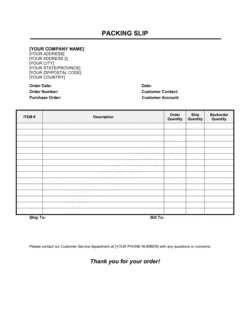
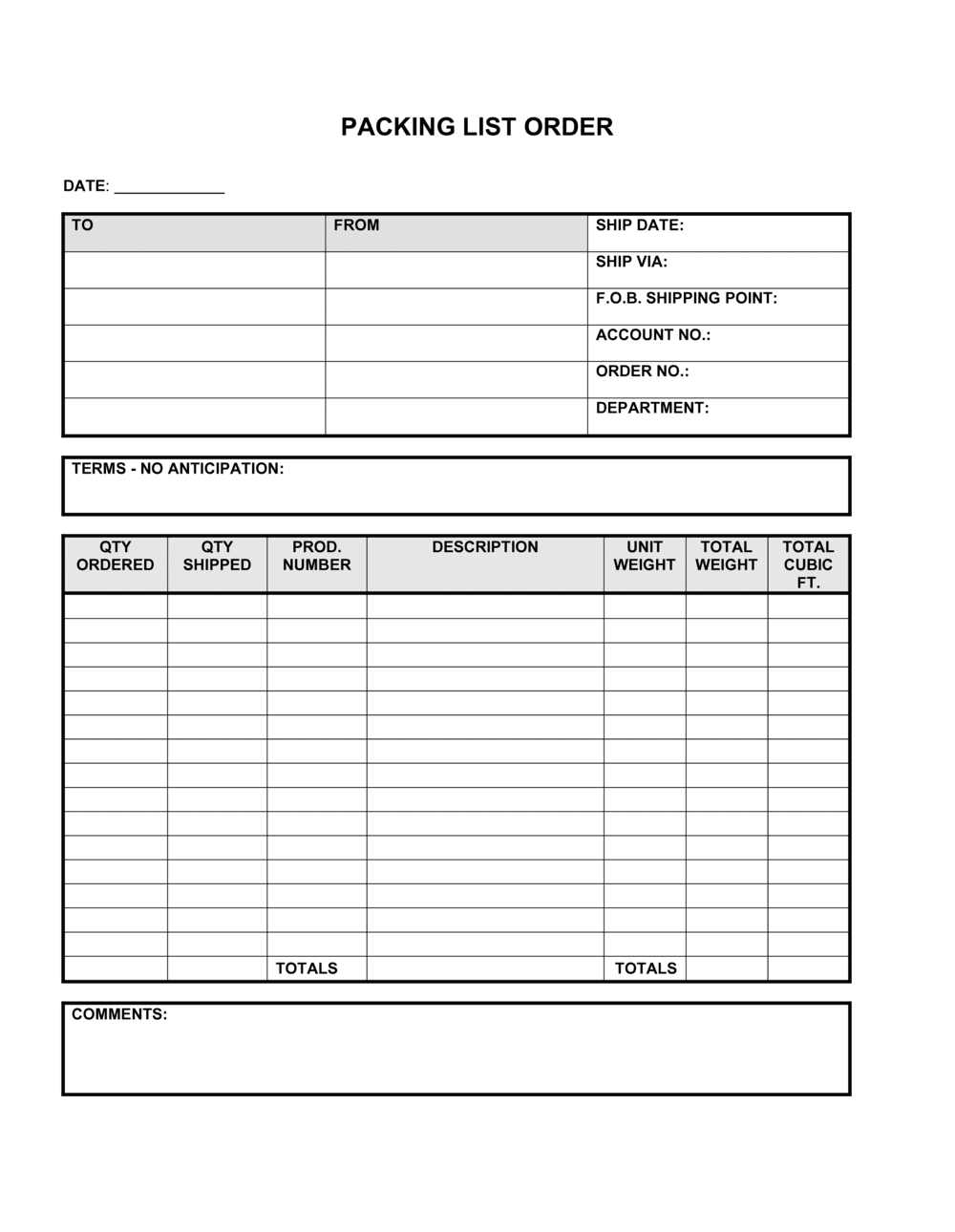
A Packing List of Order is a binding shipping document that itemizes every product included in a shipment β€” listing descriptions, quantities, unit weights, dimensions, packaging type, and handling marks for each line item. This free Word download gives you a structured, trade-ready template you can edit online and export as PDF to accompany any commercial or international order.
When you need it
Use it whenever you ship goods to a buyer, freight forwarder, or customs authority β€” domestically or across borders β€” and need a documented record of exactly what was packed, in how many units, and in what configuration. It is required by customs authorities for all commercial import and export shipments in most jurisdictions.
What's inside
Shipper and consignee details, order and shipment reference numbers, itemized line entries with product descriptions and HS codes, per-package and total gross and net weights, dimensions, packaging type, special handling instructions, and a shipper declaration with signature.

What is a Packing List of Order?

A Packing List of Order is a binding shipping document prepared by the seller or shipper that itemizes every product included in a shipment β€” recording item descriptions, HS codes, quantities per carton, total quantities, gross and net weights, package dimensions, packaging type, and handling requirements for each line item. It travels with the commercial invoice and bill of lading as one of the three core documents in any commercial shipment and serves as the primary reference for customs authorities, carriers, and receivers to verify that what was packed matches what was ordered and declared.

Why You Need This Document

Shipping goods without an accurate, complete packing list exposes you to customs holds, carrier surcharges, and receiving disputes simultaneously. Customs authorities in every major jurisdiction require a packing list for commercial imports and exports β€” an absent or vague document triggers a physical examination, which delays clearance by days and generates examination fees payable by the importer. Carriers rerate freight when declared weights or dimensions do not match physical measurements, adding unexpected costs to every shipment. Receivers cannot verify partial deliveries, reconcile inventory, or process payment without a line-by-line packing record to compare against the purchase order. Beyond logistics, a signed packing list creates a documented evidentiary record of exactly what you shipped and when β€” essential if a customer claims goods were missing or damaged in transit. This template gives you a trade-ready, customs-compliant structure that eliminates those risks from the first shipment you send.

Which variant fits your situation?

If your situation is…Use this template
Shipping goods internationally for customs clearanceCommercial Invoice and Packing List
Documenting a domestic warehouse-to-warehouse bulk transferPacking List of Order
Shipping hazardous materials requiring special declarationsDangerous Goods Packing List
Recording contents of a returned or reverse-logistics shipmentReturn Merchandise Authorization Form
Accompanying a multi-item commercial sale across bordersCommercial Invoice
Documenting goods shipped under a purchase order from a buyerPurchase Order with Packing List
Tracking inventory transferred between company locationsInventory Transfer Form

Common mistakes to avoid

❌ Vague or generic product descriptions

Why it matters: Customs officers cannot correctly classify or assess duties on items described as 'goods,' 'parts,' or 'merchandise.' Vague descriptions are the leading cause of customs examination and shipment holds.

Fix: Write descriptions specific enough for a customs officer to identify the product and assign an HS code β€” include material, function, and intended use for each item.

❌ Weight discrepancies between packing list and commercial invoice

Why it matters: Customs authorities cross-check declared weights across all accompanying documents. A discrepancy of more than 5% triggers a physical examination, which delays clearance and generates examination fees payable by the importer.

Fix: Calculate packing list weights from actual measured samples, not from product specifications, and reconcile the totals with the commercial invoice before submission.

❌ Missing or incorrect HS codes

Why it matters: An incorrect HS code results in the wrong duty rate being applied, potential penalties for misdeclaration, and reclassification upon audit β€” with back-duty assessments plus interest going back up to five years.

Fix: Verify every HS code with a licensed customs broker or the WCO Tariff Browser before finalizing the document, and update codes whenever product specifications change.

❌ Omitting IPPC heat-treatment notation for wooden packaging

Why it matters: Over 180 countries require ISPM 15-compliant wooden packaging for international shipments. Non-compliant wood packaging is fumigated at the shipper's cost or rejected outright at the destination port.

Fix: Confirm that all wooden pallets, crates, and dunnage bear a valid IPPC stamp before loading, and note the certification explicitly on the packing list.

❌ Quantity totals that do not reconcile with the purchase order

Why it matters: When the packing list quantity differs from the purchase order, receivers flag the shipment as a short or over-delivery, triggering disputes, return freight costs, or payment holds until the discrepancy is resolved.

Fix: Run a line-by-line comparison between the packing list and the original purchase order before sealing and shipping. Document any approved partial shipments in writing before the shipment departs.

❌ No authorized signature on the shipper's declaration

Why it matters: An unsigned or improperly signed packing list is legally insufficient as a customs declaration. Customs can reject the shipment or assess penalties against the exporter for an invalid declaration.

Fix: Designate one or two authorized signatories for export documents, confirm their authority in writing, and establish a checklist that prevents any shipment from leaving without a properly signed declaration.

The 10 key clauses, explained

Shipper and consignee identification

In plain language: Identifies the sending party and the receiving party by full legal name, address, and contact details, establishing who is responsible for the shipment and who is authorized to receive it.

Sample language
Shipper: [SHIPPER LEGAL NAME], [ADDRESS], [CITY, STATE/PROVINCE, POSTAL CODE], [COUNTRY], Tel: [PHONE]. Consignee: [CONSIGNEE LEGAL NAME], [ADDRESS], [CITY, STATE/PROVINCE, POSTAL CODE], [COUNTRY], Attn: [CONTACT NAME].

Common mistake: Using a trade name or nickname instead of the full registered legal name. Customs authorities match document names against registered importer/exporter records β€” mismatches delay clearance or trigger holds.

Order and shipment reference numbers

In plain language: Cross-references the purchase order number, sales order number, invoice number, and any carrier or booking reference that ties this packing list to the underlying commercial transaction.

Sample language
Purchase Order No.: [PO NUMBER] | Sales Order No.: [SO NUMBER] | Invoice No.: [INVOICE NUMBER] | Booking Ref.: [CARRIER BOOKING REF] | Shipment Date: [DATE].

Common mistake: Omitting the purchase order number when the buyer issued one. Receivers use the PO number to route the shipment and trigger payment β€” an absent PO number causes receiving delays and holds up accounts-payable processing.

Item description and product details

In plain language: Lists each distinct product or SKU in the shipment with a specific description, item number, and HS code for customs classification.

Sample language
Item No.: [ITEM/SKU NUMBER] | Description: [PRODUCT NAME AND SPECIFICATION] | HS Code: [XXXXXX.XX] | Country of Origin: [COUNTRY].

Common mistake: Using generic descriptions like 'merchandise' or 'parts.' Customs authorities can seize or delay shipments when product descriptions are too vague to assign the correct HS code and duty rate.

Quantity per package and total quantity

In plain language: States the number of units of each item per carton or pallet, and the aggregate total units for that line, enabling receivers to verify completeness and enabling carriers to calculate load plans.

Sample language
Units per Carton: [QTY] | No. of Cartons: [QTY] | Total Units: [QTY] | Unit of Measure: [EA / KG / L / M].

Common mistake: Listing total quantity without breaking it into per-carton units. Warehouse receivers cannot verify partial deliveries or short shipments without per-package counts, turning every shortage into a dispute.

Gross and net weights per line

In plain language: Records the net weight (goods only) and gross weight (goods plus packaging) for each line item and as an overall shipment total, used by carriers for freight rating and by customs for duty calculation.

Sample language
Net Weight per Unit: [X] kg | Net Weight per Carton: [X] kg | Gross Weight per Carton: [X] kg | Total Net Weight: [X] kg | Total Gross Weight: [X] kg.

Common mistake: Providing only total shipment weight without per-line breakdown. Freight carriers and customs agents need per-line weights to rate freight accurately and to calculate duties where weight is the tariff basis.

Package dimensions and volume

In plain language: Records the external dimensions (length Γ— width Γ— height) and cubic volume of each carton or pallet, enabling freight forwarders to calculate dimensional weight and plan container loading.

Sample language
Carton Dimensions (L Γ— W Γ— H): [X] cm Γ— [X] cm Γ— [X] cm | Volume per Carton: [X] mΒ³ | Total Volume: [X] mΒ³.

Common mistake: Using inside dimensions instead of outside carton dimensions. Carriers calculate dimensional weight from external measurements β€” understating dimensions leads to re-weighing fees or freight corrections at origin.

Marks and numbers

In plain language: States the identifying marks, numbers, and labels printed on each outer carton or pallet for shipment tracking, warehouse routing, and customs inspection.

Sample language
Marks: [SHIPPER MARK / LOGO] | Package Numbers: [e.g., 1/20 through 20/20] | Handling Instructions: [FRAGILE / THIS SIDE UP / KEEP DRY].

Common mistake: Printing different marks on physical cartons than those declared on the packing list. Discrepancies between physical markings and document records are a primary trigger for customs examination and potential penalties.

Packaging type and material

In plain language: Specifies how each item is packaged β€” carton, wooden pallet, crate, drum, or other β€” and the material type, which may affect fumigation or phytosanitary requirements.

Sample language
Packaging Type: [CORRUGATED CARTON / WOODEN PALLET / STEEL DRUM] | Pallet Type: [EURO / CHEP / HEAT-TREATED IPPC MARKED] | No. of Packages: [TOTAL].

Common mistake: Omitting IPPC heat-treatment certification markings for wooden packaging. Most countries require ISPM 15-compliant wood packaging for international shipments β€” missing certification results in fumigation at the importer's expense or rejection at the border.

Special handling and hazardous goods declaration

In plain language: Discloses any temperature, orientation, or handling requirements, and declares whether any item in the shipment is classified as dangerous goods under IATA, IMDG, or ADR regulations.

Sample language
Special Handling: [REFRIGERATE AT 2–8Β°C / DO NOT STACK / KEEP AWAY FROM MOISTURE]. Dangerous Goods: [YES β€” see attached DGD / NO β€” Shipper declares no dangerous goods are included in this shipment].

Common mistake: Declaring 'no dangerous goods' without verifying every product's SDS. Undeclared hazmat β€” including lithium batteries, aerosols, and certain chemicals β€” results in criminal penalties and carrier liability for the shipper.

Shipper's declaration and authorized signature

In plain language: A statement by the shipper certifying that the information on the packing list is accurate and complete to the best of their knowledge, signed by an authorized representative.

Sample language
I/We hereby certify that the information on this packing list is true, correct, and complete. Signed: ___________________________ | Name: [NAME] | Title: [TITLE] | Date: [DATE] | Company Seal (if applicable).

Common mistake: Having an unauthorized employee sign the declaration. Most customs regimes require the authorized exporter or a licensed customs broker to certify accuracy β€” an improperly authorized signature can void the declaration and trigger a formal examination.

How to fill it out

  1. 1

    Enter shipper and consignee details

    Fill in the full registered legal names and complete mailing addresses for both the shipping party and the receiving party. Include a named contact and phone number for each.

    πŸ’‘ Confirm the consignee's legal name matches their import license or customs registration β€” even a minor spelling variation can delay clearance.

  2. 2

    Record all reference numbers

    Enter the purchase order number, sales order number, invoice number, and carrier booking reference. These cross-references link the packing list to every other document in the transaction.

    πŸ’‘ List reference numbers in the same order they appear on your commercial invoice so receivers can match documents without hunting.

  3. 3

    Add a line entry for each distinct product

    Create one row per SKU or item type. Include the item number, a specific product description, the 6-digit HS code, and the country of origin for each line.

    πŸ’‘ Look up the HS code using the WCO Tariff Browser or your customs broker's database β€” an incorrect code triggers duty reclassification and potential penalties.

  4. 4

    Fill in quantities at both the unit and carton level

    For each line, enter units per carton, number of cartons, and total units. Sum all carton counts for the shipment total at the bottom.

    πŸ’‘ Cross-check your total unit count against the corresponding line on the commercial invoice before finalizing β€” any discrepancy between the two documents is a customs red flag.

  5. 5

    Enter net and gross weights for each line

    Record net weight (goods only) and gross weight (goods plus packaging) per carton and as a line total. Calculate the shipment totals at the bottom of the form.

    πŸ’‘ Weigh a representative packed sample carton and multiply by carton count rather than estimating β€” weight discrepancies of more than 5% trigger carrier reweighing fees.

  6. 6

    Measure and record carton dimensions

    Measure the external length, width, and height of each carton type in centimeters. Calculate the cubic volume and enter it per line and as a shipment total.

    πŸ’‘ Use external dimensions, not internal β€” carriers calculate dimensional weight from the outside of the carton.

  7. 7

    Confirm packaging type and IPPC markings

    Specify whether you are using cartons, pallets, crates, or drums. For any wooden packaging used in international shipments, confirm the ISPM 15 / IPPC heat-treatment stamp is present on the physical packaging and note it on the document.

    πŸ’‘ Photograph the IPPC mark on wooden pallets before shipment β€” this is your evidence if a destination country customs authority questions compliance.

  8. 8

    Sign and date the shipper's declaration

    Have an authorized representative β€” typically the export manager, logistics director, or licensed customs broker β€” sign and date the declaration before the shipment is sealed.

    πŸ’‘ Retain a signed copy in your export records for a minimum of five years β€” most customs authorities require this retention period for audit purposes.

Frequently asked questions

What is a packing list of order?

A packing list of order is a shipping document that itemizes every product included in a shipment β€” listing descriptions, quantities, weights, dimensions, and packaging details for each line item. It accompanies the commercial invoice and bill of lading, serving as the primary reference document for customs clearance, carrier handling, and receiver verification. Unlike the commercial invoice, it focuses on physical shipment details rather than commercial value.

Is a packing list legally required?

For international commercial shipments, a packing list is required by customs authorities in virtually every jurisdiction as part of the standard import or export documentation package. For domestic shipments, it is not always legally mandatory but is considered best practice for any multi-item or multi-carton order. Many carrier contracts and purchase agreements contractually require one regardless of destination.

What is the difference between a packing list and a commercial invoice?

A commercial invoice states the commercial value of goods for customs duty calculation and payment purposes. A packing list describes the physical contents, quantities, weights, and packaging of the same shipment without reference to price. Both documents are required for international customs clearance β€” customs authorities cross-check the two documents to verify that declared values and quantities are consistent.

What is the difference between a packing list and a bill of lading?

A bill of lading is a carrier-issued transport contract and title document that acknowledges receipt of the goods and governs their carriage to the destination port. A packing list is a shipper-prepared document that details the specific contents of the shipment. The bill of lading references the packing list and commercial invoice but does not replace either β€” all three travel together as the core shipping documentation set.

What information must be on a packing list?

A complete packing list must include shipper and consignee legal names and addresses, all relevant reference numbers (PO, invoice, booking), an itemized list of goods with descriptions and HS codes where required, quantity per package and total quantities, gross and net weights per line and as shipment totals, external carton dimensions, packaging type, marks and numbers on outer cartons, any special handling instructions, and a signed shipper's declaration certifying accuracy.

Does a packing list need to be signed?

Yes β€” the shipper's declaration on a packing list should be signed by an authorized representative of the exporting company. For customs purposes, the signature certifies that the declared information is accurate and complete. In many jurisdictions, submitting a false or unsigned customs declaration carries civil and criminal penalties. Licensed customs brokers may sign on behalf of the exporter in some jurisdictions if given power of attorney.

What happens if my packing list has errors?

Errors on a packing list can trigger customs examination, shipment holds, and re-delivery fees. Weight discrepancies may result in freight surcharges. Incorrect HS codes can lead to duty reclassification and back-assessments. In cases of deliberate misdeclaration, the exporter or importer faces fines and potential loss of import or export privileges. Always reconcile the packing list against the commercial invoice and purchase order before the shipment is sealed.

What is an HS code and why does it belong on a packing list?

An HS code (Harmonized System code) is a 6-digit international product classification number assigned by the World Customs Organization. It appears on the packing list and commercial invoice so customs authorities can identify the product, apply the correct duty rate, and check for import restrictions or licensing requirements. Using the wrong HS code is one of the most common and costly compliance errors in international trade, since duty reclassifications can be applied retroactively.

How long should I keep packing list records?

Most customs authorities require exporters and importers to retain all shipping documents β€” including packing lists β€” for a minimum of five years from the date of shipment. In the US, CBP requires a five-year retention period. Canada and the UK also require five years. EU member states generally mandate four to ten years depending on national VAT and customs regulations. Retain both signed originals and the corresponding commercial invoices together for audit readiness.

How this compares to alternatives

vs Commercial Invoice

A commercial invoice records the transaction value, payment terms, and seller-buyer relationship for duty calculation and payment. A packing list records the physical contents, packaging, and weights of the same shipment without stating price. Both documents are required for international customs clearance and must be consistent with each other β€” discrepancies between the two trigger examination.

vs Bill of Lading

A bill of lading is issued by the carrier and serves as the contract of carriage, receipt for goods, and a title document transferring ownership. A packing list is prepared by the shipper and details the physical contents of the shipment. The bill of lading references the packing list but does not replace it β€” customs authorities require both separately.

vs Purchase Order

A purchase order is the buyer's authorization to the seller to supply specific goods at agreed prices. A packing list is the seller's confirmation of exactly what was physically packed and shipped against that order. The packing list should reconcile to the purchase order line by line β€” quantity discrepancies between the two documents are the most common trigger for receiving disputes and payment holds.

vs Delivery Note

A delivery note confirms that goods have been dispatched and are on their way to the buyer, typically with a summary of items and quantities. A packing list is more detailed, adding weights, dimensions, HS codes, and packaging specifics required for customs and carrier purposes. Delivery notes suffice for domestic transfers; a packing list is required whenever customs clearance is involved.

Industry-specific considerations

Manufacturing and wholesale

Bulk shipments with multiple SKUs, volume-based freight rating, and customs documentation for raw materials and finished goods require per-line weight and HS code accuracy.

Retail and e-commerce

High-volume parcel shipments with mixed SKUs require per-carton packing lists to support receiver verification, returns processing, and inventory reconciliation against purchase orders.

Logistics and freight forwarding

Freight forwarders consolidate multiple shippers' packing lists into a master cargo manifest and rely on accurate dimensions and weights to plan container loading and calculate freight charges.

Food and beverage

Temperature handling requirements, expiry date and lot number declarations, phytosanitary certificates cross-referenced with the packing list, and country-of-origin labeling are all critical for regulatory compliance.

Jurisdictional notes

United States

US Customs and Border Protection (CBP) requires a packing list for all commercial imports. The document must include shipper and consignee details, a detailed product description, HS codes (Schedule B for exports, HTS for imports), and weights. CBP's Automated Manifest System (AMS) requires electronic pre-arrival filing. Exporters must retain records for five years under the Export Administration Regulations (EAR).

Canada

The Canada Border Services Agency (CBSA) requires a packing list as part of the standard import documentation set. All goods must be classified under Canada's Customs Tariff (based on the Harmonized System). CUSMA/USMCA shipments between Canada, the US, and Mexico must include country-of-origin declarations. French-language requirements apply to goods sold in Quebec at the retail level, though customs documentation is generally accepted in English.

United Kingdom

HMRC requires a packing list for all commercial imports and exports post-Brexit. UK Global Tariff codes (which diverge from EU Combined Nomenclature) must be used for imports into Great Britain. Exporters must register under the UK's Customs Declaration Service (CDS). Goods moving between Great Britain and Northern Ireland are subject to the Windsor Framework requirements, which adds additional documentation obligations for certain product categories.

European Union

EU customs law (Union Customs Code) requires a packing list for all commercial goods entering or leaving the customs territory. Combined Nomenclature (CN) codes β€” 8-digit extensions of the HS code β€” must be used for EU imports. The EU's Import Control System 2 (ICS2) requires electronic pre-arrival safety and security data for all parcels and express shipments. GDPR applies to any personal data of EU individuals included on shipping documents β€” consignee data should not be retained beyond legal necessity.

Template vs lawyer β€” what fits your deal?

PathBest forCostTime
Use the templateDomestic shipments and straightforward international orders where the shipper has established customs proceduresFree10–20 minutes per shipment
Template + legal reviewNew international trade lanes, first-time exporters, or shipments with hazardous goods or complex HS classifications$150–$400 (licensed customs broker review per shipment)1–2 business days
Custom draftedHigh-volume exporters setting up EDI-integrated documentation workflows, regulated industries, or shipments under trade compliance programs (C-TPAT, AEO)$500–$2,000+ (trade compliance consultant setup)1–3 weeks

Glossary

Consignee
The person or business to whom the shipment is addressed and who will receive the goods at the destination.
Shipper
The party that dispatches the goods, bears responsibility for the accuracy of the packing list, and signs the declaration.
HS Code (Harmonized System Code)
A standardized international numerical code assigned to each type of product for customs classification and tariff calculation.
Gross Weight
The total weight of goods including all packaging, pallets, and outer cartons β€” used by carriers for freight rating and loading calculations.
Net Weight
The weight of the goods alone, excluding any packaging β€” used by customs authorities and buyers to verify quantity.
Bill of Lading
A carrier-issued transport document that serves as a receipt for goods, a title document, and a contract of carriage β€” distinct from but cross-referenced with the packing list.
Marks and Numbers
Alphanumeric codes, symbols, or labels applied to outer cartons to identify shipment batches and match packages to a packing list.
Freight on Board (FOB)
An Incoterm indicating the point at which risk and title transfer from seller to buyer β€” typically at the named port of loading.
Customs Clearance
The process by which a customs authority reviews documentation β€” including the packing list β€” to authorize the entry or exit of goods from a country.
Country of Origin
The country in which a product was manufactured or substantially transformed, as declared on the packing list and commercial invoice for tariff and duty purposes.
Declared Value
The value of the goods as stated on shipping documents, used by customs to calculate applicable duties and taxes.

Part of your Business Operating System

This document is one of 3,000+ business & legal templates included in Business in a Box.

  • Fill-in-the-blanks β€” ready in minutes
  • 100% customizable Word document
  • Compatible with all office suites
  • Export to PDF and share electronically

Create your document in 3 simple steps.

From template to signed document β€” all inside one Business Operating System.
1
Download or open template

Access over 3,000+ business and legal templates for any business task, project or initiative.

2
Edit and fill in the blanks with AI

Customize your ready-made business document template and save it in the cloud.

3
Save, Share, Send, Sign

Share your files and folders with your team. Create a space of seamless collaboration.

Save time, save money, and create top-quality documents.

β˜…β˜…β˜…β˜…β˜…

"Fantastic value! I'm not sure how I'd do without it. It's worth its weight in gold and paid back for itself many times."

Managing Director Β· Mall Farm
Robert Whalley
Managing Director, Mall Farm Proprietary Limited
β˜…β˜…β˜…β˜…β˜…

"I have been using Business in a Box for years. It has been the most useful source of templates I have encountered. I recommend it to anyone."

Business Owner Β· 4+ years
Dr Michael John Freestone
Business Owner
β˜…β˜…β˜…β˜…β˜…

"It has been a life saver so many times I have lost count. Business in a Box has saved me so much time and as you know, time is money."

Owner Β· Upstate Web
David G. Moore Jr.
Owner, Upstate Web

Run your business with a system β€” not scattered tools

Stop downloading documents. Start operating with clarity. Business in a Box gives you the Business Operating System used by over 250,000 companies worldwide to structure, run, and grow their business.

Start freeΒ Β·Β No credit card required