Security Assessment Templates
★★★★★4.7from 280+ reviews· Trusted by 20M+ businesses
Document, enforce, and audit your organization's security posture with ready-to-use templates for every scenario.
WordEditable onlinePDF10+ security assessment templates
Other Software & Technology categories
Most popular security templates
Security policies by domain
250K+Clients
20M+Free users
20+Years
190+Countries
10,000+Law firms
50M+Downloads
Trusted across review platforms
- Capterra★★★★☆4.649 reviews
- G2★★★★☆4.713 reviews
- GetApp★★★★☆4.649 reviews
- Google Play★★★★☆4.6179 ratings
- Google Reviews★★★★☆4.567 reviews
Frequently asked questions
What is a security assessment?
A security assessment is a structured review of an organization's security controls, policies, and practices to identify gaps, risks, and areas for improvement. It can be conducted internally or by a third-party auditor, and it typically results in a written report with findings and recommended remediation steps. Security assessments are commonly required by regulators, insurers, and enterprise customers before granting access or contracts.
What's the difference between a security policy and a security procedure?
A security policy states what must be done and why — it sets the rules and assigns accountability. A security procedure describes how to do it — the specific steps staff follow to comply with the policy. Policies tend to change infrequently; procedures are updated more often as systems and processes evolve. You need both for a complete program.
Does a small business need a formal cybersecurity policy?
Yes. Cyber incidents disproportionately affect small businesses because attackers expect weaker controls. Most cyber liability insurance policies now require documented security policies as a condition of coverage. Beyond insurance, clients and partners increasingly ask for proof of security governance before sharing data or signing contracts.
How often should security policies be reviewed?
At minimum, annually. Policies should also be reviewed after a significant incident, after a major change in systems or workforce (such as a shift to remote work), or when new regulations come into force. Many compliance frameworks such as ISO 27001 and SOC 2 specify review frequency explicitly — check your applicable standard.
What is a GDPR security policy and who needs one?
A GDPR security policy documents how an organization protects personal data in line with the EU General Data Protection Regulation's Article 32 requirements for appropriate technical and organizational measures. Any business that processes personal data of EU residents — regardless of where the business is based — should maintain one. It is also a key document regulators request during a breach investigation.
Can I use a template for an IT security assessment report?
Yes. An IT security assessment report template provides the standard sections — executive summary, scope, methodology, findings, risk ratings, and remediation recommendations — that an auditor or internal team fills in with findings specific to your environment. Using a template ensures consistency across assessments and makes it easier to track improvement over time.
What should a remote work security policy include?
A remote work security policy typically covers approved device types and configurations, VPN or secure access requirements, rules for using public Wi-Fi, physical security of work materials outside the office, incident reporting obligations, and acceptable use of personal devices for work. It should also address equipment ownership and what happens to devices at the end of employment.
Is a security audit agreement legally binding?
Yes, when signed by authorized representatives of both parties. A cyber security audit agreement is a services contract that creates enforceable obligations around scope, confidentiality, deliverables, and liability. It protects both the auditing firm and the client organization. Consider having legal counsel review the agreement if the audit involves access to sensitive production systems or regulated data.
Security Assessment vs. related documents
A security policy is an internal governance document that tells employees and systems how to behave — it sets rules and expectations. A security agreement is a legal contract between two parties that creates enforceable obligations, typically in a commercial or financial context. Use a policy to govern internal behavior; use an agreement when you need contractual accountability with a third party.
A cyber security policy focuses on protecting digital assets, networks, and data from external threats such as hacking or phishing. An IT security policy is typically broader, covering hardware, software, user access, and operational procedures. In practice, many organizations use one to complement the other — cyber security defines the threat landscape while IT security defines day-to-day controls.
A security audit agreement is the contract you sign before an assessment begins — it governs scope, access rights, confidentiality, and liability. The security assessment report is the output you receive after the audit is complete — it documents findings, risk ratings, and recommended fixes. You need the agreement first; the report follows.
An information security policy covers all forms of organizational information — digital, paper, and verbal. A data security policy narrows the focus to digital data: storage, transmission, access controls, and encryption. Use both when your organization handles regulated data categories such as personal data under GDPR.
Key clauses every Security Assessment contains
Regardless of variant, effective security documents share a set of core clauses that define scope, assign responsibility, and create accountability.
- Scope and applicability. Specifies which systems, locations, data types, and personnel the policy or agreement covers.
- Roles and responsibilities. Names who is accountable for implementing, monitoring, and enforcing each security control.
- Acceptable use. Defines what employees or contractors may and may not do with company systems and data.
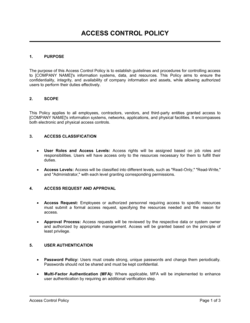
- Access controls. Describes how access to sensitive systems or physical areas is granted, reviewed, and revoked.
- Incident response. Outlines the steps to detect, contain, report, and recover from a security incident or breach.
- Compliance references. Cites applicable regulations or standards — such as GDPR, ISO 27001, or NIST — that the document is designed to support.
- Review and update cycle. States how frequently the document must be reviewed and who is responsible for keeping it current.
- Consequences of non-compliance. Specifies disciplinary, contractual, or legal consequences when rules are violated.
How to write a security assessment or policy document
A well-written security document does three things: it defines the threat scope clearly, assigns ownership unambiguously, and provides actionable controls that staff can actually follow.
1
Define the document's purpose and scope
State what the document governs — a specific system, a department, or the whole organization — and what it does not cover.
2
Identify the assets or data being protected
List the specific systems, data categories, or physical assets the policy is designed to protect.
3
Assess the threat landscape
Identify the realistic threats — phishing, unauthorized access, data leakage, physical intrusion — relevant to your environment.
4
Assign roles and responsibilities
Name the specific job titles or teams accountable for each control, not just 'management' or 'IT'.
5
Define the controls and rules
Write clear, actionable requirements: what staff must do, what systems must be configured to, and what behaviors are prohibited.
6
Reference applicable compliance requirements
Cite the regulations or standards your organization must meet — GDPR, ISO 27001, SOC 2, HIPAA — so the document serves as compliance evidence.
7
Establish a review cycle and version control
Set a review date — typically every 12 months or after a significant incident — and record the document version and approver.
8
Obtain sign-off and distribute
Have the appropriate authority (CISO, IT Director, or CEO) approve the document, then distribute it to all relevant personnel with acknowledgment records.
At a glance
- What it is
- A security assessment template is a structured document used to define, evaluate, or enforce an organization's security controls, policies, and obligations. Templates in this category cover everything from broad cybersecurity policy frameworks to specific IT audit agreements and remote work security rules.
- When you need one
- Any time your organization handles sensitive data, onboards remote workers, undergoes a third-party audit, or needs to demonstrate compliance with regulations such as GDPR, you need a documented security framework in place.
Which Security Assessment do I need?
The right template depends on whether you need a governance policy, a technical audit document, a contractual agreement, or a compliance-specific framework. Match your situation below.
Your situation
Recommended template
Setting a company-wide cybersecurity framework for all staff
Establishes organization-wide rules for protecting digital assets and systems.Documenting how the organization protects information assets broadly
Covers the full spectrum of information security controls and responsibilities.Conducting or commissioning a third-party cybersecurity audit
Formalizes scope, deliverables, and confidentiality for an external audit engagement.Producing a formal report after an IT security review
Structured report format for documenting findings, risks, and remediation steps.Establishing security rules for employees working remotely
Defines acceptable use, device rules, and access controls for remote staff.Demonstrating GDPR compliance through a documented security policy
Aligns security controls with GDPR data-protection obligations.Controlling physical access to offices and secure areas
Defines physical security zones, visitor rules, and access authorization procedures.Responding to a security breach with a documented incident plan
Outlines step-by-step procedures for detecting, containing, and reporting incidents.Glossary
- Security assessment
- A formal review of an organization's security controls and practices to identify vulnerabilities, gaps, and risks.
- Security policy
- An internal governance document that defines the rules, responsibilities, and standards an organization uses to protect its assets.
- Cyber threat
- Any malicious attempt to damage, disrupt, or gain unauthorized access to computer systems, networks, or data.
- Access control
- A security mechanism that restricts who can view or use resources in a computing environment or physical space.
- Incident response
- The organized process for detecting, containing, and recovering from a security breach or other adverse event.
- GDPR
- The EU General Data Protection Regulation — a law that sets requirements for how organizations collect, process, and protect personal data of EU residents.
- Penetration testing
- An authorized simulated attack on a system, performed to evaluate its security defenses and expose exploitable weaknesses.
- Risk rating
- A score or classification assigned to a security finding that reflects the likelihood of exploitation and the potential business impact.
- Acceptable use policy
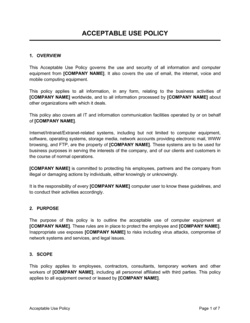
- A document that defines what employees may and may not do with company technology, networks, and data.
- Remediation
- The process of fixing or mitigating identified security vulnerabilities after they have been discovered in an assessment.
- ISO 27001
- An international standard that specifies requirements for establishing, implementing, and maintaining an information security management system.
- Zero trust
- A security model that assumes no user or system is trusted by default, requiring continuous verification before granting access.
What is a security assessment?
A security assessment is a structured evaluation of an organization's security controls, policies, systems, and practices, designed to identify vulnerabilities, assign risk ratings, and recommend corrective actions. In a business context, security assessments can take the form of a written policy that governs how employees handle data, a formal audit report produced after a technical review, or a contractual agreement that defines the terms of a third-party security engagement. The documents in this category span that full range — from broad organizational frameworks to highly specific technical policies.
Security assessment documents serve two audiences simultaneously: internal staff who need clear, actionable rules to follow, and external parties — regulators, insurers, auditors, and enterprise customers — who need evidence that your organization takes security seriously. A well-structured security policy or audit report is one of the most cost-effective risk management tools available, because it sets expectations in writing before an incident occurs rather than scrambling to explain what went wrong after one.
The category includes security policies scoped by domain (network, email, data, physical, personnel), compliance-specific frameworks (GDPR internal and external policies), remote work security rules, incident response plans, and the audit agreements and assessment reports that external reviewers use to do their work.
When you need a security assessment
The need for a formal security document is typically triggered by a change — in your workforce, systems, regulatory environment, or risk exposure. If any of the situations below apply to your organization, a template from this category gives you a documented starting point.
Common triggers:
- Your company is handling personal data subject to GDPR, HIPAA, or a similar regulation for the first time
- An enterprise customer or insurer has requested proof of a documented information security policy
- You are onboarding remote employees and need enforceable rules for device use, VPN access, and data handling
- A third-party auditor is about to review your systems and you need an engagement agreement in place first
- You have experienced a security incident and need to document the response process going forward
- Your organization is growing and informal security practices need to be formalized before they become liabilities
- A new office, data center, or physical facility requires documented access control and physical security procedures
- You are preparing for an ISO 27001 or SOC 2 certification and need policy documentation as evidence
Operating without documented security policies leaves organizations exposed in two ways: practically, staff have no clear guidance on what to do (or not do), and legally, the organization has no evidence it took reasonable steps to protect data if a breach leads to regulatory scrutiny or litigation. A documented security framework — even one built from templates — demonstrates due diligence and gives you a foundation to build on as your organization grows.
Award-winning platform
- Great Place to Work 2025
- BIG Award — Product of the Year 2025
- Smartest Companies 2025
- Global 100 Excellence 2026
- Best of the Best 2025