Production Planning Templates
★★★★★4.7from 280+ reviews· Trusted by 20M+ businesses
Plan, schedule, and manage production operations with ready-to-use templates for every stage of the process.
WordEditable onlinePDF10+ production planning templates
Other Production & Operations categories
Core production planning documents
Film and video production
Operations governance policies
250K+Clients
20M+Free users
20+Years
190+Countries
10,000+Law firms
50M+Downloads
Trusted across review platforms
- Capterra★★★★☆4.649 reviews
- G2★★★★☆4.713 reviews
- GetApp★★★★☆4.649 reviews
- Google Play★★★★☆4.6179 ratings
- Google Reviews★★★★☆4.567 reviews
Frequently asked questions
What is a production plan and what should it include?
A production plan is a document that translates a demand forecast into a schedule for producing goods or services. It should include output targets, resource assignments, a material requirements list, a production timeline, quality checkpoints, and a brief risk register. The level of detail scales with the complexity of the operation — a small manufacturer may need two pages; a large facility may need a multi-tab workbook.
What is the difference between production planning and production scheduling?
Production planning is the strategic layer — deciding what to produce, how much, with which resources, and over what period. Production scheduling is the operational output of that plan — the specific day-by-day or shift-by-shift timetable. You need a plan before you can build a meaningful schedule.
How far ahead should a production plan look?
Most manufacturers use a rolling three-to-twelve-month horizon for the master production plan, with a more detailed weekly or daily schedule for the near term. The right horizon depends on your lead times: if key materials take three months to procure, your plan must look at least that far ahead to avoid stockouts.
What is material requirement planning (MRP)?
MRP is a calculation process — often supported by software — that works backward from a production schedule to determine exactly what materials to order and when. It factors in current inventory, open purchase orders, and lead times to generate a time-phased procurement plan. An MRP template gives you the structure to perform this calculation manually or to document the outputs of an MRP system.
Do small businesses need a formal production plan?
Yes, even at small scale. A one-page production schedule and a simple materials list prevent the two most common small-business production failures: running out of materials mid-run and missing delivery commitments. The effort is proportional — a small operation doesn't need enterprise-level documentation, but some written plan prevents costly surprises.
How does a production plan relate to a health and safety policy?
The production plan defines what tasks will be performed and by whom; the health and safety policy defines the safe procedures for performing those tasks. In most jurisdictions, employers are required to assess workplace hazards before production begins. Reviewing both documents together ensures that the schedule is achievable without cutting safety corners.
Can production planning templates be used for media and creative production?
Yes. Film production budgets, video scripts, and webinar planning documents all follow the same underlying logic as manufacturing production plans — define deliverables, allocate resources, set a timeline, and control costs. The terminology differs, but the structure is identical. Templates in this folder cover both physical goods production and media or content production workflows.
What is a succession planning policy and why is it in a production folder?
A succession planning policy documents how an organization will identify and develop people to fill key operational roles when incumbents leave. In production environments, the loss of a production supervisor or operations manager without a successor plan can halt output entirely. Including succession planning in the production planning workflow ensures continuity of operations.
Production Planning vs. related documents
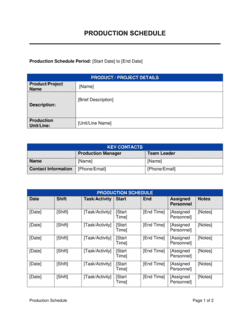
A production plan is a high-level document covering resources, capacity, and strategy across a planning period. A production schedule is the operational output of that plan — a day-by-day or week-by-week timeline of specific tasks, quantities, and deadlines. You write the plan first, then derive the schedule from it.
A project plan manages a one-time initiative with a defined start and end date. A production plan manages a repeating operational cycle — the ongoing manufacture of goods or delivery of services. Production plans focus on throughput, capacity, and inventory; project plans focus on scope, milestones, and deliverables.
MRP is a specific sub-process within production planning that calculates what raw materials and components to order and when. A production plan is broader — it sets capacity targets, staffing levels, and output goals. MRP feeds inputs into the production schedule; the production plan sets the targets that MRP works backward from.
An operations manual documents standing procedures, standards, and policies for running the business. A production plan is forward-looking — it allocates resources and sets targets for an upcoming production period. Both are necessary: the manual tells people how to work; the plan tells them what to produce and by when.
Key clauses every Production Planning contains
Regardless of industry or format, effective production planning documents share the same foundational sections.
- Production objectives. States the quantity, quality standard, and delivery deadline that the plan is designed to achieve.
- Resource allocation. Identifies the labor, equipment, and facilities assigned to each production task or phase.
- Material requirements. Lists the raw materials, components, and consumables needed, tied to a procurement schedule.
- Capacity plan. Compares available production capacity against planned demand to identify bottlenecks before they occur.
- Production timeline. A sequenced schedule showing when each phase, batch, or task begins and ends.
- Quality control checkpoints. Defines the inspection points and acceptance criteria applied during and after production.
- Health and safety requirements. Specifies the safety standards, protective equipment, and procedures applicable to the production environment.
- Risk and contingency plan. Documents foreseeable disruptions — supply shortages, equipment failure, demand spikes — and the response for each.
How to write a production plan
A production plan translates demand forecasts into a concrete operational blueprint. Follow these steps to build one that works.
1
Define your output targets
Start with the demand forecast or customer order volume — the number of units, deliverables, or service hours the plan must produce.
2
Audit your current capacity
Measure available machine hours, labor hours, and facility space against the output target to identify gaps before committing to a schedule.
3
Build the material requirements list
Work backward from the output target to list every raw material and component needed, the lead time for each, and the reorder points.
4
Assign resources and responsibilities
Map each production task to a specific team, machine, or individual, and confirm that no single resource is double-booked.
5
Sequence the production schedule
Arrange tasks in the order they must be completed, factoring in dependencies, setup times, and quality inspection holds.
6
Add quality and safety controls
Insert inspection checkpoints at critical stages and reference the applicable health and safety procedures for each work area.
7
Document risks and contingency responses
List the two or three most likely disruptions — a supplier delay, an equipment outage — and write a one-sentence response for each.
8
Review, approve, and distribute
Have the operations manager and relevant department heads sign off, then share the plan with every team responsible for execution.
At a glance
- What it is
- A production planning template is a structured document that helps operations and manufacturing teams coordinate resources, timelines, materials, and personnel to deliver output on time and within budget.
- When you need one
- Any time a business is launching, scaling, or restructuring a production process — whether manufacturing goods, creating media, or delivering services — a production plan keeps every stakeholder aligned.
Which Production Planning do I need?
The right production planning document depends on what stage of the production process you're in and which function you're trying to support. Match your situation below.
Your situation
Recommended template
Building a week-by-week timeline for a manufacturing or creative run
Gives production managers a structured timeline to track output targets and deadlines.Calculating raw materials and components needed for a production run
Maps demand to inventory requirements so procurement can order the right quantities.Budgeting costs for a film or video production project
Line-item budget template covering crew, equipment, location, and post-production costs.Establishing safety procedures across a production facility
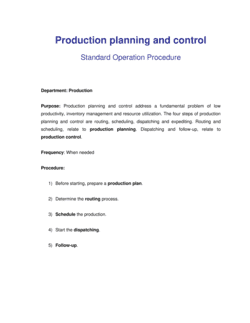
Formalizes workplace safety obligations and reduces liability in production environments.Documenting step-by-step guidance for running production operations
Provides a sequential operational guide for production managers and supervisors.Creating a long-range strategic direction for the operations function
Structures goals, priorities, and resource allocation across a planning horizon.Contracting a filmmaker or production company for a project
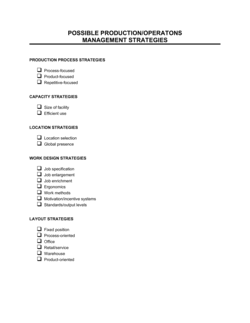
Defines scope, deliverables, rights, and payment terms for a film production engagement.Outlining possible strategies for managing production and operations
Presents a range of strategic options to inform operations decision-making.Glossary
- Master production schedule (MPS)
- A time-phased plan stating exactly how many finished goods will be produced in each period, used as the input to MRP calculations.
- Material requirement planning (MRP)
- A process that calculates the quantity and timing of raw materials and components needed to meet a production schedule.
- Capacity planning
- The process of comparing available production resources — labor, machines, space — against planned demand to identify and resolve bottlenecks.
- Bill of materials (BOM)
- A complete list of every component, raw material, and sub-assembly needed to produce one unit of finished output.
- Lead time
- The elapsed time between placing an order for a material or component and its arrival on the production floor.
- Throughput
- The rate at which a production system produces finished output per unit of time.
- Work in progress (WIP)
- Partially completed goods or tasks that are currently moving through the production process but are not yet finished.
- Production run
- A single continuous period of manufacturing the same product or batch before switching to a different item or configuration.
- Cycle time
- The total time from the start of one unit of production to the start of the next, including processing, waiting, and inspection time.
- Contingency plan
- A pre-written response to a foreseeable disruption — such as a supplier delay or equipment failure — that keeps production moving.
What is a production plan?
A production plan is a structured operational document that translates customer demand or output targets into a coordinated schedule of tasks, resource assignments, material orders, and quality controls. It tells a production team what to make, how much to make, who is responsible for each step, and when each phase must be complete. Without a written plan, production operations default to informal coordination — which works until demand spikes, a supplier delays, or a key team member is absent.
Production planning spans a wide range of industries and output types. A manufacturer building physical goods needs a plan that covers machinery, raw materials, labor shifts, and warehouse capacity. A media company producing a film or video series needs a plan that covers crew, equipment hire, location access, and post-production timelines. A service business delivering recurring output — reports, campaigns, training sessions — needs a plan that maps tasks to calendar weeks and assigns ownership. The underlying logic is identical across all three: define the goal, allocate the resources, sequence the work, and monitor against the schedule.
Effective production plans also serve as the foundation for compliance and governance. Health and safety obligations, procurement controls, and quality standards all flow from the production plan — they define the conditions under which the work in the plan is legally and safely performed.
When you need a production plan
Any time output must be coordinated across more than one person, machine, or supplier, a production plan prevents the gaps and overlaps that cause delays, cost overruns, and quality failures.
Common triggers:
- Launching a new product line or increasing output volume beyond current capacity
- Onboarding a new production supervisor or operations manager who needs a documented process to follow
- Responding to a large or time-sensitive customer order that requires dedicated scheduling
- Starting a film, video, or media production project with multiple contractors and locations
- Preparing for a third-party audit, ISO certification, or regulatory inspection of production operations
- Restructuring a facility layout, shift pattern, or supply chain after disruption
- Developing an annual operating budget that requires validated production output assumptions
- Building a succession or continuity plan to ensure operations continue if key personnel leave
Operating without a written production plan transfers risk from the document to individual memory and informal communication. When something goes wrong — a missed delivery, a safety incident, a procurement failure — the absence of a plan makes it harder to identify the cause and nearly impossible to demonstrate due diligence to customers, insurers, or regulators. A clear plan creates the paper trail that protects the business and the people running it.
Award-winning platform
- Great Place to Work 2025
- BIG Award — Product of the Year 2025
- Smartest Companies 2025
- Global 100 Excellence 2026
- Best of the Best 2025