Marketing Strategy Templates
★★★★★4.7from 280+ reviews· Trusted by 20M+ businesses
Plan, align, and execute every marketing initiative with a structured template built for your specific goal.
WordEditable onlinePDF10+ marketing strategy templates
Other Sales & Marketing categories
Most popular marketing strategy templates
Communications and brand strategy
250K+Clients
20M+Free users
20+Years
190+Countries
10,000+Law firms
50M+Downloads
Trusted across review platforms
- Capterra★★★★☆4.649 reviews
- G2★★★★☆4.713 reviews
- GetApp★★★★☆4.649 reviews
- Google Play★★★★☆4.6179 ratings
- Google Reviews★★★★☆4.567 reviews
Frequently asked questions
What should a marketing strategy template include?
A complete marketing strategy template should cover a situation analysis, target audience profiles, positioning and value proposition, goals with measurable KPIs, channel and tactic mix, budget allocation, a messaging framework, and a timeline. Templates in this folder include all of these sections in editable formats so you can adapt them to your business size and planning horizon.
What is the difference between a marketing strategy and a marketing plan?
A marketing strategy defines your positioning, target audience, and competitive approach — the "why" behind your marketing. A marketing plan translates that strategy into specific campaigns, budgets, timelines, and deliverables. Strategy is directional and relatively stable; the plan is operational and updated more frequently.
How long should a marketing strategy be?
There is no fixed length. A startup's first marketing strategy might be 4–6 pages; a mid-market company's annual plan might run 20–30 pages with supporting data. The right length is whatever covers the key components without padding — clarity and specificity matter more than page count.
How often should a marketing strategy be updated?
Most businesses revisit their marketing strategy annually, aligned with budget cycles. However, significant market changes — a new competitor, an economic shift, a product pivot — warrant an interim review. Setting a quarterly check-in to measure KPIs and flag needed adjustments is good practice even when no full rewrite is required.
Can a small business use the same marketing strategy template as a large company?
Yes, with adjustment. The core components — audience, positioning, channels, goals — apply at any scale. Small businesses typically simplify the budget and channel sections and operate with shorter planning horizons (90 days rather than 12 months). The templates in this folder are designed to be scaled up or down depending on your team size and resources.
What is a go-to-market strategy and when do I need one?
A go-to-market (GTM) strategy is a plan for launching a specific product, feature, or service into the market. It covers launch positioning, target segments, pricing, distribution channels, and sales enablement. You need one any time you introduce something new — not just at company founding. Use the Go To Market Strategies template in this folder to structure that launch planning.
How is a content strategy different from a marketing strategy?
A content strategy is a subset of the broader marketing strategy. It focuses specifically on what content to create, for whom, on which channels, and how it supports the buyer journey. A marketing strategy sets the overall direction; the content strategy details how owned media and editorial programming will contribute to those goals.
Do I need a separate social media strategy?
If social media is a significant channel for your business, a standalone social media strategy is worth the effort. It forces clarity on platform selection, posting cadence, audience personas by platform, content mix, and engagement tactics — detail that is hard to fit inside a broader marketing strategy document without bloating it.
Marketing Strategy vs. related documents
A marketing strategy defines the "why" and "who" — your target audience, positioning, and competitive approach. A marketing plan defines the "how" and "when" — specific campaigns, timelines, budgets, and deliverables. Strategy comes first; the plan executes it. Many organizations use a single document that covers both layers, which is what the Marketing Plan template in this folder supports.
A business strategy covers the entire organization: operations, finance, HR, and market positioning. A marketing strategy is a functional-level document that sits inside the business strategy and focuses specifically on how the company attracts and retains customers. The two should be aligned — marketing goals should directly support the business's growth and revenue objectives.
A marketing brief is a short document created for a specific campaign, project, or agency engagement. A marketing strategy is a standing document that governs all marketing activity over a planning horizon (typically 12 months). Briefs reference the strategy to stay aligned; they don't replace it.
A go-to-market (GTM) plan is a time-bound document for a specific launch: a product, feature, or market entry. A marketing strategy spans the full portfolio and planning year. Use a GTM plan alongside your broader strategy whenever you have a discrete launch event; retire it once the launch phase ends.
Key clauses every Marketing Strategy contains
Regardless of which template you use, every effective marketing strategy document is built from the same core components.
- Situation analysis. A snapshot of the current market, competitive landscape, and internal capabilities — often structured as a SWOT or PEST analysis.
- Target audience definition. Describes the specific customer segments the strategy addresses, including demographics, behaviors, pain points, and buying triggers.
- Positioning and value proposition. States how the brand or product is differentiated from competitors and why the target audience should choose it.
- Goals and KPIs. Sets specific, measurable marketing objectives — leads generated, conversion rate, customer acquisition cost, market share — tied to a time horizon.
- Channel and tactic mix. Specifies which channels (search, social, email, events, partnerships) will be used and what activity each will produce.
- Budget allocation. Distributes marketing spend across channels, campaigns, and time periods, with a rationale tied to expected return.
- Messaging framework. Defines the core messages, tone, and proof points used consistently across all channels and materials.
- Timeline and milestones. Maps planned activities to a calendar so teams can coordinate production, approvals, and launches.
- Measurement and review cadence. Establishes how often performance will be reviewed, which data sources will be used, and how the strategy will be adjusted.
How to write a marketing strategy
A marketing strategy is most useful when it connects business goals to specific audience insights and measurable actions — here's how to build one.
1
Start with your business goals
Anchor the strategy to one or two primary business objectives — revenue target, market share, customer count — so every tactic can be tied back to a result.
2
Analyze the market and your position in it
Document the competitive landscape, customer segments, and your current strengths and gaps using a SWOT or similar framework.
3
Define your target audience
Build specific audience profiles that go beyond demographics to include motivations, objections, preferred channels, and purchase triggers.
4
Write your positioning and value proposition
State in one or two sentences why your target customer should choose you over the alternatives — this becomes the foundation of all messaging.
5
Choose your channels and tactics
Select the channels where your audience is active and that match your budget, then assign specific tactics and owners to each.
6
Set a budget and allocate by priority
Distribute spend according to the channels and campaigns most likely to move the needle, and document the assumptions behind each allocation.
7
Define KPIs and a review schedule
Set measurable targets for each goal and schedule monthly or quarterly reviews to assess performance and adjust the strategy.
At a glance
- What it is
- A marketing strategy template is a structured document that guides how a business attracts, engages, and retains customers by defining target audiences, positioning, channels, and measurable goals. It turns strategic intent into an actionable plan the whole team can follow.
- When you need one
- Any time you launch a product, enter a new market, set an annual budget, or realign your brand, a written marketing strategy keeps decisions consistent and measurable across teams and stakeholders.
Which Marketing Strategy do I need?
The right template depends on your current goal — launching something new, growing an existing business, building audience relationships, or formalizing a cross-functional plan. Match your situation below.
Your situation
Recommended template
Launching a new product or entering a new market segment
Covers positioning, channel selection, launch milestones, and success metrics.Writing an annual marketing plan for the whole company
Full-scope plan covering goals, budget, channels, and performance KPIs.Scaling revenue through structured growth initiatives
Focused on growth levers: acquisition, conversion, retention, and referral.Building a consistent presence across social platforms
Defines platform mix, content cadence, audience personas, and engagement goals.Planning an editorial or content marketing program
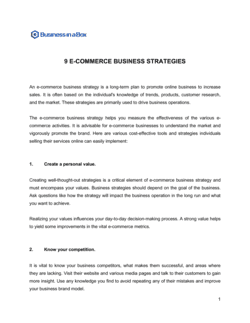
Maps content types, topics, channels, and production workflows to business goals.Selling products through an online store
Covers the nine highest-impact tactics specific to ecommerce conversion and retention.Setting or rethinking how your product is priced
Walks through competitive pricing models, value-based pricing, and margin targets.Expanding into new customer segments or geographies
Structures the research, targeting, and go-forward plan for market expansion.Glossary
- Positioning
- How a brand or product is differentiated in the minds of target customers relative to competitors.
- Value proposition
- A concise statement of the specific benefit a product or service delivers and why a customer should choose it over alternatives.
- Target audience
- The specific group of people a marketing strategy is designed to reach, defined by shared characteristics, needs, or behaviors.
- Go-to-market strategy
- A plan that outlines how a company will reach target customers and achieve competitive advantage when launching a product or entering a new market.
- KPI (Key Performance Indicator)
- A measurable value used to track progress toward a specific marketing goal, such as cost per lead or customer acquisition cost.
- SWOT analysis
- A framework that assesses a business's Strengths, Weaknesses, Opportunities, and Threats to inform strategic decisions.
- Channel mix
- The combination of marketing channels — search, social, email, events, paid media — a company uses to reach its audience.
- Messaging framework
- A structured document that defines the core messages, tone of voice, and proof points used consistently across all marketing materials.
- Customer acquisition cost (CAC)
- The total marketing and sales spend required to acquire one new customer, used to measure the efficiency of a marketing strategy.
- Market segmentation
- The process of dividing a broad target market into smaller groups with shared characteristics so marketing can be tailored to each.
- Competitive analysis
- A structured review of direct and indirect competitors' positioning, pricing, strengths, and weaknesses.
What is a marketing strategy?
A marketing strategy is a structured plan that defines how a business will attract, engage, and convert its target customers over a defined period. It establishes who the audience is, how the brand is positioned against competitors, which channels will be used to reach buyers, and what measurable outcomes the business is working toward. Unlike a campaign brief or a one-off promotion plan, a marketing strategy is a standing document that governs all marketing activity and keeps decisions consistent across teams, budgets, and quarters.
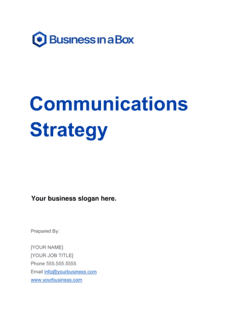
Marketing strategies range from broad, company-wide frameworks that align with overall business goals to focused, function-specific plans — such as a content strategy, a social media strategy, or a go-to-market plan for a new product launch. In practice, most businesses maintain a master marketing strategy document and a set of supporting channel or campaign strategies beneath it. The templates in this folder cover the full range, from a single-page communications strategy to a detailed growth or business development plan.
When you need a marketing strategy
Without a written strategy, marketing activity tends to be reactive — chasing trends, duplicating effort, or spending budget on channels that don't reach the right audience. A documented marketing strategy is the fix. You need one whenever the stakes are high enough that misalignment across the team would cost real money or time.
Common triggers:
- Starting a new business and deciding how to reach your first customers
- Launching a new product, feature, or service to an existing or new market
- Entering a new geographic market or customer segment
- Setting an annual marketing budget and needing to justify channel allocations
- Rebranding or repositioning after a competitive shift or pivot
- Onboarding a new marketing team, agency, or leadership hire who needs direction
- Recovering from flat or declining growth and diagnosing what to change
The cost of operating without a marketing strategy isn't always visible immediately — it shows up as inconsistent messaging, wasted spend, and missed targets over one or two planning cycles. A written strategy, reviewed and updated on a regular cadence, gives every campaign and every dollar a clear reason to exist.
Award-winning platform
- Great Place to Work 2025
- BIG Award — Product of the Year 2025
- Smartest Companies 2025
- Global 100 Excellence 2026
- Best of the Best 2025