HR Operations and Records Templates
★★★★★4.7from 280+ reviews· Trusted by 20M+ businesses
Build a consistent, compliant HR function with ready-to-use templates for every operational need.
WordEditable onlinePDF13+ HR operations and records templates
Other Human Resources categories
Most popular HR operations templates
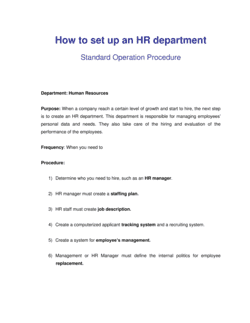
HR department setup and strategy
Job descriptions: HR and operations roles
250K+Clients
20M+Free users
20+Years
190+Countries
10,000+Law firms
50M+Downloads
Trusted across review platforms
- Capterra★★★★☆4.649 reviews
- G2★★★★☆4.713 reviews
- GetApp★★★★☆4.649 reviews
- Google Play★★★★☆4.6179 ratings
- Google Reviews★★★★☆4.567 reviews
Frequently asked questions
What documents does HR need to keep for each employee?
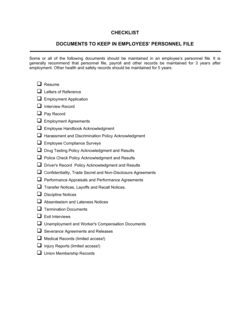
At minimum, employee records should include the offer letter, signed employment contract, tax forms, emergency contact information, performance reviews, disciplinary records, and termination documentation. Many jurisdictions also require payroll records, I-9 or equivalent work authorization documents, and records of any workplace injuries. Retention requirements vary by country and document type, so check local employment law for specifics.
How long should HR records be kept?
Retention periods depend on the document type and jurisdiction. In the US, payroll records are generally kept for three years, I-9 forms for up to three years after termination, and OSHA records for five years. In the EU, GDPR limits retention to what is necessary for the stated purpose. A formal records retention policy — reviewed by legal counsel — is the most reliable way to stay compliant.
Do small businesses need a formal HR operations manual?
Yes — even companies with 5–10 employees benefit from documented HR processes. An operations manual reduces inconsistent treatment of employees, speeds up onboarding of new managers, and provides evidence of fair practice if a dispute arises. It doesn't need to be long: a concise manual covering hiring, records, conduct, and offboarding is enough to start.
What is the difference between an HR policy and an HR procedure?
A policy states the company's position and rules on a topic — for example, "all employees must comply with our attendance policy." A procedure describes the steps to implement or enforce that policy — for example, how managers should record and report absences. Both are necessary: the policy sets the standard; the procedure makes it operational.
Who is responsible for maintaining HR records?
Typically the HR department owns and maintains employee records, with line managers contributing performance and disciplinary documentation. In small businesses without dedicated HR staff, the responsibility often falls to the business owner or office manager. Regardless of size, at least one named individual should be accountable for records accuracy, security, and timely disposal.
What should be included in an HR operations manual?
A well-structured HR operations manual typically covers the organization's HR structure, core policies (attendance, conduct, leave), hiring and onboarding procedures, performance management processes, recordkeeping requirements, and offboarding steps. It should reference — but not duplicate — the employee handbook, which is aimed at employees rather than HR practitioners.
How often should HR policies be reviewed and updated?
At minimum, review HR policies annually. Trigger an out-of-cycle review any time employment law changes, a significant incident occurs, headcount doubles, or the business enters a new jurisdiction. Document each review with a version date and the name of the reviewer, and communicate material changes to employees in writing.
Are HR records confidential?
Yes. Employee records contain sensitive personal information — compensation, health data, disciplinary history — and must be kept confidential. Access should be limited to those with a legitimate business need (typically HR and direct management). In most jurisdictions, employees have the right to access their own records. Data protection laws such as GDPR in the EU impose additional obligations on storage, processing, and transfer of personal data.
HR Operations and Record vs. related documents
An HR operations manual documents internal processes and procedures for the HR team itself. An employee handbook is a communication document directed at employees that explains their rights, benefits, and workplace expectations. You need both: the operations manual guides how HR functions; the handbook tells employees what to expect. They draw from the same policies but serve different audiences.
HR operations documents set organization-wide rules and procedures; employment contracts set the individual terms between the company and a specific employee. A policy states what the company requires of all employees (e.g., attendance, data use). A contract binds one employee to specific compensation, duties, and conditions. Policies can be updated unilaterally; contracts generally require mutual agreement to change.
An operations manual provides a broad overview of how a department or company runs, including structure and responsibilities. An SOP is a narrower, step-by-step document for a single process or task. Most well-run HR departments maintain both: the manual covers the big picture, while SOPs handle specific recurring activities like onboarding or payroll processing.
A records management and retention policy defines the rules — what to keep, how long, and how to destroy it. A retention schedule is the accompanying reference table that lists each document type and its required retention period. The policy governs the program; the schedule is the operational tool used to implement it. Both should be maintained together.
Key clauses every HR Operations and Record contains
Across all HR operations and records documents, a consistent set of core elements ensures the document is actionable and legally defensible.
- Scope and applicability. Defines which employees, locations, departments, or situations the document covers.
- Roles and responsibilities. Names who owns the process — HR, management, or employees — and what each party is expected to do.
- Recordkeeping requirements. Specifies which documents must be maintained, in what format, and for how long.
- Confidentiality and data access. Establishes who may access employee records and under what conditions, protecting personal data.
- Policy compliance and enforcement. States the consequences of non-compliance and the process for addressing violations.
- Review and update cadence. Sets out how often the document is reviewed and who is responsible for keeping it current.
- Governing law and regulatory alignment. References applicable employment laws, labor regulations, or data protection requirements the document is designed to satisfy.
How to build an HR operations and records system
Establishing a functional HR operations and records system requires defining roles, documenting processes, and creating the policies that keep everything consistent and auditable.
1
Map your HR functions and responsibilities
List every HR activity your organization performs — hiring, onboarding, recordkeeping, compliance — and assign an owner for each.
2
Draft a core HR policy document
Create a foundational HR policy that covers attendance, conduct, data handling, and other company-wide standards applicable to all employees.
3
Build an employee records system
Decide what information you'll retain for each employee, in what format (digital or paper), and who can access it.
4
Establish a records retention policy
Define how long each category of HR record is kept and how it is securely destroyed when no longer required.
5
Document operational procedures in a manual
Capture recurring HR processes — onboarding steps, payroll cycles, performance reviews — in a written operations manual.
6
Write job descriptions for HR and operations roles
Use standardized job descriptions to define reporting lines, responsibilities, and qualifications for every HR and operations position.
7
Review for legal and regulatory compliance
Check all policies against applicable employment law, data protection regulations, and any industry-specific requirements before publishing.
8
Schedule regular document reviews
Set an annual or biannual review cycle to update records, policies, and manuals as laws, headcount, or business structure changes.
At a glance
- What it is
- HR operations and records documents are the policies, procedures, manuals, and forms that govern how a company manages its workforce day to day. They create a documented, repeatable system for hiring, retaining, and administering employees while meeting legal recordkeeping requirements.
- When you need one
- Any time you're formalizing HR processes — setting up a department, onboarding staff, enforcing workplace policies, or preparing for an audit — you need properly structured HR operations documents in place.
Which HR Operations and Record do I need?
The right template depends on what HR function you're trying to document — whether that's storing employee data, setting workplace rules, defining roles, or structuring how your entire HR department runs.
Your situation
Recommended template
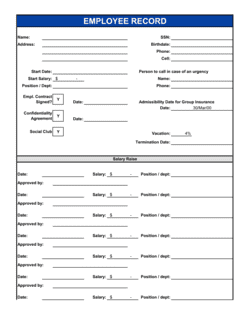
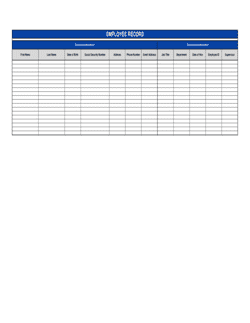
Storing and organizing personnel files for current employees
Provides a structured format for capturing all required employee data in one place.Setting a company-wide policy for keeping and disposing of files
Defines retention schedules and disposal rules to meet legal compliance requirements.Documenting standard procedures for running business operations
Gives staff a single reference for processes, responsibilities, and workflows.Standardizing HR rules and expectations across the organization
Covers core HR policy topics in a single, cohesive policy document.Building or restructuring an HR department from the ground up
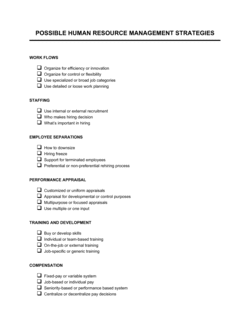
Walks through the structure, roles, and priorities needed to launch a functioning HR team.Creating a multi-year roadmap for HR strategy and workforce planning
Aligns HR goals with business objectives across recruitment, retention, and development.Hiring an HR director and defining the scope of the role
Pre-written role scope, responsibilities, and qualifications ready to post or adapt.Enforcing a probationary period policy for new hires
Establishes clear expectations and review milestones for employees in their first 90 days.Glossary
- Employee records
- The collection of documents and data a company maintains about an individual employee throughout their employment lifecycle.
- Records retention policy
- A written policy specifying how long different categories of business and HR records must be kept before they can be destroyed.
- Operations manual
- A document describing how a business or department functions, including processes, responsibilities, and standard procedures.
- HR policy
- A formal statement of the rules and expectations governing employee conduct and HR practices within an organization.
- Probationary period
- A defined timeframe — typically 30, 60, or 90 days — during which a new employee's performance and fit are formally assessed.
- Strategic HR plan
- A multi-year document aligning HR priorities — hiring, development, retention — with the organization's business goals.
- Records disposal
- The secure destruction or deletion of records that have passed their required retention period, typically per a documented policy.
- Acceptable use policy
- A policy defining how employees may use company technology, systems, and data in the course of their work.
- Data subject access request (DSAR)
- A formal request by an individual to access the personal data an organization holds about them, required under data protection laws such as GDPR.
- HR audit
- A systematic review of HR policies, records, and practices to identify gaps, compliance risks, or inefficiencies.
- Workforce planning
- The process of forecasting future staffing needs and developing a plan to meet them through hiring, training, or restructuring.
What is an HR operations and records system?
An HR operations and records system is the combination of policies, procedures, manuals, and forms that an organization uses to manage its workforce consistently and document its compliance with employment law. These documents define how the HR function is structured, what rules apply to employees, how personnel data is stored and protected, and how recurring HR processes — from hiring to offboarding — are executed.
HR operations documents serve two audiences simultaneously. Internally, they guide HR staff and managers through processes that must be applied consistently across the organization. Externally, they provide the paper trail an employer needs to defend against disputes, pass audits, and demonstrate compliance with labor regulations. Without them, even well-intentioned HR decisions can look arbitrary or discriminatory in hindsight.
The category spans a wide range: from high-level strategic plans and operations manuals that define how the HR function works, to granular policy documents covering attendance, acceptable use, anti-harassment, and background checks. Together they form the operational backbone of any HR department.
When you need HR operations and records documents
The need for formal HR operations documentation usually arises at a predictable set of inflection points: when a business hires its first employees, when headcount grows past the point where informal norms break down, when a compliance obligation surfaces, or when inconsistent HR decisions create legal exposure.
Common triggers:
- A startup reaches 10–15 employees and needs to standardize HR processes before informal practices become entrenched
- A company is audited by a labor authority and lacks documented evidence of compliant practices
- A new HR director or manager joins and needs a clear picture of how the department currently functions
- An employee dispute or termination reveals that no written policy governed the situation
- A business acquires another company and must align HR practices and records across both organizations
- A data breach or privacy complaint exposes gaps in employee records access controls
- A franchise or multi-location business needs to ensure consistent HR practices across sites
Skipping formal HR operations documentation doesn't eliminate the need for it — it just means decisions get made inconsistently, records are scattered or incomplete, and the company has little protection when things go wrong. Establishing clear documents early is far less costly than reconstructing them during a dispute or audit.
Award-winning platform
- Great Place to Work 2025
- BIG Award — Product of the Year 2025
- Smartest Companies 2025
- Global 100 Excellence 2026
- Best of the Best 2025