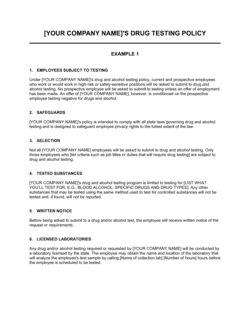
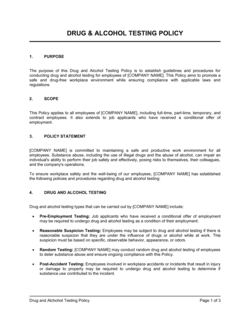
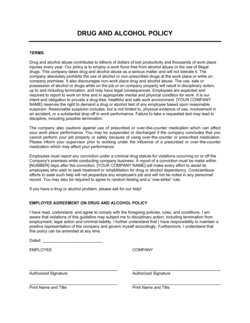
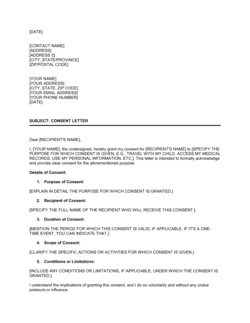
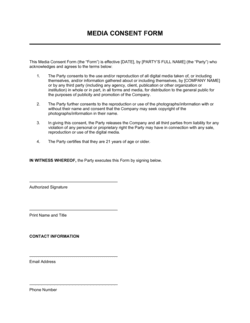
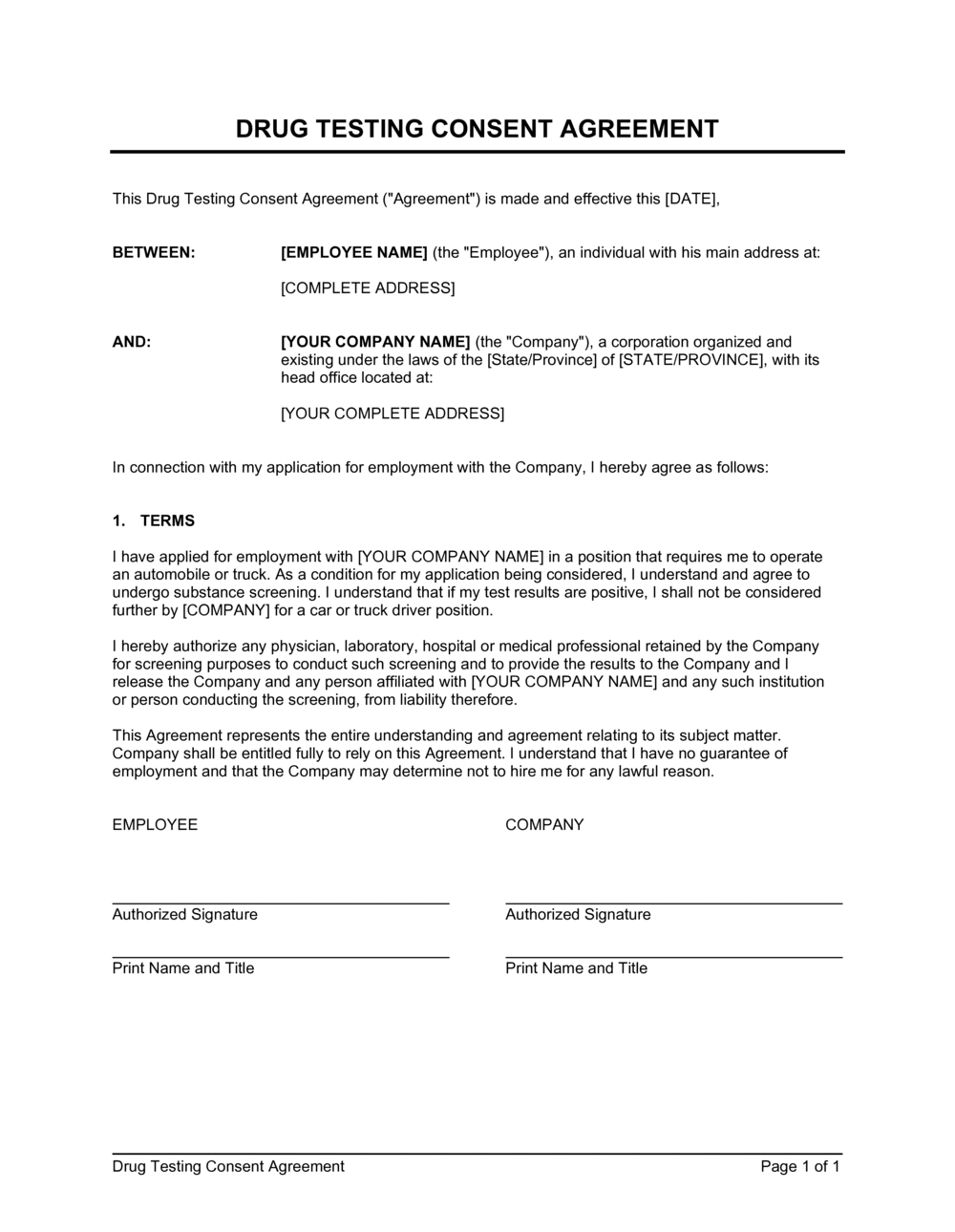
Drug Testing Consent Agreement Template

Free Word download • Edit online • Save & share with Drive • Export to PDF

1 page20–30 min to fillDifficulty: StandardSignature requiredLegal review recommended
Learn more ↓
FreeDrug Testing Consent Agreement Template

At a glance

What it is
A Drug Testing Consent Agreement is a legally binding document in which an employee or job applicant acknowledges the employer's drug and alcohol testing program and authorizes the collection and analysis of biological specimens. This free Word download covers testing scope, procedures, confidentiality, consequences of refusal or positive results, and the employee's rights — ready to edit online and export as PDF.
When you need it
Use it before conducting any pre-employment, random, reasonable-suspicion, post-accident, or return-to-duty drug test. Many industries and government contracts require documented, signed consent before any specimen is collected.
What's inside
Authorization to test, scope of substances tested, specimen collection procedures, laboratory and testing methodology, confidentiality and disclosure rules, consequences of a positive result or refusal, employee rights and appeal process, and governing law.

What is a Drug Testing Consent Agreement?

A Drug Testing Consent Agreement is a legally binding document in which an employee or job applicant expressly authorizes an employer to collect biological specimens — typically urine, oral fluid, or breath — and submit them for drug and alcohol analysis as part of a workplace testing program. It identifies both parties, defines the scope of substances tested and the occasions that trigger testing, describes the chain-of-custody and laboratory procedures, and records the individual's acknowledgment of their rights, including the right to a split-sample retest and a Medical Review Officer evaluation of any confirmed positive result. Unlike a general policy acknowledgment, a signed consent agreement creates the specific, individual-level legal authorization required before any specimen may be collected.

Why You Need This Document

Conducting a drug test without a properly executed consent agreement exposes an employer to battery claims, ADA disability discrimination liability, and statutory penalties under state drug-testing laws — regardless of whether the test result itself was positive. Without documented consent, a positive finding may be inadmissible in disciplinary proceedings, and any termination based on it becomes legally vulnerable. For DOT-regulated employers, testing without the required consent documentation is a direct violation of 49 CFR Part 40, which can result in regulatory sanctions and disqualification from federal programs. Beyond legal exposure, a well-drafted consent agreement also protects employees — it ensures they understand the process, know how to disclose lawful prescriptions before testing, and can exercise their right to challenge a positive result. This template gives employers a defensible, complete starting point that covers every material element required for a legally sound testing program.

Which variant fits your situation?

If your situation is…Use this template
Testing a job applicant before extending a formal offerPre-Employment Drug Testing Consent Agreement
Conducting random testing under a DOT-regulated safety programDOT Drug and Alcohol Testing Consent Form
Testing an employee following a workplace accident or incidentPost-Accident Drug Testing Consent Agreement
Testing an employee returning from a substance-related leaveReturn-to-Duty Drug Testing Consent Form
Testing based on observed behavioral impairment indicatorsReasonable-Suspicion Drug Testing Consent Agreement
Establishing the broader written drug-free workplace policyDrug-Free Workplace Policy
Testing contractors or third-party vendors on a job siteContractor Drug Testing Consent Agreement

Common mistakes to avoid

❌ Obtaining consent after the specimen is collected

Why it matters: Consent obtained after the fact is not legally valid consent. Any subsequent positive result may be inadmissible in disciplinary proceedings, and the employer may face claims of battery or civil rights violations.

Fix: Establish a workflow that blocks collection until a signed consent form is confirmed received — a simple checklist in the collection site intake process prevents this entirely.

❌ Using a one-size-fits-all form for DOT and non-DOT employees

Why it matters: DOT-regulated positions require specific panel composition, thresholds, MRO involvement, and split-sample rights that differ from a standard commercial testing program. Mixing the forms creates non-compliance with 49 CFR Part 40.

Fix: Maintain separate consent forms for DOT-regulated and non-DOT positions, clearly labeled, and stored in different onboarding packets.

❌ Omitting prescription medication disclosure procedures

Why it matters: An employee terminated for a positive result caused by a lawfully prescribed medication — with no mechanism to disclose it — has a strong ADA and disability discrimination claim in most jurisdictions.

Fix: Include a specific MRO contact for confidential prescription disclosures and train HR staff to defer all positive-result decisions until the MRO review is complete.

❌ Failing to update the form when the testing policy changes

Why it matters: If the consent form describes a 5-panel test but the employer administers a 10-panel, or if the consequences clause no longer matches current policy, the mismatch creates ambiguity that employees and their attorneys will exploit.

Fix: Attach a version date to every consent form and audit it annually — or whenever the underlying Drug-Free Workplace Policy is amended — to confirm all terms remain consistent.

❌ Storing drug test results in the general personnel file

Why it matters: ADA guidance, HIPAA-adjacent state statutes, and several state drug-testing laws require medical and test records to be kept in a separate, access-restricted file. Commingling them exposes the employer to statutory penalties and privacy claims.

Fix: Create a dedicated confidential medical file for each employee at hire and route all drug test documentation — consent forms, results, MRO reports — exclusively to that file.

❌ Applying testing only to certain demographic groups or roles without documented, neutral criteria

Why it matters: Selective testing based on race, national origin, or other protected characteristics violates Title VII and equivalent state and provincial anti-discrimination laws, regardless of what the consent form says.

Fix: Document the objective, role-based criteria that trigger each testing type — random-selection algorithm outputs, DOT safety-sensitive designation, or written reasonable-suspicion documentation — and apply them uniformly.

The 10 key clauses, explained

Parties and Authorization

In plain language: Identifies the employer and the individual being tested, and records the employee's or applicant's express, voluntary consent to the testing program.

Sample language
I, [EMPLOYEE/APPLICANT FULL NAME], hereby authorize [EMPLOYER LEGAL NAME] and its designated testing facility to collect biological specimens from me and to conduct drug and/or alcohol testing as described in this Agreement.

Common mistake: Using a blanket authorization buried in an onboarding packet instead of a standalone signed document. Courts have found that consent obtained without clear, specific language may not satisfy legal requirements in jurisdictions that mandate informed consent.

Scope of Testing and Substances Covered

In plain language: Defines which drugs and alcohol will be tested for, what types of specimens will be collected, and which testing occasions are covered — pre-employment, random, post-accident, or reasonable suspicion.

Sample language
Testing may include screening for [LIST OF SUBSTANCES — e.g., marijuana, cocaine, opiates, amphetamines, PCP, and alcohol]. Specimens may include urine, oral fluid, or breath. Testing occasions include: pre-employment, random selection, post-accident, and reasonable suspicion.

Common mistake: Listing only a standard 5-panel screen when the employer's policy or applicable regulations require a broader panel. A mismatch between the consent form and the actual test administered creates liability exposure.

Testing Procedures and Collection

In plain language: Describes how specimens will be collected, who will conduct the collection, chain-of-custody requirements, and the certified laboratory that will analyze the specimens.

Sample language
Specimen collection will be conducted by [COLLECTION FACILITY NAME], a [SAMHSA/DOT]-certified collector, in accordance with [49 CFR Part 40 / applicable guidelines]. All specimens will be processed under chain-of-custody procedures and analyzed by [LABORATORY NAME].

Common mistake: Omitting the name or certification status of the collection facility. If the chain of custody is later challenged, an unverified collector can invalidate the test result and undermine disciplinary action.

Confidentiality and Disclosure

In plain language: States who will receive test results, how results will be stored, and the limited circumstances under which results may be disclosed to third parties.

Sample language
Test results will be disclosed only to [HR DIRECTOR / DESIGNATED REPRESENTATIVE] and, where required, to [REGULATORY AGENCY / DOT]. Results will be maintained in a confidential file separate from the employee's general personnel record and will not be disclosed except as required by law or with the employee's written consent.

Common mistake: Failing to separate drug test records from general personnel files. Under ADA guidance and several state laws, medical and test records must be kept in a separate, confidential file.

Prescription Medication Disclosure

In plain language: Provides a process for the employee to confidentially disclose lawfully prescribed medications that may affect test results, and explains how the Medical Review Officer evaluates such disclosures.

Sample language
Prior to testing, you may confidentially disclose any lawfully prescribed medications to the Medical Review Officer at [MRO CONTACT]. The MRO will evaluate disclosed prescriptions before reporting results to [EMPLOYER NAME].

Common mistake: Skipping this clause entirely. Without a prescription disclosure mechanism, an employer who disciplines an employee for a positive result caused by a lawful prescription may face ADA or disability discrimination claims.

Consequences of a Positive Result or Refusal

In plain language: Specifies the employment consequences — including termination, suspension, or conditional reinstatement — that follow a confirmed positive result or a refusal to submit to testing.

Sample language
A confirmed positive result or refusal to submit to testing may result in [immediate termination / suspension pending investigation / conditional reinstatement subject to a return-to-duty program], at [EMPLOYER NAME]'s sole discretion, consistent with [EMPLOYER NAME]'s Drug-Free Workplace Policy.

Common mistake: Using absolute language like 'will result in immediate termination' when the employer's actual policy allows for EAP referral or last-chance agreements. Inconsistency between the consent form and the applied policy exposes the employer to wrongful termination claims.

Employee Rights and Appeal Process

In plain language: Informs the employee of their right to request a split-sample retest, receive a copy of their results, and appeal a positive determination through the MRO or a grievance process.

Sample language
You have the right to request testing of your split specimen at a second [SAMHSA]-certified laboratory within 72 hours of receiving notice of a confirmed positive result. To exercise this right, contact [MRO NAME] at [MRO CONTACT].

Common mistake: Omitting appeal rights entirely. Federal DOT regulations require disclosure of the split-sample right; failing to provide it in the consent form renders the test non-compliant and potentially inadmissible in disciplinary proceedings.

ADA and Disability Accommodation Acknowledgment

In plain language: Confirms that the employer will evaluate positive results involving lawfully prescribed controlled substances in compliance with ADA obligations, and that current illegal drug use is not a protected disability.

Sample language
Testing under this Agreement is conducted in compliance with the Americans with Disabilities Act. [EMPLOYER NAME] will consider ADA obligations when evaluating test results involving lawfully prescribed medications. Current illegal drug use is not protected under the ADA.

Common mistake: Including this clause without training supervisors on how to apply it. Supervisors who automatically terminate employees for prescription-related positives — ignoring the MRO review — expose the company to ADA discrimination liability regardless of what the form says.

Voluntary Consent and Acknowledgment

In plain language: States that the individual signs voluntarily, that they have read and understood the agreement, and that they understand refusal may affect their employment or application.

Sample language
I acknowledge that I have read and understood this Drug Testing Consent Agreement. I understand that my signature is voluntary and that refusal to sign or to submit to testing may result in [withdrawal of the employment offer / disciplinary action up to and including termination].

Common mistake: Using a checkboxonly digital acknowledgment without capturing a dated signature. Many jurisdictions and federal programs require a handwritten or legally valid electronic signature with a timestamp to demonstrate informed consent.

Governing Law and Entire Agreement

In plain language: Specifies the jurisdiction whose laws govern the agreement and confirms that this document, together with the employer's Drug-Free Workplace Policy, constitutes the complete agreement on testing.

Sample language
This Agreement is governed by the laws of [STATE/PROVINCE/COUNTRY]. Together with [EMPLOYER NAME]'s Drug-Free Workplace Policy, this Agreement constitutes the entire understanding between the parties regarding drug and alcohol testing and supersedes all prior representations.

Common mistake: Choosing a governing law that conflicts with the employee's actual work location. Several states — California, for example — impose additional restrictions on drug testing that apply regardless of what the contract's choice-of-law clause states.

How to fill it out

  1. 1

    Enter the employer's legal entity name and location

    Use the full registered corporate or business name — not a trade name or abbreviation — and the principal place of business. This entity is the contracting party responsible for the testing program.

    💡 Cross-reference your business registration or payroll records to confirm the exact legal name before the employee signs.

  2. 2

    Identify the employee or applicant

    Record the individual's full legal name, job title or applied-for position, and employee ID or applicant reference number. Pre-employment forms should note the position to which the applicant has applied.

    💡 For applicants, complete this section after a conditional offer of employment has been made — testing an applicant before any offer can raise disparate-impact concerns under EEOC guidance.

  3. 3

    Define the testing scope and substances

    Specify the substances covered (at minimum, a standard 5-panel: marijuana, cocaine, opiates, amphetamines, PCP), the specimen type (urine is most common), and which testing occasions apply to this individual.

    💡 For DOT-regulated positions, use the exact panel and thresholds required by 49 CFR Part 40 — do not substitute a generic commercial panel.

  4. 4

    Complete the collection facility and laboratory details

    Fill in the name, address, and certification status (SAMHSA-certified for federal programs) of the collection site and the laboratory that will process the specimen.

    💡 Confirm the laboratory's current SAMHSA certification before each testing cycle — certifications are reviewed annually and can lapse.

  5. 5

    Name the Medical Review Officer

    Enter the MRO's name, contact information, and the MRO's certification body. The MRO contact must be reachable directly by the employee for prescription disclosures and appeal requests.

    💡 If your testing vendor provides the MRO, confirm in writing that the MRO is independent from the collection facility to satisfy federal independence requirements.

  6. 6

    Set the consequences and cross-reference your policy

    Complete the consequences clause to match exactly what your Drug-Free Workplace Policy states — termination, suspension, EAP referral, or last-chance agreement. Cross-reference the policy by name and version date.

    💡 Never use more punitive language in the consent form than the policy itself allows. Courts and arbitrators enforce the less restrictive of the two documents.

  7. 7

    Select the governing law

    Enter the state, province, or country whose laws will govern the agreement — typically the jurisdiction where the employee performs most of their work, not where the employer is incorporated.

    💡 Review your chosen jurisdiction's drug testing statutes before finalizing. Some states require specific consent language, advance notice periods, or employee rights disclosures not covered by a generic template.

  8. 8

    Obtain a dated signature before testing begins

    Have the employee or applicant sign and date the form before any specimen is collected. For eSign, use a compliant platform that timestamps the signature and captures IP address or identity verification.

    💡 Retain the signed original in a confidential medical file separate from the general personnel record — not in the standard HR file.

Frequently asked questions

What drugs are typically covered in a workplace drug test?

The standard federal 5-panel test covers marijuana (THC), cocaine, opiates (including heroin), amphetamines (including methamphetamine), and phencyclidine (PCP). DOT programs use the same 5-panel but with federally mandated cutoff levels. Many private employers expand to a 9- or 10-panel test adding barbiturates, benzodiazepines, methadone, propoxyphene, and MDMA. Alcohol testing is conducted separately via breath or saliva and is typically addressed in the same consent agreement.

What happens if an employee tests positive for a legally prescribed medication?

A Medical Review Officer reviews the confirmed positive result and contacts the employee to inquire about legitimate medical explanations, including lawfully prescribed medications. If the MRO determines the positive is consistent with a valid prescription, the result is typically reported as negative to the employer. Employers should not receive or act on a positive result until the MRO review is complete — doing so without that review exposes the employer to ADA disability discrimination claims.

Can an employer conduct random drug testing without a consent agreement?

For at-will employees in most US states, employers can generally condition continued employment on participation in a random testing program — but obtaining a signed consent form at the outset is strongly recommended. For DOT-regulated employees, written consent and program documentation are mandatory under 49 CFR Part 40. Outside the US, random testing without clear documented consent is generally impermissible and may constitute an invasion of privacy under applicable law.

Does marijuana legalization in a state affect a workplace drug testing consent agreement?

State marijuana legalization does not override an employer's right to maintain a drug-free workplace policy and test for THC in most states — but the consequences of a positive result vary. Several states, including California, New Jersey, and New York, restrict adverse employment action based solely on off-duty marijuana use or a positive THC test without evidence of on-the-job impairment. DOT-regulated employers must continue to test for marijuana and treat positive results as violations regardless of state law. Review the specific statute in each state where employees work.

How this compares to alternatives

vs Drug-Free Workplace Policy

A drug-free workplace policy is the employer's program-level document establishing prohibited conduct, testing occasions, consequences, and EAP provisions. The consent agreement is the individual-level authorization each employee signs. You need both — the policy creates the program; the consent form creates the legal basis to test each individual. Using only a policy without individual consent forms is insufficient in most jurisdictions.

vs Employee Handbook Acknowledgment Form

A handbook acknowledgment confirms the employee received and read the employee handbook, including any drug-testing policy section. It is not a substitute for a standalone drug testing consent agreement. Courts and arbitrators distinguish between general policy acknowledgments and the specific, informed consent required for biological specimen collection — the former rarely satisfies the latter.

vs Background Check Authorization Form

A background check authorization covers criminal record, credit, and employment history searches under the Fair Credit Reporting Act. A drug testing consent agreement covers biological specimen collection and laboratory analysis. Both are pre-employment documents, but they govern different types of inquiry, carry different legal requirements, and must be kept as separate signed documents — combining them on one form is expressly prohibited for FCRA-governed background checks.

vs Medical Examination Consent Form

A medical examination consent authorizes a broader physical or fitness-for-duty evaluation, often including blood work, vision, and functional tests. Drug testing consent is narrower — it covers only substance screening specimens. Where both are required (e.g., DOT physicals), they must be executed as separate documents because the legal frameworks governing each — ADA for medical exams, DOT regulations for drug tests — impose different requirements.

Industry-specific considerations

Transportation and Logistics

DOT mandates drug and alcohol testing for all safety-sensitive positions under 49 CFR Part 40, requiring SAMHSA-certified labs, a qualified MRO, and documented random-pool selection — all of which must be referenced in the consent agreement.

Construction and Trades

Site-safety programs, general contractor requirements, and workers' compensation insurance discounts tied to drug-free workplace certification all require signed consent forms before workers access job sites.

Healthcare

Hospital accreditation standards (The Joint Commission), state licensing boards, and DEA registration conditions for facilities handling controlled substances require documented employee drug screening with signed consent.

Manufacturing

OSHA post-accident investigation protocols and safety-sensitive equipment operation requirements make documented consent critical; a missing consent form can complicate workers' compensation claims following a positive post-accident test.

Federal Contractors and Government

The Drug-Free Workplace Act of 1988 requires federal contractors and grantees receiving awards above $100,000 to maintain a written drug-free workplace program, which includes documented employee consent to testing.

Staffing and Recruitment

Staffing agencies must collect consent from candidates before placement and often maintain the consent records on behalf of the client employer, making version control and jurisdiction-specific language especially critical.

Jurisdictional notes

United States

No single federal statute mandates drug testing for private employers, but the Drug-Free Workplace Act of 1988 applies to federal contractors and grantees above $100,000. DOT regulations (49 CFR Part 40) mandate testing for safety-sensitive transportation roles. State laws vary dramatically — some states (Minnesota, Iowa, Maine) prescribe the exact language required in consent forms; others (California, New York, New Jersey) restrict adverse action based on off-duty marijuana use or require additional procedural protections. Review the specific statute in every state where employees work.

Canada

Drug testing in Canada is heavily restricted by human rights legislation at both federal and provincial levels. Random testing for non-safety-sensitive positions is generally prohibited. In safety-sensitive industries (mining, transportation, nuclear), testing may be permissible where there is evidence of a workplace drug or alcohol problem, supported by a documented safety policy. Employers must accommodate employees with substance dependency as a disability up to the point of undue hardship. Quebec's Charter of Human Rights and Freedoms adds additional privacy protections. Consent alone does not make testing lawful — the testing program itself must meet reasonableness standards.

United Kingdom

UK employers may conduct drug testing only where it is clearly justified by the nature of the role and proportionate to the risk — random testing is permissible in safety-critical sectors (transport, nuclear, offshore). The UK GDPR and Data Protection Act 2018 classify drug test results as special category health data, requiring explicit consent and a documented lawful basis for processing. Employees must receive a written policy before any testing program is introduced, and results must be processed only by named personnel with access-restricted records. Employment contracts or workplace policies must expressly authorize testing before it begins.

European Union

EU member states treat drug test results as special category health data under GDPR Article 9, requiring explicit consent or another narrowly defined lawful basis for processing. Workplace drug testing is permitted only where demonstrably necessary for occupational safety and proportionate to the risk — broad or random testing programs face significant legal barriers in most member states. France, Germany, and the Netherlands impose additional national restrictions on which roles may be tested and how results may be used. Works councils or employee representative bodies in many EU countries must be consulted before a testing program is introduced, regardless of individual consent.

Template vs lawyer — what fits your deal?

PathBest forCostTime
Use the templateSmall businesses conducting standard pre-employment or random testing for non-DOT positions in a single stateFree20–30 minutes
Template + legal reviewEmployers in states with specific drug-testing statutes (CA, NY, NJ, MN), multi-state employers, or any business adding DOT-regulated positions$300–$700 for a 1–2 hour employment attorney review2–5 business days
Custom draftedFederal contractors, DOT-regulated fleets, healthcare accreditation requirements, or businesses with unionized workforces where consent terms may be subject to collective bargaining$1,000–$3,500+1–3 weeks

Glossary

Chain of Custody
A documented sequence of possession and handling of a biological specimen from collection through laboratory analysis, used to prevent tampering and ensure test validity.
Medical Review Officer (MRO)
A licensed physician responsible for reviewing laboratory drug test results, evaluating legitimate medical explanations for positive findings, and reporting results to the employer.
Specimen
The biological sample collected for testing — most commonly urine, but also breath, oral fluid, hair, or blood, depending on the testing protocol.
Confirmed Positive
A drug test result that has been verified by a second confirmatory test (typically GC-MS) and reviewed by a Medical Review Officer, distinguishing it from an initial screen.
Reasonable Suspicion Testing
Drug or alcohol testing initiated when a supervisor has documented, articulable observations — such as slurred speech, erratic behavior, or odor — suggesting impairment.
DOT Testing
Drug and alcohol testing required by the U.S. Department of Transportation for safety-sensitive employees in transportation industries, governed by 49 CFR Part 40.
Refusal to Test
An employee's failure to appear, provide a specimen, or cooperate with the testing process — treated in most programs as equivalent to a positive test result.
Split Sample
A second portion of the same specimen retained by the testing laboratory that the employee may request be sent to a second certified lab for independent analysis.
EAP (Employee Assistance Program)
An employer-sponsored confidential counseling and referral service that employees may be directed to following a positive drug test or as a condition of continued employment.
Drug-Free Workplace Program
A formal employer policy establishing testing protocols, prohibited substance lists, employee education, and consequences — often required for federal contractors under the Drug-Free Workplace Act of 1988.

Part of your Business Operating System

This document is one of 3,000+ business & legal templates included in Business in a Box.

  • Fill-in-the-blanks — ready in minutes
  • 100% customizable Word document
  • Compatible with all office suites
  • Export to PDF and share electronically

Create your document in 3 simple steps.

From template to signed document — all inside one Business Operating System.
1
Download or open template

Access over 3,000+ business and legal templates for any business task, project or initiative.

2
Edit and fill in the blanks with AI

Customize your ready-made business document template and save it in the cloud.

3
Save, Share, Send, Sign

Share your files and folders with your team. Create a space of seamless collaboration.

Save time, save money, and create top-quality documents.

★★★★★

"Fantastic value! I'm not sure how I'd do without it. It's worth its weight in gold and paid back for itself many times."

Managing Director · Mall Farm
Robert Whalley
Managing Director, Mall Farm Proprietary Limited
★★★★★

"I have been using Business in a Box for years. It has been the most useful source of templates I have encountered. I recommend it to anyone."

Business Owner · 4+ years
Dr Michael John Freestone
Business Owner
★★★★★

"It has been a life saver so many times I have lost count. Business in a Box has saved me so much time and as you know, time is money."

Owner · Upstate Web
David G. Moore Jr.
Owner, Upstate Web

Run your business with a system — not scattered tools

Stop downloading documents. Start operating with clarity. Business in a Box gives you the Business Operating System used by over 250,000 companies worldwide to structure, run, and grow their business.

Free Forever Plan · No credit card required