Trading Policy Template

Free Word download β€’ Edit online β€’ Save & share with Drive β€’ Export to PDF

6 pagesβ€’20–30 min to fillβ€’Difficulty: Standard
Learn more ↓
FreeTrading Policy Template

At a glance

What it is
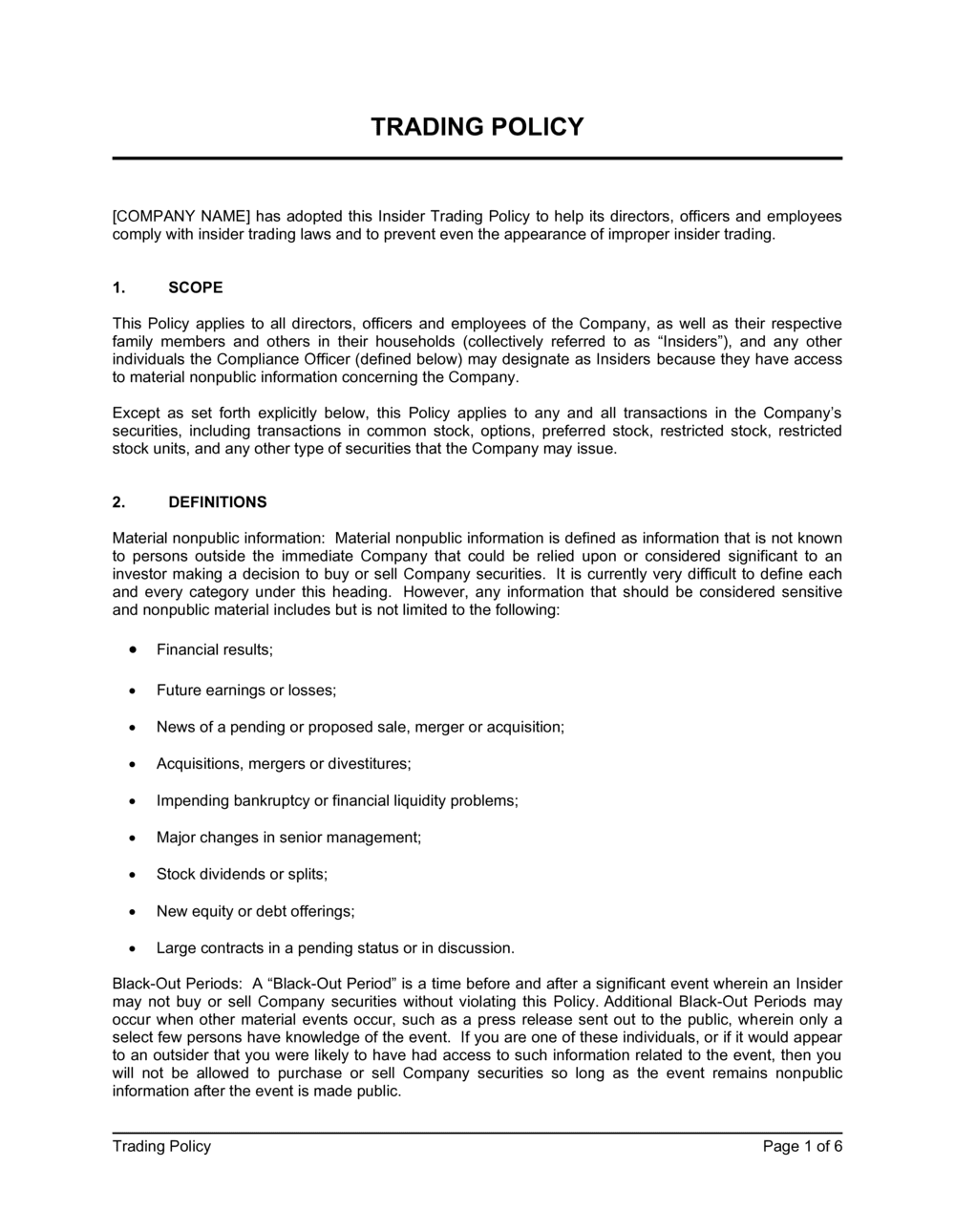
A Trading Policy is a formal internal document that defines the rules, limits, and procedures governing how employees, officers, and affiliated parties may buy, sell, or hold financial instruments β€” including company securities, derivatives, and other traded assets. This free Word download gives you a structured, ready-to-edit starting point you can customize to your organization's size and risk profile and export as PDF for distribution and acknowledgment.
When you need it
Use it when employees have access to material non-public information, when staff trade company stock or client assets, when a regulator or auditor requests evidence of internal controls over trading activity, or when onboarding into a broker-dealer, fund, or publicly listed company structure.
What's inside
Scope and covered persons, permitted and prohibited instruments, pre-clearance procedures, blackout periods, position limits and holding requirements, conflict-of-interest disclosures, reporting obligations, and enforcement and disciplinary procedures.

What is a Trading Policy?

A Trading Policy is a formal internal document that establishes the rules, procedures, and limits governing how employees, officers, directors, and affiliated individuals may buy, sell, or hold financial instruments β€” including company securities, derivatives, and other traded assets. It defines who is subject to its requirements, which instruments are covered, what activities are prohibited, how pre-clearance and blackout periods work, and what happens when the rules are breached. Unlike a general code of conduct, a trading policy provides operationally specific controls: named approval contacts, defined submission windows, and a graduated sanctions framework that can be consistently applied and documented.

Why You Need This Document

Without a written trading policy, your organization has no documented basis for disciplining an employee who trades on sensitive information, no formal blackout mechanism to activate before a material corporate announcement, and no evidence of internal controls to present to a regulator, acquirer, or auditor. The consequences of that gap are concrete: securities regulators in the US, UK, Canada, and EU treat the absence of a written policy as an aggravating factor when investigating suspected insider trading or market abuse. A single undocumented transaction by a covered employee can expose the company to institutional liability alongside the individual. A well-structured trading policy closes these gaps by creating a clear compliance framework before an incident occurs β€” and by establishing the paper trail that demonstrates the organization took its obligations seriously. This template gives you a professionally structured starting point that covers the core controls every organization needs, ready to customize to your specific instruments, jurisdictions, and risk appetite.

Which variant fits your situation?

If your situation is…Use this template
Controlling employee trading in the company's own listed securitiesInsider Trading Policy
Setting rules for treasury investment of surplus company cashTreasury Investment Policy
Governing trading by investment professionals on behalf of clientsPersonal Account Dealing Policy
Managing risk limits for a trading desk or proprietary trading unitRisk Management Policy
Documenting acceptable use of company financial accounts broadlyFinancial Controls Policy
Defining rules for cryptocurrency or digital asset transactionsDigital Asset Trading Policy
Establishing conflict-of-interest disclosures for all staffConflict of Interest Policy

Common mistakes to avoid

❌ Omitting derivatives and hedging instruments from the covered instruments list

Why it matters: Covered persons can take economically equivalent short or speculative positions through options and collars without technically violating a policy that only lists shares. The exposure β€” and the regulatory risk β€” is identical.

Fix: List all derivative instruments referencing company securities by name and add a catch-all provision covering 'any instrument whose value is materially correlated with [COMPANY] securities.'

❌ No event-driven blackout process

Why it matters: Quarterly blackouts only protect the period around earnings. M&A negotiations, undisclosed regulatory investigations, and major product announcements occur outside that window and can expose covered persons and the company to insider trading liability.

Fix: Grant the compliance officer explicit written authority to impose an immediate event-driven blackout and define the notification process β€” typically email to all covered persons within one business day of the decision to impose it.

❌ Collecting only one-time conflict-of-interest disclosures at onboarding

Why it matters: A covered person may acquire a new financial interest in a counterparty or competitor months after joining. A static onboarding form captures the conflict only if it existed on day one.

Fix: Require ongoing annual disclosure plus an immediate notification obligation β€” within 2 business days β€” whenever a new conflict arises during employment.

❌ Failing to obtain and retain signed acknowledgments

Why it matters: In a regulatory investigation or employment dispute, a company that cannot prove a covered person received and understood the policy has limited ability to enforce sanctions or defend its compliance program.

Fix: Distribute the policy at onboarding and annually thereafter, collect dated signatures or electronic acknowledgments, and store them in a compliance system with a retrievable audit trail.

The 9 key sections, explained

Purpose and scope

Covered instruments and asset classes

Prohibited trading activities

Pre-clearance procedures

Blackout periods

Position limits and holding periods

Conflict-of-interest disclosure

Reporting and record-keeping obligations

Enforcement, sanctions, and escalation

How to fill it out

  1. 1

    Define covered persons and entities

    List every category of individual bound by the policy β€” employees, officers, directors, contractors, and their immediate household members. Include controlled entities such as family trusts or LLCs through which a covered person might trade.

    πŸ’‘ Review your cap table, board roster, and contractor agreements to identify anyone with regular access to MNPI before finalizing the covered persons list.

  2. 2

    Enumerate all covered instruments

    List every instrument class the policy governs β€” equity, options, convertibles, ETFs with material concentration in company stock, and any other derivative referencing the company or its major clients.

    πŸ’‘ When in doubt, err toward inclusion. A covered person can always ask for a specific exemption; an instrument not listed is automatically outside the policy's reach.

  3. 3

    Set blackout period dates and triggers

    Enter the standard quarterly blackout start and end dates based on your fiscal calendar. Then define the event-driven trigger list β€” M&A, regulatory filings, material contract signings β€” that empowers the compliance officer to impose ad hoc blackouts.

    πŸ’‘ Build the quarterly blackout calendar for the full year and distribute it to all covered persons at the start of January β€” eliminating 'I didn't know' defenses.

  4. 4

    Establish the pre-clearance process

    Name the designated compliance contact, specify the submission format (email or form), set the lead time (2 business days is standard), and state how long an approval remains valid before it lapses.

    πŸ’‘ Keep approval validity short β€” 5 business days is the market standard. Longer windows allow trades to proceed after new MNPI has emerged.

  5. 5

    Set position limits and holding periods

    Enter the maximum portfolio concentration limit for company securities and the minimum holding period for open-market purchases. Include specific rules for shares acquired through equity compensation plans.

    πŸ’‘ Tie holding periods to your standard equity vesting schedule so the two policies are consistent and covered persons receive a single coherent message.

  6. 6

    Define reporting cadence and submission format

    Set the quarterly holdings report deadline, specify the transaction confirmation window (5 business days post-trade is standard), and name the repository β€” compliance inbox, HR system, or compliance platform β€” where records are filed.

    πŸ’‘ Request direct broker-feed confirmations or custody statements in addition to self-reporting. The additional data layer materially strengthens your audit trail.

  7. 7

    Specify sanctions and the escalation path

    List the disciplinary ladder from verbal warning through termination, and name the body β€” general counsel, audit committee, or board β€” to which confirmed violations are escalated. Include the regulatory referral obligation for suspected market abuse.

    πŸ’‘ Have legal counsel confirm the applicable regulatory referral obligation for your jurisdiction before finalizing this section β€” the obligation varies by country and instrument type.

  8. 8

    Obtain acknowledgments and store signed copies

    Distribute the policy to all covered persons and collect a signed acknowledgment confirming they have read, understood, and agree to comply. Re-collect acknowledgments annually and whenever the policy is materially amended.

    πŸ’‘ Track acknowledgment completion rates in your HR or compliance system. An unsigned policy provides weak protection β€” a regulator will ask for evidence of distribution and receipt.

Frequently asked questions

What is a trading policy?

A trading policy is a formal internal document that governs how employees, officers, directors, and affiliated parties may trade financial instruments β€” including company securities, derivatives, and other assets. It sets pre-clearance requirements, blackout periods, position limits, and conflict-of-interest disclosure obligations to prevent insider trading, market abuse, and reputational harm to the organization.

Who needs a trading policy?

Any organization where employees have access to material non-public information, trade company stock, or manage client assets typically needs a written trading policy. This includes publicly listed companies, investment firms, broker-dealers, hedge funds, and larger private companies planning an IPO. Regulators in most jurisdictions expect evidence of written controls before investigating a trading-related incident.

What is a blackout period in a trading policy?

A blackout period is a defined window during which covered persons are prohibited from trading company securities regardless of whether they possess MNPI. Standard quarterly blackouts typically begin 15 calendar days before a fiscal quarter ends and lift 2 business days after earnings are publicly released. Event-driven blackouts can be imposed at any time by the compliance officer when a material undisclosed event is in progress.

What is pre-clearance and when is it required?

Pre-clearance is a mandatory approval process requiring a covered person to obtain written permission from a designated compliance contact before executing a personal trade in a covered instrument. It is typically required for all open-market transactions outside a pre-approved Rule 10b5-1 plan. The standard lead time is 2 business days, and approvals typically lapse after 5 business days if not acted upon.

Does a trading policy prevent all insider trading liability?

A well-drafted trading policy significantly reduces the risk of insider trading violations by establishing controls, documentation, and a compliance culture. However, it does not eliminate liability if a covered person knowingly trades on MNPI in violation of the policy. The policy's primary function is to create clear rules, deter violations, and provide evidence of the organization's compliance program to regulators.

What is the difference between a trading policy and an insider trading policy?

An insider trading policy focuses specifically on preventing trades based on material non-public information about the company. A trading policy is broader β€” it also covers position limits, permitted instruments, conflict-of- interest disclosures, treasury trading rules, and general conduct standards for anyone managing or transacting in financial instruments on behalf of or in connection with the organization.

How often should a trading policy be updated?

Review the policy annually as a minimum, and update it immediately following any material change in the company's regulatory status, listing venue, instrument types traded, or applicable law. Companies preparing for an IPO should update their policy at least 6 months before the expected listing date to embed controls before insider status becomes a significant legal exposure.

Does a private company need a trading policy?

Private companies with employee stock options, convertible notes, or secondary trading activity in their shares benefit from a trading policy even before listing. It establishes a compliance culture, protects against claims of unfair information asymmetry among shareholders, and positions the company well for diligence by acquirers or underwriters who will expect evidence of internal controls.

What should happen when a covered person violates the trading policy?

The policy should specify a graduated sanctions ladder β€” from written warning to termination β€” and an escalation path to general counsel or the audit committee. Where the violation involves suspected trading on MNPI, the company typically has a regulatory obligation to report the activity to the relevant securities regulator. Documented, consistent enforcement is critical; selective application undermines the policy's credibility and the company's compliance defense.

How this compares to alternatives

vs Conflict of Interest Policy

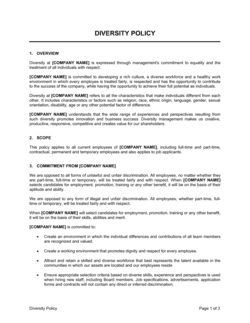
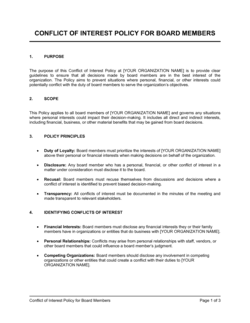
A conflict of interest policy governs all situations where an employee's personal interests could influence their professional judgment β€” gifts, outside employment, vendor relationships, and financial holdings. A trading policy is narrower, focusing specifically on the rules and procedures for buying and selling financial instruments. Most organizations need both; the trading policy handles the mechanics of permitted transactions, while the conflict of interest policy addresses the broader disclosure framework.

vs Risk Management Plan

A risk management plan identifies, assesses, and prioritizes all categories of organizational risk β€” operational, financial, reputational, and strategic β€” and defines mitigation strategies. A trading policy is an operational control document focused on a single risk domain: unauthorized or harmful trading activity. The trading policy typically exists as one of several controls referenced in the broader risk management plan.

vs Investment Policy Statement

An investment policy statement governs how the organization's own capital β€” endowment, pension assets, or treasury reserves β€” is invested, setting asset allocation targets, permitted instruments, and performance benchmarks. A trading policy governs the personal and professional trading behavior of employees and officers. They serve different principals: the investment policy statement applies to institutional funds; the trading policy applies to individual covered persons.

vs Code of Business Conduct

A code of business conduct is a high-level statement of ethical standards covering a wide range of behaviors β€” honesty, fairness, legal compliance, and respect in the workplace. A trading policy is an operationally specific document with defined procedures, approval workflows, and sanctions. The code of conduct sets the ethical tone; the trading policy provides the mechanics. Both documents are typically distributed together at onboarding.

Industry-specific considerations

Financial Services and Investment Management

Personal account dealing rules, Chinese wall procedures between research and trading desks, and mandatory suspicious transaction reporting to securities regulators.

Technology / SaaS

Pre-IPO and post-IPO insider trading controls, equity compensation trading windows, and blackout periods aligned to product launch and earnings cycles.

Professional Services

Client-information barriers for advisory firms, conflict-of-interest disclosures when staff hold positions in client companies, and trading restrictions for M&A and audit engagements.

Manufacturing and Industrials

Treasury and commodity hedging policy governing approved instruments, counterparty limits, and board-level authorization thresholds for derivative positions.

Template vs pro β€” what fits your needs?

PathBest forCostTime
Use the templatePrivate companies, small listed companies, and organizations implementing a written trading policy for the first timeFree2–4 hours to customize and distribute
Template + professional reviewListed companies, investment firms, or any organization subject to securities regulation in multiple jurisdictions$500–$2,000 for a compliance consultant or legal review3–5 business days
Custom draftedBroker-dealers, fund managers, and companies with complex equity structures, proprietary trading desks, or imminent IPO$3,000–$10,000+ for specialist securities counsel2–6 weeks

Glossary

Material Non-Public Information (MNPI)
Any information about a company that is not available to the general public and that a reasonable investor would consider significant enough to influence a buy or sell decision.
Blackout Period
A defined window of time β€” typically around earnings announcements or major corporate events β€” during which covered persons are prohibited from trading company securities.
Pre-Clearance
A mandatory approval process requiring an employee to obtain written permission from a designated compliance contact before executing a personal trade.
Covered Person
Any individual subject to the policy β€” typically employees, officers, directors, and their immediate household members or controlled entities.
Position Limit
The maximum size of a single holding or aggregate exposure in a given instrument or asset class that a covered person or trading desk is permitted to hold.
Short Sale
The sale of a security the seller does not currently own, with the intention of buying it back at a lower price β€” often restricted or prohibited under trading policies.
Derivative Instrument
A financial contract whose value is derived from an underlying asset such as a stock, index, commodity, or currency β€” including options, futures, and swaps.
Holding Period
A minimum duration for which a position must be held before it can be sold, designed to prevent short-term speculative trading by insiders.
Chinese Wall (Information Barrier)
A procedural and physical separation between departments with access to MNPI and those conducting trading activity, preventing the flow of sensitive information.
Suspicious Transaction Report (STR)
A mandatory regulatory filing submitted when a firm or individual has reasonable grounds to suspect a transaction may involve market abuse or money laundering.

Part of your Business Operating System

This document is one of 3,000+ business & legal templates included in Business in a Box.

  • Fill-in-the-blanks β€” ready in minutes
  • 100% customizable Word document
  • Compatible with all office suites
  • Export to PDF and share electronically

Create your document in 3 simple steps.

From template to signed document β€” all inside one Business Operating System.
1
Download or open template

Access over 3,000+ business and legal templates for any business task, project or initiative.

2
Edit and fill in the blanks with AI

Customize your ready-made business document template and save it in the cloud.

3
Save, Share, Send, Sign

Share your files and folders with your team. Create a space of seamless collaboration.

Save time, save money, and create top-quality documents.

β˜…β˜…β˜…β˜…β˜…

"Fantastic value! I'm not sure how I'd do without it. It's worth its weight in gold and paid back for itself many times."

Managing Director Β· Mall Farm
Robert Whalley
Managing Director, Mall Farm Proprietary Limited
β˜…β˜…β˜…β˜…β˜…

"I have been using Business in a Box for years. It has been the most useful source of templates I have encountered. I recommend it to anyone."

Business Owner Β· 4+ years
Dr Michael John Freestone
Business Owner
β˜…β˜…β˜…β˜…β˜…

"It has been a life saver so many times I have lost count. Business in a Box has saved me so much time and as you know, time is money."

Owner Β· Upstate Web
David G. Moore Jr.
Owner, Upstate Web

Run your business with a system β€” not scattered tools

Stop downloading documents. Start operating with clarity. Business in a Box gives you the Business Operating System used by over 250,000 companies worldwide to structure, run, and grow their business.

Free Forever PlanΒ Β·Β No credit card required