Separation Policy Template

Free Word download β€’ Edit online β€’ Save & share with Drive β€’ Export to PDF

3 pagesβ€’20–25 min to fillβ€’Difficulty: Standard
Learn more ↓
FreeSeparation Policy Template

At a glance

What it is
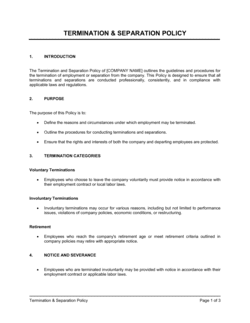
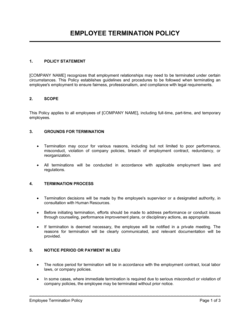
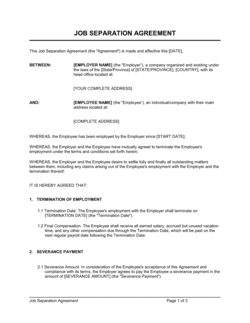
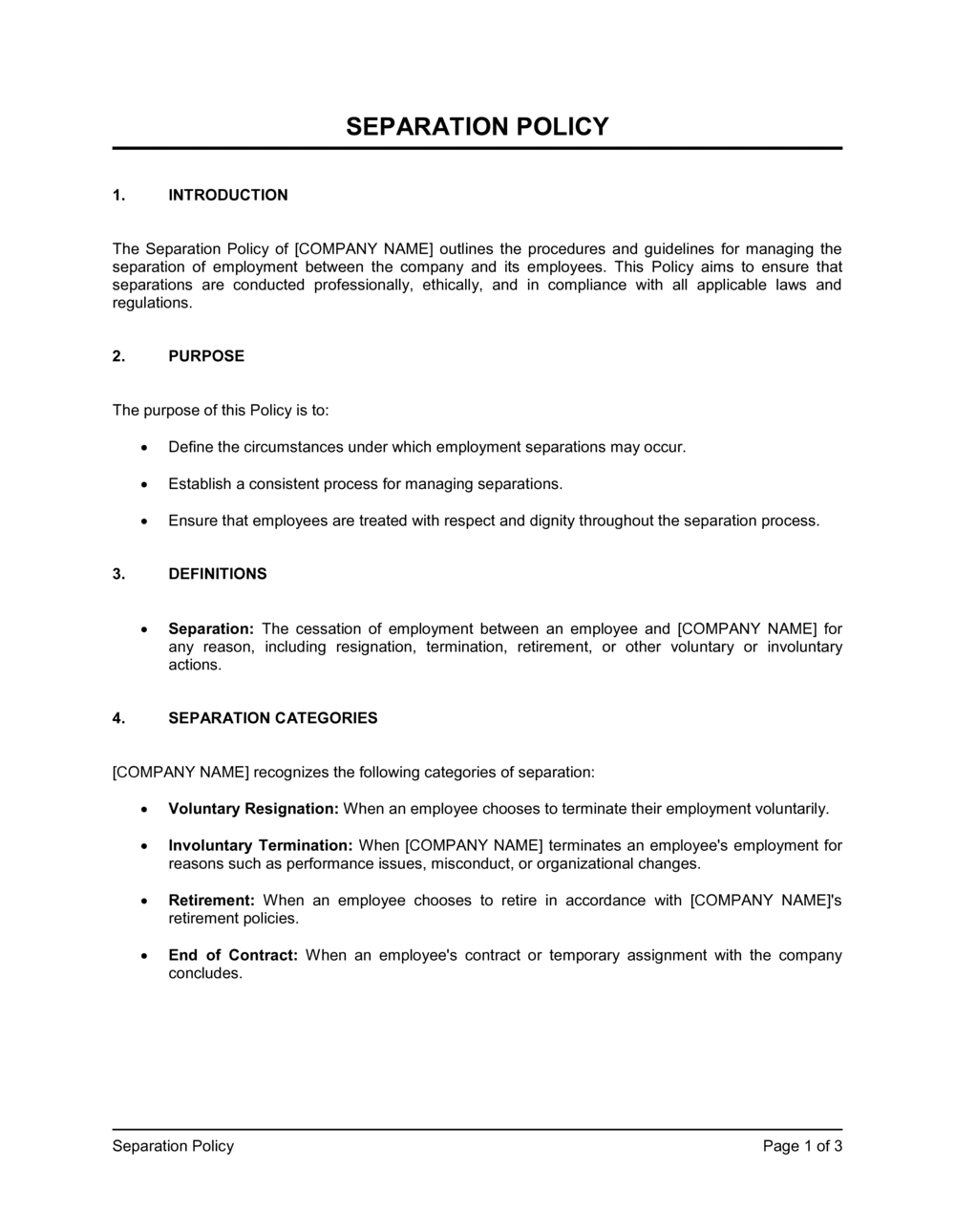
A Separation Policy is a formal internal HR document that defines the procedures, responsibilities, and timelines an organization follows when an employee exits β€” whether through voluntary resignation, involuntary termination, layoff, or retirement. This free Word download gives you a structured, editable starting point you can tailor to your organization's size and HR practices, then export as PDF for your employee handbook or HR portal.
When you need it
Use it when formalizing your offboarding process for the first time, updating an outdated termination procedure, or building a consistent HR framework as your team grows past 10 employees. It is also needed when preparing for an HR audit, ISO certification, or multi-location operations that require standardized people practices.
What's inside
The policy covers separation types and definitions, notice period requirements, final pay and benefits continuation rules, asset return and access revocation procedures, exit interview protocols, and documentation and records retention requirements.

What is a Separation Policy?

A Separation Policy is a formal internal HR document that establishes the standard procedures, timelines, and responsibilities an organization follows whenever an employee exits β€” whether through voluntary resignation, involuntary termination, layoff, or retirement. It defines separation types, specifies notice requirements, outlines final pay and benefits rules, governs asset return and IT access revocation, and sets records retention standards. Unlike a separation agreement β€” which resolves the legal terms of one specific exit β€” a separation policy provides the operational framework that governs every departure consistently, regardless of the reason or the individual involved.

Why You Need This Document

Without a documented separation policy, every employee exit becomes an improvised event managed differently by each manager or HR generalist involved. The consequences are concrete: final pay issued late triggers statutory penalties in most US states; IT access left open after an employee's last day creates data exfiltration exposure; severance paid without a signed release of claims gives away money without obtaining legal protection; and inconsistent treatment across separations hands plaintiffs evidence of disparate practice in wrongful termination claims. A written policy closes all of these gaps by standardizing the process before a departure occurs β€” so HR, IT, payroll, and managers all execute the same steps in the same order every time. This template gives you a complete, editable starting point to formalize your offboarding process in an afternoon rather than building it from scratch after a separation has already gone wrong.

Which variant fits your situation?

If your situation is…Use this template
Documenting the full lifecycle of an employee exit from any causeSeparation Policy
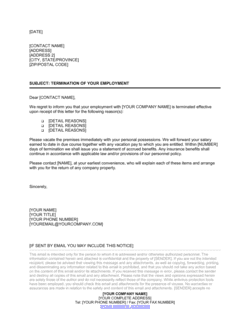
Formally notifying an employee their role is being eliminatedEmployee Termination Letter
Structuring the step-by-step offboarding checklist for IT and HREmployee Offboarding Checklist
Documenting a group layoff or reduction-in-force eventReduction in Force Policy
Recording the terms of a mutual separation and release of claimsSeparation Agreement
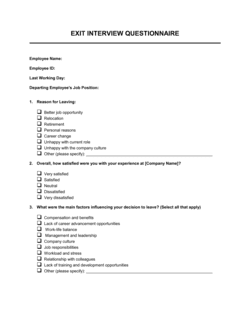
Conducting a structured conversation with a departing employeeExit Interview Form
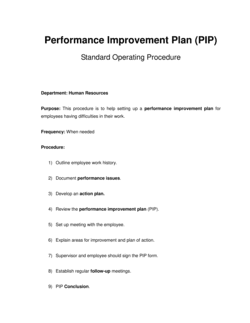
Outlining performance improvement steps before termination for causePerformance Improvement Plan

Common mistakes to avoid

❌ No jurisdiction-specific final pay deadlines

Why it matters: Many US states mandate same-day or next-business-day final pay for involuntary terminations. Missing the deadline triggers statutory penalties that can equal two to three times the unpaid wages.

Fix: Add a jurisdiction appendix to the policy listing the final pay deadline for each state or province where you have employees, and instruct payroll to apply the most restrictive timeline.

❌ Offering severance without a required release of claims

Why it matters: Severance paid without a signed release gives the employee compensation but preserves their right to sue β€” the company pays out without obtaining the legal protection the payment is intended to secure.

Fix: State explicitly in the severance section that payment is contingent on the employee executing a Separation Agreement and Release within the applicable review period.

❌ Vague IT access revocation timing

Why it matters: Specifying 'access will be revoked on the last day' without a time leaves systems open after an employee has been escorted out, creating data exfiltration risk during after-hours access.

Fix: Coordinate a specific revocation time with IT (e.g., noon on the final day for involuntary separations) and document it in both the policy and the offboarding checklist.

❌ Storing separation records in managers' personal email or local drives

Why it matters: Records stored outside a centralized HRIS are unavailable when an unemployment claim, EEOC charge, or lawsuit requires them β€” often months or years after the separation.

Fix: Name a specific HRIS or secure file system in the policy as the mandatory location for all separation records, and assign an HR custodian responsible for filing within five business days.

The 9 key sections, explained

Purpose and scope

Definitions of separation types

Notice requirements

Final pay and accrued benefits

Severance pay and eligibility

Asset return and access revocation

Knowledge transfer and transition responsibilities

Exit interview process

Documentation and records retention

How to fill it out

  1. 1

    Customize the purpose and scope section

    Replace all placeholders with your company's legal name, list the jurisdictions where you operate, and confirm which employee classifications (full-time, part-time, contract) the policy covers.

    πŸ’‘ If you have employees in multiple states or provinces, note jurisdiction-specific carve-outs in an appendix rather than complicating the main policy body.

  2. 2

    Define each separation type precisely

    Review the definitions section and adjust the language to match your existing HR terminology. Add a job abandonment definition specifying the number of consecutive no-call/no-show days that trigger the classification.

    πŸ’‘ Align your definitions with the language used in your employment contracts and employee handbook to avoid contradictions.

  3. 3

    Set notice periods for each separation type

    Enter the required notice periods for both employee resignations and employer-initiated separations. Add a pay-in-lieu provision confirming that the company may elect to pay notice rather than require the employee to work it.

    πŸ’‘ Check your employment agreements β€” if they specify longer notice periods for specific roles, the policy must reference that the contract governs where it provides more than the policy minimum.

  4. 4

    Enter final pay timing and accrued-balance rules

    Insert the specific number of days for final pay issuance and confirm whether accrued PTO is paid out on separation. Verify the applicable state or provincial deadlines and use the shorter of the two as your policy standard.

    πŸ’‘ Some states (e.g., California) require same-day final pay for involuntary terminations β€” note this as a state-specific exception even if it differs from your general policy.

  5. 5

    Define severance eligibility and the release requirement

    Set the minimum tenure required for severance eligibility, the per-year-of-service formula, and the maximum cap. Confirm that severance is explicitly conditioned on the employee signing a Separation Agreement and Release within 21 days.

    πŸ’‘ For employees over 40, the Older Workers Benefit Protection Act (OWBPA) in the US requires a 21-day review period and a 7-day revocation window for releases of age-discrimination claims.

  6. 6

    Populate the asset return and access revocation checklist

    List every category of company property relevant to your workforce (laptops, phones, access cards, company vehicles) and specify a revocation time for IT access on the separation date.

    πŸ’‘ Coordinate with IT to confirm the exact revocation window β€” a specific time (e.g., 5:00 PM local time on the last day) prevents ambiguity far better than 'end of business.'

  7. 7

    Add the records retention period and filing location

    Insert your retention period (typically 5–7 years depending on jurisdiction), name the HRIS or filing system where records are stored, and assign a specific HR role as the records custodian.

    πŸ’‘ Cross-reference your jurisdiction's employment records retention requirements β€” federal EEOC regulations in the US require personnel records to be kept for 1 year from termination; state laws may require longer.

  8. 8

    Review against your employee handbook and distribute

    Compare the completed policy against your handbook's termination section to eliminate contradictions. Publish the policy to your HR portal and notify all managers with a one-page summary of their responsibilities under it.

    πŸ’‘ Version-stamp the policy with an effective date and a next-review date (typically 12 months) so it doesn't become stale and go unenforced.

Frequently asked questions

What is a separation policy?

A separation policy is a formal HR document that defines the procedures an organization follows when an employee exits β€” covering voluntary resignation, involuntary termination, layoff, and retirement. It specifies notice periods, final pay rules, asset return procedures, severance eligibility, and records retention requirements. Its purpose is to ensure every departure is handled consistently, compliantly, and with a clear audit trail.

What is the difference between a separation policy and a separation agreement?

A separation policy is an internal operational document that defines standard procedures for all employee exits. A separation agreement is a binding legal contract negotiated for a specific individual departure β€” typically including a mutual release of claims in exchange for severance. The policy governs the process; the agreement documents the terms of one particular exit.

Is a separation policy legally required?

No law in the US explicitly mandates a written separation policy, but several employment regulations β€” including WARN Act notice requirements for mass layoffs and state-specific final pay laws β€” impose obligations that a policy helps operationalize. In the UK and Canada, written HR policies are expected by employment tribunals as evidence of fair practice. In practice, organizations without a documented policy face greater exposure in wrongful termination and discrimination claims.

What should a separation policy include?

A complete separation policy covers: definitions of separation types, notice period requirements for both employees and the employer, final pay timing and accrued-balance payout rules, severance eligibility and formula, conditions for severance payment (including release of claims), asset return and IT access revocation procedures, knowledge transfer expectations, exit interview process, and documentation and records retention requirements.

What is the difference between termination for cause and termination without cause?

Termination for cause is an employer-initiated separation based on specific documented conduct β€” misconduct, fraud, gross negligence, or repeated policy violations. It typically carries no severance and requires documented progressive discipline in most jurisdictions. Termination without cause is a business-driven separation unrelated to employee conduct, such as a restructuring or role elimination. It typically triggers severance and notice obligations. The distinction matters because the procedures and documentation requirements are different for each.

How long should separation records be retained?

US federal regulations require personnel records to be kept for at least one year from the date of termination under EEOC guidelines; the ADEA requires three years for payroll records. Many employment attorneys recommend seven years to cover the statute of limitations for most employment claims. State laws may impose longer requirements. As a practical standard, retaining all separation records for seven years covers most jurisdictions and claim types.

Should exit interviews be mandatory in a separation policy?

Making exit interviews mandatory for voluntarily departing employees produces more consistent and useful data than making them optional. However, exit interviews cannot be compelled under most employment frameworks β€” the policy should state that HR will schedule an exit interview with all departing employees, acknowledging that participation is expected but not grounds for withholding final pay. Aggregate, anonymized results are most actionable when reviewed quarterly.

How often should a separation policy be updated?

Review the policy at least annually and immediately after any significant change β€” a new state or country of operation, an update to final pay laws, a change in severance formula, or a major organizational restructuring. Version-stamp each revision with an effective date and archive prior versions so you can demonstrate what policy was in effect at the time of any specific separation.

How this compares to alternatives

vs Separation Agreement

A separation policy is an internal HR procedure document applied uniformly to all exits. A separation agreement is a negotiated legal contract between the employer and a specific departing employee, typically exchanging severance for a release of claims. The policy defines how the company manages departures; the agreement resolves the legal dimension of one particular exit. Both documents are typically used together for involuntary terminations.

vs Employee Termination Letter

A termination letter is a written notice to one employee confirming the end of their employment, the effective date, and the reason for separation. A separation policy is the internal framework that governs how all terminations are processed. The letter is a deliverable that comes out of following the policy β€” not a substitute for it.

vs Performance Improvement Plan

A performance improvement plan (PIP) is used before a termination for cause to document performance gaps and give the employee a structured opportunity to improve. A separation policy governs what happens once the employment relationship ends. In a well-run HR process, the PIP precedes the separation; the policy governs what follows.

vs Employee Handbook

An employee handbook is a comprehensive guide to all company policies β€” compensation, conduct, benefits, and procedures including separation. A standalone separation policy is a more detailed operational document that expands on the handbook's separation section with specific procedures, timelines, and checklists for HR and managers. The handbook communicates the rules to employees; the separation policy operationalizes them for the people running the process.

Industry-specific considerations

Technology / SaaS

IP assignment verification and immediate system-access revocation are critical given employees' broad access to source code, customer data, and cloud infrastructure.

Healthcare

HIPAA-compliant offboarding requires revoking access to EHR systems on the separation date and documenting the revocation, with patient data access logs retained for audit purposes.

Financial Services

Regulatory obligations may require notifying FINRA or the FCA of licensed employee departures within a defined window, and garden leave is common for senior traders or advisors.

Retail / Hospitality

High turnover and shift-based scheduling make a streamlined, manager-executable offboarding checklist essential β€” the policy must be simple enough for frontline supervisors to apply consistently.

Template vs pro β€” what fits your needs?

PathBest forCostTime
Use the templateSmall and mid-sized businesses establishing a standard separation process for the first timeFree2–3 hours to customize and publish
Template + professional reviewCompanies with employees in multiple states or provinces, or those updating after a termination dispute$300–$800 for an HR consultant or employment attorney review3–5 business days
Custom draftedEnterprises with unionized workforces, complex multi-jurisdiction operations, or heavily regulated industries$1,500–$4,000+2–4 weeks

Glossary

Voluntary Separation
An employee-initiated exit, including resignation or retirement, where the employee chooses to end the employment relationship.
Involuntary Separation
An employer-initiated exit, including termination for cause, layoff, or reduction in force.
Notice Period
The amount of advance notice β€” expressed in days or weeks β€” that either party must give before the separation becomes effective.
Final Pay
All wages, accrued vacation, commissions, and other compensation owed to an employee at separation, typically required by law within a specified number of days.
COBRA Continuation
A US federal law allowing departing employees to continue group health coverage for up to 18 months by paying the full premium themselves.
Reduction in Force (RIF)
A structured elimination of positions β€” driven by budget, restructuring, or business contraction β€” rather than individual performance.
Severance Pay
Compensation offered to an employee beyond their final paycheck upon separation, typically tied to length of service and conditioned on signing a release of claims.
Exit Interview
A structured conversation or survey conducted with a departing employee to gather candid feedback on their experience and reasons for leaving.
Offboarding
The full administrative and operational process of transitioning an employee out of the organization, covering IT access, asset return, knowledge transfer, and final paperwork.
Separation Agreement
A binding legal document β€” separate from the policy β€” in which both parties agree to the terms of a specific separation, often including a mutual release of claims.

Part of your Business Operating System

This document is one of 3,000+ business & legal templates included in Business in a Box.

  • Fill-in-the-blanks β€” ready in minutes
  • 100% customizable Word document
  • Compatible with all office suites
  • Export to PDF and share electronically

Create your document in 3 simple steps.

From template to signed document β€” all inside one Business Operating System.
1
Download or open template

Access over 3,000+ business and legal templates for any business task, project or initiative.

2
Edit and fill in the blanks with AI

Customize your ready-made business document template and save it in the cloud.

3
Save, Share, Send, Sign

Share your files and folders with your team. Create a space of seamless collaboration.

Save time, save money, and create top-quality documents.

β˜…β˜…β˜…β˜…β˜…

"Fantastic value! I'm not sure how I'd do without it. It's worth its weight in gold and paid back for itself many times."

Managing Director Β· Mall Farm
Robert Whalley
Managing Director, Mall Farm Proprietary Limited
β˜…β˜…β˜…β˜…β˜…

"I have been using Business in a Box for years. It has been the most useful source of templates I have encountered. I recommend it to anyone."

Business Owner Β· 4+ years
Dr Michael John Freestone
Business Owner
β˜…β˜…β˜…β˜…β˜…

"It has been a life saver so many times I have lost count. Business in a Box has saved me so much time and as you know, time is money."

Owner Β· Upstate Web
David G. Moore Jr.
Owner, Upstate Web

Run your business with a system β€” not scattered tools

Stop downloading documents. Start operating with clarity. Business in a Box gives you the Business Operating System used by over 250,000 companies worldwide to structure, run, and grow their business.

Start freeΒ Β·Β No credit card required