Team Building Guide

Free to read β€’ Save or share with one click

FreeTeam Building Guide Template

At a glance

What it is
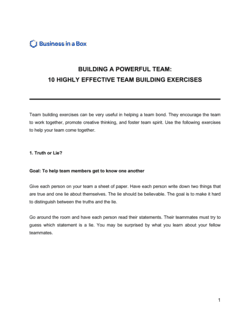
A Team Building Guide is a structured operational document that outlines objectives, activities, logistics, and evaluation methods for building cohesion, trust, and collaboration within a team. This free Word download gives managers and HR professionals a ready-to-edit framework they can tailor to their team size, culture, and goals, then export as PDF to share with stakeholders or distribute to participants.
When you need it
Use it when onboarding a new team, after a reorganization or merger, when collaboration or morale problems surface in engagement surveys, or when preparing a recurring annual team development program.
What's inside
Team assessment and objectives, activity planning with time and budget allocations, facilitation guidelines, communication plan, success metrics, and a post-event evaluation framework β€” all in a single cohesive document.

What is a Team Building Guide?

A Team Building Guide is a structured operational document that plans, organizes, and evaluates a program of activities designed to strengthen collaboration, trust, and communication within a team. It walks managers and facilitators through every stage of the process β€” from assessing the team's current dynamics and setting measurable objectives, through selecting and scheduling activities, managing logistics and budget, and evaluating outcomes against a defined baseline. Unlike a one-page event agenda, a team building guide functions as a repeatable operational framework that connects group experiences to real behavioral change in the workplace.

Why You Need This Document

Running a team building session without a structured guide typically produces a pleasant event that changes nothing. Teams return to the same communication patterns, the same unspoken tensions, and the same collaboration gaps β€” because nothing was diagnosed, nothing was measured, and no one was accountable for following through. A formal guide forces the program designer to identify specific team gaps before selecting activities, set measurable objectives that justify the investment, and build a follow-through mechanism that translates session insights into lasting behavioral commitments. For organizations that need to justify L&D spend, post-event evaluation data captured through the guide is the difference between renewing the program budget and losing it. This template gives HR professionals and team leaders a ready-to-use structure that replaces ad-hoc planning with a consistent, evidence-based approach to team development.

Which variant fits your situation?

If your situation is…Use this template
Integrating two teams following a merger or reorganizationTeam Building Guide (Integration Focus)
Onboarding a new remote or hybrid teamRemote Team Building Guide
Addressing specific communication or conflict issuesTeam Communication Plan
Planning a single off-site team retreatTeam Retreat Agenda
Tracking ongoing team performance and goalsTeam Development Plan
Rolling out a company-wide engagement initiativeEmployee Engagement Plan
Evaluating team effectiveness after a building programTeam Performance Review

Common mistakes to avoid

❌ Choosing activities before defining objectives

Why it matters: Activities selected without a clear purpose often entertain without changing behavior β€” producing no measurable improvement in collaboration or trust.

Fix: Complete the objectives section before researching any activities, and require each activity to map to at least one defined objective.

❌ No structured debrief after activities

Why it matters: The activity creates an experience; the debrief is where behavioral learning is extracted and connected to real work. Without it, the event is entertainment, not development.

Fix: Build a minimum 15-minute debrief into every 45-minute activity block using a structured framework such as What / So What / Now What.

❌ Designing activities that exclude remote or hybrid participants

Why it matters: Remote team members who cannot fully participate disengage and often feel the event reinforces their exclusion rather than addressing it.

Fix: Test every activity for remote participation before the event. If a physical activity cannot be adapted, schedule a separate parallel activity for remote participants.

❌ No follow-through on action items after the session

Why it matters: Teams that leave with commitments but no accountability mechanism revert to previous behaviors within two to four weeks, and cynicism about future programs increases.

Fix: Assign a named owner and a specific deadline to every action item before the session closes. Review progress at the next team meeting.

The 9 key sections, explained

Team Assessment and Current State

Objectives and Success Metrics

Activity Plan and Schedule

Budget and Resources

Facilitation Guidelines

Communication and Logistics Plan

Inclusion and Accessibility Considerations

Post-Event Evaluation

Action Items and Follow-Through Plan

How to fill it out

  1. 1

    Complete the team assessment section first

    Gather input from an engagement survey, one-on-ones, or a brief team self-assessment before filling in any other section. Identify 2–3 specific gaps the program needs to address.

    πŸ’‘ A five-question pulse survey sent one week before planning takes less than 20 minutes to analyze and produces activity choices that actually land with the team.

  2. 2

    Set measurable objectives tied to the assessment findings

    Write 2–4 objectives using the format: 'Improve [metric] from [baseline] to [target] by [date].' Each objective should trace directly to a gap identified in the assessment.

    πŸ’‘ Limit yourself to four objectives maximum β€” programs that try to solve every team problem at once tend to solve none of them.

  3. 3

    Select activities matched to each objective

    Choose activities based on the team's current Tuckman stage and the specific objective they support. Allocate at least 15 minutes of structured debrief for every 45 minutes of activity.

    πŸ’‘ If the team is in the storming stage, avoid purely competitive games β€” they amplify existing tensions rather than resolving them.

  4. 4

    Build the budget with a 10% contingency

    List every cost line β€” venue, facilitation, materials, catering, and travel β€” and add a 10% contingency on the subtotal. Get written approval from the budget holder before committing to vendors.

    πŸ’‘ Book venues at least 3 weeks in advance for groups over 15 β€” popular off-site locations fill up quickly, especially mid-week.

  5. 5

    Write the facilitation guidelines in step-by-step format

    Break each activity into timed steps with specific discussion prompts. Include a 'if this happens' note for common facilitation challenges β€” low participation, dominant voices, or time overruns.

    πŸ’‘ Run a 20-minute dry-run with a colleague before the event to catch timing gaps and ambiguous instructions.

  6. 6

    Send pre-event communications with context

    Use the communication plan section to draft the participant invitation, including the program purpose, what to expect, any preparation required, and practical logistics.

    πŸ’‘ Sharing the program objectives in the invite β€” not just the agenda β€” increases voluntary participation and reduces resistance from skeptical team members.

  7. 7

    Distribute the post-event survey within 24 hours

    Send the evaluation survey while the experience is still fresh. Keep it to 5–8 questions β€” a mix of rating scales and one open-ended question on the most valuable takeaway.

    πŸ’‘ Anonymous surveys consistently return more honest feedback than named ones for team building programs, especially when trust is still developing.

  8. 8

    Review results and assign follow-through actions

    Within one week of the event, compile evaluation results and facilitator notes. Present a one-page summary to the sponsoring manager and confirm which action items have named owners and deadlines.

    πŸ’‘ Schedule a 30-day check-in on the action items at the close of the event itself β€” while participants are still energized β€” rather than trying to calendar it afterward.

Frequently asked questions

What is a team building guide?

A team building guide is a structured document that plans, organizes, and evaluates activities designed to improve collaboration, trust, and communication within a team. It covers everything from the initial team assessment and objectives through activity scheduling, facilitation instructions, budget, and post-event evaluation β€” giving managers and HR professionals a repeatable framework rather than a one-off event.

Why do organizations use a team building guide?

A guide ensures that team building is intentional and measurable rather than a social event with no development outcome. It links activities to specific team gaps, provides facilitation structure that maintains session quality, documents budget and logistics for organizational approval, and captures evaluation data to justify future investment. Without a guide, programs tend to be inconsistently executed and difficult to repeat or improve.

What types of activities should a team building guide include?

Activity selection should match the team's current development stage. Forming teams benefit from structured introductions and shared goal-setting exercises. Storming teams need facilitated communication and conflict- resolution activities. Norming and performing teams respond well to stretch challenges, cross-functional problem-solving, and innovation workshops. Every activity type should include a structured debrief to extract learning from the experience.

How long should a team building program last?

A half-day program (3–4 hours) is sufficient for targeted skill-building or refreshing an existing team. A full day (6–8 hours) allows for deeper exploration and multiple activity cycles with debriefs. Multi-day off-site retreats are suited to significant organizational transitions β€” mergers, major restructuring, or culture resets. Frequency matters as much as duration: a quarterly 2-hour session produces more sustained change than a single annual day.

How do you measure the success of a team building program?

Measure success against the specific objectives set at the start of the program. Common metrics include engagement survey scores before and after, frequency of cross-team communication (trackable in collaboration tools), manager-observed behavioral changes at 30 and 90 days, and participant satisfaction ratings. Programs with no baseline measurement cannot demonstrate ROI and are vulnerable to budget cuts.

Can a team building guide be used for remote or hybrid teams?

Yes β€” a team building guide works for remote and hybrid teams when activities are explicitly adapted for virtual participation. This means selecting video-based collaboration tools, designing activities that do not require physical presence, building in extra time for technical setup, and structuring breakout groups to mix remote and in-person participants rather than segregating them. The inclusion and accessibility section of the guide is the right place to document these adaptations.

Who should facilitate a team building program?

An internal team lead or HR professional can facilitate standard programs using this guide. An external facilitator adds value when the team has unresolved interpersonal conflicts that benefit from a neutral party, when the program is a significant cultural intervention, or when senior leadership will be participating alongside their direct reports. External facilitation typically costs $1,500–$5,000 per day depending on team size and program complexity.

How often should team building programs be run?

Quarterly shorter sessions (2–3 hours) maintain momentum and reinforce skills between annual events. An annual half-day or full-day program serves as a reset point for goals and team norms. One-time programs run only after a problem surfaces rarely produce lasting change β€” the research on team dynamics consistently shows that frequency and consistency matter more than intensity.

What is the difference between a team building guide and a team charter?

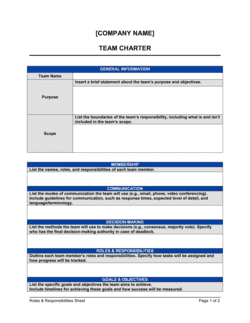
A team building guide plans and documents activities designed to improve team dynamics over time. A team charter defines the team's purpose, roles, decision-making processes, and operating norms β€” it is a governance document, not a development program. The two are complementary: team building programs often produce the shared understanding that makes a team charter meaningful, and a charter gives the team a reference point between building sessions.

How this compares to alternatives

vs Employee Engagement Plan

An employee engagement plan addresses the broader relationship between individual employees and the organization β€” covering recognition, career development, manager effectiveness, and workplace culture. A team building guide focuses specifically on the dynamics, trust, and collaboration within a defined team. Both documents are complementary but operate at different levels of scope.

vs Team Development Plan

A team development plan focuses on building individual and collective skills aligned to long-term performance goals β€” it maps competency gaps to learning interventions over a 6–12 month horizon. A team building guide focuses on relational dynamics and cohesion through facilitated activities. Development plans address what the team knows; building guides address how well the team works together.

vs Training Plan

A training plan delivers structured knowledge or skill transfer to individuals β€” courses, certifications, and on-the-job learning modules. A team building guide facilitates group experiences designed to strengthen interpersonal trust and collaboration. Training builds individual capability; team building builds group dynamics. Most effective organizations run both in parallel.

vs Meeting Agenda

A meeting agenda structures a single business meeting β€” time blocks, topics, presenters, and decisions required. A team building guide plans a multi-activity program with facilitation, evaluation, and follow-through components that extend well beyond the session itself. Using a meeting agenda for a team building session produces an under-facilitated, under-evaluated event.

Industry-specific considerations

Technology / SaaS

Remote-first and distributed teams require virtual-adapted activities; programs often target psychological safety to support candid feedback in fast-paced sprint environments.

Professional Services

High-pressure, billable-hour cultures benefit from programs focused on peer support and cross-practice collaboration, often scheduled around project completion milestones.

Healthcare

Multidisciplinary clinical teams use structured programs to improve handoff communication and reduce errors linked to poor team coordination under shift-work constraints.

Manufacturing

Safety culture and cross-shift coordination are primary objectives; activities are typically scheduled during shift overlaps and must account for physical worksite logistics.

Retail / Hospitality

High turnover and seasonal staffing mean programs must be short, repeatable, and effective with mixed-tenure groups β€” onboarding cohort integration is a primary use case.

Education

Faculty and staff teams use guides to build cross-departmental collaboration; academic calendars constrain scheduling to start-of-term or professional development days.

Template vs pro β€” what fits your needs?

PathBest forCostTime
Use the templateManagers and HR professionals planning standard team building programs for intact teams of 5–25 peopleFree3–6 hours to plan; half-day to full-day to run
Template + professional reviewPrograms involving cross-departmental teams, post-merger integration, or senior leadership groups$500–$2,000 for an external facilitator consultation or program design review1–2 weeks planning with facilitation input
Custom draftedLarge-scale culture transformation programs, executive off-sites, or teams with active interpersonal conflict requiring a neutral third party$2,000–$10,000+ for a professional organizational development consultant or external facilitation team3–6 weeks design and delivery

Glossary

Team Cohesion
The degree to which team members feel connected, trust one another, and are committed to shared goals.
Psychological Safety
A team climate where members feel safe to speak up, take risks, and admit mistakes without fear of punishment or ridicule.
Facilitation
The structured guidance of group activities or discussions by a neutral person to achieve a defined outcome.
Debrief
A structured post-activity discussion that surfaces learnings, feelings, and takeaways to reinforce the team building objective.
Tuckman's Stages
A model describing four stages of team development β€” forming, storming, norming, and performing β€” used to calibrate activity selection.
Engagement Survey
A questionnaire measuring how motivated, committed, and connected employees feel to their team and organization.
Ice-Breaker
A short, low-stakes activity designed to reduce social awkwardness and help team members get comfortable with one another at the start of a session.
Retrospective
A structured meeting where a team reflects on what went well, what didn't, and what to change β€” commonly used in agile teams but applicable broadly.
Stretch Goal
An objective set deliberately beyond comfortable reach to encourage collaboration and creative problem-solving under pressure.
Team Charter
A document that defines a team's purpose, roles, operating norms, and decision-making process β€” often created during or after a team building program.

Part of your Business Operating System

This document is one of 3,000+ business & legal templates included in Business in a Box.

  • Fill-in-the-blanks β€” ready in minutes
  • Compatible with all office suites
  • Export to PDF and share electronically

Create your document in 3 simple steps.

From template to signed document β€” all inside one Business Operating System.
1
Download or open template

Access over 3,000+ business and legal templates for any business task, project or initiative.

2
Edit and fill in the blanks with AI

Customize your ready-made business document template and save it in the cloud.

3
Save, Share, Send, Sign

Share your files and folders with your team. Create a space of seamless collaboration.

Save time, save money, and create top-quality documents.

β˜…β˜…β˜…β˜…β˜…

"Fantastic value! I'm not sure how I'd do without it. It's worth its weight in gold and paid back for itself many times."

Managing Director Β· Mall Farm
Robert Whalley
Managing Director, Mall Farm Proprietary Limited
β˜…β˜…β˜…β˜…β˜…

"I have been using Business in a Box for years. It has been the most useful source of templates I have encountered. I recommend it to anyone."

Business Owner Β· 4+ years
Dr Michael John Freestone
Business Owner
β˜…β˜…β˜…β˜…β˜…

"It has been a life saver so many times I have lost count. Business in a Box has saved me so much time and as you know, time is money."

Owner Β· Upstate Web
David G. Moore Jr.
Owner, Upstate Web

Run your business with a system β€” not scattered tools

Stop downloading documents. Start operating with clarity. Business in a Box gives you the Business Operating System used by over 250,000 companies worldwide to structure, run, and grow their business.

Start freeΒ Β·Β No credit card required