Shop Tenancy Agreement Template

Free Word download β€’ Edit online β€’ Save & share with Drive β€’ Export to PDF

6 pagesβ€’25–35 min to fillβ€’Difficulty: Complexβ€’Signature requiredβ€’Legal review recommended
Learn more ↓
FreeShop Tenancy Agreement Template

At a glance

What it is
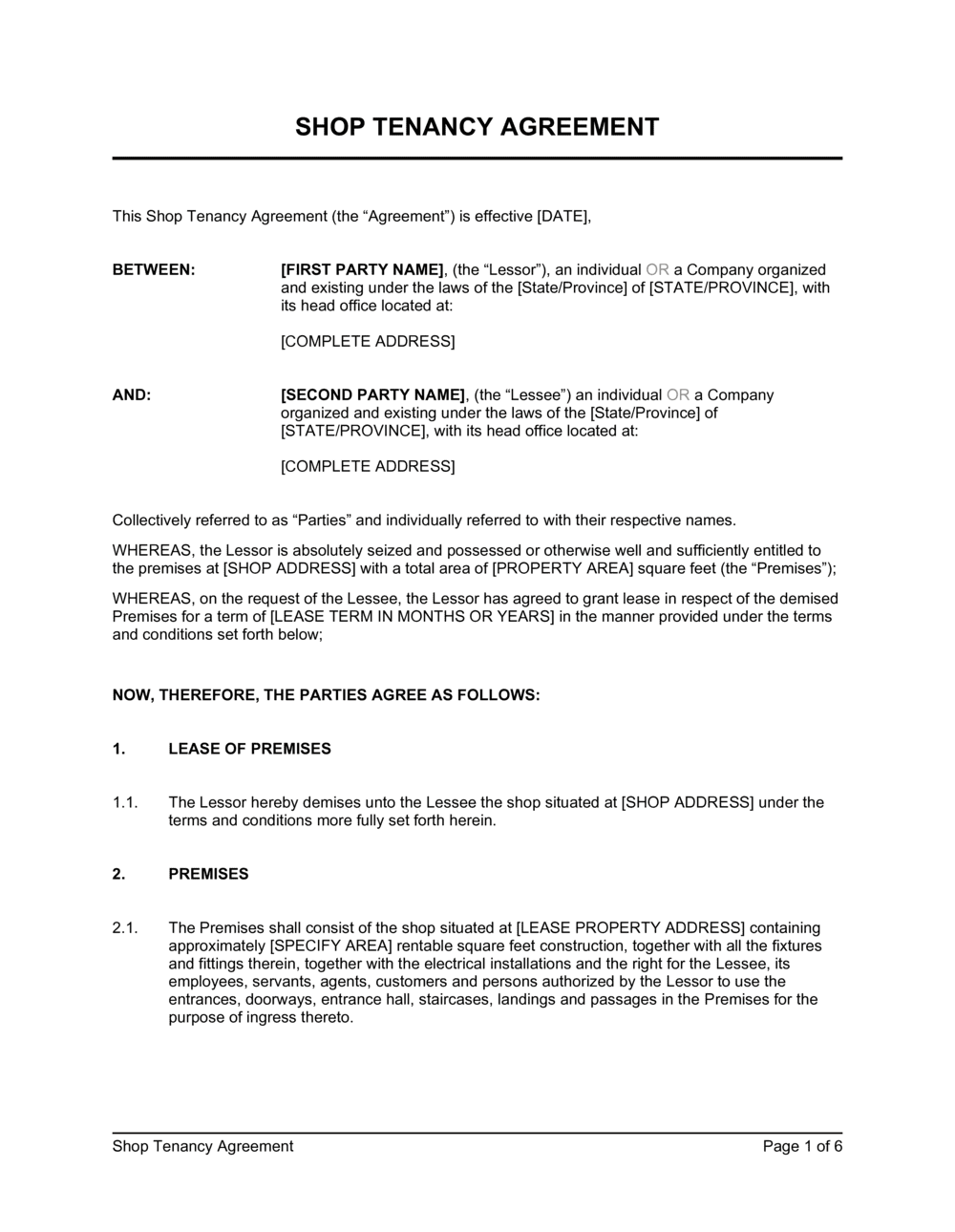
A Shop Tenancy Agreement is a legally binding commercial lease between a landlord and a retail tenant that governs the occupation of a shop or retail premises. This free Word download covers rent, lease term, security deposit, permitted use, fit-out rights, repair obligations, insurance, assignment, and termination β€” in a single document you can edit online and export as PDF for execution.
When you need it
Use it before a retail tenant takes possession of any shop, boutique, kiosk, or commercial unit where the primary purpose is selling goods or services to the public. It replaces verbal arrangements and informal letters of intent with enforceable written terms.
What's inside
Parties and premises description, lease term and renewal options, base rent and rent review mechanism, security deposit, permitted use and trading hours, fit-out and alterations rights, landlord and tenant repair obligations, insurance requirements, assignment and subletting, and termination and default provisions.

What is a Shop Tenancy Agreement?

A Shop Tenancy Agreement is a legally binding commercial lease between a property owner (the landlord) and a retail business (the tenant) that grants the tenant exclusive possession of a shop, boutique, or retail unit for a defined term in exchange for rent. It is structurally distinct from a residential tenancy β€” there are far fewer statutory protections and the written agreement is the primary source of both parties' rights and obligations. A properly drafted shop tenancy agreement covers base rent and rent review, security deposit, permitted use, fit-out and alteration rights, repair and maintenance allocation, insurance requirements, assignment and subletting, and the grounds and process for termination.

Why You Need This Document

Operating a retail tenancy without a written agreement β€” or with only an informal letter of intent β€” exposes both the landlord and the tenant to serious financial and legal risk. A tenant who fits out and trades without a signed lease has no documented right to remain, no defined renewal option, and no protection against the landlord recovering the premises on short notice. A landlord without a written agreement cannot enforce permitted-use restrictions, make-good obligations, or insurance requirements β€” meaning a tenant can trade in ways that damage the property or void the building insurance without any documented recourse. Make-good disputes alone, where the restoration of the premises at lease end is in question, are among the most litigated commercial property matters in every major jurisdiction. This template gives landlords and retail tenants a complete, professionally structured starting point β€” covering every material clause for a standard retail tenancy β€” so that both parties trade from a position of documented, enforceable certainty rather than assumption.

Which variant fits your situation?

If your situation is…Use this template
Leasing an entire commercial building rather than a single retail unitCommercial Lease Agreement
Leasing office space rather than customer-facing retail premisesOffice Space Lease Agreement
Short-term or month-to-month retail occupation with no fixed termMonth-to-Month Commercial Lease
Subleasing a portion of existing retail space to another businessSublease Agreement
Leasing a food service or restaurant unit with kitchen and extractionRestaurant Lease Agreement
Tenant needs to capture agreed pre-lease terms before full lease is draftedLetter of Intent (Commercial Lease)
Renewing or extending an existing retail tenancy at new termsLease Renewal Agreement

Common mistakes to avoid

❌ No written fit-out schedule or approved works list

Why it matters: Without a documented scope of approved works, landlords dispute what the tenant was permitted to install, triggering make-good claims for items the tenant believed were sanctioned.

Fix: Attach a Schedule of Approved Works signed by both parties before possession. Photograph the premises on handover and at fit-out completion to establish a baseline condition record.

❌ Permitted use clause too narrow for the tenant's actual business

Why it matters: A retailer who expands into adjacent product categories without a broad enough permitted use clause is technically in breach β€” giving the landlord grounds to withhold lease renewal or claim damages.

Fix: Draft permitted use as a category rather than a product list. 'Retail sale of homewares and associated lifestyle products' covers far more than 'sale of cushions, throws, and candles.'

❌ Omitting a cure period for non-monetary breaches

Why it matters: Immediate termination rights for non-monetary breaches are routinely struck down as disproportionate, leaving the landlord with no enforceable remedy and months of litigation exposure.

Fix: Include a 30-day written notice and cure period for all non-monetary defaults. For breaches incapable of remedy, state that explicitly and limit termination rights to those specific defined events.

❌ Signing the lease after the tenant has already taken possession

Why it matters: In common-law jurisdictions, a tenant already in occupation may argue they hold on a periodic tenancy with statutory protections rather than on the agreed commercial terms β€” voiding key restrictions.

Fix: Execute the lease and hand over keys on the same day. If practical constraints require early access, issue a separate licence for access that explicitly states it does not create a tenancy until execution.

❌ Setting public liability insurance limits that are too low

Why it matters: A $1M per-occurrence public liability limit, once standard, is now insufficient for most retail environments. A single serious personal injury claim can exhaust it, leaving the landlord exposed to uninsured liability claims.

Fix: Require a minimum of $5M per occurrence for all retail tenancies, and $10M for food, beverage, or high-footfall premises. Review limits at each rent review or at least every 3 years.

❌ No defined process for returning the security deposit

Why it matters: Without a stated deadline, landlords hold deposits for months while conducting inspections and obtaining make-good quotes, creating disputes and β€” in some jurisdictions β€” statutory penalties for unreasonable delay.

Fix: State a specific return deadline β€” 14 to 28 days from lease expiry or make-good completion, whichever is later β€” and specify the documentation the landlord must provide with any deduction.

The 10 key clauses, explained

Parties, premises description, and term

In plain language: Identifies the landlord and tenant as legal entities, provides a precise description of the premises including any car parks or storage, and states the lease start date, end date, and any renewal options.

Sample language
This Shop Tenancy Agreement is made on [DATE] between [LANDLORD LEGAL NAME] of [ADDRESS] ('Landlord') and [TENANT LEGAL NAME] of [ADDRESS] ('Tenant'). The Landlord lets and the Tenant takes the premises known as [UNIT NUMBER, BUILDING, ADDRESS] ('Premises') for a term of [X] years commencing [START DATE] and expiring [END DATE], with an option to renew for [X] years on notice given no later than [X] months before expiry.

Common mistake: Describing the premises only by street address without referencing the title or lot number. If the landlord owns multiple units in a building, an address alone can be ambiguous and cause a dispute over which unit is actually leased.

Rent, payment terms, and rent review

In plain language: States the base rent, payment frequency, due date, accepted payment method, and the formula for rent increases at review intervals.

Sample language
The Tenant shall pay base rent of $[AMOUNT] per calendar month, payable in advance on the [1st] day of each month by electronic funds transfer to [ACCOUNT DETAILS]. Rent shall be reviewed on [DATE] and each anniversary thereafter by the greater of CPI or [X]%, not to exceed [X]% in any 12-month period.

Common mistake: Omitting a rent-review cap. Uncapped CPI or market reviews can produce rent increases the tenant cannot absorb, leading to default or early termination disputes. A ceiling protects both parties.

Security deposit and bank guarantee

In plain language: Sets the deposit amount, the conditions under which the landlord may draw on it, the process for returning it at lease end, and whether a bank guarantee is acceptable in lieu of a cash deposit.

Sample language
On execution, the Tenant shall pay a security deposit of $[AMOUNT] (equivalent to [X] months' rent). The Landlord may draw on the deposit to remedy any breach by the Tenant after giving [X] days' written notice. The deposit shall be returned within [14] days of lease expiry, less any lawful deductions.

Common mistake: Not specifying the timeline for returning the deposit. Without a deadline, landlords routinely hold deposits for months, creating disputes and β€” in jurisdictions with statutory protections β€” regulatory liability.

Permitted use and trading hours

In plain language: Restricts the tenant to a defined category of retail activity and sets the minimum or maximum trading hours, protecting the landlord's ability to manage tenant mix in a multi-tenanted centre.

Sample language
The Tenant shall use the Premises solely for the retail sale of [DESCRIPTION OF GOODS/SERVICES] and for no other purpose without the Landlord's prior written consent. The Tenant shall trade during the Centre's core hours of [HOURS] on [DAYS], and may trade outside those hours subject to [CONDITIONS].

Common mistake: Drafting permitted use so narrowly that a modest product expansion requires a formal lease variation. Aim for a category description broad enough to cover adjacent product lines the tenant is likely to carry.

Fit-out, alterations, and signage

In plain language: Defines the tenant's right to install shopfittings and signage, the landlord's approval process for alterations, and who owns any improvements at the end of the lease.

Sample language
The Tenant may carry out the fit-out works described in Schedule [X] ('Approved Works') at its own cost. Any additional alterations require the Landlord's prior written consent, not to be unreasonably withheld. All fixtures and improvements shall become the Landlord's property at lease expiry unless the Landlord requires removal under the make-good clause.

Common mistake: No written fit-out schedule at all, or an approval process that takes longer than the tenant's rent-free period. Delays in fit-out approval eat into the tenant's trading time and often trigger disputes over when rent should start.

Repair, maintenance, and make good

In plain language: Allocates responsibility for structural repairs to the landlord and day-to-day maintenance to the tenant, and requires the tenant to restore the premises at lease end.

Sample language
The Landlord shall maintain the structure, roof, and common areas in good repair. The Tenant shall keep the interior, shopfront, fixtures, and services in good repair and condition. On expiry or earlier termination, the Tenant shall make good all alterations to the reasonable satisfaction of the Landlord.

Common mistake: Assigning 'all repairs' to the tenant without carving out structural defects. Courts have found tenants liable for structural failure under such clauses, which is rarely the commercial intention of either party.

Insurance obligations

In plain language: Requires the tenant to hold public liability insurance and plate glass cover at specified minimum limits, and requires the landlord to insure the building β€” with each party providing evidence of cover on request.

Sample language
The Tenant shall maintain public liability insurance of not less than $[AMOUNT] per occurrence and plate glass insurance covering the Premises shopfront. The Landlord shall insure the building for its full replacement value. Each party shall provide certificates of currency within [5] business days of request.

Common mistake: Setting a public liability minimum that was standard 10 years ago. $1M limits are no longer adequate for most retail settings β€” $5M–$10M per occurrence is now the accepted minimum for commercial tenancies in most markets.

Assignment and subletting

In plain language: Governs whether and how the tenant can transfer the lease or sublet the premises, what information the landlord requires to consider consent, and what conditions can be imposed.

Sample language
The Tenant shall not assign this lease or sublet the Premises without the Landlord's prior written consent, not to be unreasonably withheld or delayed. The Tenant shall provide the Landlord with [30] days' notice, financial statements for the proposed assignee, and evidence of equivalent trading experience.

Common mistake: Including an absolute prohibition on assignment without a carve-out for sale of the tenant's business. This traps the tenant and can destroy business value β€” courts in several jurisdictions will imply a reasonableness standard regardless.

Default and termination

In plain language: States the events of default that entitle the landlord to re-enter the premises, the notice and cure period the tenant must be given, and the consequences of termination including outstanding rent liability.

Sample language
If the Tenant fails to pay rent within [14] days of the due date, or materially breaches any other term and fails to remedy within [30] days of written notice, the Landlord may re-enter the Premises and terminate this lease without prejudice to any claim for arrears or damages.

Common mistake: No cure period for non-monetary breaches. Immediate termination rights for minor or technical breaches are disproportionate and are routinely refused by courts, leaving the landlord with an unenforceable clause and no practical remedy.

Governing law and dispute resolution

In plain language: Specifies which jurisdiction's commercial tenancy law governs the agreement and how disputes β€” including rent disputes and make-good claims β€” are resolved.

Sample language
This Agreement is governed by the laws of [STATE / PROVINCE / COUNTRY]. Any dispute that the parties cannot resolve by negotiation within [20] business days shall be referred to mediation before either party commences litigation or arbitration proceedings.

Common mistake: Omitting a mediation step and going straight to litigation as the default remedy. Commercial tenancy disputes β€” especially fit-out and make-good claims β€” are resolved far faster and cheaper through mediation, and many jurisdictions now mandate it before any tribunal hearing.

How to fill it out

  1. 1

    Identify the parties with their full legal entity names

    Enter the landlord's and tenant's complete registered legal names β€” not trading names or abbreviations. For companies, include the registration number. For individuals, use the name as it appears on government ID.

    πŸ’‘ Confirm the tenant's ABN, company number, or EIN before signing β€” a lease signed by an undisclosed sole trader rather than a company strips the landlord of the benefit of a corporate guarantee.

  2. 2

    Describe the premises precisely

    Include the unit number, building name, street address, and any included areas such as storage rooms, car parks, or rear access. Reference the title or lot number if available.

    πŸ’‘ Attach a floor plan as a schedule and have both parties initial it β€” this eliminates 'which unit' disputes in multi-tenanted properties.

  3. 3

    Set the lease term and renewal options

    Enter the exact start and end dates. If offering renewal options, state the number and duration of each option, the notice period required to exercise, and whether rent for the option period is at market or a fixed increase.

    πŸ’‘ In most jurisdictions, an option to renew must be exercised strictly within the stated window β€” a tenant who misses the deadline by one day typically loses the right. Consider adding a landlord-notification obligation if the tenant has not given notice 30 days before the deadline.

  4. 4

    Complete the rent and rent-review schedule

    Enter the base rent, payment frequency, due date, and the rent-review formula. State clearly whether rent reviews are upward-only or can go down as well as up.

    πŸ’‘ Upward-only review clauses are unenforceable in some jurisdictions (notably parts of the EU). Check local law before including one.

  5. 5

    Calculate and document the security deposit

    Set the deposit at an amount that reflects realistic exposure β€” typically 1–3 months' rent. State whether a bank guarantee from a reputable institution is acceptable in lieu of cash and on what terms the landlord can call on it.

    πŸ’‘ In several US states and Australian states, security deposits for commercial leases above a certain amount must be held in a trust account. Confirm your jurisdiction's requirements before accepting cash.

  6. 6

    Define permitted use with appropriate breadth

    Write a permitted use description that covers the tenant's current trading activity and likely adjacent categories. A specialty coffee retailer might need 'sale of coffee, beverages, and light food items' rather than just 'cafΓ©.'

    πŸ’‘ If operating in a shopping centre, check that the permitted use doesn't conflict with exclusivity rights already granted to another tenant β€” this is one of the most common sources of tenancy litigation.

  7. 7

    Attach the fit-out schedule and approved works list

    List all fit-out items the tenant is approved to install before trading. Include dimensions, materials, and any engineering sign-off requirements. State the rent-free period and the date by which fit-out must be completed.

    πŸ’‘ Tie the rent commencement date to the later of the fit-out completion date or a fixed long-stop date β€” this prevents the tenant from claiming rent-free time indefinitely due to fit-out delays.

  8. 8

    Execute before the tenant takes possession

    Both parties must sign before keys are handed over. Arrange for witnesses or a commissioner of oaths where required by local law. Provide each party with a fully executed original.

    πŸ’‘ In the UK and Australia, leases over three years typically require execution as a deed β€” a simple signature is insufficient. Confirm the execution formalities required in your jurisdiction before the signing meeting.

Frequently asked questions

What is a shop tenancy agreement?

A shop tenancy agreement is a commercial lease between a landlord and a retail tenant that grants the tenant the right to occupy a shop or retail premises for a defined term in exchange for rent. It sets out all material obligations of both parties β€” including rent, deposit, permitted use, repair, insurance, and termination β€” and is legally binding on execution. Unlike a residential tenancy, it is generally governed by commercial property law with fewer statutory protections for the tenant.

What is the difference between a shop tenancy agreement and a commercial lease?

A shop tenancy agreement is a type of commercial lease specifically tailored to retail premises β€” covering retail-specific provisions such as permitted use, trading hours, fit-out, and tenant mix. A generic commercial lease may cover offices, warehouses, or industrial units and typically omits these retail-specific clauses. For any customer-facing retail premises, a shop tenancy agreement provides more appropriate and complete protection for both parties.

How long should a retail lease term be?

Retail lease terms typically run from 1 to 10 years, with 3+3 (a 3-year term with a 3-year option) and 5+5 structures being the most common for established retailers. Short-term leases of 6–12 months suit pop-ups and market testing. Longer terms of 5–10 years are generally expected by landlords when fit-out investment is significant, since a 5-year term gives the tenant sufficient time to amortize the cost of shopfitting.

What should a security deposit cover in a retail lease?

A security deposit in a retail tenancy is held against unpaid rent, damage to the premises beyond fair wear and tear, failure to comply with make-good obligations, and any other breach of the lease. It is not a prepayment of rent. The typical deposit is 1–3 months' rent, though landlords in high-demand locations or for tenants without a trading history may require the equivalent of 6 months or a bank guarantee.

Is a shop tenancy agreement different from a licence to occupy?

Yes. A lease grants the tenant exclusive possession of the premises for a fixed term, creating a proprietary interest that binds successors in title. A licence to occupy gives permission to use the premises without exclusive possession and can generally be terminated on shorter notice. For most retail operations requiring a stable trading location and the ability to fit out and assign, a lease is the appropriate instrument. Courts sometimes reclassify licences as leases if the occupier has effective exclusive possession regardless of what the document is called.

Can a retail tenant sublet or assign the lease to a new business?

Assignment and subletting are typically permitted only with the landlord's prior written consent, which must not be unreasonably withheld under most commercial tenancy legislation. The landlord is generally entitled to assess the financial standing and retail experience of a proposed assignee, and may condition consent on the outgoing tenant providing a guarantee for a period after assignment. An absolute prohibition on assignment is difficult to enforce and can significantly reduce the value of a business being sold.

Who is responsible for repairs in a shop tenancy?

In most commercial retail leases, the landlord is responsible for structural repairs, the roof, and external common areas, while the tenant is responsible for the interior fit-out, shopfront, fixtures, and services such as air conditioning units serving only the tenanted space. The precise allocation depends on the lease β€” some full-repairing and insuring leases (common in the UK) place all repair obligations on the tenant. Always check the repair clause carefully before signing.

What is a make-good obligation and how does it work?

A make-good obligation requires the tenant to restore the premises to their original condition at lease expiry β€” typically by removing all fit-out items, patching walls, removing signage, and repairing any alterations. The landlord's ability to enforce it depends on having clear evidence of the original condition, which is why a photographic condition report signed by both parties at handover is essential. Make-good disputes are the most common source of litigation at the end of retail tenancies.

Do retail tenants have statutory protections comparable to residential tenants?

Generally no β€” commercial tenants have significantly fewer statutory protections than residential tenants. However, many jurisdictions have enacted retail leasing legislation that provides minimum rights: mandatory disclosure documents, cooling-off periods, restrictions on key money, and in some cases rent control mechanisms. In Australia, each state has a Retail Leases Act; the UK has the Landlord and Tenant Act 1954; and in the US, protections vary widely by state with no federal retail tenancy statute. Always check the specific legislation for the premises' location.

How this compares to alternatives

vs Commercial Lease Agreement

A commercial lease agreement is a broader instrument covering offices, warehouses, and industrial premises as well as retail. A shop tenancy agreement adds retail-specific provisions β€” permitted use, trading hours, tenant mix, fit-out schedules, and turnover rent β€” that a generic commercial lease typically omits. For any customer-facing retail premises, the shop tenancy agreement is the more appropriate starting point.

vs Residential Lease Agreement

A residential lease governs a tenant's right to occupy a dwelling and is subject to extensive statutory protections β€” security deposit rules, minimum notice periods, habitability standards β€” that do not apply to commercial premises. Using a residential lease for a retail shop is legally incorrect and will fail to cover commercial obligations such as fit-out, insurance, and outgoings. Always use a commercial instrument for retail premises.

vs Office Space Lease Agreement

An office lease is designed for non-customer-facing premises and typically lacks trading-hours clauses, shopfront provisions, tenant mix exclusivity, and fit-out approval schedules. Retail premises require all of these. An office lease used for a retail unit will have significant structural gaps and may not satisfy the disclosure obligations imposed by retail leasing legislation in many jurisdictions.

vs Sublease Agreement

A sublease is used when an existing tenant grants part or all of their leased space to a third party while remaining bound to the head landlord. A shop tenancy agreement is the primary instrument between the property owner and the first tenant. A subtenant's rights are derivative of and limited by the head lease β€” meaning the subtenant should always review the head lease before signing a sublease.

Industry-specific considerations

Retail and fashion

Tenant mix exclusivity, seasonal trading-hours variations, and percentage-rent structures tied to gross sales turnover are standard in fashion retail leases in shopping centres.

Food and beverage

Additional clauses cover grease trap maintenance, exhaust and extraction systems, health permit compliance, and enhanced public liability limits of at least $10M per occurrence.

Health and beauty services

Permitted use must cover all service categories offered (e.g., hairdressing, beauty therapy, and cosmetic services) and specific fit-out clauses address plumbing, ventilation, and chemical storage requirements.

Franchising

Landlords frequently require a head-lease or franchisor consent clause, and the permitted use must align precisely with the franchise agreement's approved product and service categories.

Jurisdictional notes

United States

The US has no federal retail tenancy statute β€” commercial lease law is entirely state-governed. Most states impose few mandatory protections on commercial tenants, so the written lease is the primary source of rights. California, New York, and Illinois have specific judicial interpretations of commercial lease obligations worth reviewing. Some municipalities enacted temporary commercial rent protections during COVID-19 that may still have residual effect in certain jurisdictions.

Canada

Each province has its own commercial tenancy legislation. Ontario's Commercial Tenancies Act and the Retail Business Holidays Act, British Columbia's Commercial Tenancy Act, and Alberta's Commercial Tenancies Act each impose different minimum obligations. Quebec leases must comply with the Civil Code provisions on commercial leases and, for provincially-regulated businesses, must be in French. Security deposits in some provinces are restricted or subject to trust requirements.

United Kingdom

The Landlord and Tenant Act 1954 gives qualifying commercial tenants a statutory right to renew their lease at the end of the term unless the landlord serves a valid Section 25 notice with statutory grounds for opposition. Leases for more than three years must be executed as a deed. Full Repairing and Insuring (FRI) leases are the standard in the UK, placing almost all repair and insurance obligations on the tenant. Scotland has separate legislation under the Tenancy of Shops (Scotland) Act 1949.

European Union

Commercial tenancy law varies significantly across EU member states. France provides strong tenant protections under the Statut des Baux Commerciaux, including a minimum 9-year lease term and a right to renewal. Germany's civil code (BGB) governs commercial leases with relatively few mandatory protections beyond general contract law. The Netherlands requires commercial leases to be registered to bind third parties. GDPR considerations apply if tenant turnover data or foot traffic analytics are collected under a percentage-rent arrangement.

Template vs lawyer β€” what fits your deal?

PathBest forCostTime
Use the templateShort-term retail tenancies of 1–2 years with straightforward fit-out and no turnover rent componentFree30–60 minutes
Template + legal reviewTenancies of 3 years or more, significant fit-out investment, shopping centre locations, or any assignment or exclusivity clause$500–$1,5002–5 business days
Custom draftedFlagship retail leases, franchise head-leases, high-value fit-out, turnover rent structures, or multi-site portfolio agreements$2,000–$8,000+2–4 weeks

Glossary

Base Rent
The fixed periodic payment the tenant pays to the landlord for the right to occupy the premises, excluding any variable charges such as outgoings or turnover rent.
Security Deposit
A sum paid by the tenant at the start of the tenancy, held by the landlord as security against unpaid rent, damage, or breach of lease terms.
Permitted Use
The specific trading activity the tenant is authorized to conduct at the premises β€” for example, 'retail sale of clothing and accessories' β€” beyond which use is a breach.
Outgoings
Operating costs of the property β€” such as council rates, insurance, and maintenance β€” that the lease allocates between landlord and tenant, often passed through to the tenant in full.
Rent Review
A mechanism in the lease that adjusts rent at defined intervals β€” typically annually or every 3 years β€” by reference to CPI, market rent, or a fixed percentage increase.
Fit-Out
The tenant's work to install shopfittings, signage, fixtures, and equipment to make the premises operational for retail trading.
Make Good
The tenant's obligation at lease expiry to restore the premises to their original condition by removing fit-out items and repairing any alterations made during the tenancy.
Assignment
The transfer of the tenant's entire interest in the lease to a new tenant, typically requiring the landlord's prior written consent.
Subletting
Granting a third party the right to occupy part or all of the premises under a sublease, while the original tenant retains their obligations to the landlord.
Turnover Rent
A variable rent component calculated as a percentage of the tenant's gross retail sales, sometimes payable instead of or in addition to base rent.
Dilapidations
The physical disrepair of the premises attributable to the tenant's failure to comply with repair covenants, forming the basis of a landlord's claim at lease end.
Break Clause
A provision allowing one or both parties to terminate the lease before its contractual expiry date by giving specified written notice and meeting any stated conditions.

Part of your Business Operating System

This document is one of 3,000+ business & legal templates included in Business in a Box.

  • Fill-in-the-blanks β€” ready in minutes
  • 100% customizable Word document
  • Compatible with all office suites
  • Export to PDF and share electronically

Create your document in 3 simple steps.

From template to signed document β€” all inside one Business Operating System.
1
Download or open template

Access over 3,000+ business and legal templates for any business task, project or initiative.

2
Edit and fill in the blanks with AI

Customize your ready-made business document template and save it in the cloud.

3
Save, Share, Send, Sign

Share your files and folders with your team. Create a space of seamless collaboration.

Save time, save money, and create top-quality documents.

β˜…β˜…β˜…β˜…β˜…

"Fantastic value! I'm not sure how I'd do without it. It's worth its weight in gold and paid back for itself many times."

Managing Director Β· Mall Farm
Robert Whalley
Managing Director, Mall Farm Proprietary Limited
β˜…β˜…β˜…β˜…β˜…

"I have been using Business in a Box for years. It has been the most useful source of templates I have encountered. I recommend it to anyone."

Business Owner Β· 4+ years
Dr Michael John Freestone
Business Owner
β˜…β˜…β˜…β˜…β˜…

"It has been a life saver so many times I have lost count. Business in a Box has saved me so much time and as you know, time is money."

Owner Β· Upstate Web
David G. Moore Jr.
Owner, Upstate Web

Run your business with a system β€” not scattered tools

Stop downloading documents. Start operating with clarity. Business in a Box gives you the Business Operating System used by over 250,000 companies worldwide to structure, run, and grow their business.

Start freeΒ Β·Β No credit card required