Confirmation of Employment and Letter of Recommendation Template

Free Word download β€’ Edit online β€’ Save & share with Drive β€’ Export to PDF

2 pagesβ€’20–25 min to fillβ€’Difficulty: Standard
Learn more ↓
FreeConfirmation of Employment and Letter of Recommendation Template

At a glance

What it is
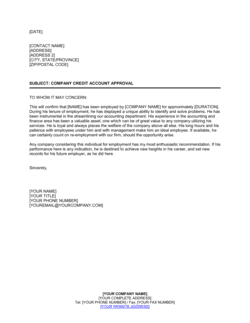
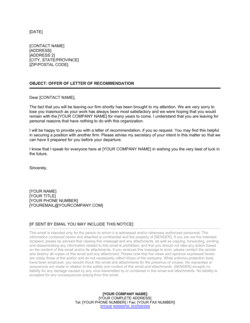
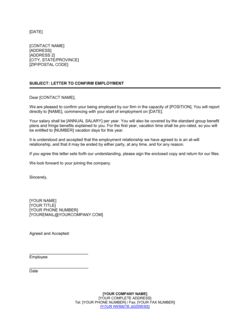
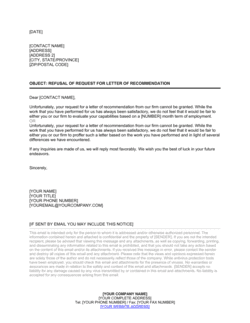
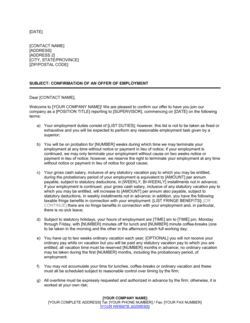
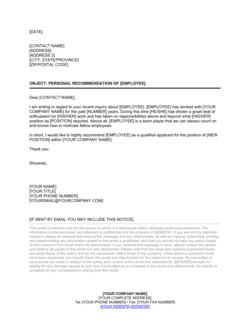
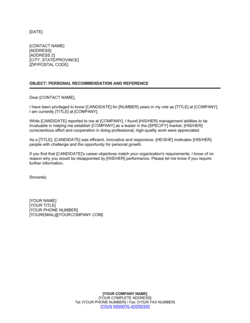
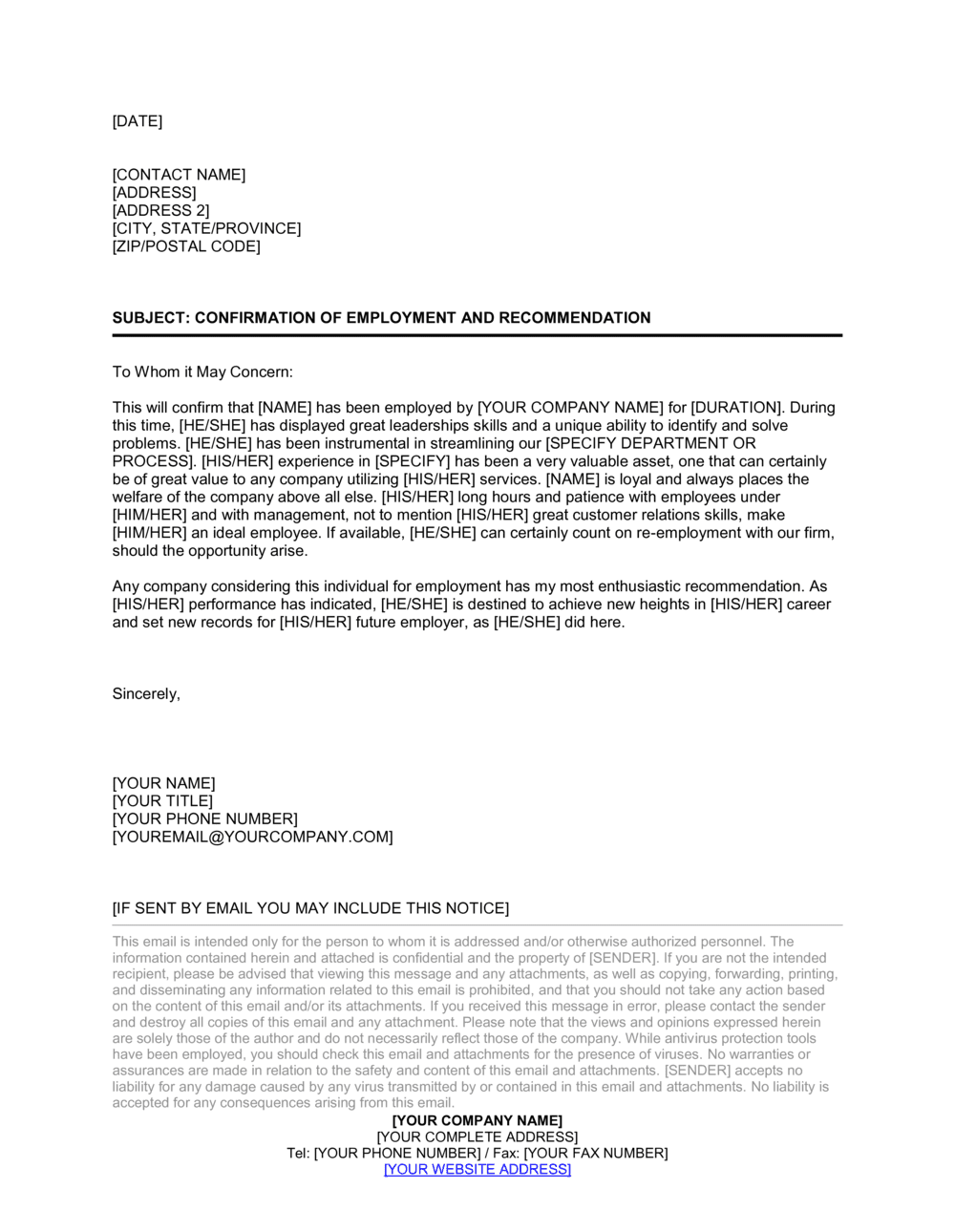
A Confirmation of Employment and Letter of Recommendation is a single formal letter issued by an employer that does two things at once: it verifies an employee's job title, employment dates, and salary range as factual record, and it adds a personal endorsement of the employee's performance and character. This free Word download can be edited online and exported as PDF in minutes, ready for submission to immigration offices, landlords, or prospective employers.
When you need it
Use it when an employee needs documented proof of employment combined with a professional endorsement β€” most commonly for visa or work-permit applications, rental or mortgage approvals, and new-job reference checks. A single combined letter satisfies both requirements in one document rather than forcing the recipient to chase two separate letters.
What's inside
Employer and employee identification, confirmation of role and employment dates, salary range or compensation statement, a performance and character endorsement, and a direct contact invitation for follow-up questions β€” structured as a professional business letter with a formal closing.

What is a Confirmation of Employment and Letter of Recommendation?

A Confirmation of Employment and Letter of Recommendation is a formal employer-issued letter that serves two purposes within a single document: it verifies an employee's factual employment history β€” job title, department, dates of service, and salary range β€” and it adds a direct personal endorsement of the employee's performance, skills, and character. Rather than requesting two separate letters from the same employer, recipients such as consulates, landlords, mortgage lenders, and prospective employers can satisfy both their verification and reference requirements in one professionally formatted document. It is written on company letterhead, signed by a manager or HR representative, and typically runs one page.

Why You Need This Document

When an employee needs to prove their employment status and vouch for their professional standing simultaneously β€” for a visa application, a rental agreement, or a new-job reference β€” asking their employer for two separate letters creates unnecessary friction and delays. A combined letter eliminates that back-and-forth. For employers, a well-structured template ensures every letter issued is factually consistent with HR records, contains the specific performance detail that institutions actually look for, and avoids the liability risk of vague or inaccurate statements. Without a template, managers tend to produce letters that either omit the salary information a lender requires or rely on generic praise that immigration officers and hiring managers discount. This template provides the structure to get both components right the first time, in under 15 minutes.

Which variant fits your situation?

If your situation is…Use this template
Recipient needs only factual employment verification with no personal endorsementEmployment Verification Letter
Employee is applying for a senior role and needs a detailed character referenceLetter of Recommendation
Employee is leaving and needs a formal record of serviceExperience Certificate
Prospective landlord requires proof of income specificallyProof of Income Letter
New employer needs a structured reference check form completedEmployee Reference Check Form
Employee requires a letter confirming salary for a mortgage applicationSalary Verification Letter
Employer is providing a character reference for a non-employment purpose such as a court proceedingCharacter Reference Letter

Common mistakes to avoid

❌ Generic praise with no specific examples

Why it matters: Phrases like 'excellent team player' and 'strong work ethic' appear in every letter and are routinely discounted by hiring managers and immigration evaluators who are scanning for evidence.

Fix: Include at least one specific achievement, project, or measurable outcome that illustrates the quality you are describing.

❌ Approximate or incorrect employment dates

Why it matters: Even a one-month discrepancy between the letter and payroll records can trigger a formal audit request from a bank, visa office, or background-check provider, delaying the application by weeks.

Fix: Pull the start and end dates directly from your HR system or original offer letter and copy them verbatim into the letter.

❌ Omitting a direct contact for follow-up

Why it matters: Letters with no reply address or phone number are treated as incomplete by many consulates and financial institutions, which require the ability to verify the letter's authenticity.

Fix: Include a direct email address and phone number for the signatory at the end of the letter, and ensure that person is available to respond promptly.

❌ Having the wrong person sign the letter

Why it matters: A letter signed by a peer or junior colleague carries far less institutional weight than one signed by the employee's direct manager or an HR director β€” some organizations will not accept letters from non-supervisory signatories.

Fix: Identify the most senior person who can speak directly to the employee's work and have that person sign. If a senior executive must sign, have the direct manager draft the performance content.

The 9 key clauses, explained

Letterhead and date

In plain language: The employer's company name, address, phone, and email printed at the top, followed by the date the letter is issued.

Sample language
[COMPANY NAME] | [STREET ADDRESS], [CITY, STATE ZIP] | [PHONE] | [EMAIL] | [DATE]

Common mistake: Using a personal email address or home address instead of official company contact details β€” recipients such as immigration officers may reject the letter as unverifiable.

Recipient address block

In plain language: The name and address of the individual or organization the letter is addressed to, or 'To Whom It May Concern' when the recipient is unknown.

Sample language
To Whom It May Concern, / [RECIPIENT NAME] / [RECIPIENT ORGANIZATION] / [RECIPIENT ADDRESS]

Common mistake: Leaving the recipient block blank entirely when submitting to a specific institution. Named letters carry more weight with immigration offices and financial lenders than generic 'To Whom It May Concern' salutations.

Opening confirmation statement

In plain language: A direct sentence confirming that the named employee works or worked for the company, establishing the factual basis of the letter.

Sample language
I am writing to confirm that [EMPLOYEE FULL NAME] is employed by [COMPANY NAME] in the position of [JOB TITLE], and has been continuously employed with us since [START DATE].

Common mistake: Opening with the recommendation praise before establishing the employment facts β€” recipients parsing for verification data will not find it quickly, and some automated systems reject letters that do not lead with factual confirmation.

Employment details

In plain language: Specifies the employee's official job title, department, full-time or part-time status, and the precise employment start and end dates (or confirmation that employment is ongoing).

Sample language
[EMPLOYEE NAME] holds the role of [JOB TITLE] in the [DEPARTMENT] department on a [full-time / part-time] basis. Employment commenced on [START DATE] and is [ongoing / concluded on END DATE].

Common mistake: Stating an approximate start date rather than the exact date on record. Even a one-month discrepancy can delay a visa application or trigger a follow-up audit from a lender.

Salary or compensation statement

In plain language: States the employee's current or final annual salary, or a salary range if the employer's policy prohibits disclosing exact figures.

Sample language
[EMPLOYEE NAME]'s current annual compensation is $[AMOUNT], paid [bi-weekly / monthly]. / Alternatively: [EMPLOYEE NAME]'s compensation falls within the range of $[LOW] to $[HIGH] per year.

Common mistake: Omitting compensation details entirely when the letter is intended for a rental or mortgage application β€” landlords and lenders require income confirmation and will request a separate letter if it is missing.

Performance and skills endorsement

In plain language: The personal recommendation component: a specific description of the employee's strengths, key contributions, and professional qualities.

Sample language
During [his/her/their] tenure, [EMPLOYEE NAME] has consistently demonstrated [SPECIFIC SKILL OR QUALITY], including [SPECIFIC ACHIEVEMENT OR EXAMPLE]. [He/She/They] approaches [work type] with [characteristic], making [him/her/them] a reliable and valued member of our team.

Common mistake: Using only generic praise such as 'hardworking and reliable' without a single specific example. Recommendation letters without concrete details carry significantly less weight with hiring managers and immigration evaluators.

Character statement

In plain language: A brief statement affirming the employee's integrity, conduct, and reliability beyond their technical job performance.

Sample language
I have found [EMPLOYEE NAME] to be honest, dependable, and professional in all interactions with colleagues and clients. [He/She/They] consistently upholds the values of [COMPANY NAME] and represents the organization with integrity.

Common mistake: Repeating the same qualities already covered in the performance endorsement. The character statement should speak to personal conduct and ethics, not restate job skills.

Endorsement closing and offer of contact

In plain language: A concluding recommendation sentence followed by an explicit invitation for the recipient to contact the signatory directly with any questions.

Sample language
I recommend [EMPLOYEE NAME] without reservation and am confident [he/she/they] will bring the same commitment and professionalism to any future endeavor. Please feel free to contact me directly at [PHONE] or [EMAIL] should you require any additional information.

Common mistake: Ending the letter without a contact invitation. Recipients β€” particularly visa offices β€” routinely follow up by phone or email, and a letter with no contact details may be treated as incomplete.

Signature block

In plain language: The signatory's printed name, job title, company name, and handwritten or electronic signature.

Sample language
Sincerely, / [SIGNATORY NAME] / [TITLE] / [COMPANY NAME]

Common mistake: Having a junior HR clerk sign a letter that would carry more weight signed by the employee's direct manager or a senior executive β€” particularly for immigration or professional licensing applications where the signatory's authority matters.

How to fill it out

  1. 1

    Add the company letterhead

    Insert your company's official name, full mailing address, phone number, and email at the top of the document. Set the issue date to the day you will sign and send the letter.

    πŸ’‘ Print on physical company letterhead or ensure the digital header includes your company logo β€” this increases credibility with immigration and financial institutions.

  2. 2

    Address the recipient

    If you know the specific recipient β€” a consulate, landlord, or employer β€” enter their name and address. Use 'To Whom It May Concern' only when the employee needs a general-purpose letter.

    πŸ’‘ Ask the employee who specifically will receive the letter before you draft it. A named salutation increases the letter's perceived authority.

  3. 3

    Enter the employee's factual employment details

    Fill in the employee's full legal name, exact job title, department, employment type, and start date pulled directly from your HR or payroll system. If employment has ended, add the exact end date.

    πŸ’‘ Cross-check the start date against the original offer letter or onboarding record β€” discrepancies of even a few days can delay visa or loan processing.

  4. 4

    State the salary or compensation range

    Enter the employee's current or final annual salary, or a salary band if your policy restricts exact disclosure. Specify the payment frequency β€” bi-weekly, semi-monthly, or monthly.

    πŸ’‘ If the employee's compensation includes bonuses or commissions, note the base salary separately and indicate that total compensation may be higher β€” this is especially useful for rental and mortgage applications.

  5. 5

    Write the performance endorsement with a specific example

    Describe two or three concrete strengths the employee demonstrated in their role. Anchor at least one strength to a specific project, outcome, or measurable result rather than a general quality.

    πŸ’‘ A single quantified achievement β€” 'reduced client onboarding time by three weeks' or 'managed a team of eight across two time zones' β€” does more work than a full paragraph of adjectives.

  6. 6

    Add the character statement and closing endorsement

    Write one to two sentences on the employee's personal conduct and integrity, then close with an unqualified recommendation and your direct contact details for follow-up.

    πŸ’‘ If you have any reservations about giving an unqualified endorsement, issue a standalone employment confirmation letter instead β€” a lukewarm recommendation letter can actively harm an application.

  7. 7

    Sign and deliver in the requested format

    Sign the letter with a wet signature or an accepted electronic signature, then export as PDF for email delivery or print on company letterhead for physical submission.

    πŸ’‘ Some visa applications and financial institutions require a wet-ink signature on company letterhead β€” confirm the required format with the employee before choosing your delivery method.

Frequently asked questions

What is a confirmation of employment and letter of recommendation?

It is a single formal letter from an employer that combines two functions: it verifies factual employment details β€” job title, dates of service, and salary range β€” and it adds a personal endorsement of the employee's performance and character. The combined format satisfies both verification and reference requirements in one document, which is particularly useful for visa applications, rental approvals, and new-employer reference checks.

When would an employee need this letter?

The most common triggers are visa or work-permit applications that require proof of employment alongside a character reference, rental or mortgage applications where the landlord or lender wants both income verification and a professional endorsement, and new-job applications where a prospective employer requests a combined reference. Some scholarship and grant programs also accept this format in lieu of separate letters.

Is this letter legally binding?

No. A confirmation of employment and letter of recommendation is a formal professional document, not a legally binding contract. It does not create employment obligations, guarantee a job offer, or commit the employer to any financial arrangement. Employers should be factually accurate β€” knowingly false statements in a verification letter can expose the signatory to defamation or fraud claims depending on the jurisdiction.

Should the letter state the exact salary or a salary range?

Either is acceptable in most situations. Many employers disclose an exact annual figure when the letter is required for a mortgage or visa application where precise income matters. Others use a salary range β€” for example, "$55,000 to $70,000 per year" β€” when internal policy restricts exact compensation disclosure. Confirm what the receiving institution requires before drafting the letter, as some lenders and consulates require an exact figure.

Who should sign the letter?

Ideally, the employee's direct manager or a senior HR representative signs the letter β€” someone who can speak from personal experience about the employee's performance. For visa and financial applications, a more senior signatory (director, VP, or HR director) often carries more weight. The signatory must be reachable at the contact details provided in the letter.

Can the same letter be used for multiple purposes?

Yes, but with caution. A general-purpose letter addressed 'To Whom It May Concern' can serve multiple purposes, but a named letter addressed to a specific consulate or lender typically carries more authority for that specific application. If the employee needs the letter for both a visa application and a rental application, consider issuing two versions β€” one named for each recipient β€” rather than one generic letter.

How long should the letter be?

One page is the standard length for this type of letter. The factual confirmation section β€” title, dates, and salary β€” typically takes two to three short paragraphs. The recommendation section adds another two to three paragraphs. Longer letters are rarely necessary and may suggest the writer is padding rather than speaking with confidence.

What is the difference between this letter and a standalone reference letter?

A standalone reference or recommendation letter focuses entirely on the employee's qualities and performance without the factual verification component. This combined letter adds the employment confirmation data β€” title, dates, salary β€” that many institutions require alongside a recommendation. If the recipient needs only a subjective endorsement, a standalone recommendation letter is sufficient; if they need both proof and endorsement, this combined format saves everyone time.

Does the letter need to be on official company letterhead?

For most formal applications β€” visas, mortgages, and background checks β€” yes. Official letterhead with the company name, address, logo, and contact details signals authenticity and allows the recipient to verify the employer independently. A letter printed on plain paper without company branding is more likely to trigger a follow-up verification request or outright rejection.

How this compares to alternatives

vs Letter of Recommendation

A standalone letter of recommendation focuses exclusively on the employee's qualities, achievements, and character β€” it contains no factual employment verification data. Use the standalone version when the recipient needs only a subjective endorsement. Use this combined template when the same recipient also needs proof of employment dates, title, and compensation.

vs Employment Verification Letter

An employment verification letter is purely factual β€” it confirms job title, dates, and salary without any personal endorsement. Use it when a landlord or lender needs income confirmation but has not requested a recommendation. This combined template is the right choice when a single document must satisfy both the verification and reference requirement simultaneously.

vs Experience Certificate

An experience certificate is a brief formal document issued at the end of employment confirming the employee's role and tenure β€” it typically does not include a performance recommendation. This combined letter goes further by adding an active endorsement and is suitable for current employees as well as departing ones.

vs Character Reference Letter

A character reference letter speaks to personal integrity and conduct β€” it is typically written for non-employment purposes such as court proceedings, volunteer positions, or community applications. This combined employment letter is rooted in a professional employer-employee relationship and includes factual employment data that a character reference does not.

Industry-specific considerations

Technology / SaaS

Commonly needed when engineers or product managers relocate internationally on work visas and need both an employment confirmation and a technical performance endorsement in one document.

Healthcare

Credentialing boards and licensing authorities often require combined employment verification and character endorsement letters for clinicians moving between facilities or jurisdictions.

Professional Services

Accounting, legal, and consulting firms use these letters when associates transfer to client organizations or apply for professional certifications requiring verified employment history.

Retail / Hospitality

High employee turnover makes a reusable combined letter template particularly valuable β€” managers can issue consistent, policy-compliant letters quickly without drafting from scratch each time.

Template vs pro β€” what fits your needs?

PathBest forCostTime
Use the templateHR managers, small business owners, and direct managers writing standard employment confirmation and reference lettersFree10–15 minutes
Template + professional reviewLetters for senior executives, complex visa categories, or situations where the signatory has concerns about liability$100–$300 (HR consultant or employment lawyer review)1–2 days
Custom draftedHigh-stakes immigration filings, regulated professional licensing applications, or letters requiring specific legal language mandated by a government body$300–$8002–5 days

Glossary

Employment Confirmation
A formal written statement from an employer verifying that a named individual is or was employed, including their job title and dates of service.
Letter of Recommendation
A written endorsement from a supervisor or employer attesting to an employee's skills, work ethic, and character for the benefit of a third party.
Employment Verification
The process by which a third party β€” such as a landlord, bank, or immigration authority β€” confirms that an individual's employment details are accurate.
Salary Range
The minimum and maximum compensation figures disclosed in lieu of an exact salary, used to protect privacy while satisfying financial verification requirements.
Reference Contact
The named signatory or HR contact who agrees to respond to follow-up inquiries from the letter's recipient.
Date of Hire
The official first day of employment as recorded in payroll and HR systems, used to calculate tenure.
Character Endorsement
A qualitative statement in a recommendation letter that speaks to the employee's integrity, reliability, and personal qualities beyond job-specific skills.
Letterhead
A pre-printed or digitally formatted header on business correspondence that displays the company name, address, logo, and contact information.
Employment Status
Whether the individual is currently employed (active) or was formerly employed (past), and whether on a full-time, part-time, or contract basis.
At-Will Statement
Optional language clarifying that employment is or was at-will, included to prevent the letter from being misread as implying a guaranteed contract.

Part of your Business Operating System

This document is one of 3,000+ business & legal templates included in Business in a Box.

  • Fill-in-the-blanks β€” ready in minutes
  • 100% customizable Word document
  • Compatible with all office suites
  • Export to PDF and share electronically

Create your document in 3 simple steps.

From template to signed document β€” all inside one Business Operating System.
1
Download or open template

Access over 3,000+ business and legal templates for any business task, project or initiative.

2
Edit and fill in the blanks with AI

Customize your ready-made business document template and save it in the cloud.

3
Save, Share, Send, Sign

Share your files and folders with your team. Create a space of seamless collaboration.

Save time, save money, and create top-quality documents.

β˜…β˜…β˜…β˜…β˜…

"Fantastic value! I'm not sure how I'd do without it. It's worth its weight in gold and paid back for itself many times."

Managing Director Β· Mall Farm
Robert Whalley
Managing Director, Mall Farm Proprietary Limited
β˜…β˜…β˜…β˜…β˜…

"I have been using Business in a Box for years. It has been the most useful source of templates I have encountered. I recommend it to anyone."

Business Owner Β· 4+ years
Dr Michael John Freestone
Business Owner
β˜…β˜…β˜…β˜…β˜…

"It has been a life saver so many times I have lost count. Business in a Box has saved me so much time and as you know, time is money."

Owner Β· Upstate Web
David G. Moore Jr.
Owner, Upstate Web

Run your business with a system β€” not scattered tools

Stop downloading documents. Start operating with clarity. Business in a Box gives you the Business Operating System used by over 250,000 companies worldwide to structure, run, and grow their business.

Start freeΒ Β·Β No credit card required