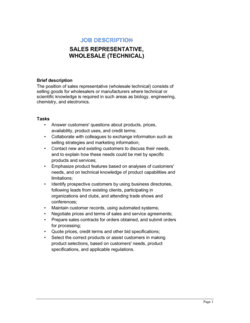
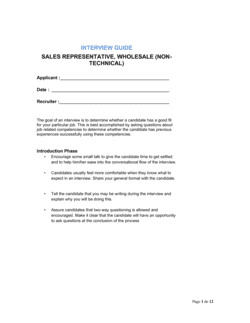
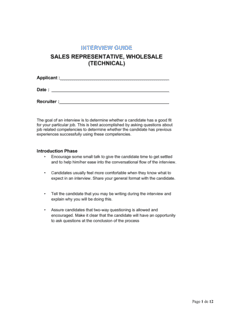
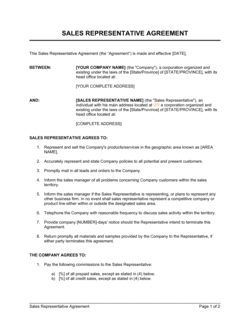
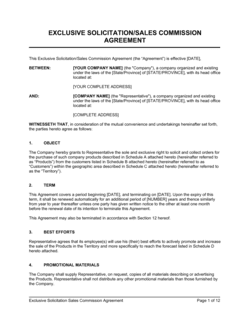
Sales Representative_Wholesale (Non-technical) Job Description Template

Free Word download • Edit online • Save & share with Drive • Export to PDF

2 pages20–30 min to fillDifficulty: StandardSignature requiredLegal review recommended
Learn more ↓
FreeSales Representative_Wholesale (Non-technical) Job Description Template

At a glance

What it is
A Sales Representative Wholesale (Non-Technical) Job Description is a legally referenced document that defines the scope, duties, compensation structure, performance expectations, and reporting obligations for a non-technical wholesale sales role. This free Word download gives employers a structured, enforceable starting point they can edit online and attach to an employment contract or offer letter before a new hire's first day.
When you need it
Use it when hiring or reclassifying a wholesale sales representative who sells consumer or commodity goods — rather than technical or engineered products — to distributors, retailers, or institutional buyers. It is also used when updating an existing sales role to reflect new quotas, territories, or reporting lines.
What's inside
Role summary and objectives, detailed duties and responsibilities, required qualifications and skills, territory and account assignment, compensation and commission structure, performance targets, reporting hierarchy, and conditions of employment including confidentiality and non-solicitation references.

What is a Sales Representative Wholesale (Non-Technical) Job Description?

A Sales Representative Wholesale (Non-Technical) Job Description is a formally structured document that defines the duties, performance targets, compensation structure, territory assignment, and reporting obligations for an employee hired to sell non-technical goods — such as consumer products, food and beverage, apparel, or building materials — to wholesale buyers including distributors, retailers, and institutional accounts. When incorporated by reference into a signed employment agreement, it becomes a legally binding record of what the employer and employee agreed the role entails, providing the evidentiary foundation needed to enforce commission calculations, manage performance, and terminate for cause without dispute.

Unlike a generic job posting used for recruitment, this document is designed to be signed, filed in the employee's personnel record, and referenced in commission or performance proceedings. It specifies not just what the rep does day-to-day, but the precise triggers for commission payment, the boundaries of account ownership, the CRM obligations that support forecasting and management, and the post-employment obligations the rep carries forward after separation.

Why You Need This Document

Without a signed, detailed job description incorporated into the employment contract, four problems become routine. First, commission disputes over house accounts, territory boundaries, and the earn-on-payment trigger have no written resolution mechanism — and reps who feel shortchanged typically escalate or resign at the worst possible time in the sales cycle. Second, terminating an underperforming rep without a documented quota threshold and progressive-discipline reference creates wrongful-termination exposure in virtually every jurisdiction, including US states that otherwise recognize at-will employment. Third, a rep who leaves and immediately calls your top wholesale accounts has almost certainly violated a non-solicitation obligation — but that obligation is unenforceable unless it is in a signed agreement the rep received before their start date. Fourth, CRM hygiene breaks down immediately when logging is listed as a duty but carries no documented consequence, leaving the company with no pipeline visibility and no account history when the rep departs. This template closes all four gaps in the time it takes to customize 10 fields.

Which variant fits your situation?

If your situation is…Use this template
Hiring a rep who sells technical or engineered products requiring product expertiseSales Representative (Technical) Job Description
Engaging an independent rep on a commission-only basis rather than as an employeeIndependent Sales Representative Agreement
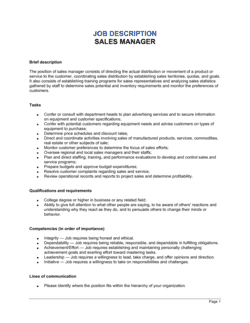
Hiring a sales manager to oversee a team of wholesale repsSales Manager Job Description
Defining the full employment terms alongside this job descriptionEmployment Contract
Bringing on a retail sales associate for in-store selling rather than wholesaleSales Associate Job Description
Hiring a sales rep for inside sales and telephone-based wholesale outreachInside Sales Representative Job Description
Creating a documented commission and quota plan to attach to this descriptionSales Commission Agreement

Common mistakes to avoid

❌ No signed acknowledgment block

Why it matters: An unsigned job description cannot be used as evidence of an employee's awareness of their duties or performance obligations in a wrongful-termination or commission dispute. Courts treat unsigned documents as informational, not contractual.

Fix: Add a dated signature line to every job description and obtain the employee's signature before or on day one. Attach the signed document to the employment contract in the personnel file.

❌ Vague territory definition with no account exclusions listed

Why it matters: Reps who discover undisclosed house accounts or inbound-lead exclusions after signing are far more likely to dispute commissions, disengage, or resign — and they often win informal disputes when the exclusions were never documented.

Fix: List every house account, inbound digital account, and shared territory exception in a named Exhibit A attached to the job description at the time of signing.

❌ Commission 'earned on order submission' rather than on customer payment

Why it matters: Paying commission when an order is submitted — rather than when payment is received — means the company pays out on cancelled, returned, or uncollected orders, creating material cash-flow exposure as the sales team scales.

Fix: Define commission as earned upon receipt of customer payment and include a clawback for commissions already paid on orders that are subsequently cancelled or remain unpaid beyond 90 days.

❌ Embedding non-solicitation terms only in the job description

Why it matters: Post-employment non-solicitation obligations included solely in a job description — and not in the executed employment contract — are routinely challenged as non-binding, because job descriptions are rarely treated as standalone contracts by courts.

Fix: Include the full non-solicitation clause in the employment contract and use the job description only to reference and acknowledge it. Ensure both documents are signed before the employee's start date.

❌ No CRM compliance consequence

Why it matters: Listing CRM maintenance as a duty without a stated consequence means managers have no documented enforcement mechanism. Reps deprioritize logging, account history is lost when they leave, and pipeline forecasts become unreliable.

Fix: State explicitly that failure to maintain CRM records within the required timeframe may result in account reassignment and will be addressed through the standard performance improvement process.

❌ Qualifications that exceed genuine occupational requirements

Why it matters: Listing a four-year degree as required for a role where demonstrated sales performance is the actual criterion can constitute indirect discrimination in several jurisdictions, particularly if the requirement disproportionately screens out protected groups.

Fix: Audit each qualification for genuine operational necessity. Replace degree requirements with demonstrated-experience equivalents where the credential is not legally or professionally mandated for the role.

The 10 key clauses, explained

Role Summary and Objectives

In plain language: Defines the purpose of the position, the primary business outcome expected, and where the role fits within the sales organization.

Sample language
The Wholesale Sales Representative (Non-Technical) is responsible for generating revenue by acquiring new wholesale accounts and growing existing customer relationships within the assigned territory. The role reports to the [REGIONAL SALES MANAGER / DIRECTOR OF SALES] and is expected to achieve annual revenue targets of $[AMOUNT].

Common mistake: Writing a generic role summary that could apply to any sales job. A vague summary creates ambiguity about whether the rep's obligations include account management, prospecting, or both — leading to disputes over commission eligibility on house accounts.

Duties and Responsibilities

In plain language: Lists the specific, day-to-day tasks the representative must perform — prospecting, presentations, order management, and account reviews.

Sample language
Responsibilities include: (a) prospecting and qualifying new wholesale accounts within the assigned territory; (b) conducting product presentations and price negotiations; (c) submitting accurate orders via [CRM PLATFORM]; (d) maintaining a minimum of [X] customer-facing calls per week; and (e) attending [FREQUENCY] trade shows and sales meetings.

Common mistake: Omitting CRM maintenance as a duty. When reps do not log activity, managers have no documented basis for performance improvement plans, and the company loses the account history if the rep leaves.

Qualifications and Skills Required

In plain language: States the minimum education, experience, and competencies needed to perform the role — used as the legal baseline for hiring and performance decisions.

Sample language
Minimum qualifications: [X] years of B2B or wholesale sales experience; demonstrated ability to manage a portfolio of [X]+ accounts; proficiency in Microsoft Office and [CRM NAME]; valid driver's license required for territory travel. Preferred: experience in [INDUSTRY VERTICAL].

Common mistake: Listing qualifications that are not genuine occupational requirements — for example, requiring a degree for a role where demonstrated sales performance is the real criterion. Overly restrictive qualifications can expose employers to discrimination claims in several jurisdictions.

Territory and Account Assignment

In plain language: Defines the geographic or named-account scope within which the rep operates and whether the territory is exclusive or shared.

Sample language
Representative is assigned the [GEOGRAPHIC REGION / NAMED ACCOUNT LIST] as their primary territory. Territory is [exclusive / non-exclusive]. House accounts — listed in Exhibit A — are excluded from commission calculations. Territory assignments may be modified by the Company with [X] days' written notice.

Common mistake: Granting an 'exclusive' territory without defining what exclusivity means for inbound digital leads or house accounts. Reps who discover unadvertised exclusions after signing typically escalate to formal disputes or resignation.

Compensation, Commission, and Bonus

In plain language: States the base salary (if any), commission rate and calculation method, payment timing, and any bonus tied to quota attainment.

Sample language
Base salary: $[AMOUNT] per year, paid bi-weekly. Commission: [X]% of net invoice value on all closed orders within the assigned territory, paid within [30] days of customer payment receipt. Accelerator: [X]% on revenue exceeding [Y]% of quarterly quota. All commissions are earned upon receipt of customer payment, not upon order submission.

Common mistake: Failing to define when a commission is 'earned.' Without an earned-on-payment clause, reps in several jurisdictions may claim commission on orders submitted but later cancelled, returned, or unpaid — a significant financial exposure for the company.

Performance Targets and Metrics

In plain language: Identifies the quota, activity KPIs, and performance standards against which the rep will be formally evaluated.

Sample language
Annual quota: $[AMOUNT] in net wholesale revenue. Quarterly minimum threshold: [X]% of annualized quota to remain in good standing. Activity KPIs: minimum [X] new account contacts per week, [X] account reviews per quarter. Performance below [Y]% of quota for [Z] consecutive quarters constitutes grounds for a formal performance improvement plan.

Common mistake: Setting quotas in the job description without linking them to the commission plan or employment contract. Disconnected documents allow reps to argue they were not formally bound by the quota threshold when termination for underperformance is challenged.

Reporting Obligations and CRM Compliance

In plain language: Defines the reports, call logs, forecast submissions, and CRM entries the representative must complete and when.

Sample language
Representative shall: (a) update [CRM NAME] within [24] hours of all customer interactions; (b) submit a weekly pipeline report to [MANAGER TITLE] by [DAY/TIME]; (c) provide a monthly account review covering top [X] accounts by revenue. Failure to maintain CRM records may result in account reassignment.

Common mistake: No explicit consequence for CRM non-compliance. Without a stated outcome — account reassignment or documented warning — the obligation is unenforceable in practice and reps routinely deprioritize it.

Confidentiality and Customer Data

In plain language: Prohibits the rep from disclosing pricing, customer lists, and proprietary sales data during and after employment, and references the governing confidentiality provisions in the employment agreement.

Sample language
Representative acknowledges that customer account lists, pricing schedules, and sales data are Confidential Information of the Company as defined in the Employment Agreement dated [DATE]. Representative shall not use or disclose such information for any purpose other than performing their duties under this Job Description.

Common mistake: Treating the job description as the sole confidentiality document without referencing a signed NDA or employment agreement. Job descriptions are often challenged as non-binding; the confidentiality obligations must be anchored in a separately executed agreement.

Non-Solicitation Reference

In plain language: Flags that the representative is subject to a non-solicitation restriction — the details of which are contained in the governing employment contract — preventing post-employment poaching of accounts or colleagues.

Sample language
Representative acknowledges that upon separation from employment, the non-solicitation obligations set out in Section [X] of the Employment Agreement shall remain in full force. Representative shall not, for [X] months following separation, directly or indirectly solicit any wholesale account served during their tenure.

Common mistake: Embedding full non-solicit terms only in the job description and not in the employment contract. Courts in most jurisdictions will not enforce post-employment restrictions that appear only in a job description, as it is typically not treated as a binding contractual document.

Conditions of Employment and Acknowledgment

In plain language: States that the job description supplements — and does not replace — the employment agreement, and requires the employee to sign acknowledging receipt and understanding.

Sample language
This Job Description is incorporated by reference into and forms part of the Employment Agreement between [COMPANY NAME] and [EMPLOYEE NAME] dated [DATE]. Employee acknowledges receipt of this Job Description and confirms they understand and accept the duties, performance standards, and obligations described herein. Signature: ___________ Date: ___________

Common mistake: Distributing the job description without obtaining a signed acknowledgment. An unsigned job description cannot be introduced as evidence that an employee was aware of their performance obligations in a wrongful-termination or commission dispute.

How to fill it out

  1. 1

    Enter the company name, location, and role title

    Use the employer's full registered legal name, the primary work location or territory base, and the exact job title that will appear on the offer letter and payroll records.

    💡 Keep the job title consistent across the job description, offer letter, employment contract, and payroll system — inconsistencies create classification and tax complications.

  2. 2

    Define the reporting structure and team context

    Name the specific manager title the rep reports to and note whether this role is part of a larger regional or national field sales team.

    💡 Avoid naming the specific manager by personal name — use their title so the document remains valid if the manager changes.

  3. 3

    List duties in order of time allocation

    Sequence the responsibilities from highest to lowest estimated time commitment. Lead with core revenue-generating duties — prospecting, presentations, closing — before administrative tasks like CRM updates and reports.

    💡 Add a catch-all clause: 'and any other duties reasonably assigned by management' to preserve flexibility without triggering a contract amendment every time scope shifts.

  4. 4

    Specify the territory and note any exclusions

    Define the territory clearly — by state, zip code range, named account list, or vertical market. List all house accounts and inbound-channel exclusions explicitly in Exhibit A.

    💡 If the territory is non-exclusive, say so clearly. An ambiguous territory clause is one of the most common triggers for commission disputes in wholesale sales.

  5. 5

    Complete the compensation and commission block

    Enter base salary, commission rate, accelerator tiers, and the explicit earn-on-payment trigger. Cross-reference the commission plan document if one exists separately.

    💡 Include a clawback provision for commissions paid on orders that are subsequently returned or remain unpaid beyond 90 days.

  6. 6

    Set quantified performance targets

    Enter the annual quota in dollar terms, the quarterly minimum threshold percentage, and the activity KPIs. Tie the performance thresholds directly to the terms in the employment contract.

    💡 State the consequence of missing the threshold — a performance improvement plan, not immediate termination — to preserve a defensible progressive discipline process.

  7. 7

    Cross-reference the employment agreement and NDA

    Add the execution date of the governing employment agreement and NDA in the confidentiality and non-solicitation clauses so the documents are legally linked.

    💡 Never let the job description be the only signed document. It should always reference and be attached to a fully executed employment agreement.

  8. 8

    Obtain a dated signature before day one

    Have the employee sign the acknowledgment block before or on their first day of employment. File the signed copy in the employee's HR record and provide a copy to the employee.

    💡 Use a timestamped eSign solution so the execution date is indisputable if the document is ever introduced in a commission or termination dispute.

Frequently asked questions

What is a wholesale sales representative job description?

A wholesale sales representative job description is a formal document that defines the duties, performance expectations, compensation structure, territory, and reporting obligations for a sales representative who sells goods in bulk to retailers, distributors, or institutional buyers. In its legally referenced form, it is incorporated into the employment contract and signed by the employee to create an enforceable record of agreed obligations — particularly for commission and performance management purposes.

What is the difference between a technical and non-technical wholesale sales representative?

A non-technical wholesale sales representative sells consumer goods, commodity products, or packaged goods that do not require specialized engineering or technical knowledge to present and sell — examples include FMCG products, apparel, food and beverage, and household goods. A technical sales representative sells products that require product-specific expertise — industrial equipment, chemicals, or software — and the job description typically includes technical qualification requirements and more complex product-training obligations.

Does a job description need to be signed?

A job description does not need to be signed to serve as an internal reference document, but it should be signed when it is incorporated into an employment contract or used as the basis for performance management and commission disputes. An unsigned job description is generally treated as informational by courts; a signed one, referenced in the employment agreement, creates an enforceable record of what the employee understood and accepted about their role and obligations.

Can I use a job description as the only document for a new hire?

No. A job description defines the role but does not replace an employment contract, which governs IP assignment, confidentiality, non-compete and non-solicitation obligations, termination terms, and severance. Relying on a job description alone leaves the employer without enforceable post-employment restrictions and creates ambiguity on termination obligations. Always pair a signed job description with a fully executed employment agreement.

How detailed should a wholesale sales rep quota be in the job description?

Quotas should be stated in dollar terms with a specific period — for example, $750,000 in net wholesale revenue per fiscal year, with a quarterly minimum of 20% of annualized quota to remain in good standing. Vague targets like 'meeting expectations' or 'achieving growth' are not enforceable. Quantified targets are essential when using performance against quota as the basis for a performance improvement plan or termination for cause.

What should the commission clause in a wholesale sales job description include?

At minimum: the commission rate (e.g., 5% of net invoice value), the trigger event (earned on receipt of customer payment, not on order submission), the payment timing (within 30 days of customer payment), any accelerator tiers for quota overachievement, and a clawback provision for commissions paid on orders that are cancelled or remain unpaid. Missing the earn-on-payment clause is the single most common source of commission disputes in wholesale sales.

Are non-solicitation clauses in a job description enforceable?

Generally, non-solicitation clauses referenced in a job description are not independently enforceable unless they are also contained in a signed employment contract or standalone restrictive covenant agreement. Courts in most jurisdictions require that post-employment restrictions be in a separately executed document supported by adequate consideration. A job description can acknowledge and reference those obligations, but the binding language must live in the employment contract.

How does a wholesale sales job description differ across US states, Canada, and the UK?

In the US, job descriptions are governed by state employment law, and the enforceability of at-will language, quota-based termination, and non-solicitation varies by state — California imposes particularly strict limits. In Canada, job descriptions must align with provincial employment standards, and termination for underperformance requires documented progressive discipline. In the UK, job descriptions must be consistent with the written statement of employment particulars required by law, and any commission structure changes require employee consent.

How often should a wholesale sales representative job description be updated?

Review and update the job description whenever a rep's territory, quota, reporting line, or compensation structure changes materially. Minor updates can be issued as addenda; substantive changes — particularly to compensation or territory — require the employee's written acknowledgment and, in some jurisdictions, may require fresh consideration to be legally binding. Annual reviews aligned to the fiscal year planning cycle are a sound practice.

How this compares to alternatives

vs Independent Sales Representative Agreement

An independent sales representative agreement governs a self-employed contractor who sells on the company's behalf without employment entitlements — no base salary, no benefits, and no tax withholding. A wholesale sales rep job description, by contrast, is used for an employee relationship with full statutory obligations. Misclassifying an employee rep as an independent contractor triggers back payroll taxes, benefit liability, and penalties in most jurisdictions.

vs Sales Commission Agreement

A sales commission agreement is a standalone document that governs the mechanics of commission calculation, payment timing, clawbacks, and accelerators in contractual detail. A job description defines the role and references the commission structure at a summary level. Both documents are typically used together — the job description defines the role; the commission agreement governs the pay. Using only a job description without a commission agreement leaves critical payment terms underspecified.

vs Employment Contract

An employment contract is the primary binding document governing IP assignment, confidentiality, non-compete, termination, and severance. A job description defines the role duties, quota, and territory — it supplements the contract rather than replacing it. Post-employment restrictions and termination terms must be in the employment contract to be enforceable; a job description alone is insufficient as a standalone legal document.

vs Sales Manager Job Description

A sales manager job description governs a supervisory role responsible for hiring, coaching, and holding a team of reps accountable to collective targets — it includes team management duties, hiring authority, and broader strategic planning obligations. A wholesale sales representative job description covers an individual contributor focused on territory revenue and account management. The two are used together as a team is built: the rep description is issued first, then the manager description is added when the team reaches a size requiring dedicated leadership.

Industry-specific considerations

Consumer Goods and FMCG

High call-frequency requirements, SKU-level sales targets, planogram compliance duties, and retailer-specific promotional execution obligations.

Food and Beverage

Distributor account management, on-premise versus off-premise channel splits, seasonal quota adjustments, and cold-chain compliance references in duties.

Apparel and Wholesale Fashion

Seasonal buying-cycle alignment, showroom presentation duties, markdown responsibility clauses, and territory exclusivity tied to retailer tier.

Building Materials and Hardware

Project-pipeline tracking in CRM, contractor and dealer account tiers, volume-rebate program management, and specification-selling duties with architects or contractors.

Healthcare and Medical Supplies

Compliance with anti-kickback and HCP interaction policies, required product training certifications, and hospital GPO contract adherence in the duties block.

Professional Services and Wholesale Distribution

Named-account ownership structures, value-added reseller channel management, and tiered commission structures based on account category and margin contribution.

Jurisdictional notes

United States

At-will employment governs most US sales roles, but quota-based termination must still follow a documented progressive-discipline process in states like Montana and under certain implied-contract doctrines. Commission payment timing is regulated in several states — California, for example, requires commissions to be paid as soon as practicable after they are earned and prohibits clawbacks in most circumstances. Non-solicitation clauses in California are broadly unenforceable; review state-specific restrictions before including them.

Canada

Canadian employment standards legislation in each province sets minimum requirements for notice, termination pay, and severance that cannot be contracted out of. Quota-based termination must follow documented progressive discipline to avoid constructive dismissal claims. Commission structures must comply with provincial wage payment legislation — Ontario's Employment Standards Act, for example, requires that commission statements be provided in writing. Quebec-based roles require French-language versions of all employment documents for provincially regulated employers.

United Kingdom

UK employers must provide a written statement of employment particulars on or before day one, and the job description should be consistent with those particulars. Commission structures that change materially require the employee's express written consent — unilateral changes can trigger constructive dismissal claims. The Working Time Regulations cap average working hours at 48 per week unless the employee opts out in writing, which is relevant for field sales roles with high travel demands. Post-termination non-solicitation clauses must be reasonable in duration and scope to be enforceable.

European Union

The EU Transparent and Predictable Working Conditions Directive requires that core employment terms — including duties and remuneration — be provided in writing within seven days of hire. Member states vary significantly on commission protection: France and Germany impose strict rules on unilateral commission plan changes and require employee agreement for material amendments. Post-employment non-solicitation obligations typically require compensation to the employee in Germany and several other member states to be enforceable. GDPR applies to the handling of customer data accessed by sales reps, and this should be referenced in the confidentiality clause.

Template vs lawyer — what fits your deal?

PathBest forCostTime
Use the templateSmall businesses and growing sales teams hiring non-technical wholesale reps in a single domestic jurisdictionFree20–30 minutes
Template + legal reviewCompanies with complex commission structures, exclusive territory grants, or reps hired across multiple US states or Canadian provinces$300–$6001–3 days
Custom draftedEmployers hiring in heavily regulated industries (healthcare, financial services), cross-border roles, or roles with material non-solicitation and IP exposure$1,000–$3,0001–2 weeks

Glossary

Wholesale Sales
The sale of goods in bulk to retailers, distributors, or institutional buyers for resale — distinct from selling directly to end consumers.
Territory Assignment
A defined geographic area, named account list, or vertical market within which the sales representative has primary responsibility for generating revenue.
Sales Quota
A quantified revenue or unit-volume target the representative is expected to meet or exceed within a defined period, typically a quarter or fiscal year.
Commission Structure
The formula that determines the variable portion of a sales rep's compensation — for example, 5% of net invoice value on all closed wholesale orders.
Account Ownership
The formal assignment of a customer relationship to a specific sales representative, determining who earns commission and is accountable for retention.
Non-Solicitation Clause
A restriction, typically referenced in the job description and binding in the employment contract, preventing a departing rep from poaching customers or colleagues.
Reporting Structure
The formal hierarchy defining who the sales representative reports to, receives direction from, and submits performance data to.
At-Will Employment
An employment arrangement — common in most US states — where either party may end the relationship at any time for any lawful reason without advance notice or cause.
KPI (Key Performance Indicator)
A measurable value used to evaluate how effectively the sales representative is achieving business objectives — examples include number of new accounts opened, revenue per account, and call activity rate.
CRM (Customer Relationship Management)
A software platform used to log sales activity, track pipeline, manage customer accounts, and report on quota attainment — reps are typically required to maintain CRM records as part of their duties.

Part of your Business Operating System

This document is one of 3,000+ business & legal templates included in Business in a Box.

  • Fill-in-the-blanks — ready in minutes
  • 100% customizable Word document
  • Compatible with all office suites
  • Export to PDF and share electronically

Create your document in 3 simple steps.

From template to signed document — all inside one Business Operating System.
1
Download or open template

Access over 3,000+ business and legal templates for any business task, project or initiative.

2
Edit and fill in the blanks with AI

Customize your ready-made business document template and save it in the cloud.

3
Save, Share, Send, Sign

Share your files and folders with your team. Create a space of seamless collaboration.

Save time, save money, and create top-quality documents.

★★★★★

"Fantastic value! I'm not sure how I'd do without it. It's worth its weight in gold and paid back for itself many times."

Managing Director · Mall Farm
Robert Whalley
Managing Director, Mall Farm Proprietary Limited
★★★★★

"I have been using Business in a Box for years. It has been the most useful source of templates I have encountered. I recommend it to anyone."

Business Owner · 4+ years
Dr Michael John Freestone
Business Owner
★★★★★

"It has been a life saver so many times I have lost count. Business in a Box has saved me so much time and as you know, time is money."

Owner · Upstate Web
David G. Moore Jr.
Owner, Upstate Web

Run your business with a system — not scattered tools

Stop downloading documents. Start operating with clarity. Business in a Box gives you the Business Operating System used by over 250,000 companies worldwide to structure, run, and grow their business.

Start free · No credit card required