Sales Addendum Template

Free Word download β€’ Edit online β€’ Save & share with Drive β€’ Export to PDF

2 pagesβ€’20–30 min to fillβ€’Difficulty: Standardβ€’Signature requiredβ€’Legal review recommended
Learn more ↓
FreeSales Addendum Template

At a glance

What it is
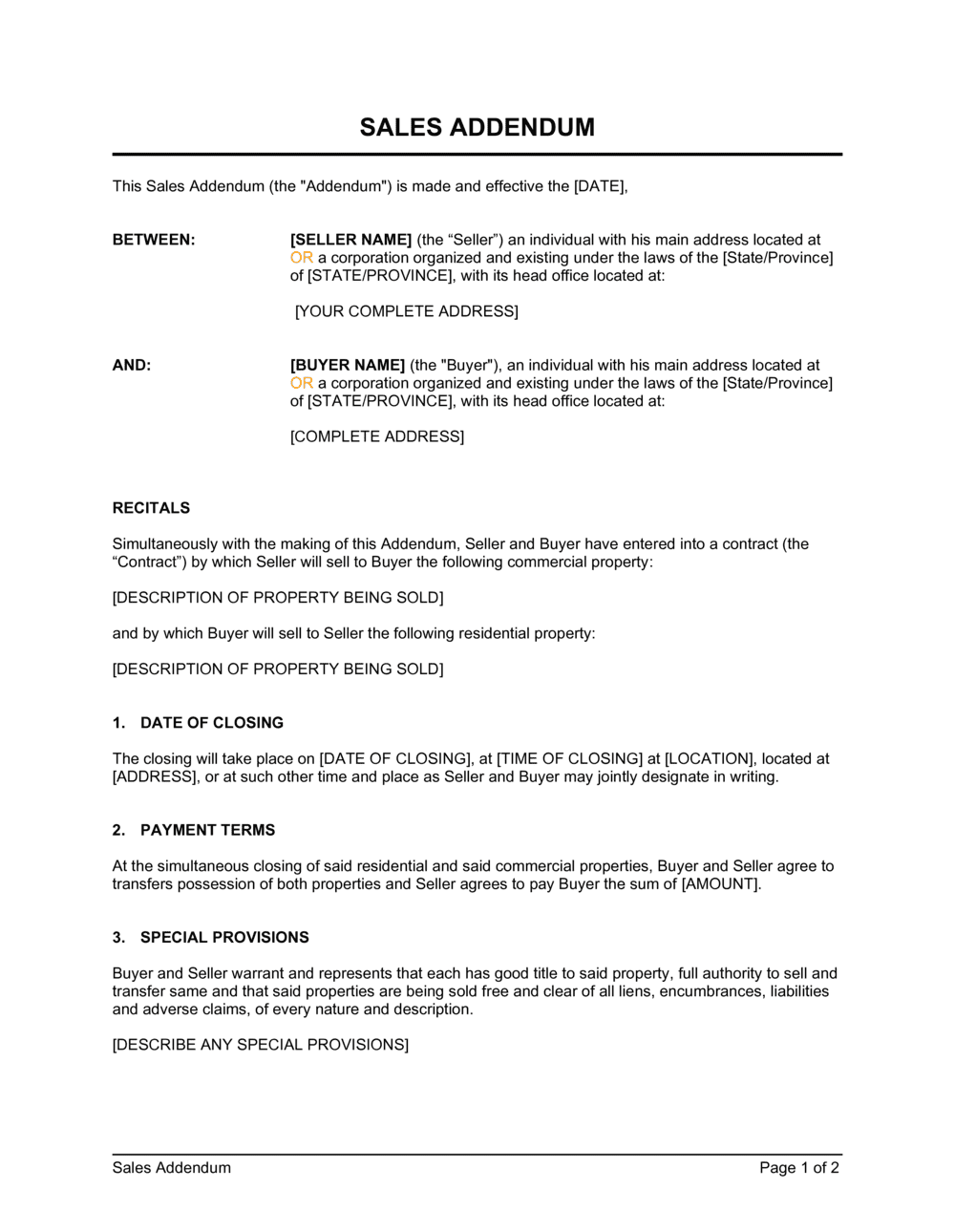
A Sales Addendum is a legally binding document that modifies, supplements, or extends the terms of an existing sales agreement without replacing the original contract. This template is a free Word download you can edit online and export as PDF β€” covering price adjustments, revised delivery schedules, updated warranties, additional products or services, and any other negotiated change that both parties agree to after the original contract was signed.
When you need it
Use it whenever the terms of a signed sales agreement need to change mid- transaction or before closing β€” a revised price, a later delivery date, an additional line item, or a modified warranty term. It is also used when conditions discovered after signing require formal written acknowledgment by both parties.
What's inside
Identification of the original agreement and parties, a clear statement of which terms are being modified and how, the effective date of the changes, confirmation that all unmodified terms remain in force, and signature blocks for both parties. Some versions also include a representations and warranties update clause and a dispute resolution provision.

What is a Sales Addendum?

A Sales Addendum is a legally binding document that modifies, supplements, or extends specific provisions of an existing sales agreement after it has been signed by both parties. Rather than discarding and rewriting the original contract, a sales addendum targets only the terms that need to change β€” a revised purchase price, an updated delivery schedule, an additional product or service, or a modified warranty β€” while preserving every other obligation in the original agreement. It incorporates itself into the original contract by reference and requires signatures from all parties who executed the original, making the combined documents the complete and controlling statement of the parties' deal.

Why You Need This Document

Without a written addendum, any mid-deal change agreed verbally or over email has uncertain legal standing. Oral modifications to written contracts are routinely disputed, difficult to prove, and β€” in jurisdictions that require contracts to be in writing β€” outright unenforceable. A buyer who verbally agreed to a higher price can deny it; a seller who promised a later delivery date has no written record to produce. The cost of an undocumented modification ranges from a stalled transaction to litigation over which version of the deal controls. A properly executed sales addendum eliminates that uncertainty in under 30 minutes: it creates a clear paper trail, resolves any conflict with the original in the addendum's favor, and gives both parties a single document to point to if the terms of the deal are ever challenged. This template gives you the structure to capture any sales contract modification correctly the first time.

Which variant fits your situation?

If your situation is…Use this template
Changing only the purchase price on an active sales contractSales Addendum (Price Amendment)
Adjusting delivery dates or shipping terms on a product saleSales Addendum (Delivery Terms)
Adding new line items or products to an existing orderSales Addendum (Scope Extension)
Amending terms on a real estate purchase and sale agreementReal Estate Purchase Addendum
Modifying warranty coverage or service terms after signingSales Addendum (Warranty Amendment)
Extending the closing or completion deadline on a signed contractContract Extension Addendum
Replacing an original sales contract entirely with new termsSales Agreement

Common mistakes to avoid

❌ Vague modification language

Why it matters: Phrases like 'the price is updated to reflect current market rates' without a specific number leave the modification unenforceable and invite disputes over what was actually agreed.

Fix: State the exact new term in full β€” section number, deleted language, and complete replacement text β€” so neither party can dispute what the contract now says.

❌ Only one party signs the addendum

Why it matters: A sales agreement is a bilateral contract. A modification signed by only one party is not a mutual agreement and is routinely held unenforceable in litigation.

Fix: Circulate the addendum to all parties who signed the original contract and obtain their signatures before treating any modified terms as binding.

❌ No conflict-resolution hierarchy between addendum and original

Why it matters: If the addendum and the original contract contain conflicting provisions and neither document states which governs, courts apply their own rules β€” often producing a result neither party intended.

Fix: Include a clause stating explicitly that in the event of conflict between the addendum and the original agreement, the addendum controls.

❌ Omitting the effective date

Why it matters: Without an explicit effective date, the amendment defaults to the signature date, which may not reflect when the parties actually agreed to the change β€” creating a gap period where the applicable terms are disputed.

Fix: Always state a specific effective date, even if it is the same as the signing date. For retroactive changes, state that the addendum is effective 'as of [PRIOR DATE]' and confirm both parties consent.

❌ Failing to update linked provisions

Why it matters: Changing a delivery date without updating the payment milestone tied to delivery β€” or revising a product spec without updating the warranty description β€” creates internal contract conflicts that can void individual clauses or the whole addendum.

Fix: Before finalizing, map every cross-reference in the original contract to the terms you are modifying and update each one explicitly.

❌ Using an addendum when a full contract replacement is warranted

Why it matters: When more than half the substantive terms of an agreement are changing, an addendum layered over the original creates a confusing document that is difficult to enforce and even harder to interpret under time pressure.

Fix: If the scope of changes is extensive, draft a restated or superseding sales agreement that incorporates all current terms in a single, clean document and explicitly cancels the original.

The 9 key clauses, explained

Recitals and reference to the original agreement

In plain language: Identifies the original sales contract by its title, execution date, and parties, and states the purpose of the addendum.

Sample language
This Addendum (the 'Addendum') is entered into as of [EFFECTIVE DATE] by and between [SELLER LEGAL NAME] ('Seller') and [BUYER LEGAL NAME] ('Buyer'), and amends the Sales Agreement dated [ORIGINAL DATE] (the 'Agreement'). Capitalized terms not defined herein have the meanings given in the Agreement.

Common mistake: Referencing the original contract by a trade name or informal description rather than its exact title and date β€” creating ambiguity about which agreement the addendum applies to.

Statement of modifications

In plain language: Specifies precisely which section, clause, or term of the original agreement is being changed and states the new language in full.

Sample language
Section [X] of the Agreement, 'Purchase Price,' is hereby deleted in its entirety and replaced with the following: 'The purchase price for the Goods shall be $[NEW AMOUNT], payable in accordance with Section [Y] of the Agreement.'

Common mistake: Using vague language like 'the price is updated' without specifying which section is modified or what the exact new term reads β€” leaving both parties uncertain about what the contract now says.

Effective date of changes

In plain language: States the exact date the amended terms take effect, which may be retroactive, concurrent with signing, or future-dated.

Sample language
The modifications set forth in this Addendum shall be effective as of [DATE], regardless of the date of execution by the parties.

Common mistake: Omitting an effective date entirely, so that it defaults to the signature date β€” which can create disputes when changes were agreed verbally days or weeks earlier.

Consideration

In plain language: Confirms that both parties are receiving something of value in exchange for agreeing to the changes, satisfying the legal requirement for an enforceable modification.

Sample language
In consideration of the mutual covenants herein, the revised pricing, and other good and valuable consideration, the receipt and sufficiency of which are hereby acknowledged, the parties agree as follows.

Common mistake: Assuming consideration is implied by the original contract and omitting it from the addendum β€” in some jurisdictions a modification without fresh consideration is unenforceable.

Continuation of original terms

In plain language: Confirms that every provision of the original agreement not specifically changed by the addendum remains in full force and effect.

Sample language
Except as expressly modified by this Addendum, all terms and conditions of the Agreement shall remain unchanged and in full force and effect. In the event of any conflict between this Addendum and the Agreement, the terms of this Addendum shall control.

Common mistake: Failing to include a conflict-resolution hierarchy, so that if the addendum and the original contract say different things, it is unclear which governs.

Updated delivery or performance terms

In plain language: Revises the delivery schedule, shipment method, Incoterms, or performance milestones originally set out in the agreement.

Sample language
The delivery date specified in Section [X] of the Agreement is hereby amended from [ORIGINAL DATE] to [NEW DATE]. All other delivery terms, including FOB [LOCATION], remain unchanged.

Common mistake: Changing the delivery date without updating related payment milestones or penalty clauses that are tied to it β€” creating a mismatch between obligations.

Representations and warranties update

In plain language: Confirms that each party's representations about the goods, services, or their authority to contract remain true as of the addendum's effective date, or identifies any changes.

Sample language
Each party represents and warrants that, as of the Effective Date of this Addendum, its representations and warranties set forth in the Agreement remain true and correct in all material respects, except as follows: [LIST ANY EXCEPTIONS OR STATE 'NONE'].

Common mistake: Skipping this clause when circumstances have changed β€” for example, when a product specification has been revised β€” leaving the seller exposed to a warranty claim under the original description.

Governing law and dispute resolution

In plain language: Confirms that the same governing law and dispute resolution mechanism as the original agreement apply to the addendum, or specifies a different forum if the parties have agreed to one.

Sample language
This Addendum shall be governed by and construed in accordance with the laws of [STATE / PROVINCE / COUNTRY], without regard to conflict-of-law principles. Any dispute arising under this Addendum shall be resolved in accordance with Section [X] of the Agreement.

Common mistake: Silently relying on the original agreement's governing-law clause without confirming it applies to the addendum β€” courts in some jurisdictions require each document to state its own governing law.

Signature block and counterparts

In plain language: Provides execution blocks for both parties with name, title, date, and a counterparts clause confirming electronic or physically separate signatures are valid.

Sample language
This Addendum may be executed in one or more counterparts, each of which shall be deemed an original. Electronic signatures shall be deemed valid and binding. IN WITNESS WHEREOF, the parties have executed this Addendum as of the date first written above. [SELLER SIGNATURE BLOCK] [BUYER SIGNATURE BLOCK]

Common mistake: Having only one party sign the addendum and treating it as fully effective β€” a modification to a bilateral contract requires signatures from all original parties to be enforceable.

How to fill it out

  1. 1

    Identify the original agreement precisely

    Enter the exact legal title of the original sales contract, the date it was signed, and the full legal names of both parties as they appear on that document. Confirm entity types (LLC, Inc., etc.) match the original.

    πŸ’‘ Cross-reference the original contract's signature page rather than the cover page β€” the legal names on the signature block control.

  2. 2

    State the effective date of the amendments

    Decide whether the changes take effect on the signing date, a future date, or retroactively. Enter this date explicitly in the effective date clause β€” do not leave it to default to the signature date.

    πŸ’‘ If the parties agreed to changes verbally before signing, a retroactive effective date prevents disputes about which terms applied during the gap.

  3. 3

    Draft the statement of modifications with exact new language

    For each provision being changed, cite the specific section number from the original agreement, state the old language is deleted, and set out the full replacement text. Do not use shorthand like 'updated price' β€” write the complete new clause.

    πŸ’‘ Use a redline or tracked-changes comparison against the original to confirm you haven't accidentally left conflicting language in both documents.

  4. 4

    Confirm consideration is documented

    Include a brief consideration recital acknowledging that both parties receive value from the modification β€” the revised terms themselves typically constitute valid consideration when they benefit both sides.

    πŸ’‘ If one party receives all the benefit and the other receives nothing in return (e.g., a pure concession), add a nominal cash consideration of $1 to ensure enforceability.

  5. 5

    Add the continuation of original terms clause

    Insert the standard clause confirming all unmodified provisions of the original agreement remain in full force, and add a conflict-resolution hierarchy stating the addendum controls over the original where they conflict.

    πŸ’‘ This clause is the safety net that prevents the addendum from accidentally voiding provisions you intended to keep.

  6. 6

    Update representations, warranties, and delivery terms

    Review every provision in the original agreement that is linked to the terms you are changing β€” delivery dates, payment milestones, warranty descriptions, and product specifications β€” and update any that are affected.

    πŸ’‘ Create a checklist of every cross-reference in the original contract before finalizing the addendum; one missed linked clause is the most common source of post-signing disputes.

  7. 7

    Obtain signatures from all original parties

    Route the addendum for signature by every party who signed the original agreement. Electronic signatures via a platform that timestamps and records consent are sufficient in most jurisdictions.

    πŸ’‘ Archive the fully signed addendum alongside the original contract in a single folder so anyone reading the file sees the complete current terms at a glance.

  8. 8

    Distribute and file the executed addendum

    Send a fully executed copy to all parties and confirm receipt. Update your contracts register to reflect the amended terms, effective date, and the fact that an addendum is on file.

    πŸ’‘ If you use a CRM or contract management system, attach the signed addendum directly to the original contract record rather than filing it separately.

Frequently asked questions

What is a sales addendum?

A sales addendum is a legally binding document that modifies, supplements, or extends specific terms of an existing sales agreement without replacing the original contract. It identifies the original agreement by name and date, states exactly which provisions are changing and what the new language is, confirms that all other terms remain in force, and requires signatures from all parties to the original contract. It is the standard mechanism for handling mid-deal changes to price, delivery, scope, or warranties.

What is the difference between an addendum and an amendment?

In everyday practice the terms are often used interchangeably. Technically, an addendum adds new provisions to a contract that did not exist in the original, while an amendment modifies existing language. Some industries β€” particularly real estate β€” use 'addendum' consistently for both. For legal purposes, the document's substance controls over its label: if it is signed by all parties, references the original contract, and states the change clearly, it is enforceable regardless of whether it is titled addendum, amendment, or modification.

Does a sales addendum need to be signed by both parties?

Yes. A sales agreement is a bilateral contract, and any modification to it requires mutual consent evidenced by signatures from all parties who signed the original. An addendum signed by only the seller or only the buyer does not create a binding modification and can be challenged or ignored by the unsigned party. Electronic signatures are valid in most jurisdictions under laws such as the US ESIGN Act, Canada's PIPEDA, and the EU's eIDAS Regulation.

Can an addendum change the price in an existing sales contract?

Yes β€” a price modification is one of the most common uses of a sales addendum. State the original section number containing the price, delete the old language, and replace it with the new amount in full. Include a consideration clause confirming both parties receive value from the change, and update any payment milestone or penalty clauses that reference the original price. Both parties must sign before the new price is enforceable.

Is a sales addendum the same as a contract extension?

Not exactly. A contract extension addendum specifically pushes back the termination date or performance deadline of an agreement β€” it is a specialized type of addendum focused on duration. A sales addendum is broader and can modify any term: price, delivery schedule, product specifications, warranties, or payment terms. Both require the same execution formalities to be enforceable.

When should I use a new sales agreement instead of an addendum?

Use a new agreement when more than half the substantive terms are changing, when the parties and subject matter have materially shifted, or when the addendum layered on the original would be too complex to read coherently. A restated or superseding agreement incorporates all current terms into one clean document and explicitly cancels the original, eliminating the risk of conflicting provisions scattered across multiple documents.

Does a sales addendum need to state consideration?

In most common-law jurisdictions β€” the US, Canada, the UK, and Australia β€” a contract modification requires fresh consideration to be enforceable if it benefits only one party. Where both parties receive value from the change (for example, the buyer gets a later delivery date and the seller gets a higher price), the mutual exchange typically constitutes valid consideration. To be safe, always include a brief consideration recital in the addendum. Civil law jurisdictions in the EU generally do not require consideration for contract modifications to be valid.

Can a sales addendum be used in real estate transactions?

Yes. Real estate addenda are a standard part of residential and commercial purchase and sale transactions β€” modifying closing dates, purchase prices, inspection contingency deadlines, repair credits, or financing terms after an offer has been accepted. Real estate addenda typically follow state- or province-specific forms prescribed by the local real estate board or licensing authority, so confirm which form is required in your jurisdiction before drafting a custom version.

What happens if the addendum conflicts with the original contract?

When an addendum and the original contract contain conflicting provisions and neither document specifies which governs, courts apply local contract interpretation rules β€” most commonly the principle that the later document controls. To avoid unpredictable outcomes, always include an explicit conflict-resolution clause stating that the addendum's terms prevail over the original in the event of any inconsistency.

Do I need a lawyer to prepare a sales addendum?

For straightforward changes β€” a price revision, a shifted delivery date, or an added line item on a standard commercial sale β€” a well-drafted template is generally sufficient. Engage a lawyer when the original contract involves significant dollar amounts, when the modification affects IP rights, warranties, or indemnities, when the parties are in different countries, or when one party is pushing back on the proposed change and the modification may become contested.

How this compares to alternatives

vs Sales Agreement

A sales agreement is the primary contract establishing the entire terms of a transaction from the outset. A sales addendum modifies or supplements specific provisions of that agreement after it has been signed β€” it does not replace it. Use a new sales agreement when the scope of changes is so broad that an addendum would be confusing; use an addendum for targeted, discrete changes.

vs Contract Amendment

A contract amendment is a general-purpose document used to modify any type of agreement β€” employment, service, partnership, or sales. A sales addendum is purpose-built for sales transactions and typically includes provisions specific to goods, delivery, and warranty. For sales-related changes, the sales addendum provides more targeted structure; for non-sales contracts, use a general amendment.

vs Extension of Agreement

An extension of agreement modifies only the duration or deadline of a contract β€” pushing back an expiry date or performance deadline. A sales addendum is broader and can modify any substantive term. If you only need to extend a closing or delivery date without changing anything else, an extension agreement is simpler and more focused.

vs Letter of Intent

A letter of intent records the parties' preliminary understanding of proposed deal terms before a binding contract is signed β€” it is typically non-binding. A sales addendum is a binding post-execution modification to an already-signed agreement. If you are still negotiating terms, use a letter of intent; once the contract is signed and you need to change something, use an addendum.

Industry-specific considerations

Wholesale and distribution

Price adjustments tied to commodity indices, revised minimum order quantities, and updated freight and Incoterms when logistics conditions change mid-order.

Real estate

Purchase price credits, closing date extensions, repair obligations discovered during inspection, and financing contingency modifications after offer acceptance.

Manufacturing

Revised bill-of-materials specifications, updated delivery milestones tied to production capacity, and warranty term adjustments when product design changes post-order.

Technology and SaaS

Scope expansions adding software modules or user seats, updated implementation timelines, and revised SLA commitments when product capabilities change between signing and go-live.

Professional services

Fee adjustments for expanded project scope, revised deliverable deadlines, and updated payment milestone schedules when client requirements shift after contract execution.

Retail and e-commerce

Supplier pricing updates tied to seasonal cost changes, revised SKU lists on existing purchase orders, and updated return and restocking terms negotiated mid-season.

Jurisdictional notes

United States

Under the UCC (Article 2), modifications to contracts for the sale of goods do not require separate consideration to be enforceable, but must be made in good faith. Contracts over $500 in goods value must be in writing under the Statute of Frauds; the addendum satisfies this requirement when signed by both parties. State-level variations exist β€” California and New York have additional enforceability requirements for no-oral-modification clauses.

Canada

Canadian contract law requires consideration for a modification to be enforceable at common law in most provinces; this differs from the US UCC approach. Quebec's Civil Code does not require consideration but does require the consent of both parties and written form for certain contract types. Real estate addenda in Ontario and BC must follow prescribed forms. French-language requirements apply to consumer contracts in Quebec.

United Kingdom

Under English law, a contract modification generally requires fresh consideration unless executed as a deed. The Consumer Rights Act 2015 imposes additional requirements when one party is a consumer β€” unfair modification terms may be unenforceable. Electronic signatures are valid under the Electronic Communications Act 2000. Scotland operates under Scots law, which differs from English common law on contract formation and modification.

European Union

EU civil law jurisdictions (France, Germany, Spain, Italy, and others) generally do not require consideration for contract modifications, but do require mutual consent and, for certain contract types, written form. The EU's eIDAS Regulation permits qualified electronic signatures as equivalent to handwritten signatures across all member states. The Consumer Rights Directive restricts modification clauses in B2C contracts that were not individually negotiated.

Template vs lawyer β€” what fits your deal?

PathBest forCostTime
Use the templateStandard commercial sales changes β€” price, delivery date, or additional line items β€” on deals under $50,000Free20–30 minutes
Template + legal reviewMid-size deals ($50K–$500K), modifications affecting warranties or indemnities, or cross-border sales$200–$6001–2 days
Custom draftedHigh-value transactions, heavily negotiated IP or liability terms, multi-party agreements, or regulated industries$800–$3,000+3–10 days

Glossary

Addendum
A document that adds to or modifies the terms of an existing contract while keeping the original agreement intact.
Amendment
A formal change to a contract's existing terms β€” functionally similar to an addendum, though some practitioners reserve 'amendment' for changes to original language and 'addendum' for entirely new provisions.
Integration Clause
A contract provision stating that the written agreement β€” including any addenda β€” constitutes the entire understanding between the parties, preventing prior oral or written statements from overriding it.
Effective Date
The specific calendar date on which the addendum's changes take legal effect, which may differ from the date the document is signed.
Consideration
Something of value exchanged by both parties that makes a contract or addendum legally enforceable β€” the revised price, extended delivery window, or added goods or services being the typical consideration in a sales addendum.
Governing Law
The jurisdiction whose laws apply to interpret and enforce the contract and any addenda, typically the state or country specified in the original agreement.
Representations and Warranties
Statements of fact and promises made by one or both parties about the subject matter of the sale β€” updated in an addendum when circumstances have changed since the original signing.
Force Majeure
A clause excusing a party from performance obligations when extraordinary events outside their control β€” natural disasters, strikes, pandemics β€” prevent fulfillment.
Counterparts Clause
A provision allowing the addendum to be signed in separate copies, each of which constitutes an original, including electronic signatures.
Survivability
The principle that certain contract terms β€” confidentiality, indemnification, IP assignment β€” remain in effect even after the contract or addendum expires or is terminated.

Part of your Business Operating System

This document is one of 3,000+ business & legal templates included in Business in a Box.

  • Fill-in-the-blanks β€” ready in minutes
  • 100% customizable Word document
  • Compatible with all office suites
  • Export to PDF and share electronically

Create your document in 3 simple steps.

From template to signed document β€” all inside one Business Operating System.
1
Download or open template

Access over 3,000+ business and legal templates for any business task, project or initiative.

2
Edit and fill in the blanks with AI

Customize your ready-made business document template and save it in the cloud.

3
Save, Share, Send, Sign

Share your files and folders with your team. Create a space of seamless collaboration.

Save time, save money, and create top-quality documents.

β˜…β˜…β˜…β˜…β˜…

"Fantastic value! I'm not sure how I'd do without it. It's worth its weight in gold and paid back for itself many times."

Managing Director Β· Mall Farm
Robert Whalley
Managing Director, Mall Farm Proprietary Limited
β˜…β˜…β˜…β˜…β˜…

"I have been using Business in a Box for years. It has been the most useful source of templates I have encountered. I recommend it to anyone."

Business Owner Β· 4+ years
Dr Michael John Freestone
Business Owner
β˜…β˜…β˜…β˜…β˜…

"It has been a life saver so many times I have lost count. Business in a Box has saved me so much time and as you know, time is money."

Owner Β· Upstate Web
David G. Moore Jr.
Owner, Upstate Web

Run your business with a system β€” not scattered tools

Stop downloading documents. Start operating with clarity. Business in a Box gives you the Business Operating System used by over 250,000 companies worldwide to structure, run, and grow their business.

Start freeΒ Β·Β No credit card required