Verification of Employment and Letter of Recommendation Template

Free Word download β€’ Edit online β€’ Save & share with Drive β€’ Export to PDF

1 pageβ€’15–25 min to fillβ€’Difficulty: Standard
Learn more ↓
FreeVerification of Employment and Letter of Recommendation Template

At a glance

What it is
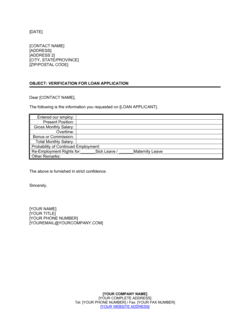
A Verification of Employment and Letter of Recommendation is a formal business letter that simultaneously confirms an employee's job title, tenure, and compensation and provides a written endorsement of their professional character and performance. This free Word download lets a manager or HR professional fill in the key details and export a polished, print-ready letter in under ten minutes.
When you need it
Use it when a current or departing employee requests written confirmation of their employment for a new employer, landlord, lender, visa authority, or academic institution β€” and you want to go beyond bare facts to actively support their next step. It is also appropriate when an employee has performed well and deserves a written endorsement to accompany their employment record.
What's inside
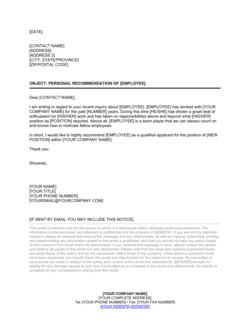
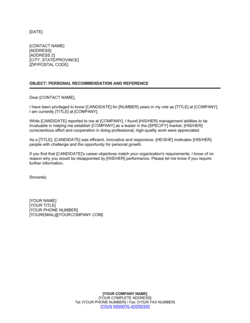
Letterhead and date, recipient address block, opening confirmation paragraph with employment facts, a performance and character endorsement section, a specific recommendation statement, and a closing with contact details for follow-up inquiries.

What is a Verification of Employment and Letter of Recommendation?

A Verification of Employment and Letter of Recommendation is a formal business letter that combines two functions into a single document: it confirms the objective facts of an employee's working relationship β€” job title, tenure, employment status, and compensation β€” and it provides a written professional endorsement of their skills, character, and contributions. Employers issue it on company letterhead and sign it in an official capacity, giving the letter the standing required by banks, landlords, immigration authorities, and prospective employers who need both a factual record and a credible character reference in one place.

Why You Need This Document

Without a properly structured letter, an employee's rental application, mortgage, or visa renewal can stall for weeks waiting on documentation that takes under fifteen minutes to produce. Informal emails or verbal references are routinely rejected by financial institutions and government agencies that require a formal, dated, signed letter on company letterhead. Writing one from scratch each time risks inconsistent information, omitted fields, and legal exposure if salary is disclosed without proper authorization. This template gives HR managers and supervisors a reliable starting point that covers every required element β€” employment facts, performance endorsement, formal recommendation, and signatory authority β€” so the employee gets a document that actually works, and the employer maintains a consistent, defensible record.

Which variant fits your situation?

If your situation is…Use this template
Recipient only needs employment facts confirmed β€” no endorsement requiredEmployment Verification Letter
Employee needs a standalone character or professional referenceLetter of Recommendation
Confirming employment for a mortgage or bank loan applicationProof of Income Letter
Departing employee needs a reference after terminationEmployee Reference Letter
Academic institution requires a formal faculty or student recommendationAcademic Letter of Recommendation
Employee is leaving and needs a formal goodbye announcement for clientsEmployee Departure Announcement
Employer needs to confirm salary only for a background checkSalary Verification Letter

Common mistakes to avoid

❌ Disclosing salary without written employee consent

Why it matters: Unauthorized disclosure of compensation can expose the employer to privacy complaints and, in some jurisdictions, civil liability.

Fix: Obtain a signed written authorization from the employee before including any compensation figures. Keep the authorization on file.

❌ Using vague praise with no specific evidence

Why it matters: Phrases like 'great team player' or 'hard worker' are ignored by experienced hiring managers and landlords who receive dozens of identical letters.

Fix: Replace each generic adjective with one observable behavior or quantified achievement β€” '20% reduction in processing errors' carries more weight than 'detail-oriented.'

❌ Omitting the letter date or writing an undated letter

Why it matters: Lenders, immigration offices, and housing authorities frequently reject undated letters because they cannot confirm the employment information is current.

Fix: Always include the date in the letterhead and reference it in the opening paragraph as the date on which the facts are confirmed.

❌ Signing with insufficient authority

Why it matters: A letter signed by a peer or junior colleague rather than a manager, director, or HR representative may be dismissed as lacking credibility by the recipient.

Fix: Ensure the signatory holds a title that plausibly reflects direct knowledge of the employee's work β€” typically their direct manager, department head, or an HR officer.

The 9 key clauses, explained

Letterhead and date

In plain language: Establishes the official source of the letter and when it was written β€” essential for the recipient to assess its currency.

Sample language
[COMPANY NAME] | [ADDRESS] | [CITY, STATE ZIP] | [PHONE] | [EMAIL] | [DATE]

Common mistake: Omitting the date or using a vague reference like 'current.' Lenders and immigration authorities often reject undated letters because they cannot confirm the information is still accurate.

Recipient address block

In plain language: Identifies who the letter is addressed to β€” a named individual, organization, or a general 'To Whom It May Concern' if the recipient is unknown.

Sample language
To: [RECIPIENT NAME / TITLE] | [ORGANIZATION] | [ADDRESS] β€” or β€” To Whom It May Concern:

Common mistake: Always defaulting to 'To Whom It May Concern.' When the recipient is known, using their name makes the letter more credible and harder to dismiss as a form letter.

Opening employment confirmation paragraph

In plain language: States the core employment facts β€” full name, job title, department, start date, and current employment status β€” in clear, unambiguous terms.

Sample language
I am writing to confirm that [EMPLOYEE FULL NAME] has been employed with [COMPANY NAME] as a [JOB TITLE] in the [DEPARTMENT] department since [START DATE] and is currently [employed on a full-time basis / employed as of the date of this letter].

Common mistake: Stating 'is currently employed' in a letter that will be used weeks after it is written. Add the letter's date and note that employment status is confirmed as of that date only.

Compensation and hours statement

In plain language: Discloses the employee's salary or hourly rate and standard working hours β€” commonly required by lenders, landlords, and visa officers.

Sample language
[EMPLOYEE NAME]'s current annual salary is $[AMOUNT], paid [bi-weekly / semi-monthly]. [He/She/They] works [HOURS] hours per week on a [full-time / part-time] basis.

Common mistake: Including compensation without the employee's explicit written consent. Disclosing salary without authorization can create privacy and legal exposure for the employer.

Performance and responsibilities summary

In plain language: Describes the employee's main duties and highlights specific accomplishments or contributions that substantiate the recommendation.

Sample language
In this role, [EMPLOYEE NAME] is responsible for [KEY RESPONSIBILITIES]. During [his/her/their] tenure, [he/she/they] has [SPECIFIC ACHIEVEMENT β€” e.g., led a team of 8, reduced processing time by 20%, managed a $500K budget].

Common mistake: Using vague praise like 'excellent work ethic' with no supporting detail. Specific, quantified achievements give the endorsement credibility; generic adjectives do not.

Character and professional qualities endorsement

In plain language: Speaks to the employee's interpersonal skills, reliability, integrity, and cultural fit β€” the qualitative dimensions a hiring manager or landlord cannot verify from a resume.

Sample language
[EMPLOYEE NAME] is highly regarded by colleagues and clients alike for [his/her/their] [reliability / communication skills / problem-solving ability]. [He/She/They] consistently demonstrates professionalism and integrity in all interactions.

Common mistake: Repeating the same adjective used in the previous clause. Vary the language and connect each quality to a concrete observable behavior.

Formal recommendation statement

In plain language: The explicit sentence where the writer states that they recommend the employee without reservation β€” the core purpose of the endorsement half of the letter.

Sample language
I recommend [EMPLOYEE NAME] without reservation and am confident [he/she/they] will be a valuable asset to any organization fortunate enough to work with [him/her/them].

Common mistake: Writing a lukewarm recommendation using hedged language like 'I believe [he/she] may be suitable.' Hedged language is read by experienced recipients as a negative signal.

Closing and contact for follow-up

In plain language: Invites the recipient to contact the signatory directly with questions and provides a phone number and email address β€” demonstrating the writer stands behind the letter's contents.

Sample language
Should you require any additional information or wish to discuss [EMPLOYEE NAME]'s background further, please do not hesitate to contact me at [PHONE NUMBER] or [EMAIL ADDRESS].

Common mistake: Listing only a general company phone number. Providing a direct line signals genuine availability and increases the letter's credibility with recipients who conduct follow-up calls.

Signature block

In plain language: Records the signatory's full name, title, and relationship to the employee β€” establishing their authority to speak on behalf of the organization.

Sample language
Sincerely, [SIGNATORY FULL NAME] | [TITLE] | [COMPANY NAME] | [DATE SIGNED]

Common mistake: Signing only with a first name or leaving the title blank. Recipients use the signatory's title to assess how well they actually know the employee and whether the endorsement carries organizational weight.

How to fill it out

  1. 1

    Add your company letterhead

    Replace the placeholder header with your company logo, legal name, address, phone, and email. Verify the address matches your current registered location.

    πŸ’‘ Use the same letterhead format as your other official correspondence so the letter looks consistent if recipients cross-reference documents.

  2. 2

    Insert the date and recipient details

    Enter today's date in the format used in your country (e.g., May 2, 2026). If you know the recipient's name and organization, address the letter directly to them rather than using a generic salutation.

    πŸ’‘ For letters that will be submitted to multiple recipients over time, note 'Valid as of [DATE]' in the opening paragraph to prevent the letter being reused after employment status changes.

  3. 3

    Confirm the employee's employment facts

    Enter the employee's full legal name, exact job title, department, and official start date from your HR system. State current employment status clearly β€” 'currently employed full-time' or 'employed until [END DATE]'.

    πŸ’‘ Cross-check the start date against your payroll records before writing β€” a one-day discrepancy can trigger a failed background check.

  4. 4

    Add compensation details if authorized

    Include the employee's salary or hourly rate and weekly hours only if the employee has signed a written consent authorizing disclosure. Note the currency explicitly for international recipients.

    πŸ’‘ Keep a copy of the signed consent form in the employee's HR file alongside a copy of this letter.

  5. 5

    Write the performance and responsibilities section

    Summarize the employee's two or three most significant responsibilities and include at least one quantified achievement β€” a number, a percentage, or a dollar figure that a reader can anchor to.

    πŸ’‘ Ask the employee to share their most recent self-review or a brief bullet list of achievements before you write this section β€” they will remember specifics you may have forgotten.

  6. 6

    Complete the recommendation statement

    State your recommendation directly and without hedging. Confirm you are available to speak further and provide your direct contact details β€” a phone number and email address, not a general inbox.

    πŸ’‘ Read the closing paragraph aloud before finalizing. If it sounds tentative when spoken, rewrite it to be direct β€” recipients notice ambiguous language immediately.

  7. 7

    Sign and send

    Print the letter on company letterhead paper and sign in ink for physical submissions. For digital submissions, export as PDF after filling in all fields.

    πŸ’‘ Retain a copy in the employee's HR file with a note of the date sent, the recipient, and the purpose β€” this protects you if the letter's contents are later disputed.

Frequently asked questions

What is a verification of employment and letter of recommendation?

It is a single formal letter that serves two purposes: it confirms the objective facts of a person's employment β€” employer name, job title, start date, and compensation β€” and it provides a written endorsement of the employee's professional performance and character. Combining both functions saves time for the employer and provides a more useful document for the employee than a bare verification alone.

Who typically writes this letter?

The letter is most commonly written by the employee's direct manager, department head, or an HR representative. The signatory should be someone with direct knowledge of the employee's work and the authority to speak on behalf of the organization. For small businesses, the owner or managing director typically signs.

Does this letter need to be notarized?

In most situations β€” rental applications, new employer reference checks, and standard loan applications β€” notarization is not required. Some immigration authorities and foreign institutions may request a notarized version. Check the specific requirements of the recipient before going through the notarization process.

Should I include the employee's salary in this letter?

Only if the employee has explicitly authorized the disclosure in writing. Many recipients β€” particularly lenders and landlords β€” require salary information, so it is practical to include it when authorized. Without consent, omit the figure and note that compensation details are available upon the employee's written authorization.

What is the difference between this letter and a standalone reference letter?

A standalone reference letter focuses entirely on qualitative endorsement β€” skills, character, and professional qualities β€” without confirming factual employment details. This combined letter adds verified employment facts (title, tenure, salary) alongside the endorsement, making it suitable for situations where the recipient needs both confirmation and a recommendation from a single document.

Can I write this letter for a current employee, or only departing ones?

You can write it for both. Current employees often need it for loan applications, rental agreements, or visa renewals. Departing employees typically need it to support a new job search. The wording differs slightly β€” for current employees, use present tense; for former employees, note the end date and use past tense for the employment facts.

How recent does the letter need to be?

Most recipients β€” banks, landlords, and immigration offices β€” require a letter dated within the past 30 to 90 days. Letters older than 90 days are frequently rejected as outdated. Write the letter as close to the submission date as possible and include a 'valid as of [DATE]' note if you expect a gap between signing and submission.

What should I do if I cannot honestly recommend the employee?

If you cannot write a genuine endorsement, issue a verification-only letter that confirms employment facts without the recommendation component. Avoid writing a lukewarm letter β€” hedged language is read by recipients as a negative signal and can harm the employee more than no endorsement at all. Discuss with the employee what type of letter is appropriate given your honest assessment.

How this compares to alternatives

vs Employment Verification Letter

A standalone employment verification letter confirms factual details β€” job title, start date, salary, and employment status β€” without any endorsement of the employee's performance or character. Use a pure verification when the recipient only needs facts confirmed, such as a background check provider or a government form request. Choose the combined letter when the recipient also expects a professional endorsement, such as a new employer or a graduate school.

vs Reference Letter

A reference letter focuses solely on qualitative endorsement β€” describing skills, work ethic, and professional character β€” without confirming the objective facts of employment. It is appropriate when the requester has already verified employment through another channel and only needs a personal endorsement. The combined letter is more efficient when the recipient needs both verification and recommendation in a single document.

vs Offer Letter

An offer letter is issued by a prospective employer to a candidate confirming the terms of a new job. A verification and recommendation letter is issued by a current or former employer to confirm and endorse past employment. The two documents belong to opposite ends of the hiring timeline and serve different recipients entirely.

vs Employee Dismissal Letter

A dismissal letter documents the termination of employment and the reasons for it. A verification and recommendation letter documents the positive contribution of an employee. Using a verification and recommendation letter for a dismissed employee is inappropriate unless the separation was amicable and performance was genuinely satisfactory prior to the circumstances of departure.

Industry-specific considerations

Technology / SaaS

Engineers and product managers frequently need verification letters for visa renewals and global relocation applications, requiring precise title and compensation details.

Healthcare

Credentialing bodies and licensing boards often require verified employment history with endorsements of professional conduct as part of ongoing licensure reviews.

Professional Services

Law firms, accounting practices, and consulting firms use these letters when associates move between firms and need documented evidence of client-facing responsibilities.

Retail / Hospitality

High staff turnover means managers write verification letters frequently; a standard template ensures consistency and reduces the time burden on supervisors.

Template vs pro β€” what fits your needs?

PathBest forCostTime
Use the templateHR managers and supervisors writing standard verification and recommendation letters for departing or current employeesFree10–15 minutes per letter
Template + professional reviewLetters used for immigration applications, international employment, or situations where compensation disclosure consent is complex$50–$200 (HR consultant or employment lawyer review)1–2 business days
Custom draftedExecutive-level references with complex tenure, equity, or cross-border employment history requiring detailed legal language$200–$6002–5 business days

Glossary

Employment Verification
A formal written confirmation of the key facts of a person's employment β€” including employer name, job title, start date, and current status.
Letter of Recommendation
A written statement from an employer or supervisor that endorses a former or current employee's skills, character, and professional conduct.
Tenure
The continuous length of time an employee has been employed by a specific organization, measured from the official start date.
Reference Check
A process by which a prospective employer, lender, or institution contacts a named reference to verify information and obtain a professional assessment of the candidate.
Good Standing
A phrase indicating that an employee is current with all obligations, maintains a satisfactory performance record, and has no disciplinary actions on file.
Compensation
The total remuneration paid to an employee, including base salary or hourly wage and any stated benefits or allowances.
At-Will Employment
An employment relationship that either party may end at any time for any lawful reason, relevant when the letter must avoid implying a guarantee of continued employment.
Professional Character
An employee's conduct, ethics, reliability, and interpersonal effectiveness as observed in the workplace over time.
Signatory
The authorized person β€” typically a manager, HR director, or company officer β€” who signs and takes responsibility for the contents of the letter.
Letterhead
Formatted header containing the company's logo, legal name, address, phone number, and website, which establishes the official source of the correspondence.

Part of your Business Operating System

This document is one of 3,000+ business & legal templates included in Business in a Box.

  • Fill-in-the-blanks β€” ready in minutes
  • 100% customizable Word document
  • Compatible with all office suites
  • Export to PDF and share electronically

Create your document in 3 simple steps.

From template to signed document β€” all inside one Business Operating System.
1
Download or open template

Access over 3,000+ business and legal templates for any business task, project or initiative.

2
Edit and fill in the blanks with AI

Customize your ready-made business document template and save it in the cloud.

3
Save, Share, Send, Sign

Share your files and folders with your team. Create a space of seamless collaboration.

Save time, save money, and create top-quality documents.

β˜…β˜…β˜…β˜…β˜…

"Fantastic value! I'm not sure how I'd do without it. It's worth its weight in gold and paid back for itself many times."

Managing Director Β· Mall Farm
Robert Whalley
Managing Director, Mall Farm Proprietary Limited
β˜…β˜…β˜…β˜…β˜…

"I have been using Business in a Box for years. It has been the most useful source of templates I have encountered. I recommend it to anyone."

Business Owner Β· 4+ years
Dr Michael John Freestone
Business Owner
β˜…β˜…β˜…β˜…β˜…

"It has been a life saver so many times I have lost count. Business in a Box has saved me so much time and as you know, time is money."

Owner Β· Upstate Web
David G. Moore Jr.
Owner, Upstate Web

Run your business with a system β€” not scattered tools

Stop downloading documents. Start operating with clarity. Business in a Box gives you the Business Operating System used by over 250,000 companies worldwide to structure, run, and grow their business.

Free Forever PlanΒ Β·Β No credit card required