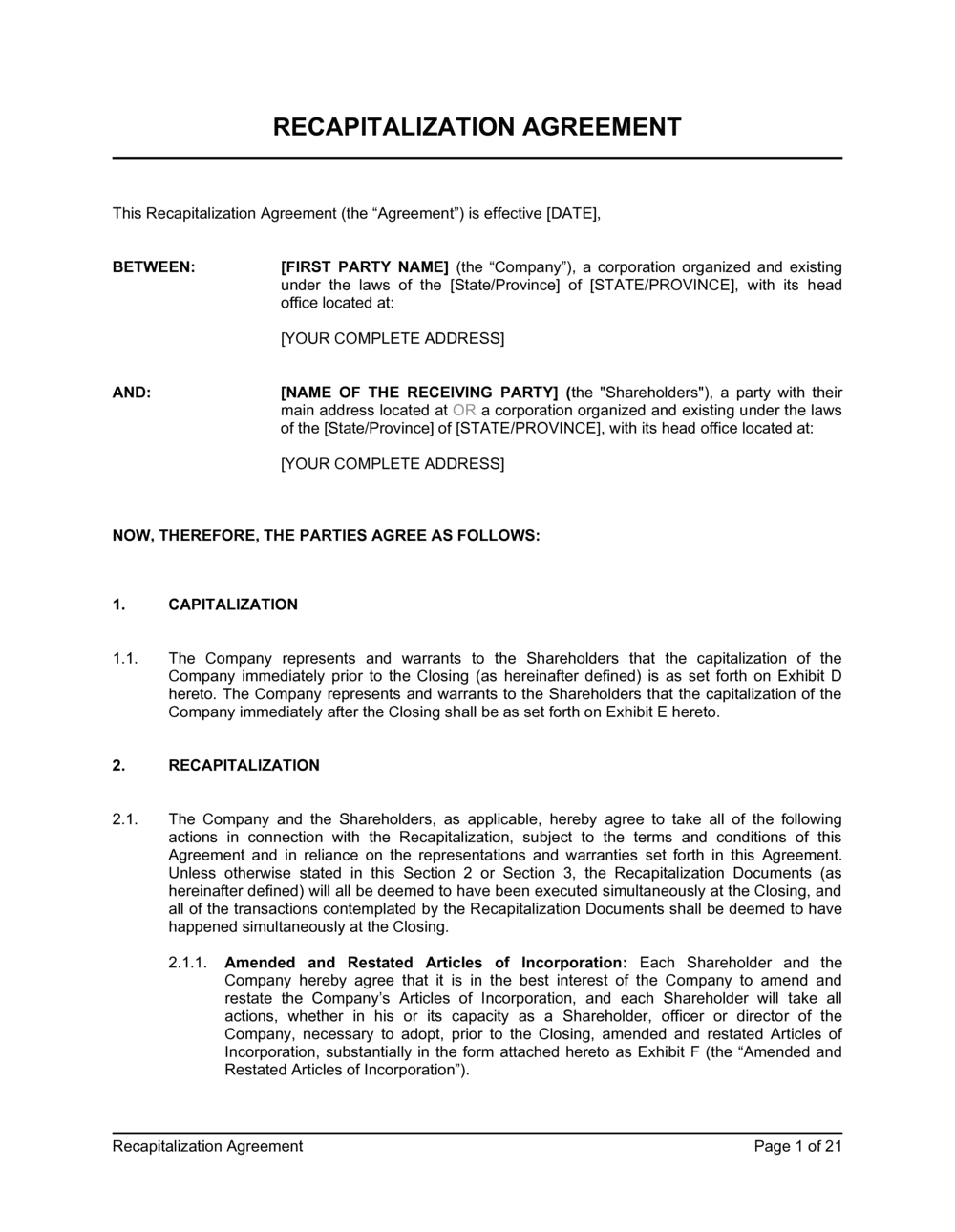
Recapitalization Agreement Template

Free Word download • Edit online • Save & share with Drive • Export to PDF

21 pages35–50 min to fillDifficulty: ComplexSignature requiredLegal review recommended
Learn more ↓
FreeRecapitalization Agreement Template

At a glance

What it is
A Recapitalization Agreement is a legally binding contract that restructures a company's existing capital structure — altering the mix of equity, debt, and hybrid instruments — among shareholders, lenders, and the company itself. This free Word download gives you a professionally drafted starting point you can edit online and export as PDF, covering share reclassification, debt conversion, new security issuances, and updated governance terms in a single enforceable document.
When you need it
Use it when a company is converting debt to equity, bringing in a new investor class, preparing for a buyout or ownership transition, or restructuring its balance sheet to meet lender covenants or investor requirements. It is also commonly used ahead of an M&A transaction or succession event where the existing capital structure must be cleaned up.
What's inside
Parties and recitals, description of the existing capital structure, terms of the new capital arrangement, share reclassification or exchange mechanics, debt conversion or payoff provisions, representations and warranties, conditions precedent to closing, governance changes, and post-closing covenants.

What is a Recapitalization Agreement?

A Recapitalization Agreement is a legally binding contract that formally restructures a company's capital structure — altering the combination of equity, debt, and hybrid securities among the company, its shareholders, and its lenders. It governs the mechanics of share reclassifications, debt-to-equity conversions, new security issuances, and the governance changes that accompany them, creating an enforceable record of every party's rights and obligations before and after the transaction closes. Unlike a routine share transfer, a recapitalization changes the fundamental architecture of the company's balance sheet, which is why it requires documented consent from all materially affected parties and coordinated amendments to the company's constitutional documents.

Why You Need This Document

Without a properly executed recapitalization agreement, a restructured cap table is legally incomplete — existing shareholders may challenge new share classes, lenders may assert that their security interests were never properly released, and the corporate registrar may reject amended articles that lack a supporting authorization document. The practical consequences include unenforceable governance provisions, unresolved debt claims surviving the transaction, and costly litigation among shareholders who disagree on the post-closing ownership percentages. Tax authorities in the US and Canada require specific documentation to support tax-neutral treatment of stock-for-stock exchanges; without it, shareholders may face unexpected gain recognition. This template gives you a professionally structured starting point that addresses every material element — parties, pre-closing cap table, conversion mechanics, conditions precedent, representations, and post-closing obligations — so that a single signed document creates a clean, defensible record of the entire restructuring.

Which variant fits your situation?

If your situation is…Use this template
Converting outstanding convertible debt into preferred equity at a priced roundRecapitalization Agreement (Debt-to-Equity)
Reclassifying common shares into voting and non-voting classes for successionRecapitalization Agreement (Share Reclassification)
Leveraged recapitalization where new debt is issued to fund a shareholder distributionRecapitalization Agreement (Leveraged)
Equity recapitalization as part of a management buyoutManagement Buyout Agreement
Full capital restructuring combined with a new investor subscriptionShareholders Agreement
Restructuring following financial distress or a workout arrangementDebt Restructuring Agreement
Recapitalizing a corporation ahead of a share exchange or mergerShare Exchange Agreement

Common mistakes to avoid

❌ Incomplete pre-closing cap table

Why it matters: If outstanding SAFEs, warrants, or option pools are omitted from the baseline cap table, the post-closing ownership percentages are wrong. This creates immediate disputes among shareholders and can unwind the transaction.

Fix: Generate a certified cap table from your corporate records showing every issued security, convertible instrument, and reserved equity pool before drafting the agreement.

❌ No longstop date on conditions precedent

Why it matters: Without a deadline, a single party can stall the transaction indefinitely by delaying a required consent or filing, leaving all other parties in limbo with no contractual remedy.

Fix: Insert a longstop date — typically 60 to 90 days from signing — after which either party may terminate if conditions remain unsatisfied.

❌ Attaching unsigned or draft amended articles

Why it matters: If the amended articles attached as a schedule are not in final executed form, the new share class rights and governance provisions have no legal effect even after closing.

Fix: Confirm the amended articles are in their final filing-ready form before execution, and attach only the version that will be filed with the corporate registrar.

❌ Omitting accrued interest from debt conversion mechanics

Why it matters: Converting only the principal balance while leaving accrued interest outstanding means the lender retains a live unsecured debt claim post-closing, which can complicate future financing or an exit.

Fix: State explicitly whether accrued and unpaid interest is (a) converted to equity at the same conversion price, (b) paid in cash at closing, or (c) forgiven — and include a full release of the debt obligation.

❌ Using percentage-based conversion ratios instead of a fixed price per share

Why it matters: A conversion ratio stated as a percentage of post-closing equity shifts with every subsequent option exercise or share issuance, making the actual share count impossible to determine with certainty.

Fix: Express all conversions as a fixed dollar price per share so the number of shares issued is calculable from a static formula regardless of subsequent changes.

❌ Signing without all required shareholder and lender consents

Why it matters: Most corporate statutes and existing shareholder agreements require approval from existing shareholders and secured lenders before a recapitalization can be effected. Proceeding without consent exposes the company to derivative litigation and can void the transaction.

Fix: Map all required consents before drafting — check the company's existing shareholders agreement, loan covenants, and applicable corporate statute — and obtain written approvals before or simultaneously with execution.

The 10 key clauses, explained

Parties and recitals

In plain language: Identifies the company, all participating shareholders, and any lenders or new investors involved. The recitals provide the background — why the recapitalization is happening and what the parties intend to accomplish.

Sample language
This Recapitalization Agreement ('Agreement') is entered into as of [DATE] by and among [COMPANY NAME], a [STATE/PROVINCE] [ENTITY TYPE] ('Company'), the shareholders listed on Schedule A ('Existing Shareholders'), and [NEW INVESTOR NAME] ('New Investor').

Common mistake: Listing shareholders by name only instead of their legal entity or full legal name. If a shareholder is a trust, LLC, or holding company, using a personal name creates ambiguity about who is actually bound.

Description of existing capital structure

In plain language: Sets out the company's capitalization immediately before the transaction — authorized and issued share classes, outstanding debt instruments, warrants, options, and convertible securities.

Sample language
Immediately prior to the Closing, the Company's capitalization consists of [X] issued and outstanding Common Shares, [X] Series A Preferred Shares, and a convertible note in the principal amount of $[AMOUNT] held by [LENDER NAME], as set out in Schedule B.

Common mistake: Failing to include all outstanding convertible instruments — SAFEs, warrants, and option pools — in the pre-closing cap table. An incomplete baseline makes the post-closing cap table unenforceable and creates disputes about dilution.

Terms of the new capital arrangement

In plain language: Defines the post-recapitalization capital structure — new share classes being created, new debt being issued, conversion ratios, and the resulting ownership percentages for each party.

Sample language
Upon Closing, the Company shall (a) create a new class of [CLASS NAME] Shares with the rights set out in the Amended Articles attached as Schedule C; (b) issue [X] [CLASS NAME] Shares to [PARTY] at a price of $[PRICE] per share; and (c) cancel the outstanding convertible note in exchange for [X] Common Shares at a conversion price of $[PRICE].

Common mistake: Stating conversion ratios as percentages rather than a fixed price per share. Percentage-based conversions become ambiguous once any further issuances or option exercises occur post-closing.

Share reclassification or exchange mechanics

In plain language: Details the technical steps for reclassifying, converting, or exchanging existing shares — including the surrender of old share certificates, the cancellation of existing classes, and the issuance of new certificates or book entries.

Sample language
Each issued and outstanding Common Share held by an Existing Shareholder shall automatically be reclassified into [X] Class A Voting Shares and [X] Class B Non-Voting Shares, effective as of the Closing, without any further act or formality by the holder.

Common mistake: Relying on 'automatic' reclassification language without confirming the corporate statute in the applicable jurisdiction allows automatic share conversions without a shareholder vote. Some statutes require unanimous consent or a court order.

Debt conversion or payoff provisions

In plain language: Specifies whether existing debt is being converted to equity, repaid in cash, or refinanced — and the exact mechanics, including interest treatment, accrued fees, and release of security.

Sample language
The outstanding principal of $[AMOUNT] and accrued interest of $[AMOUNT] under the Loan Agreement dated [DATE] shall be fully satisfied by the issuance of [X] Common Shares to [LENDER NAME] at the Conversion Price. Upon such issuance, [LENDER NAME] shall deliver a full release of all security interests.

Common mistake: Converting only the principal balance and leaving accrued interest outstanding. The lender retains a live debt claim for unpaid interest unless the clause expressly addresses it.

Representations and warranties

In plain language: Each party confirms that they have authority to enter the agreement, the company's capitalization is as described, there are no undisclosed liabilities or encumbrances on the shares, and applicable consents have been obtained.

Sample language
The Company represents and warrants to each Shareholder that: (a) it is duly incorporated and in good standing; (b) the capitalization set out in Schedule B is accurate and complete as of the date hereof; (c) no consent or approval not already obtained is required to consummate the transactions contemplated herein.

Common mistake: Including no bring-down provision — meaning representations are only true as of signing, not as of closing. If the closing occurs weeks later and the cap table changes, the representations are stale and provide no protection.

Conditions precedent to closing

In plain language: Lists the specific actions and approvals that must be completed before the recapitalization becomes effective — such as board and shareholder resolutions, amended articles filed with the registrar, regulatory clearances, and lender consents.

Sample language
The obligations of the parties to consummate the Closing are subject to satisfaction of the following conditions: (a) receipt of all required board and shareholder approvals; (b) filing and acceptance of the Amended Articles by [REGISTRAR]; (c) receipt of written consent from [SENIOR LENDER] to the transactions contemplated herein.

Common mistake: No longstop date on conditions precedent. Without a date by which all conditions must be satisfied, any party can hold the transaction open indefinitely by delaying their required deliverable.

Governance changes and amended articles

In plain language: Documents changes to the company's constitutional documents resulting from the recapitalization — new share class rights, changes to the board composition, voting thresholds, drag-along and tag-along rights, and any new investor protective provisions.

Sample language
At Closing, the Company shall adopt the Amended and Restated Articles attached as Schedule C, which shall, among other things: (a) create the [CLASS NAME] Shares with the rights and restrictions set out therein; (b) grant [NEW INVESTOR] the right to appoint one director to the Board; (c) require approval of [X]% of [CLASS NAME] Shareholders for the matters listed in Schedule D.

Common mistake: Describing governance changes in the body of the agreement instead of attaching fully drafted amended articles. If the articles are not attached, the governance terms are aspirational rather than legally constituted.

Post-closing covenants

In plain language: Obligations each party agrees to fulfill after closing — such as updating the share register, filing required regulatory notices, issuing new share certificates, and maintaining the agreed capital structure.

Sample language
Following the Closing, the Company shall: (a) update the Register of Shareholders to reflect the post-closing capitalization within [5] business days; (b) file any required notice with [REGULATORY BODY] within [30] days; (c) issue new share certificates or book-entry confirmations to each holder within [10] business days.

Common mistake: No deadline on post-closing administrative steps. Without a specified timeframe, updating the share register or filing required notices gets deferred indefinitely, creating cap table discrepancies and regulatory exposure.

Governing law, dispute resolution, and entire agreement

In plain language: Specifies which jurisdiction's law governs the agreement, how disputes are resolved (arbitration or courts), and confirms that this document supersedes all prior negotiations and side agreements.

Sample language
This Agreement shall be governed by and construed in accordance with the laws of [STATE/PROVINCE/COUNTRY]. Any dispute shall be resolved by binding arbitration in [CITY] under the rules of [AAA / JAMS / applicable arbitral body]. This Agreement constitutes the entire agreement of the parties with respect to the subject matter hereof.

Common mistake: Choosing a governing law with no connection to where the company is incorporated or operates. Several jurisdictions will apply local corporate law regardless of the governing-law clause, making a mismatched choice confusing rather than protective.

How to fill it out

  1. 1

    Identify all parties and confirm their legal names

    List the company's full registered legal name, all existing shareholders (by legal entity or full personal name), participating lenders, and any new investors. Attach a Schedule A with each party's details.

    💡 Pull legal names from the corporate registry and share register — not from business cards or email signatures — to avoid enforcement gaps.

  2. 2

    Document the pre-closing capital structure in Schedule B

    List every authorized and issued share class, outstanding convertible notes, SAFEs, warrants, and option pools with their principal amounts, conversion prices, and holders.

    💡 Have your corporate counsel or capitalization tracking software (e.g., Carta) generate a certified cap table snapshot dated as of the agreement date.

  3. 3

    Define the new capital arrangement in precise numbers

    Enter conversion prices per share (not percentages), new share class names and quantities, and cash amounts for any debt repayment. Attach the amended articles as Schedule C before execution.

    💡 Express all conversion ratios as a fixed dollar price per share so the formula is unambiguous after any subsequent option exercises.

  4. 4

    Draft and attach the amended articles

    Prepare fully drafted amended and restated articles of incorporation reflecting the new share classes, voting rights, and investor protections. Attach them as Schedule C to the agreement — do not merely describe the changes in the body.

    💡 File a draft with your corporate registrar before the closing date to confirm the filing will be accepted and no additional information is required.

  5. 5

    List all conditions precedent with a longstop date

    Identify every consent, approval, and filing required before closing can occur. Set a specific longstop date — typically 30 to 90 days from signing — by which all conditions must be satisfied or the agreement terminates.

    💡 Assign responsibility for each condition to a named party with a corresponding deadline to avoid last-minute ambiguity.

  6. 6

    Include bring-down representations at closing

    Add language confirming that all representations and warranties are true as of the closing date, not just the signing date. This protects all parties if the company's condition changes between execution and closing.

    💡 For transactions with a gap between signing and closing exceeding two weeks, add a covenant requiring the company to notify parties of any material change.

  7. 7

    Specify post-closing administrative obligations and deadlines

    Set exact business-day deadlines for updating the share register, issuing new certificates, filing regulatory notices, and delivering closing deliverables to each party.

    💡 Assign a single named individual — typically the corporate secretary or legal counsel — responsible for each post-closing deliverable.

  8. 8

    Execute before the effective date and retain fully executed copies

    Obtain signatures from all parties — company, all shareholders, lenders, and new investors — on or before the closing date. Store fully executed copies alongside the updated share register and amended articles.

    💡 Use a structured closing checklist to confirm every signature page and schedule is attached before declaring the transaction closed.

Frequently asked questions

What is a recapitalization agreement?

A recapitalization agreement is a legally binding contract that restructures a company's existing capital structure by changing the mix of equity, debt, and hybrid instruments. It formally documents the terms under which shares are reclassified or exchanged, debt is converted to equity or repaid, new investors subscribe for securities, and governance arrangements are updated. It is executed by the company, its shareholders, and any participating lenders or new investors as part of a single coordinated closing.

When is a recapitalization agreement used?

A recapitalization agreement is used whenever a company restructures its balance sheet in a material way — converting convertible notes or SAFEs to equity at a priced round, reclassifying shares for succession or estate planning, issuing new debt to fund a special dividend in a leveraged recap, or cleaning up a cap table ahead of a sale or merger. It is also common when a company needs to satisfy lender covenants, bring in a new strategic investor class, or resolve shareholder disputes through a negotiated restructuring.

What is the difference between a recapitalization and a restructuring?

Recapitalization specifically refers to changing the composition of a company's capital structure — equity, debt, and hybrid instruments — while the underlying business continues operating. Restructuring is a broader term that can include operational changes, workforce reductions, asset sales, and business unit reorganizations, in addition to capital changes. All recapitalizations involve a form of restructuring, but not all restructurings involve a recapitalization.

Do all shareholders need to sign a recapitalization agreement?

In most cases, yes — or at minimum, the required approval threshold under the existing shareholders agreement and applicable corporate statute must be met. Most agreements require consent from all affected shareholders, particularly when existing share rights are being altered. Secured lenders whose collateral is being affected must also consent. Proceeding without required consents exposes the company to litigation and may void the transaction.

What is the difference between a leveraged recapitalization and an equity recapitalization?

In a leveraged recapitalization, the company takes on new debt to fund a cash distribution to shareholders — increasing financial leverage while returning capital. In an equity recapitalization, the company issues new equity or reclassifies existing shares to change ownership structure without necessarily taking on new debt. Both use a recapitalization agreement, but the terms, conditions, and lender involvement differ significantly.

Is a recapitalization agreement required to be notarized?

Notarization is not typically required for a recapitalization agreement in most common-law jurisdictions — the US, Canada, and the UK. The agreement is generally enforceable when signed by authorized representatives of all parties. However, the amended articles of incorporation filed with the corporate registrar may require notarization or certification depending on the jurisdiction, and some lenders may require notarized signature blocks on their consents.

How long does it take to close a recapitalization?

Simple recapitalizations — such as converting a single convertible note at a priced round — can close in one to two weeks once all parties agree on terms. Complex transactions involving multiple share classes, lender consents, regulatory filings, and amended articles typically take four to twelve weeks from term sheet to closing. The most common delay is obtaining lender consent and having amended articles accepted by the corporate registrar.

Does a recapitalization trigger tax consequences for shareholders?

It can. In the US, a recapitalization may qualify as a tax-free reorganization under Section 368(a)(1)(E) of the Internal Revenue Code if it meets specific requirements — generally, if it involves only stock-for-stock exchanges within the same corporation. Cash boot payments or debt-for-equity conversions can trigger taxable events. In Canada and the UK, similar tax-neutral treatment is available under specific provisions, but each shareholder's situation differs. Consider consulting a tax advisor before executing any recapitalization.

Can a recapitalization agreement be used to prepare a company for sale?

Yes — a pre-sale recapitalization is one of the most common uses of this document. M&A advisors and corporate attorneys use it to convert outstanding convertible instruments, eliminate secondary share classes with complex rights, reclassify shares to simplify the cap table, and ensure all shareholders hold the same class of common shares ahead of a sale. A clean cap table typically accelerates due diligence and reduces friction in buyer negotiations.

How this compares to alternatives

vs Shareholders Agreement

A shareholders agreement governs the ongoing relationship among existing shareholders — voting rights, transfer restrictions, and dispute resolution — without necessarily changing the capital structure. A recapitalization agreement specifically restructures the composition of equity and debt at a single point in time. The two are complementary: a recapitalization often requires an amendment to the existing shareholders agreement and a new one may be executed concurrently.

vs Share Purchase Agreement

A share purchase agreement documents the sale of existing shares from one holder to another, transferring ownership without altering the company's capital structure. A recapitalization agreement creates or cancels securities and changes the overall capital structure of the company itself. In an acquisition, both may be used — a recapitalization to clean up the cap table followed by a share purchase agreement for the actual sale.

vs Convertible Note Agreement

A convertible note agreement establishes the terms of a loan that will convert to equity at a future event. A recapitalization agreement is the document executed at that future event — it carries out the conversion, formally cancels the note, and issues the new equity. The convertible note creates the obligation; the recapitalization agreement executes it.

vs Subscription Agreement

A subscription agreement documents a new investor's purchase of freshly issued shares in the company — it adds capital without necessarily restructuring existing securities. A recapitalization agreement restructures the existing capital stack, which may include a new subscription as one component. A standalone subscription is simpler; a recapitalization is appropriate when the existing capital structure must be altered as a condition of the new investment.

Industry-specific considerations

Technology / SaaS

Converting SAFE notes and convertible bridge debt to preferred equity at a Series A or B priced round, creating new preferred share classes with liquidation preferences and anti-dilution protections.

Private Equity and Venture Capital

Leveraged recapitalizations to return capital to LPs, management buyout recaps, and portfolio company balance sheet restructurings ahead of a secondary sale or IPO.

Family Business and Succession

Reclassifying common shares into voting and non-voting classes to separate economic ownership from control, facilitating ownership transfer to next-generation family members while the founder retains decision-making authority.

Financial Services

Bank and credit union recapitalizations following regulatory capital requirement changes, issuance of Tier 1 or Tier 2 capital instruments, and structured debt-to-equity conversions under regulatory workout arrangements.

Jurisdictional notes

United States

US recapitalizations are primarily governed by state corporate law — Delaware General Corporation Law is the most commonly used framework given the prevalence of Delaware-incorporated entities. A stock-for-stock recapitalization may qualify as a tax-free reorganization under IRC Section 368(a)(1)(E), but cash boot or debt components can trigger gain recognition. The FTC and DOJ may require HSR Act filings if transaction thresholds are met. Securities law implications under the Securities Act of 1933 should be reviewed when issuing new securities.

Canada

Canadian recapitalizations are governed by federal or provincial corporate statutes — the Canada Business Corporations Act (CBCA) or provincial equivalents such as the Ontario Business Corporations Act (OBCA). Share reclassifications typically require a special resolution approved by two-thirds of voting shareholders, plus class vote approval where existing class rights are altered. Tax-neutral treatment may be available under Section 86 of the Income Tax Act for share-for-share exchanges. Quebec entities subject to the Civil Code may face additional formalities.

United Kingdom

UK recapitalizations are governed by the Companies Act 2006. A reduction of share capital requires either a special resolution supported by a solvency statement from directors or a court order. New share issuances require disapplication of statutory pre-emption rights under Section 561 unless shareholders pass a special resolution to waive them. Stamp Duty at 0.5% applies to share transfers but not to new share issuances. FCA rules apply to any public company recapitalization.

European Union

EU recapitalizations are primarily governed by member state company law, with significant variation between jurisdictions. The EU Capital Directive provides a floor for shareholder protection in public companies, requiring general meeting approval for capital increases or reductions. In Germany, a capital reduction by share exchange requires notarial deed and court registration. In France, share reclassifications require an extraordinary general meeting. Cross-border mergers or restructurings involving EU subsidiaries may trigger the EU Cross-Border Conversions Directive requirements.

Template vs lawyer — what fits your deal?

PathBest forCostTime
Use the templateSimple single-class share reclassifications or straightforward convertible note conversions with one or two consenting shareholdersFree1–3 days
Template + legal reviewMulti-shareholder recapitalizations, leveraged recaps, or transactions involving new investor classes and amended articles$1,000–$3,000 for corporate counsel review1–2 weeks
Custom draftedComplex multi-tier capital restructurings, regulated industries, cross-border transactions, or any recapitalization preceding a significant M&A or IPO event$5,000–$25,000+4–12 weeks

Glossary

Recapitalization
A corporate restructuring that changes the composition of a company's capital structure by altering the proportion of equity, debt, or hybrid securities.
Capital Structure
The mix of debt, equity, and hybrid instruments a company uses to finance its assets and operations.
Share Reclassification
The conversion of existing shares from one class to another — for example, converting common shares into voting and non-voting classes.
Debt-to-Equity Conversion
The cancellation of outstanding debt obligations in exchange for newly issued equity shares, reducing liabilities and increasing equity on the balance sheet.
Leveraged Recapitalization
A restructuring in which a company takes on significant new debt to fund a special dividend or share buyback, increasing financial leverage.
Conditions Precedent
Specific requirements that must be satisfied before the recapitalization transaction can legally close — such as regulatory approvals, shareholder consent, or lender sign-off.
Cap Table
A spreadsheet or schedule listing all equity owners, their share classes, ownership percentages, and the effect of any new issuances or conversions.
Pro Rata Rights
The right of existing shareholders to participate in future financing rounds in proportion to their current ownership percentage, preserving their stake against dilution.
Representations and Warranties
Factual statements made by each party about the current state of the company — financial condition, capitalization, legal compliance — that, if false, create indemnification liability.
Closing Mechanics
The specific steps, deliverables, and signatures required on or before the closing date for the recapitalization to become legally effective.
Anti-Dilution Protection
A provision that adjusts the conversion price of preferred shares or warrants downward if the company later issues shares at a lower valuation, protecting earlier investors.
Indemnification
A contractual obligation by one party to compensate another for losses, liabilities, or damages arising from a breach of representations, warranties, or covenants.

Part of your Business Operating System

This document is one of 3,000+ business & legal templates included in Business in a Box.

  • Fill-in-the-blanks — ready in minutes
  • 100% customizable Word document
  • Compatible with all office suites
  • Export to PDF and share electronically

Create your document in 3 simple steps.

From template to signed document — all inside one Business Operating System.
1
Download or open template

Access over 3,000+ business and legal templates for any business task, project or initiative.

2
Edit and fill in the blanks with AI

Customize your ready-made business document template and save it in the cloud.

3
Save, Share, Send, Sign

Share your files and folders with your team. Create a space of seamless collaboration.

Save time, save money, and create top-quality documents.

★★★★★

"Fantastic value! I'm not sure how I'd do without it. It's worth its weight in gold and paid back for itself many times."

Managing Director · Mall Farm
Robert Whalley
Managing Director, Mall Farm Proprietary Limited
★★★★★

"I have been using Business in a Box for years. It has been the most useful source of templates I have encountered. I recommend it to anyone."

Business Owner · 4+ years
Dr Michael John Freestone
Business Owner
★★★★★

"It has been a life saver so many times I have lost count. Business in a Box has saved me so much time and as you know, time is money."

Owner · Upstate Web
David G. Moore Jr.
Owner, Upstate Web

Run your business with a system — not scattered tools

Stop downloading documents. Start operating with clarity. Business in a Box gives you the Business Operating System used by over 250,000 companies worldwide to structure, run, and grow their business.

Free Forever Plan · No credit card required