Offer to Loan Customers to Move December Payment Template

Free Word download β€’ Edit online β€’ Save & share with Drive β€’ Export to PDF

1 pageβ€’20–30 min to fillβ€’Difficulty: Standardβ€’Signature requiredβ€’Legal review recommended
Learn more ↓
FreeOffer to Loan Customers to Move December Payment Template

At a glance

What it is
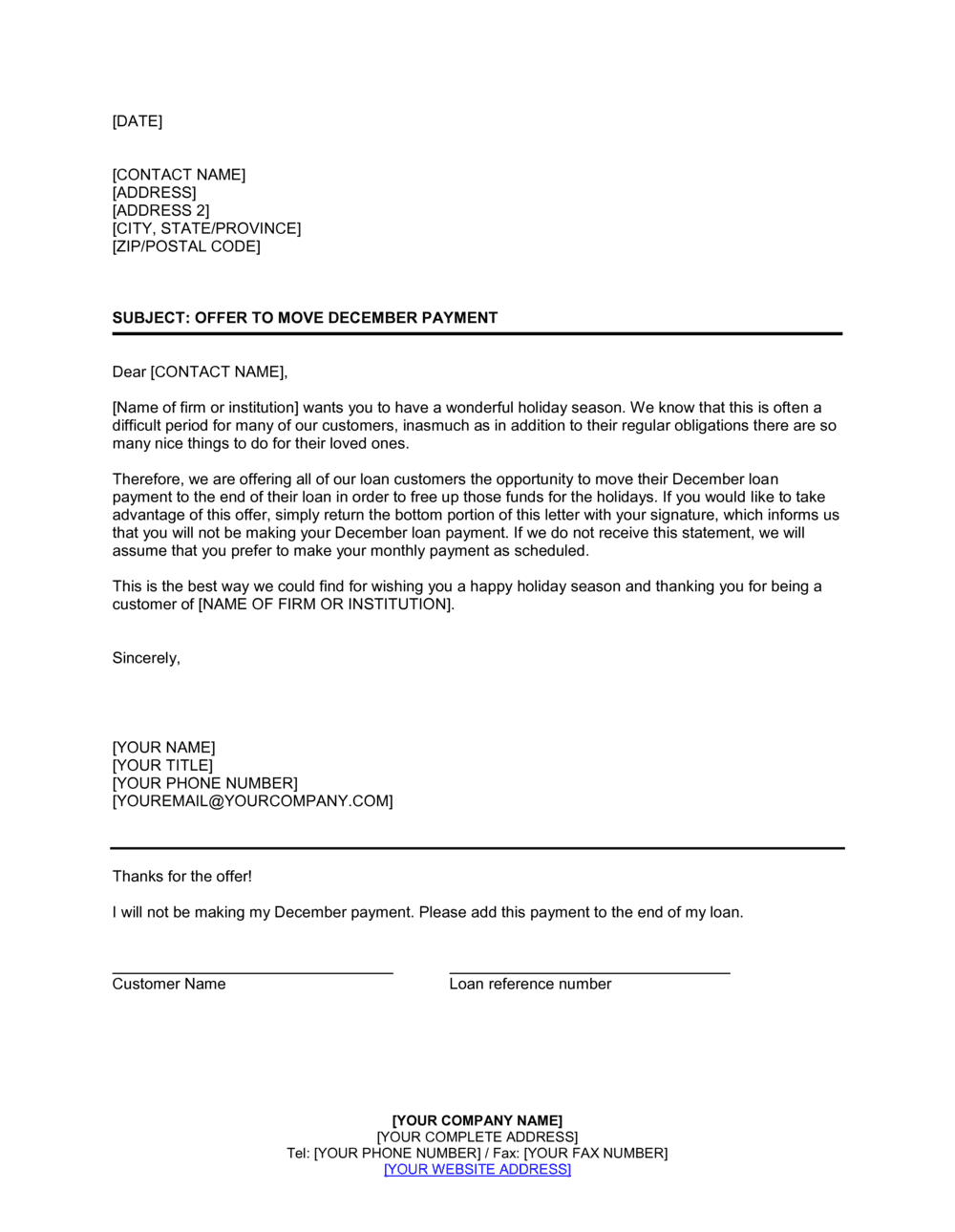
An Offer to Loan Customers to Move December Payment is a legally binding agreement in which a lender or service provider extends a short-term loan to a customer so their scheduled December payment can be deferred to a later date β€” typically January or the end of the loan term. This free Word download gives businesses a structured, customizable template they can edit online and export as PDF to send to customers seeking seasonal payment relief.
When you need it
Use it when customers request a December payment deferral due to holiday cash-flow pressures, and you want to accommodate the request while maintaining a legally documented and interest-bearing arrangement. It is also appropriate when your business proactively offers seasonal relief programs to improve customer retention and reduce default risk.
What's inside
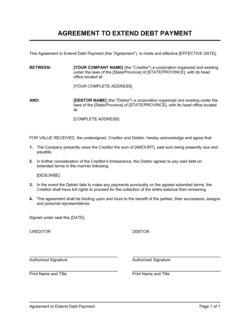
The template covers the loan offer terms, the deferred payment amount and original due date, the new repayment date, applicable interest or fees, customer consent and acknowledgment, representations and warranties, and the governing law clause β€” all in a single signed document.

What is an Offer to Loan Customers to Move December Payment?

An Offer to Loan Customers to Move December Payment is a legally binding agreement in which a lender or credit provider extends a short-term loan to a customer specifically to fund the deferral of their scheduled December payment. Rather than forgiving or waiving the payment, the agreement structures the deferral as a formal loan β€” the deferred amount remains outstanding, interest continues to accrue, and the full balance must be repaid on a new agreed date, typically the following month or at the end of the original loan term. The document records the offer terms, the customer's informed consent, the interest and fee disclosures required under consumer lending regulations, and the effect on the remaining repayment schedule, creating a clean amendment to the underlying loan agreement.

Why You Need This Document

Offering a December payment deferral without a signed written agreement creates significant legal and financial exposure on both sides. Without documentation, a verbal or informal deferral can be interpreted as a waiver β€” permanently extinguishing the lender's right to collect the deferred amount and triggering an unintended write-off. For regulated consumer lenders, an undocumented deferral that results in additional interest charges violates disclosure requirements under the Truth in Lending Act, Canada's Cost of Credit Disclosure rules, and the UK Consumer Credit Act, exposing the business to regulatory fines and borrower disputes. From the customer's perspective, the absence of a written agreement leaves them uncertain about whether the payment was truly deferred, what interest will accrue, and when the amount will be collected β€” confusion that drives missed payments and damaged relationships. A properly executed deferral agreement protects the lender's receivable, keeps the account performing and correctly classified, satisfies regulatory disclosure obligations, and gives the customer a clear, written record of the new terms β€” all in a document that takes fewer than 20 minutes to complete.

Which variant fits your situation?

If your situation is…Use this template
Deferring a single monthly installment loan paymentOffer to Loan Customers to Move December Payment
Suspending multiple consecutive payments for a set periodLoan Forbearance Agreement
Permanently restructuring a customer's repayment scheduleLoan Modification Agreement
Extending new credit to an existing customerPersonal Loan Agreement
Adjusting payment terms for a business-to-business accountPayment Plan Agreement
Issuing a formal notice of changed payment due datePayment Deferral Notice Letter

Common mistakes to avoid

❌ Framing the deferral as a waiver or forgiveness

Why it matters: Language that implies the December payment is forgiven rather than deferred can extinguish the lender's right to collect it, creating an unintended write-off and a tax event.

Fix: Use explicit loan-offer language confirming the deferred amount remains outstanding and will be repaid with accrued interest on the new due date.
❌ Omitting the interest accrual disclosure

Why it matters: Consumer lending statutes in most US states and Canadian provinces require clear disclosure of any additional interest cost before the borrower signs. Omitting it exposes the lender to regulatory fines and voids the fee entitlement.

Fix: Include both the accrual rate and an estimated dollar amount of interest for the deferral period in the agreement body, not just in a separate disclosure form.

❌ Not executing the agreement before the payment due date

Why it matters: A deferral agreement signed after the due date has passed may be treated as a cure of an existing default rather than a proactive amendment β€” with different legal and credit-reporting consequences.

Fix: Issue the offer at least 7–10 business days before the December due date and follow up to secure a signed copy before the date passes.

❌ Leaving the effect on the remaining loan schedule ambiguous

Why it matters: Customers commonly assume all future payments shift by one month; if they do not, the customer may miss the January payment expecting it was moved, triggering an actual default.

Fix: Add an explicit sentence confirming whether remaining payments shift, and attach or reference an updated payment schedule so the customer has a clear record of all future due dates.

The 10 key clauses, explained

Parties and Loan Account Identification

In plain language: Identifies the lender and the customer by their full legal names, states the original loan or account number, and confirms this agreement amends only the specified account.

Sample language
This Agreement is entered into between [LENDER LEGAL NAME] ('Lender') and [CUSTOMER FULL NAME] ('Borrower'), with respect to Loan Account No. [ACCOUNT NUMBER] ('Account'). This Agreement modifies only the payment terms described below and does not alter any other provision of the original Loan Agreement dated [ORIGINAL DATE].

Common mistake: Referencing only the customer's name without the account number, making it impossible to tie the deferral to a specific obligation if the customer holds multiple accounts.

December Payment Amount and Original Due Date

In plain language: States the exact dollar amount of the payment being deferred and the original scheduled due date in December.

Sample language
The Borrower's scheduled payment of $[PAYMENT AMOUNT] originally due on [DECEMBER DUE DATE] ('Deferred Payment') is hereby deferred under the terms of this Agreement.

Common mistake: Using an approximate or rounded payment amount instead of the exact contractual figure β€” discrepancies create disputes when the deferred payment is collected.

Loan Offer and Deferral Mechanics

In plain language: Explains the legal mechanism: the lender is extending a short-term loan equal to the deferred payment amount, which suspends the December obligation and creates a new repayment obligation.

Sample language
Lender hereby offers Borrower a loan in the amount of $[PAYMENT AMOUNT] ('Deferral Loan') for the purpose of satisfying the Deferred Payment. Borrower acknowledges that the Deferred Payment is not forgiven and that the Deferral Loan amount will be added to the outstanding loan balance or repaid as described in Section [X].

Common mistake: Framing the deferral as a forgiveness or waiver rather than a loan, which can eliminate the lender's right to collect the deferred amount.

Interest Accrual During Deferral Period

In plain language: Specifies whether interest continues to accrue on the deferred balance during December and, if so, at what rate and how the accrued interest will be collected.

Sample language
Interest shall continue to accrue on the Deferred Payment at the rate of [INTEREST RATE]% per annum from [DECEMBER DUE DATE] through [REPAYMENT DATE]. Accrued interest of approximately $[ESTIMATED AMOUNT] will be added to the Borrower's [final payment / next payment / outstanding balance].

Common mistake: Omitting the accrual period or rate, leaving the customer with a valid argument that no additional interest was agreed to during the deferral period.

New Repayment Date and Method

In plain language: Sets the specific date on which the deferred payment and any accrued interest will be collected, and how β€” added to the final payment, spread across remaining payments, or paid as a lump sum.

Sample language
The Deferred Payment and all accrued interest shall be due and payable on [REPAYMENT DATE] ('New Due Date'). Repayment shall be made by [LUMP SUM PAYMENT / ADDITION TO FINAL INSTALLMENT / EQUAL SPREAD ACROSS REMAINING PAYMENTS].

Common mistake: Setting the new repayment date without confirming whether it extends the loan maturity β€” an extended maturity may require additional regulatory disclosures under consumer lending laws.

Effect on Remaining Loan Schedule

In plain language: Clarifies whether the deferral shifts all subsequent payments by one month or leaves the remaining schedule unchanged except for the new repayment obligation.

Sample language
Except as expressly modified herein, all remaining scheduled payments shall continue as set forth in the original Loan Agreement. The maturity date of the original Loan Agreement [shall / shall not] be extended by [NUMBER] days as a result of this deferral.

Common mistake: Leaving the effect on the remaining schedule ambiguous β€” customers often assume all future payments shift, while lenders intend only the December payment to move.

Borrower Representations and Eligibility

In plain language: Requires the customer to confirm they are current on all other obligations, that no default exists, and that they have authority to enter the agreement.

Sample language
Borrower represents and warrants that: (a) no default or event of default exists under the original Loan Agreement as of the date of this Agreement; (b) Borrower has the legal authority to enter into this Agreement; and (c) all information provided to Lender in connection with this offer is accurate and complete.

Common mistake: Omitting the 'no existing default' representation, which can trap the lender into a deferral arrangement with a borrower already in breach of the underlying loan.

Fees and Costs

In plain language: Discloses any processing fee charged for the deferral and confirms how it will be collected β€” immediately, added to the balance, or deducted from the next payment.

Sample language
A deferral processing fee of $[FEE AMOUNT] [is / is not] applicable to this Agreement. If applicable, the fee shall be [collected immediately / added to the Deferred Payment balance / deducted from the next scheduled payment] on [DATE].

Common mistake: Charging a fee without disclosing it in the agreement β€” undisclosed fees on consumer loan products are subject to TILA, consumer protection, and provincial disclosure requirements.

Customer Consent and Acknowledgment

In plain language: Documents the customer's informed consent: they understand the deferral is a loan, that interest continues to accrue, that the deferred amount must be repaid, and that all other loan terms remain in force.

Sample language
By signing below, Borrower acknowledges that: (i) this Agreement constitutes a binding amendment to the original Loan Agreement; (ii) interest will accrue on the Deferred Payment as stated above; (iii) the Deferred Payment is not waived or forgiven; and (iv) all other terms of the original Loan Agreement remain in full force and effect.

Common mistake: Using a checkbox or email reply as the sole evidence of consent for a consumer loan amendment β€” most jurisdictions require a wet or electronic signature with clear disclosure language.

Governing Law and Entire Agreement

In plain language: States which jurisdiction's law governs the agreement and confirms this document, together with the original loan agreement, constitutes the entire understanding between the parties.

Sample language
This Agreement is governed by the laws of [STATE / PROVINCE / COUNTRY] without regard to its conflict-of-laws provisions. This Agreement, together with the original Loan Agreement, constitutes the entire agreement between the parties with respect to the subject matter hereof and supersedes all prior representations and understandings.

Common mistake: Choosing a governing law with no connection to where the borrower resides or the loan was originated β€” consumer protection statutes in the borrower's home state often apply regardless of the governing-law clause.

How to fill it out

  1. 1

    Enter the lender and borrower legal names

    Use the lender's full registered entity name β€” not a trade name or brand β€” and the customer's legal name exactly as it appears on the original loan agreement. Confirm both against your loan origination records.

    πŸ’‘ If the loan is held by a servicing entity different from the originating lender, use the servicer's name and note the originator's name parenthetically to avoid customer confusion.

  2. 2

    Reference the original loan account number

    Enter the account or loan number from your origination system. If the customer has multiple accounts, confirm you are referencing the correct one before issuing the offer.

    πŸ’‘ Include both the account number and the original loan date β€” together they eliminate any ambiguity about which obligation is being deferred.

  3. 3

    State the exact deferred payment amount and original December due date

    Pull the scheduled payment amount directly from the amortization schedule β€” do not round. Enter the specific calendar date in December the payment was originally due.

    πŸ’‘ If the payment includes both principal and interest components, confirm whether the deferral applies to the full payment or only the principal portion.

  4. 4

    Set the interest accrual rate and estimated accrued amount

    Confirm the original contractual interest rate applies during the deferral period, or specify a different rate if your program uses one. Calculate the estimated accrued interest for the deferral period and include it as a disclosure.

    πŸ’‘ Many consumer protection regulations require a specific dollar estimate of additional interest cost β€” not just the rate β€” to be disclosed in the agreement.

  5. 5

    Define the new repayment date and method

    Choose one of three repayment structures: lump sum on a specific date, addition to the final loan installment, or equal spread across remaining payments. Document the choice explicitly and include a revised payment schedule if the monthly amount changes.

    πŸ’‘ Adding the deferred amount to the final payment is the simplest structure and least likely to require a full loan re-amortization β€” but confirm it does not inadvertently extend the maturity date past a regulatory limit.

  6. 6

    Disclose any processing fee

    If your program charges a deferral fee, enter the exact dollar amount and collection method. If no fee applies, state that expressly so the customer has written confirmation.

    πŸ’‘ Under TILA and equivalent consumer credit statutes, fees associated with a loan modification or deferral must be disclosed before the customer signs β€” verbal disclosure alone is insufficient.

  7. 7

    Send for signature before the December due date

    Issue the offer with enough lead time for the customer to review, sign, and return it before the payment would otherwise be due. A fully executed agreement protects both parties if the payment is missed.

    πŸ’‘ Use a documented electronic signature method β€” DocuSign, Adobe Sign, or Business in a Box eSign β€” that time-stamps acceptance and stores the executed copy automatically.

Frequently asked questions

What is an offer to loan customers to move a December payment?

It is a formal written agreement in which a lender or creditor extends a short-term loan to a customer equal to their scheduled December payment, effectively deferring that payment to a later date. The deferral is structured as a loan β€” not a forgiveness β€” so the deferred amount remains outstanding and accrues interest until repaid. The document records the offer terms, the customer's consent, and the new repayment obligation in a legally binding format.

Is a signed agreement required to defer a customer's December payment?

Yes, for any lending arrangement regulated under consumer credit law β€” which includes most installment loans, auto loans, and personal credit accounts β€” a signed written agreement is required to amend the payment schedule. An email exchange or phone call is generally not sufficient. A signed deferral agreement protects the lender's right to collect the deferred amount and gives the customer clear written confirmation of the new terms.

Does interest continue to accrue during the deferral period?

In most cases, yes. Unless the agreement expressly states that interest is waived for the deferral period, interest continues to accrue on the outstanding balance β€” including the deferred payment amount β€” at the original contract rate. Consumer protection laws in most jurisdictions require the lender to disclose the estimated additional interest cost before the borrower signs the deferral agreement.

Does deferring a December payment extend the loan's maturity date?

It depends on how the repayment is structured. If the deferred amount is added to the final scheduled payment, the maturity date typically stays the same. If the deferral is handled by pushing all remaining payments back by one month, the maturity date extends by approximately one month. The agreement should state which structure applies and, in some jurisdictions, an extended maturity may trigger additional disclosure obligations.

Can a lender charge a fee for offering a payment deferral?

Yes, a processing fee is permissible in most jurisdictions, but it must be disclosed in the agreement before the customer signs. Under the US Truth in Lending Act and equivalent statutes in Canada and the UK, undisclosed fees on consumer credit products are unenforceable and can expose the lender to regulatory sanctions. If your program includes a fee, state the exact dollar amount and collection method in the agreement.

How does a payment deferral affect the customer's credit report?

If the deferral agreement is executed before the payment due date, the account should not be reported as delinquent β€” the lender is accepting modified terms. However, credit reporting treatment varies by lender policy and reporting guidelines. Some lenders report skip-a-payment programs with a special comment code; others do not report them at all. The agreement itself should not promise a specific credit reporting outcome, as that is governed by FCRA and CRA reporting obligations, not the deferral contract.

What happens if the customer does not repay the deferred amount on the new due date?

Failure to repay the deferred amount on the new due date constitutes a default under the deferral agreement and typically also triggers a default under the original loan agreement. The lender's remedies β€” acceleration, collection action, or repossession β€” are governed by the original loan agreement and applicable law. The deferral agreement should cross-reference the original loan agreement's default and remedies clauses so the enforcement rights are clear.

Who should sign the offer to loan customers to move December payment?

Both the lender (or an authorized representative) and the customer must sign the agreement before the December due date. For consumer loans, electronic signatures are generally valid under the ESIGN Act in the US, the Electronic Commerce Act in Canada, and the Electronic Communications Act in the UK, provided the customer has consented to electronic execution. Retain a copy of the fully executed agreement in the customer's loan file.

Is this document suitable for business-to-business payment deferrals?

The template can be adapted for B2B arrangements, but the core design is oriented toward consumer lending with regulatory disclosure requirements. For B2B accounts, you may be able to simplify the disclosure language and remove certain consumer-protection provisions, but you should still include the core terms β€” deferred amount, interest accrual, new due date, and mutual signatures β€” to create an enforceable amendment to the underlying credit arrangement.

How this compares to alternatives

vs Loan Forbearance Agreement

A forbearance agreement suspends or reduces payments for a defined hardship period β€” often multiple months β€” typically in response to documented financial difficulty. An offer to move a December payment is a narrower, proactive deferral of a single payment for seasonal cash-flow reasons. Forbearance typically requires evidence of hardship; a December deferral offer does not.

vs Loan Modification Agreement

A loan modification permanently changes one or more terms of the original loan β€” interest rate, monthly payment, or maturity date. A December payment deferral is a temporary, single-payment adjustment that leaves all other loan terms unchanged. Modifications require more extensive underwriting and disclosure; deferrals are simpler and faster to execute.

vs Payment Plan Agreement

A payment plan agreement restructures an overdue or disputed balance into a series of future installments, typically used after a default has already occurred. A December deferral offer is a proactive amendment made before any default β€” it preserves the performing status of the account and is typically only available to customers who are current.

vs Promissory Note

A promissory note creates a new, standalone debt obligation with its own repayment schedule and terms. A December deferral agreement is an amendment to an existing loan agreement, not a new note. The deferral relies on the original loan's terms for default, remedies, and governing law rather than establishing an independent obligation.

Industry-specific considerations

Consumer Lending and Finance

Skip-a-payment programs are a standard seasonal retention tool; TILA disclosure requirements, state usury laws, and credit reporting treatment all apply to the deferral agreement.

Automotive and Dealer Finance

Auto loan deferral programs offered at dealerships must comply with both the retail installment sales contract and state motor vehicle financing statutes, which often impose specific notice and disclosure requirements.

Banking and Credit Unions

Credit unions running holiday skip-a-payment promotions face NCUA guidance on loan modification documentation and must track deferrals carefully to avoid adverse classification of performing loans.

Property Management

Landlords offering tenants a formal loan to defer December rent should document the arrangement carefully, as verbal deferrals can be interpreted as rent waivers in jurisdictions with strong tenant-protection laws.

Jurisdictional notes

United States

The Truth in Lending Act (TILA) and Regulation Z require clear disclosure of any additional finance charges β€” including accrued interest during the deferral period β€” before the borrower signs a consumer credit amendment. State-level consumer lending statutes may impose additional notice, fee-cap, and disclosure requirements. California, New York, and Texas each have specific rules on loan modification disclosures that apply even to single-payment deferrals.

Canada

Federal and provincial consumer protection legislation β€” including the Cost of Credit Disclosure regulations under the Bank Act and provincial Consumer Protection Acts β€” requires lenders to disclose the cost of borrowing, including any additional interest resulting from a deferral, before the customer consents. Quebec's Consumer Protection Act imposes French-language requirements for consumer credit documents issued to Quebec residents.

United Kingdom

Consumer credit agreements regulated under the Consumer Credit Act 1974 require a formal variation notice for any amendment to payment terms, including a deferral. The FCA's Consumer Duty rules require lenders to act in the customer's best interests and ensure the deferral is genuinely appropriate for the customer's circumstances. Any additional interest or fees must be disclosed in a clear and prominent manner before the customer signs.

European Union

The Consumer Credit Directive (2008/48/EC, updated by Directive 2023/2225/EU) governs amendments to consumer credit agreements across EU member states. Lenders must provide pre-contractual information when materially changing credit terms, including payment deferrals. GDPR applies to the processing of borrower data in connection with the deferral offer. Individual member states β€” particularly France, Germany, and the Netherlands β€” impose additional disclosure and consent requirements beyond the Directive's minimum standards.

Template vs lawyer β€” what fits your deal?

PathBest forCostTime
Use the templateConsumer lenders, credit unions, and small businesses running standard seasonal deferral programs for performing accountsFree15–20 minutes per agreement
Template + legal reviewLenders offering deferrals across multiple states or provinces, or where the deferred amount exceeds $5,000$300–$600 for a compliance attorney review1–3 days
Custom draftedBanks and regulated finance companies with high-volume deferral programs, multi-jurisdiction portfolios, or complex fee and interest structures requiring custom disclosure forms$1,500–$4,000+1–3 weeks

Glossary

Payment Deferral
An arrangement in which a scheduled payment is postponed to a future date without triggering a default or late-payment penalty.
Skip-a-Payment Program
A promotional offering by a lender that allows a qualifying borrower to skip one scheduled payment, with interest continuing to accrue during the skipped period.
Accrued Interest
Interest that accumulates on the outstanding principal during the deferral period, even though no payment is collected at that time.
Loan Modification
A permanent change to the original loan terms β€” such as interest rate, monthly payment, or maturity date β€” as opposed to a temporary deferral.
Forbearance
A temporary agreement by a lender not to exercise its right to collect full payment, typically in response to a borrower's documented hardship.
Maturity Date
The date on which the final scheduled repayment of the full outstanding loan balance is due.
Deferred Balance
The specific payment amount that is postponed under a deferral agreement, which may be added to the end of the loan term or repaid on a new specified date.
Consent and Acknowledgment
A signed statement by the borrower confirming they understand and agree to the deferral terms, including any additional interest or fees that will result.
Governing Law Clause
The contract provision specifying which jurisdiction's laws will be used to interpret and enforce the agreement.
Consideration
Something of value exchanged between parties to make a contract enforceable β€” in this context, the lender's willingness to defer and the borrower's agreement to repay with accrued interest.

Part of your Business Operating System

This document is one of 3,000+ business & legal templates included in Business in a Box.

  • Fill-in-the-blanks β€” ready in minutes
  • 100% customizable Word document
  • Compatible with all office suites
  • Export to PDF and share electronically

Create your document in 3 simple steps.

From template to signed document β€” all inside one Business Operating System.
1
Download or open template

Access over 3,000+ business and legal templates for any business task, project or initiative.

2
Edit and fill in the blanks with AI

Customize your ready-made business document template and save it in the cloud.

3
Save, Share, Send, Sign

Share your files and folders with your team. Create a space of seamless collaboration.

Save time, save money, and create top-quality documents.

β˜…β˜…β˜…β˜…β˜…

"Fantastic value! I'm not sure how I'd do without it. It's worth its weight in gold and paid back for itself many times."

Managing Director Β· Mall Farm
Robert Whalley
Managing Director, Mall Farm Proprietary Limited
β˜…β˜…β˜…β˜…β˜…

"I have been using Business in a Box for years. It has been the most useful source of templates I have encountered. I recommend it to anyone."

Business Owner Β· 4+ years
Dr Michael John Freestone
Business Owner
β˜…β˜…β˜…β˜…β˜…

"It has been a life saver so many times I have lost count. Business in a Box has saved me so much time and as you know, time is money."

Owner Β· Upstate Web
David G. Moore Jr.
Owner, Upstate Web

Run your business with a system β€” not scattered tools

Stop downloading documents. Start operating with clarity. Business in a Box gives you the Business Operating System used by over 250,000 companies worldwide to structure, run, and grow their business.

Start freeΒ Β·Β No credit card required