1
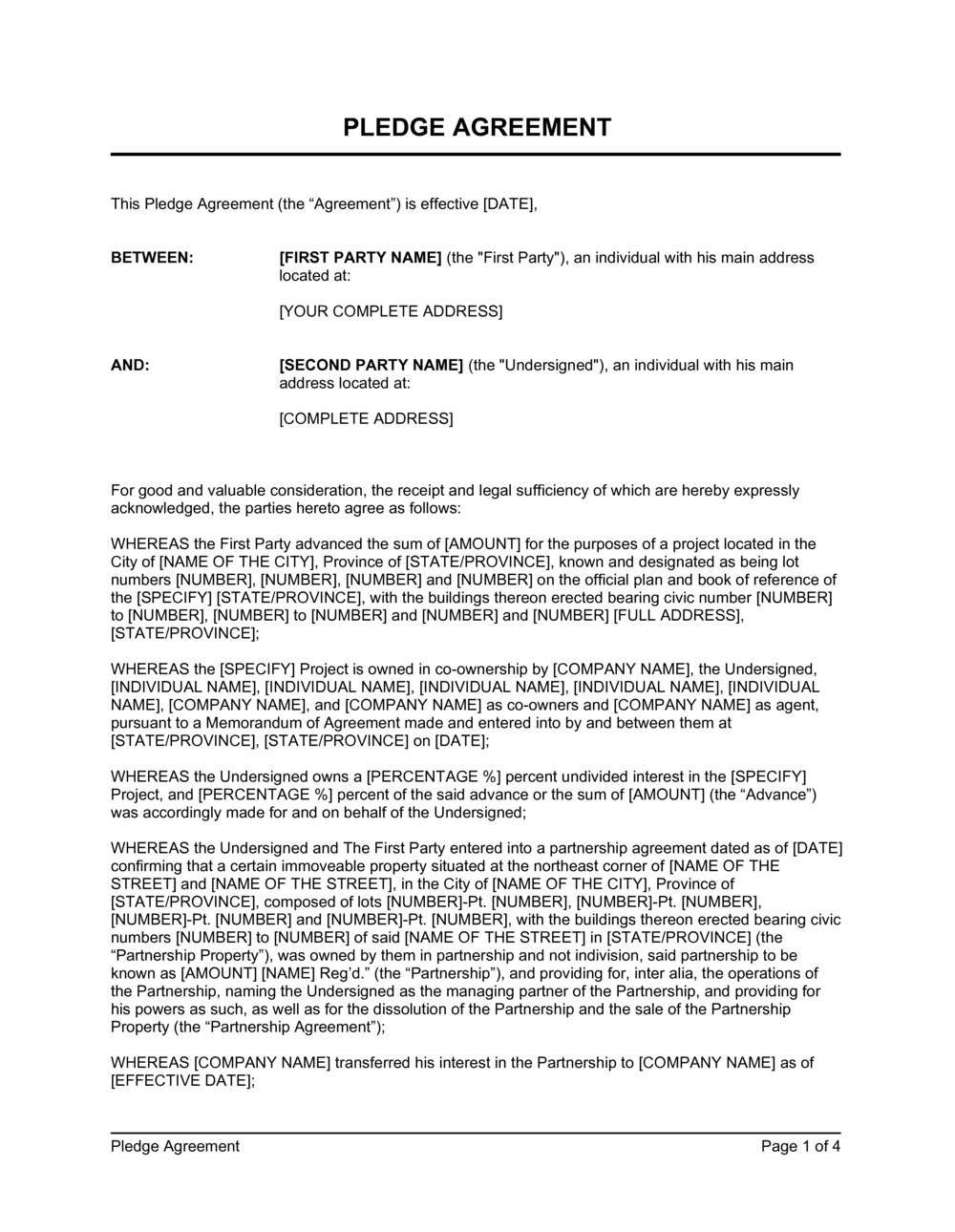
Enter the full legal names of both parties
Insert the pledgor's and pledgee's registered legal entity names — or full legal names for individuals — along with their addresses and entity types. Cross-reference the collateral's registered ownership records to ensure names match exactly.
💡 For share pledges, confirm the pledgor's name matches the name on the share certificate and the company's register of members before signing.
2
Identify and describe the collateral precisely
List every pledged asset with sufficient detail to identify it uniquely — share certificate numbers, equipment serial numbers, account numbers, or IP registration numbers. Attach a Schedule A for lengthy asset lists rather than embedding everything in the body.
💡 Vague collateral descriptions are the single most common reason security interests fail in court. If in doubt, be more specific rather than less.
3
State the advance amount and reference the underlying loan document
Enter the total advance amount in figures and words, and reference the promissory note or loan agreement that creates the underlying debt. If no separate loan document exists, include basic repayment terms in this agreement.
💡 Always state the currency explicitly — particularly for cross-border arrangements where USD, CAD, GBP, and EUR can be confused.
4
Complete the representations and warranties section
Confirm ownership, authority, and the absence of prior encumbrances. If existing liens exist on the collateral, disclose them here and confirm the pledgee's interest will rank second (or negotiate a subordination agreement with the prior lienholder).
💡 Run a UCC, PPSA, or Companies House search on the collateral before signing to identify any existing registrations you may not be aware of.
5
Define events of default and cure periods
List each default trigger explicitly and set cure periods appropriate to the nature of the breach — typically 5–10 business days for payment defaults and 15–30 days for covenant breaches. Avoid zero-day cure periods, which are commercially unreasonable in most jurisdictions.
💡 Include a cross-default clause referencing the underlying loan agreement so that default under either document triggers remedies under both.
6
Confirm perfection filing responsibilities
Specify who will file the UCC-1 (US), PPSA registration (Canada), or equivalent notice, and within how many days of signing. Authorize the pledgee to file on behalf of the pledgor if necessary.
💡 File within 24–48 hours of signing. Priority among competing security interests is determined by the order of filing, not the order of signing.
7
Sign and execute before the advance is disbursed
Both parties must sign the agreement — and any required witnesses or notaries must execute their blocks — before funds are advanced. Post-advance signing can create enforceability challenges.
💡 For share pledges, deliver the physical share certificates (and signed blank stock transfer forms) to the pledgee at closing to perfect possession-based security in common-law jurisdictions.
8
File perfection documents and store executed copies
File all required financing statements or registration notices in the correct jurisdiction immediately after execution. Store the fully executed agreement and filing receipts in a secure, accessible location.
💡 Set a calendar reminder for the UCC or PPSA registration expiry date — most registrations lapse after 5 years unless renewed, leaving the security interest unperfected.