- Limited Liability Company (LLC)
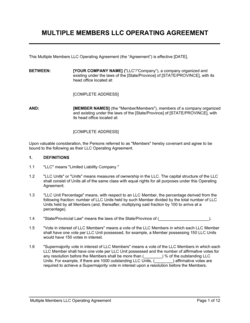
- A business structure that separates personal assets from business debts while offering flexible tax treatment and minimal formalities compared to a corporation.
- Member
- An owner of an LLC, analogous to a shareholder in a corporation, whose rights and obligations are governed by the operating agreement.
- Membership Interest
- An owner's percentage stake in the LLC, representing their share of profits, losses, and voting power.
- Capital Contribution
- Cash, property, or services a member provides to the LLC in exchange for their membership interest.
- Member-Managed LLC
- An LLC where all members share responsibility for day-to-day management decisions, each acting as an agent of the company.
- Manager-Managed LLC
- An LLC where one or more designated managers — who may or may not be members — handle operations, while other members function as passive investors.
- Profit and Loss Allocation
- The method by which the LLC's annual income and losses are divided among members, which may or may not mirror ownership percentages.
- Distributions
- Cash or property paid out to members from the LLC's profits, distinct from salary or draws, and governed by the allocation rules in the operating agreement.
- Buy-Sell Provision
- A clause that sets the process and price formula for purchasing a departing or deceased member's interest, preventing ownership from passing to unwanted third parties.
- Right of First Refusal (ROFR)
- A clause giving existing members the option to purchase a departing member's interest before it can be sold to an outside party.
- Dissolution
- The formal winding down and termination of the LLC, including liquidation of assets, payment of debts, and distribution of remaining funds to members.
- Charging Order
- A court remedy allowing a creditor of an individual member to intercept distributions from the LLC without gaining voting rights or forcing dissolution.