Policy on Privacy and Employee Monitoring Template

Free Word download β€’ Edit online β€’ Save & share with Drive β€’ Export to PDF

1 pageβ€’20–25 min to fillβ€’Difficulty: Standard
Learn more ↓
FreePolicy on Privacy and Employee Monitoring Template

At a glance

What it is
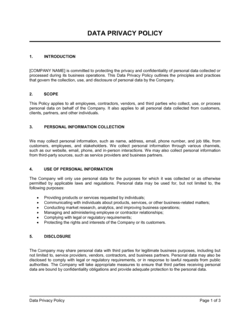
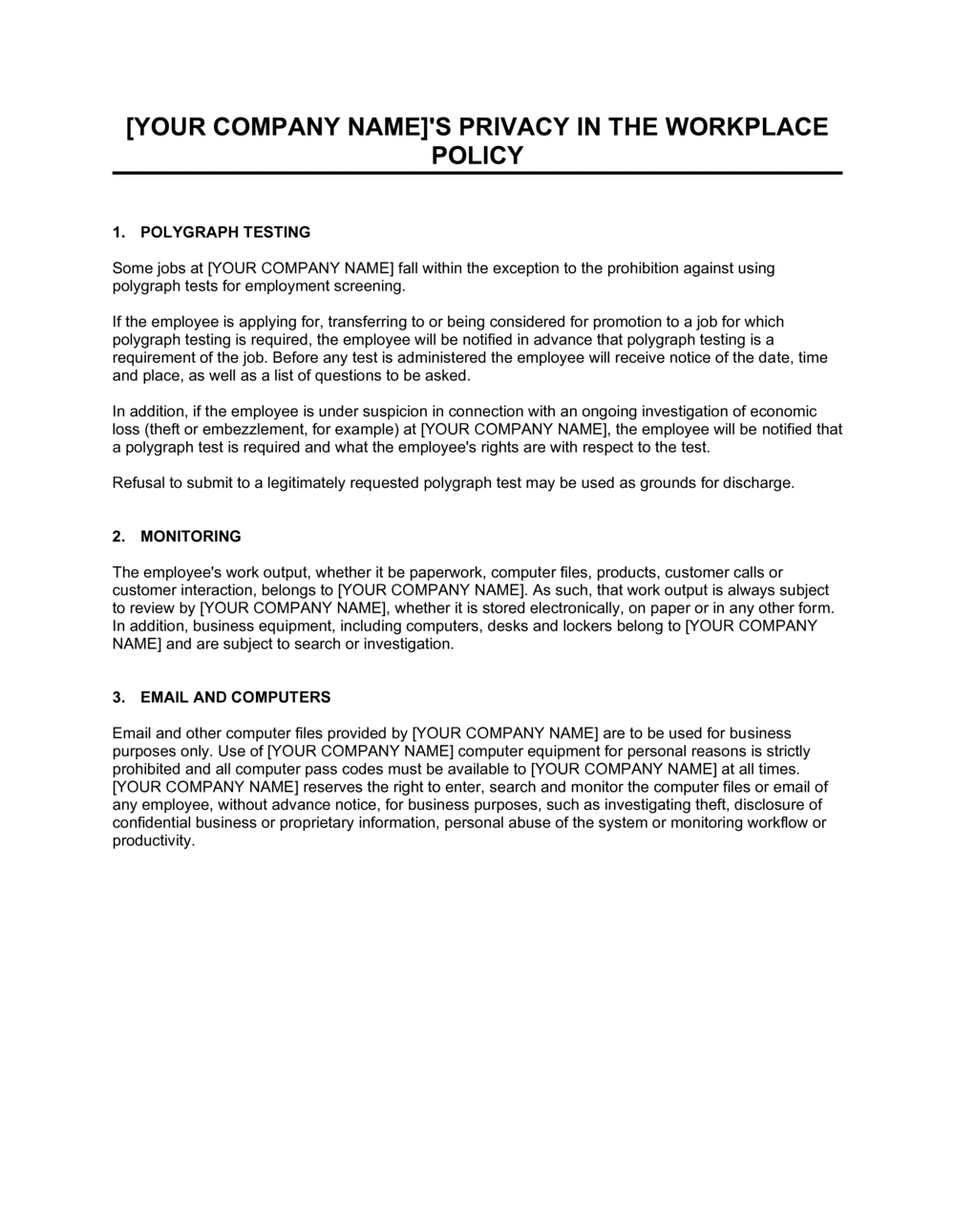
A Policy on Privacy and Employee Monitoring is a written operational document that tells employees exactly what the company monitors, how that data is collected and stored, who can access it, and what the consequences are for policy violations. This free Word download gives you a structured, editable starting point you can tailor to your organization and distribute to staff during onboarding or policy updates.
When you need it
Use it when deploying any monitoring technology β€” email scanning, internet filtering, keystroke logging, video surveillance, GPS tracking on company vehicles, or remote-work screen capture β€” or when updating your employee handbook to reflect new tools. Any employer that issues company devices or provides network access needs this document in place before monitoring begins.
What's inside
The policy covers the purpose and legal basis for monitoring, a precise description of every monitoring method in use, employee consent procedures, data retention and access rules, acceptable-use guidelines for company systems, employee privacy rights and complaint procedures, and the disciplinary consequences for misuse or circumvention.

What is a Policy on Privacy and Employee Monitoring?

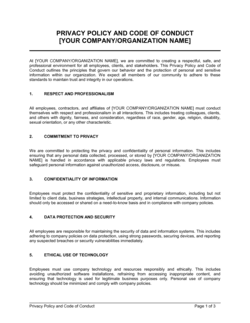
A Policy on Privacy and Employee Monitoring is a formal operational document that tells employees, contractors, and other covered individuals exactly what a company observes, records, and analyzes about their activity on company systems, devices, and premises. It identifies every monitoring method in use β€” from email scanning and network traffic logging to CCTV surveillance and GPS tracking β€” and explains the legal basis for that monitoring, how long data is retained, who can access it, and what rights employees have in relation to records held about them. By putting all of this in writing and obtaining signed acknowledgment, the policy transforms informal surveillance practices into a transparent, legally defensible program.

Why You Need This Document

Operating without a written monitoring policy exposes your organization on multiple fronts simultaneously. Employees who discover they are being monitored without prior notice can file regulatory complaints with data-protection authorities, bring employment claims for invasion of privacy, or challenge the admissibility of monitoring evidence in disciplinary proceedings β€” all of which become substantially harder to defend without documented disclosure. In the US, several states including Connecticut, Delaware, and New York require employers to provide written notice before monitoring electronic communications; in the EU and UK, GDPR demands a documented legal basis, proportionality assessment, and clear employee notice before any monitoring begins. Beyond compliance, a clear policy reduces workplace tension by setting transparent expectations: employees know what is watched, what is not, and why. This template gives you a structured, editable starting point that covers every standard section β€” purpose, scope, specific methods, consent, retention, rights, and disciplinary consequences β€” so you can deploy monitoring tools confidently without legal gaps.

Which variant fits your situation?

If your situation is…Use this template
Policy covering remote workers using personal devices on company networksRemote Work Policy
Policy governing acceptable use of company computers and internetComputer And Internet Usage Policy
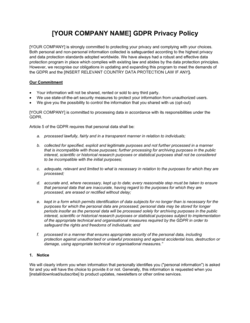
Policy addressing personal data collected from employees under GDPR or CCPAEmployee Data Privacy Policy
Policy covering company-issued mobile phones and GPS trackingMobile Device Usage Policy
Policy for monitoring field employees via vehicle GPS systemsVehicle Use And GPS Tracking Policy
Comprehensive employee handbook incorporating all workplace policiesEmployee Handbook
Policy specifically addressing email and communications monitoringEmail And Communications Monitoring Policy

Common mistakes to avoid

❌ Vague catch-all monitoring disclosure

Why it matters: Phrases like 'all activity on company systems may be monitored' have been found insufficient for informed consent in multiple jurisdictions, rendering the policy unenforceable at the moment it matters most.

Fix: Replace catch-all language with a numbered list of every specific monitoring method in use, updated each time a new tool is deployed.

❌ No defined data retention period

Why it matters: Storing monitoring records indefinitely creates liability under GDPR, CCPA, and equivalent frameworks, and gives plaintiffs in employment disputes access to years of surveillance data that was never meant to be preserved.

Fix: Assign a specific retention window β€” for example, 60 days for screen-capture logs, 30 days for CCTV footage β€” and automate deletion at that interval.

❌ Applying the policy only to full-time employees

Why it matters: Contractors, consultants, and temporary workers who use company systems are equally capable of data exfiltration or policy violations, and equally entitled to disclosure of monitoring practices.

Fix: Expand the scope clause to cover all individuals accessing company systems or premises, regardless of employment classification, and reference the policy in contractor agreements.

❌ No acknowledgment re-obtained when monitoring methods change

Why it matters: A consent obtained in 2021 for email monitoring does not cover AI-based productivity scoring introduced in 2024. Deploying new monitoring tools without updated disclosure exposes the employer to employee grievances and regulatory complaints.

Fix: Treat any material change to monitoring methods as a policy update trigger, notify affected employees in writing, and collect fresh acknowledgments before activating the new tool.

❌ Omitting employee privacy rights entirely

Why it matters: A policy that reads as unlimited employer surveillance authority is more likely to generate employee resistance, union grievances, and regulatory scrutiny than one that acknowledges the boundaries of monitoring.

Fix: Add an explicit section confirming that personal devices, personal accounts, and restricted physical areas are not monitored, and that employees may request access to records held about them.

❌ No named complaint handler or response timeline

Why it matters: Without a designated contact and a committed response window, employee complaints about monitoring misuse default to external channels β€” labor authorities or employment tribunals β€” before any internal resolution is attempted.

Fix: Name the specific role responsible for complaints (e.g., HR Director or Data Protection Officer) and commit to a written response within 20 business days.

The 10 key sections, explained

Purpose and scope

Legal basis for monitoring

Types of monitoring in use

Employee consent and acknowledgment

Data collection, storage, and access

Acceptable use of company systems

Employee privacy rights and limitations

Complaint and review procedure

Disciplinary consequences

Policy review and updates

How to fill it out

  1. 1

    Audit every monitoring tool currently in use

    Before filling in any section, compile a complete list of every technology that observes, records, or analyzes employee activity. Include email filters, web proxies, CCTV systems, GPS units, screen-capture software, and badge-access logs.

    πŸ’‘ Ask IT, facilities, and HR independently β€” each team typically manages a different category of monitoring and no single person has the full picture.

  2. 2

    Identify the applicable legal framework

    Determine which data-protection and employment laws govern your employees' locations. US employers face a patchwork of state laws (California, Connecticut, Delaware have specific notice requirements); EU and UK employers must meet GDPR and UK GDPR standards.

    πŸ’‘ If employees work in more than two jurisdictions, note jurisdiction-specific requirements in an appendix rather than trying to fold them into the main policy body.

  3. 3

    Define scope and covered individuals

    List every category of person who accesses company systems or premises: full-time employees, part-time staff, contractors, consultants, interns, and on-site vendors. Each group should be explicitly included or excluded.

    πŸ’‘ Contractors and consultants are often overlooked. If they use your network or VPN, they should be covered β€” and their contracts should reference the policy.

  4. 4

    Describe each monitoring method with specificity

    For each tool identified in your audit, write a one- to two-sentence description of what is collected, when, and how it is triggered. Avoid vague language like 'may monitor' β€” state what you actually do.

    πŸ’‘ Specificity protects you: a court is more likely to uphold a consent obtained against a precise disclosure than one obtained against a vague catch-all.

  5. 5

    Set data retention periods for each monitoring type

    Assign a specific retention period β€” in days or months β€” to each category of monitoring data. Security logs, CCTV footage, and email archives each warrant different retention windows based on business need and regulatory minimums.

    πŸ’‘ 30–90 days covers most routine monitoring needs. Extending retention beyond 90 days requires a documented business justification to withstand regulatory scrutiny.

  6. 6

    Draft the complaint and access procedure

    Name the specific role (not just a department) responsible for handling monitoring-related complaints and data-access requests. Set a response time commitment of no more than 30 business days.

    πŸ’‘ Align this procedure with any existing subject-access-request process in your data-protection policy to avoid conflicting timelines.

  7. 7

    Obtain signed acknowledgments before rolling out

    Attach an acknowledgment form as an exhibit and collect signatures from all covered individuals before the policy takes effect. Store executed acknowledgments in each employee's personnel file.

    πŸ’‘ For existing employees, allow a 5–10 business day window to read and ask questions before the acknowledgment deadline β€” rushed sign-offs attract more grievances.

  8. 8

    Schedule an annual review date

    Set a calendar reminder for 12 months after the policy's effective date. Assign a named owner β€” typically IT Security or HR β€” to lead the review and confirm whether new monitoring tools have been deployed since the last version.

    πŸ’‘ Even if nothing has changed, a dated annual review notation in the document header signals good governance to auditors and regulators.

Frequently asked questions

What is an employee monitoring policy?

An employee monitoring policy is a written document that discloses to employees what the employer monitors, how monitoring data is collected and stored, who can access it, and what the consequences are for violations. It provides the legal and operational framework for any surveillance or tracking the employer conducts on company systems, devices, or premises.

Do employees have privacy rights at work?

Yes. Employees generally retain a reasonable expectation of privacy in personal devices, personal email accounts accessed on personal data plans, physical spaces such as changing rooms and medical areas, and β€” in some jurisdictions β€” personal messages sent on company devices during breaks. A well-drafted monitoring policy acknowledges these boundaries explicitly rather than asserting unlimited surveillance authority.

What monitoring methods should the policy cover?

The policy should list every method currently in use: email content scanning, web traffic logging, CCTV surveillance, GPS tracking on company vehicles, screen-capture or keystroke-logging software, badge-access logs, phone call recording, and any AI-based productivity or behavior analytics tools. Each method should be described specifically β€” vague catch-all language is insufficient in most jurisdictions.

How long should monitoring data be retained?

Retention periods should be set per data type and documented in the policy. Common benchmarks are 30 days for CCTV footage, 60–90 days for screen-capture logs, and 12 months for email security scans. Retaining data longer than necessary increases regulatory liability under GDPR, CCPA, and equivalent frameworks. Automated deletion at the stated interval is best practice.

Does the policy need to cover contractors and remote workers?

Yes. Any individual accessing company systems, networks, or premises should be covered regardless of employment classification. Contractors and remote workers are particularly high-risk from a data-security standpoint and are equally entitled to disclosure of monitoring practices. Reference the policy in contractor agreements and remote-work addenda.

What happens when new monitoring tools are deployed after the policy is signed?

Deploying new monitoring technology without updating the policy and re-obtaining employee acknowledgment is a common compliance failure. Any material change to monitoring methods β€” adding screen-capture software, deploying AI productivity scoring, or expanding GPS tracking β€” should trigger a policy update, written notification to employees, and fresh signed acknowledgments before activation.

Should employees sign an acknowledgment form?

Yes. A signed acknowledgment form attached as an exhibit to the policy is the standard mechanism for documenting informed consent. Collect signatures during onboarding for new hires and within a defined window for existing employees when the policy is first introduced or materially updated. Store executed forms in each employee's personnel file.

How often should the monitoring policy be reviewed?

An annual review is the minimum standard. In practice, the policy should also be reviewed whenever a new monitoring tool is deployed, applicable law changes, or the workforce structure changes significantly β€” for example, moving to a primarily remote model. Assign a named owner to each review cycle and record the review date and outcome in the document header.

How this compares to alternatives

vs Computer And Internet Usage Policy

A computer and internet usage policy defines what employees may and may not do on company systems β€” the rules. A privacy and monitoring policy discloses what the company watches and records to enforce those rules. Both documents are needed: the usage policy sets standards; the monitoring policy provides the legally required notice that those standards are actively enforced.

vs Employee Handbook

An employee handbook is an omnibus policy document covering the full employment relationship β€” compensation, leave, conduct, and more. A standalone monitoring policy provides the depth of disclosure β€” specific methods, retention periods, legal basis β€” that a handbook entry cannot accommodate without becoming unwieldy. The handbook should reference the standalone policy rather than replicate it.

vs Remote Work Policy

A remote work policy governs where, when, and how employees may work outside the office. A monitoring policy governs what the company observes regardless of location. Remote work arrangements typically require more monitoring disclosure, not less β€” screen capture and activity tracking that would be visible in an office become covert when an employee is at home, making the monitoring policy more critical, not optional.

vs Non-Disclosure Agreement

An NDA is a binding legal contract obligating employees to keep company information confidential. A monitoring policy is an operational disclosure that informs employees how the company detects potential breaches. They serve complementary roles: the NDA creates the confidentiality obligation; the monitoring policy describes how compliance is observed and enforced.

Industry-specific considerations

Technology / SaaS

Source code access logs, screen capture on developer workstations, and network traffic monitoring for data-exfiltration prevention are standard; remote-work screen monitoring requires explicit GDPR-compliant disclosure for EU-based employees.

Financial Services

Regulatory requirements under FINRA, FCA, and MiFID II mandate electronic communications archiving for registered employees; the monitoring policy must align with these retention and access obligations.

Healthcare

HIPAA audit-log requirements mean monitoring of EHR access is legally mandated rather than discretionary; the policy should distinguish between compliance-driven monitoring and productivity monitoring.

Retail / Logistics

CCTV surveillance for loss prevention and GPS tracking on delivery vehicles are the primary methods; the policy must address both in-store employees and field drivers with distinct disclosure language.

Template vs pro β€” what fits your needs?

PathBest forCostTime
Use the templateSmall and mid-size employers deploying standard monitoring tools with a domestic workforceFree2–3 hours to customize and distribute
Template + professional reviewEmployers with employees in multiple states or provinces, or those deploying AI-based monitoring tools$300–$800 for an HR consultant or employment attorney review3–5 business days
Custom draftedMultinational employers, heavily regulated industries (financial services, healthcare), or organizations subject to GDPR with EU-based employees$1,500–$5,000+2–4 weeks

Glossary

Monitoring
Any systematic observation, recording, or review of employee activity on company systems, premises, or devices.
Acceptable Use Policy (AUP)
Rules governing how employees may use company-provided technology, networks, and communications tools.
Consent
An employee's documented acknowledgment that they have been informed of monitoring practices and agree to them as a condition of employment.
Data Retention
The defined period for which monitoring records β€” logs, footage, screenshots β€” are stored before being deleted or anonymized.
Reasonable Expectation of Privacy
The legal standard for whether an individual in a given context can expect their communications or activities to remain private.
Keystroke Logging
Software that records every keystroke made on a device, often used for security audits or productivity monitoring.
CCTV / Video Surveillance
Closed-circuit camera systems installed on company premises to record employee activity in common areas or workspaces.
Network Traffic Monitoring
Inspection of data packets transmitted over a company network, used to detect unauthorized access, data exfiltration, or policy violations.
GPS Tracking
Location-monitoring technology installed in company vehicles or on company-issued mobile devices to track movement in real time.
Data Subject
The identified or identifiable individual β€” in this context, the employee β€” whose personal data is being collected or processed.
Proportionality
The principle that monitoring should be limited to what is necessary and appropriate given the legitimate business purpose it serves.

Part of your Business Operating System

This document is one of 3,000+ business & legal templates included in Business in a Box.

  • Fill-in-the-blanks β€” ready in minutes
  • 100% customizable Word document
  • Compatible with all office suites
  • Export to PDF and share electronically

Create your document in 3 simple steps.

From template to signed document β€” all inside one Business Operating System.
1
Download or open template

Access over 3,000+ business and legal templates for any business task, project or initiative.

2
Edit and fill in the blanks with AI

Customize your ready-made business document template and save it in the cloud.

3
Save, Share, Send, Sign

Share your files and folders with your team. Create a space of seamless collaboration.

Save time, save money, and create top-quality documents.

β˜…β˜…β˜…β˜…β˜…

"Fantastic value! I'm not sure how I'd do without it. It's worth its weight in gold and paid back for itself many times."

Managing Director Β· Mall Farm
Robert Whalley
Managing Director, Mall Farm Proprietary Limited
β˜…β˜…β˜…β˜…β˜…

"I have been using Business in a Box for years. It has been the most useful source of templates I have encountered. I recommend it to anyone."

Business Owner Β· 4+ years
Dr Michael John Freestone
Business Owner
β˜…β˜…β˜…β˜…β˜…

"It has been a life saver so many times I have lost count. Business in a Box has saved me so much time and as you know, time is money."

Owner Β· Upstate Web
David G. Moore Jr.
Owner, Upstate Web

Run your business with a system β€” not scattered tools

Stop downloading documents. Start operating with clarity. Business in a Box gives you the Business Operating System used by over 250,000 companies worldwide to structure, run, and grow their business.

Free Forever PlanΒ Β·Β No credit card required