OKR Template

Free Excel download β€’ Use online β€’ Print or share

5 pagesβ€’25–30 min to useβ€’Difficulty: Complexβ€’Signature requiredβ€’Legal review recommended
Learn more ↓
FreeXLSOKR Template

At a glance

What it is
An OKR Template is a structured planning document that formalizes a company's Objectives and Key Results β€” defining what the organization, department, or individual aims to achieve and the measurable outcomes that define success. This free Word download gives you a ready-to-use framework you can edit online, adapt to any planning cycle, and export as PDF to share with leadership, teams, or board members.
When you need it
Use it at the start of a quarterly or annual planning cycle to set strategic priorities, align cross-functional teams, and create a shared accountability framework. It is also appropriate when onboarding a new executive, launching a new business unit, or formalizing performance expectations tied to compensation or equity milestones.
What's inside
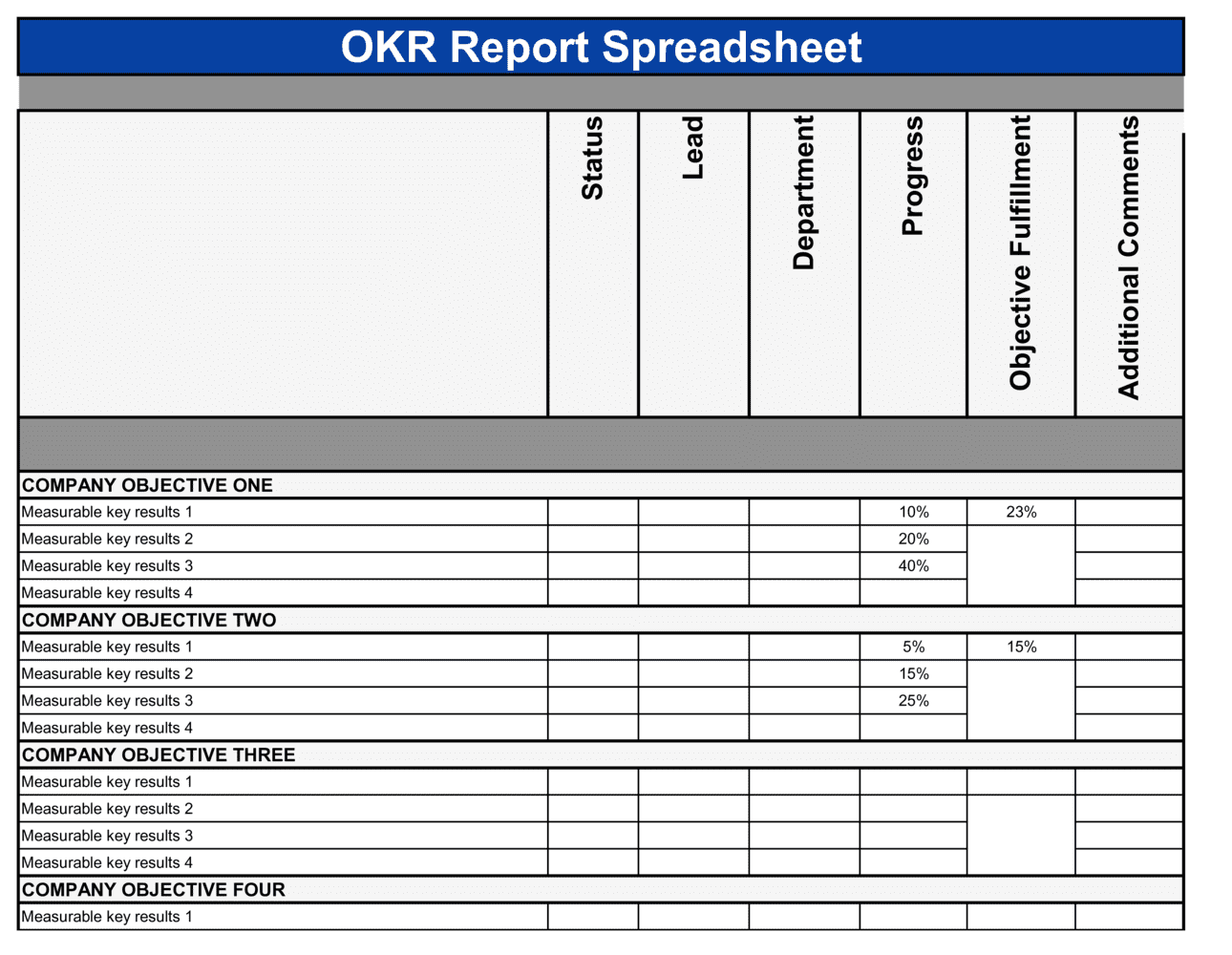
Company and team identification, planning period, high-level objectives with supporting key results, ownership assignments, scoring criteria, progress check-in cadence, and sign-off fields for both leadership and direct reports.

What is an OKR Template?

An OKR Template is a structured planning document that formalizes a company's, department's, or individual's Objectives and Key Results β€” defining what the organization intends to achieve within a specific planning cycle and the measurable outcomes that define whether it succeeded. Each objective is a qualitative, directional statement of ambition; each key result is a specific, numeric outcome that collectively proves the objective was met. The template adds the operational infrastructure around these goals: ownership assignments, scoring criteria, check-in schedules, dependency documentation, and sign-off fields that transform an abstract goal-setting exercise into a managed accountability system.

Why You Need This Document

Without a formalized OKR document, quarterly goal-setting tends to produce a list of aspirations that no one revisits until the final week of the cycle β€” by which point recovery is impossible and scoring is contested. The absence of signed ownership means misses are attributed to circumstances rather than to individuals, and the absence of a documented baseline makes it impossible to measure whether any progress was actually made. When OKR outcomes are referenced in employment contracts, bonus structures, or equity vesting schedules, an undocumented or unsigned OKR creates legal ambiguity that can surface in compensation disputes or, in Canada and the UK, employment tribunal proceedings. A properly completed OKR template with signed acknowledgments, documented dependencies, and a defined scoring methodology gives leadership a defensible record of agreed expectations β€” and gives teams the clarity they need to prioritize work that actually moves the business forward.

Which variant fits your situation?

If your situation is…Use this template
Setting company-wide annual priorities for the leadership teamCompany OKR Template
Running quarterly goal cycles for a single departmentDepartment OKR Template
Tracking individual contributor goals tied to performance reviewsIndividual OKR Template
Aligning product development goals with engineering sprintsProduct Team OKR Template
Formalizing sales team targets with measurable revenue key resultsSales OKR Template
Connecting OKR outcomes to a broader strategic roadmapStrategic Planning Template
Tying individual OKRs to a formal performance review processEmployee Performance Review Template

Common mistakes to avoid

❌ Writing task-based key results instead of outcome-based ones

Why it matters: Key results written as tasks ('run five customer interviews') can be completed without the underlying objective moving forward. The team checks a box while the goal stagnates.

Fix: Rewrite every key result to express an outcome with a measurable delta: baseline, target value, and unit of measure. If it does not have a number, it is probably a task.

❌ Setting more than five objectives per cycle

Why it matters: More than five objectives dilutes focus to the point where none receives sufficient attention. Teams with seven or more objectives consistently score lower on all of them than teams with three to four.

Fix: Force-rank all candidate objectives and cut to the top three to five. Deprioritized objectives can be noted as 'on-deck' for the next cycle without being ignored permanently.

❌ Assigning team-level ownership instead of a named individual

Why it matters: When a team owns a key result, responsibility diffuses. Every individual assumes someone else is tracking progress, and misses are discovered at end-of-cycle rather than mid-cycle when recovery is still possible.

Fix: Replace every team-level owner with a single named person. Make that person responsible for surfacing blockers at check-ins, not just reporting numbers.

❌ Never revisiting OKRs after the cycle kickoff meeting

Why it matters: OKRs set in week one and reviewed only in week thirteen function as a grading exercise, not a management system. Most misses that could have been rescued are identified too late.

Fix: Enforce a weekly or bi-weekly written check-in with a traffic-light status update. A one-sentence status entry per key result takes under five minutes and creates a visible early warning system.

❌ Tying OKR scores directly to performance ratings or bonuses

Why it matters: When compensation is directly linked to OKR scores, employees set conservative, easily achievable objectives. Aspirational OKRs disappear because no one accepts the personal risk of a 0.7 score.

Fix: Separate OKR scoring from compensation decisions. Use OKR data as one qualitative input into performance discussions rather than a mechanical rating trigger.

❌ Skipping the end-of-cycle retrospective

Why it matters: Without a retrospective, the same structural problems β€” unclear ownership, undocumented dependencies, unrealistic baselines β€” repeat in every subsequent cycle.

Fix: Block a 60-minute retrospective meeting in the calendar before the cycle even starts. Use a simple three-question format: what did we achieve, what blocked us, and what one structural change would improve the next cycle.

The 10 key clauses, explained

Planning period and cycle identification

In plain language: States the organization name, department or team, the planning cycle (Q1 2026, FY2026, etc.), and the start and end dates.

Sample language
Organization: [COMPANY NAME] | Department: [TEAM / DEPARTMENT NAME] | Cycle: [Q1 / Q2 / Q3 / Q4] [YEAR] | Period: [START DATE] to [END DATE]

Common mistake: Omitting explicit start and end dates and relying on 'Q1' alone. Teams in different time zones or fiscal calendars interpret quarter boundaries differently, causing misaligned review windows.

Objective statement

In plain language: A single qualitative statement describing what the team intends to achieve β€” ambitious, actionable, and written in plain language without metrics.

Sample language
Objective [#]: [OBJECTIVE STATEMENT β€” e.g., 'Establish [COMPANY NAME] as the preferred vendor in the [TARGET MARKET] segment by [END DATE].']

Common mistake: Including a number or percentage in the objective statement itself. Metrics belong in key results β€” a metric-laden objective becomes a key result and loses its motivational quality.

Key results (per objective)

In plain language: Two to five measurable outcomes that collectively define what success looks like for the linked objective. Each uses a baseline, target value, and unit of measure.

Sample language
KR [#.#]: Increase [METRIC] from [BASELINE VALUE] to [TARGET VALUE] by [DATE]. | KR [#.#]: Achieve [BINARY MILESTONE β€” e.g., 'launch [PRODUCT FEATURE] to production'] by [DATE].

Common mistake: Writing key results as tasks ('conduct three customer interviews') instead of outcomes ('increase NPS from 32 to 45 based on 50+ responses'). Task-based KRs can be completed without moving the objective forward.

Ownership and accountability assignment

In plain language: Names the individual or role responsible for each objective and each key result, and identifies who provides oversight or final sign-off.

Sample language
Objective Owner: [NAME / TITLE] | Key Result Owner: [NAME / TITLE] | Reviewed By: [MANAGER NAME / TITLE] | Sign-Off Authority: [EXECUTIVE NAME / TITLE]

Common mistake: Assigning a team rather than a named individual as owner. Shared ownership with no named accountable person consistently results in no one taking responsibility when progress stalls.

Scoring criteria and methodology

In plain language: Defines the 0.0–1.0 scoring scale applied at cycle end, states what each score band represents, and distinguishes committed from aspirational OKRs.

Sample language
Scoring Scale: 0.0–0.3 = missed target; 0.4–0.6 = partial progress; 0.7–0.9 = strong result (aspirational target); 1.0 = fully achieved (committed target). OKR Type: [Committed / Aspirational].

Common mistake: Applying the same scoring expectations to both committed and aspirational OKRs. A score of 0.7 on a stretch goal is a strong outcome; the same score on a committed goal indicates underdelivery.

Check-in cadence and progress tracking

In plain language: Specifies the frequency of structured check-ins, the format (written update, meeting, or dashboard), and who is responsible for maintaining current progress data.

Sample language
Check-In Frequency: [Weekly / Bi-Weekly] | Format: [Written status update / Team meeting / Dashboard] | Updated By: [NAME / ROLE] | Due each: [DAY OF WEEK / DATE]

Common mistake: Setting a check-in schedule in the document but never enforcing it. OKRs without a consistent review rhythm become a filing exercise rather than a management tool.

Dependencies and cross-team linkages

In plain language: Documents other teams, systems, or external parties whose output is required for a key result to be achieved, and the agreed handoff dates.

Sample language
Dependency: KR [#.#] requires [OUTPUT] from [TEAM / VENDOR] by [DATE]. Confirmed by: [CONTACT NAME] on [DATE].

Common mistake: Leaving dependencies undocumented and assuming verbal alignment is sufficient. Undocumented dependencies are the single most common cause of missed key results at cycle end.

Mid-cycle review and adjustment clause

In plain language: States the conditions under which an objective or key result may be revised mid-cycle β€” typically limited to material changes in business context β€” and the approval process required.

Sample language
OKRs may be revised mid-cycle only upon written approval from [APPROVER TITLE] in the event of [MATERIAL CHANGE β€” e.g., 'strategic pivot, acquisition, or significant market disruption']. Revisions must be documented in [SYSTEM / RECORD].

Common mistake: Allowing informal verbal updates to OKRs mid-cycle without documenting them. Unrecorded changes make end-of-cycle scoring disputes impossible to resolve objectively.

End-of-cycle review and retrospective

In plain language: Defines the close-out process: when final scores are entered, who conducts the retrospective, and how learnings are carried into the next cycle.

Sample language
Final scores due: [DATE]. Retrospective meeting: [DATE]. Output: written summary of [WHAT WORKED / WHAT DIDN'T / WHAT CHANGES NEXT CYCLE] filed in [SYSTEM / LOCATION].

Common mistake: Skipping the retrospective when the cycle ends poorly. The retrospective is most valuable after a difficult cycle β€” omitting it means the same structural mistakes recur in the next planning period.

Signatures and acknowledgment

In plain language: Signature fields for the objective owner, their direct manager, and any executive sponsor, confirming all parties have reviewed and agreed to the OKRs before the cycle begins.

Sample language
Objective Owner: [NAME] _______________ Date: [DATE] | Manager / Reviewer: [NAME] _______________ Date: [DATE] | Executive Sponsor: [NAME] _______________ Date: [DATE]

Common mistake: Treating signatures as optional or collecting them weeks after the cycle starts. Unsigned OKRs lack the mutual commitment that makes the framework effective as an accountability tool.

How to fill it out

  1. 1

    Define the planning period and scope

    Enter the organization name, department, cycle label (e.g., Q2 2026), and exact start and end dates. Clarify whether this is a company-level, department-level, or individual OKR document.

    πŸ’‘ Align your cycle boundaries to your fiscal calendar from day one β€” mixing calendar quarters with fiscal quarters creates scoring ambiguity at year-end.

  2. 2

    Write three to five objectives

    Draft each objective as a qualitative, inspiring statement of intent. Objectives should be ambitious but not vague β€” a good objective makes a clear directional claim without containing any numbers.

    πŸ’‘ Run the 'so that' test: 'We will do X so that Y happens.' If Y is not meaningful to the business, the objective is probably too tactical.

  3. 3

    Assign two to five key results per objective

    For each objective, write outcome-based key results with a numeric baseline, target, and unit of measure. Ensure that collectively they would prove the objective was achieved.

    πŸ’‘ If all key results can be completed without the objective actually being met, rewrite them β€” they are measuring activity, not impact.

  4. 4

    Name a single owner for each objective and key result

    Assign one named individual β€” not a team β€” as accountable for each objective and each key result. Record their manager and the sign-off authority in the ownership block.

    πŸ’‘ If two people share an objective, clarify which one is the primary owner with final accountability. Co-ownership without a tiebreaker creates accountability gaps.

  5. 5

    Classify each OKR as committed or aspirational

    Mark each objective as either committed (full achievement expected, score 1.0) or aspirational (stretch goal, 0.7 is strong). Apply the scoring scale accordingly in the scoring criteria section.

    πŸ’‘ Limit aspirational OKRs to no more than 30–40% of the total set. An entirely aspirational OKR portfolio makes performance management conversations difficult.

  6. 6

    Document dependencies and cross-team agreements

    For any key result that relies on output from another team, vendor, or system, name the dependency, the required deliverable, and the agreed handoff date. Get written confirmation from the dependency owner.

    πŸ’‘ Treat an undocumented dependency as a risk β€” if it fails, there is no paper trail to diagnose the root cause or assign accountability fairly.

  7. 7

    Set the check-in schedule and collect signatures

    Enter the check-in frequency, format, and the name of who is responsible for maintaining progress data. Then route the document for signature by the objective owner, their manager, and the executive sponsor before the cycle start date.

    πŸ’‘ Schedule the first check-in meeting before the cycle begins β€” having it on the calendar signals to the team that tracking is not optional.

Frequently asked questions

What is an OKR template?

An OKR template is a structured document that guides the process of setting Objectives and Key Results for a company, department, or individual. It provides standardized fields for the planning period, objective statements, measurable key results, ownership assignments, scoring criteria, and sign-off fields. Using a consistent template across teams ensures OKRs are written in a comparable format and can be rolled up into company-level reporting.

What is the difference between an objective and a key result?

An objective is a qualitative, directional statement of what you want to achieve β€” ambitious and inspirational, with no numbers. A key result is a specific, measurable outcome that tracks progress toward that objective, expressed with a baseline value, target value, and unit of measure. Objectives answer 'where do we want to go?' Key results answer 'how will we know we got there?'

How many OKRs should a team set per quarter?

The standard recommendation is three to five objectives per team, with two to five key results per objective. More than five objectives dilutes focus and consistently produces lower scores across the entire set. If a team identifies more than five strong candidates, force-rank them and carry the lower-priority items to the following cycle rather than overloading the current one.

Should OKR scores be tied to performance reviews or bonuses?

Most practitioners β€” including Google, where the OKR framework was popularized β€” explicitly separate OKR scores from compensation. When scores are tied directly to pay, employees set conservative, easily achievable objectives and aspirational goals disappear from the system. OKR data should inform performance conversations as one qualitative input, not serve as a mechanical rating formula.

What does a good OKR score look like?

For aspirational OKRs, a score of 0.7 on a 0.0–1.0 scale is considered a strong outcome β€” a consistent 1.0 suggests the objectives were not ambitious enough. For committed OKRs, 1.0 is the expectation. Scores below 0.4 on any key result should trigger a retrospective to identify whether the baseline was wrong, the target unrealistic, or a dependency failed.

How is an OKR template different from a KPI dashboard?

A KPI dashboard tracks ongoing operational health metrics β€” revenue, churn, uptime β€” on a continuous basis. An OKR template is a time-bound planning document that sets specific ambitious outcomes for a defined cycle and scores them at the end. KPIs monitor the baseline; OKRs set the target for improvement. Both are useful, but they serve different management purposes and should not be conflated.

Who should sign an OKR document?

At minimum, the objective owner and their direct manager should sign before the cycle begins. For company-level or department-level OKRs with material resource or compensation implications, an executive sponsor or C-suite sign-off is appropriate. Signatures confirm mutual agreement on the goals and create a documented accountability record that supports fair end-of-cycle reviews.

How often should OKRs be updated?

Progress should be updated at each check-in β€” weekly or bi-weekly is most common. OKR targets themselves should only be revised mid-cycle in the event of a material change in business context, such as a strategic pivot, acquisition, or significant market disruption. Routine downward revisions to make targets more achievable undermine the entire purpose of the framework.

Can OKRs be used in small businesses and nonprofits, not just tech companies?

Yes. The OKR framework was developed at Intel and popularized at Google, but it is applicable to any organization that needs to align priorities and track progress. Small businesses use OKRs to focus limited resources on the highest-impact goals. Nonprofits use them to tie programmatic objectives to measurable community outcomes that satisfy board and funder reporting requirements. The template structure is the same regardless of sector.

How this compares to alternatives

vs Strategic Planning Template

A strategic plan defines a 3–5 year direction, core priorities, and resource allocation for an established business. An OKR template translates that strategy into time-bound, measurable commitments for a specific quarter or year. The strategic plan sets the destination; OKRs are the quarterly navigation checkpoints. Organizations typically need both, with OKRs cascading directly from the strategic plan's priorities.

vs Employee Performance Review Template

A performance review evaluates an employee's overall contribution, behaviors, and development over a review period. An OKR template sets forward-looking goals and measures specific outcomes. OKR data can inform a performance review as one input, but the two documents serve different purposes β€” one is evaluative and retrospective, the other is planning-oriented and prospective.

vs Project Plan Template

A project plan details tasks, milestones, timelines, and resources for a specific initiative with a defined start and end. An OKR template sets high-level outcome targets for a business cycle without prescribing how those outcomes are achieved. OKRs define what success looks like; project plans define how to deliver it. A single OKR key result may generate one or more project plans as execution vehicles.

vs KPI Dashboard Template

A KPI dashboard tracks ongoing operational metrics on a continuous basis to monitor business health β€” revenue, churn, uptime. An OKR template is a time-bound planning document that sets specific ambitious targets for a defined cycle and scores them at the end. KPI dashboards tell you where you are; OKR templates define where you are trying to go and whether you got there.

Industry-specific considerations

Technology / SaaS

Product, engineering, and growth teams use separate OKR sets that cascade from a company North Star metric such as MRR or net revenue retention.

Professional Services

Consulting and agency teams use OKRs to set utilization targets, client satisfaction scores, and new service line launch milestones on a quarterly cycle.

Healthcare

Clinical and operational OKRs focus on patient outcome metrics, compliance milestones, and staff training completion rates tied to accreditation requirements.

Retail / E-commerce

Buying, marketing, and fulfillment teams align OKRs around conversion rate, average order value, and on-time delivery percentage tied to seasonal planning cycles.

Financial Services

Regulatory compliance milestones, AUM growth targets, and client retention metrics require both committed and aspirational OKR structures with documented audit trails.

Nonprofit

Program OKRs link directly to grant deliverables and funder reporting requirements, making measurable key results essential for demonstrating impact and securing renewal funding.

Jurisdictional notes

United States

OKR documents used purely for internal planning carry no specific legal requirements at the federal or state level. However, when OKR outcomes are referenced in employment contracts, bonus plans, or equity vesting schedules, they become contractually significant. California employment law is particularly sensitive to performance metrics tied to compensation β€” consult an employment attorney before linking OKR scores to pay decisions in California.

Canada

In Canada, any document that ties measurable performance targets to compensation, termination, or benefits may be subject to provincial Employment Standards Act review. Ontario and British Columbia courts have treated employer-set performance benchmarks as implied contractual terms. OKR documents signed by employees should include language clarifying that scores are one input into performance discussions, not standalone grounds for termination or pay reduction.

United Kingdom

In the UK, OKR documents that form part of a formal performance improvement or management process may be subject to employment tribunal scrutiny if used as grounds for dismissal. ACAS guidance recommends that performance targets be clearly documented, mutually agreed, and reviewed regularly. Signed OKR records support a fair procedure defense in unfair dismissal claims.

European Union

EU member states vary significantly in how performance documentation interacts with employment law β€” France and Germany impose strict procedural requirements before performance-related dismissal. GDPR applies to any OKR system that processes employee personal data, including performance scores stored in HR platforms. Works council or employee representative consultation may be required before implementing a formalized OKR system in Germany, the Netherlands, and several other member states.

Template vs lawyer β€” what fits your deal?

PathBest forCostTime
Use the templateTeams and small businesses setting internal OKRs for operational alignment and quarterly planningFree1–3 hours per planning cycle
Template + legal reviewOrganizations tying OKR outcomes to compensation, equity milestones, or employment contract amendments$300–$800 for an HR advisor or employment lawyer review2–5 business days
Custom draftedEnterprises embedding OKRs into formal performance management systems with legal enforceability, or organizations in regulated industries with compliance documentation requirements$1,500–$5,000+1–3 weeks

Glossary

Objective
A qualitative, inspirational statement of what an organization or individual aims to achieve within a defined time period.
Key Result
A specific, measurable outcome that tracks progress toward an objective β€” typically expressed as a number, percentage, or binary milestone.
OKR Cycle
The recurring planning period β€” most commonly a calendar quarter β€” during which objectives are set, tracked, and scored.
Cascading OKRs
The process of aligning company-level objectives downward so that department and individual OKRs directly support the top-level goals.
OKR Score
A 0.0–1.0 rating assigned to each key result at the end of a cycle, where 0.7 is typically considered a strong outcome in the OKR methodology.
Stretch Goal
An objective deliberately set beyond comfortable reach, intended to drive ambitious performance rather than incremental improvement.
Check-In Cadence
The scheduled frequency β€” typically weekly or bi-weekly β€” at which progress against key results is reviewed and updated.
North Star Metric
A single primary metric that best captures the core value a company delivers to its customers and serves as the anchor for top-level objectives.
Key Performance Indicator (KPI)
A recurring operational metric used to monitor business health β€” distinct from a key result in that KPIs track ongoing performance rather than time-bound progress.
Committed vs. Aspirational OKR
A committed OKR is expected to be fully achieved (score 1.0); an aspirational OKR is ambitious by design, with 0.7 representing strong performance.
Ownership Assignment
The named individual or role accountable for delivering a specific objective or key result within the planning cycle.

Part of your Business Operating System

This document is one of 3,000+ business & legal templates included in Business in a Box.

  • Fill-in-the-blanks β€” ready in minutes
  • 100% customizable Word document
  • Compatible with all office suites
  • Export to PDF and share electronically

Create your document in 3 simple steps.

From template to signed document β€” all inside one Business Operating System.
1
Download or open template

Access over 3,000+ business and legal templates for any business task, project or initiative.

2
Edit and fill in the blanks with AI

Customize your ready-made business document template and save it in the cloud.

3
Save, Share, Send, Sign

Share your files and folders with your team. Create a space of seamless collaboration.

Save time, save money, and create top-quality documents.

β˜…β˜…β˜…β˜…β˜…

"Fantastic value! I'm not sure how I'd do without it. It's worth its weight in gold and paid back for itself many times."

Managing Director Β· Mall Farm
Robert Whalley
Managing Director, Mall Farm Proprietary Limited
β˜…β˜…β˜…β˜…β˜…

"I have been using Business in a Box for years. It has been the most useful source of templates I have encountered. I recommend it to anyone."

Business Owner Β· 4+ years
Dr Michael John Freestone
Business Owner
β˜…β˜…β˜…β˜…β˜…

"It has been a life saver so many times I have lost count. Business in a Box has saved me so much time and as you know, time is money."

Owner Β· Upstate Web
David G. Moore Jr.
Owner, Upstate Web

Run your business with a system β€” not scattered tools

Stop downloading documents. Start operating with clarity. Business in a Box gives you the Business Operating System used by over 250,000 companies worldwide to structure, run, and grow their business.

Free Forever PlanΒ Β·Β No credit card required